Archive for the ‘Complete Albums’ Category

I’m back! And I brought all the Japanese synth-pop with me!

Tuesday, January 22nd, 2013

Okay, so here was my plan: Put a couple posts in the pipe while I was in China, and then once I got to Japan, occasionally blog about the stuff I was getting/feature some music from any out-of-print CDs I may have bought while in the country.

The first part of my plan worked perfectly, however, once in Japan I realized I failed to take into account HOW FUCKING AWESOME TOKYO IS. Sorry, but once I got there the last thing I wanted to do was sit in my hotel room and write about what I bought that day. I wanted to go out and play in the arcades; walk around Shibuya until midnight; go to crazy Japanese clubs; drink crazy Japanese drinks; and so much more! There’s so much to do and see in that city, and the longer I was there, the less I cared about getting back to my hotel in time to write a really good blog post. I just wanted to explore that city until my feet couldn’t take anymore, sleep, wake up, and repeat the whole process. So sorry if the blog kind of fell into a wasteland for a couple of weeks, but I was honestly having too much fun to really care.

But I’m back now! And holy shit do I have a lot to talk about! I plan on writing a couple of massive posts about my trip in the coming weeks/month, hopefully for my oft-delayed new site, but until then, I’m just going to start posting music that I picked up on the trip. I bought a ton of Western stuff, but expect to see a good portion of Japanese music as well, starting with tonight.

Yellow Magic Orchestra
Y.M.O. Mega-Mix
Firecracker (Remix)
Behind The Mask (Remix)
I wish I knew the reason why most of Yellow Magic Orchestra’s discography remains painfully hard to get in the states. Only one of their albums is available digitally on Amazon, and only a select few are available to buy via import. Is it a right’s issue? Or is Sony (I think that’s who own this stuff) just too stupid to give the stuff a proper release. I get why they haven’t bothered to put the CDs out here, but it would cost them next to nothing to get this stuff on digital download stores. What gives?

I didn’t want to wait to find out, so when I was in Japan I pretty much picked up a complete YMO discography across both CD and LP, and over the next few months I’m going to try and figure out what to post and what not to. Sure, nearly all of their albums aren’t available in the states, but I still think that most of them are worth tracking down and picking up, even at import prices. Maybe I’ll do some kind of “Greatest Hits” where I choose my favorite YMO tracks across the records I picked up. I think that’s the best and most ethical way to do things.

Tonight though I’m putting up a complete CD single, because even if the YMO albums proper ever make their way to American shores, I really doubt these remixes will. These are from a 1990 CD single simply called Y.M.O MEGA MIX that contains the self-titled medley track, and two additional YMO remixes.  The mega-mix is a massive 12 minute beast, containing snippets from seven different YMO tracks. None of them are massively re-worked, but it’s a great brief journey through some of YMO’s better tracks, including the excellent “Rydeen” and the super-catchy “Computer Game.”

I personally prefer the two additional remixes more than the mega-mix, especially the mix of “Behind The Mask” that extends the song by nearly two minutes and really lets the track’s excellent melody come to life.

It’s good to be back! And expect plenty of amazing stuff over the next few months! I bought so many records in Japan…

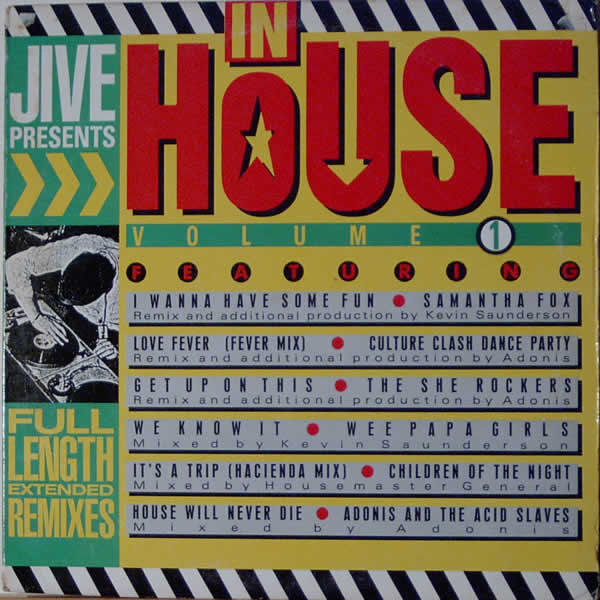
Jive Presents In-House Volume 1

Wednesday, December 12th, 2012

I used to think Jive Records was dogshit, but that was just as much their fault as it was mine. Shit, you know what? It was way more their fault than it was mine.

They’re the ones who subjected the world to Britney Spears, the Backstreet Boys and N-SYNC. As a teen in the late 90s it was nearly impossible to turn on MTV and not see their name at the bottom of some video I found atrocious by some vapid pop act who I thought was sucking the lifeforce out of popular music. They didn’t do much to improve their image for me in the 2000s either, signing artists like T-Pain, Eamon (fuck you Eamon, I don’t want you back), Joe, Nick Carter and probably dozens of other shitty pop acts I can’t even remember. In 2011, when it was announced that their parent label RCA Records would be dissolving the label and shutting it down, I didn’t shed a tear for their demise.

It wasn’t until recently that I discovered their important role in the history of new wave, hip-hop and dance music. They were the first label to new wave/big hair pioneers Flock Of Seagulls, and they were also the home to golden age rap legends Whodini. As their influence grew in the late 80s, they signed other important hip-hop artists like KRS-One, Schooly D and A Tribe Called Quest.

Digging through their discography on Discogs, it seemed to be around this time that the label also got into the habit of releasing compilations geared towards the clubs and the dance floor. At first these records were mostly hip-hop focused, but as time went on, the label eventually started to embrace the then new sound of house music.

I focused on one of these releases a few months ago, the awesome Jive Presents Acid House, but tonight I’m going to put the spotlight on the labels’ very first house compilation, 1988’s Jive Presents In-House Volume 1. While Jive had yet to attach the “acid” moniker to the music on this compilation, many of the tunes on the In-House album are clearly some of the earliest examples of the acid house sound making its way into the pop dance scene. It’s not all the way there yet, much of In-House lacks the edge and attitude of acid house that would come just a year later, but it’s clearly hear, and its fascinating to hear a genre really finding its footing, getting ready to claim the first half of the 90s for its own.

Enjoy, and if you have any insight as to other super-early acid house compilations or releases (aside from “Acid Trax,” I am aware) please let me know!

Samantha Fox
I Wanna Have Some Fun
While it’s not credited as such on the linear notes, this is a remix of Fox’s biggest hit, one that is double the length of the original and has an overall production feel that is less “poppy” and more pure dance. It’s still a silly, cute song though.

Culture Clash Dance Party
Love Fever (Fever Mix)
THIS SONG IS AWESOME AND I LOVE AND IT’S REALLY GOOD AND I WISH I KNEW MORE ABOUT CULTURE CLASH DANCE PARTY BECAUSE THEY SEEM PRETTY RAD.

She Rockers
Get Up On This
The She Rockers aren’t the world’s best rappers, but they got attitude that more than makes up for it. This shit sounds like an edgy Technotronic. I love it.

The Wee Papa Girls
We Know It
The worst named act in late 80s acid house is back! The Wee Papa Girls also appeared on the Jive Presents Acid House album, but this song is much better than the tune the contributed to that album. Expect some more from the Wee Papa Girls next week.

Children Of The Night
It’s a Trip (Tune In, Turn On, Drop Out)
Children Of The Night contributed one of my favorite tracks to the Jive Presents Acid House album, so it’s not surprising that they deliver another great banger here. This is the first track on the album that really sounds like acid house in both style and lyrical content (especially thanks to its parenthetical title). A great song, the best on the album if you ask me.

Adonis And The Acid Slaves
House Will Never Die
Adonis and the Acid Slaves is Michael A. Smith, a DJ/producer who first started releasing music in the late 80s. According to his Discogs page he has about a billion aliases, including Black Balls, Jack Frost, Percy Richblood and The Circle Jerks (no, not the punk band). He is also responsible for the mixes of “Love Fever” and “Get Up On This” that appear on this very album. Of all the tracks on this record, this is the one that sounds the most like acid house, complete with squelching “acid” sounds and constant references to acid slaves. It also has the best lyric of the album: “Do you want house? Or do you want bluegrass?”

If I saw this dude live back in the day I would have been the asshole to say “I want bluegrass!”

THE TIME. IS RIGHT. TO FIIIIIIIIIIIIIIIIIIIIIIIIIIGHT!!!

Thursday, November 29th, 2012

I wrote the majority of this post on Tuesday without any knowledge that today, November 29th, 2012, is the 40th anniversary of the release of Pong and that Buzzfeed has published an excellent article about the game entitled Atari Teenage Riot. Serendipity doo!

Alec Empire
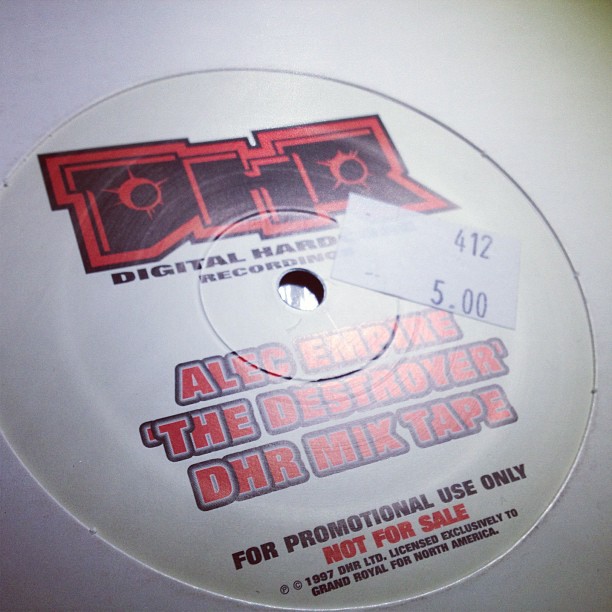
‘The Destroyer’ DHR Mix Tape Side 1
‘The Destroyer’ DHR Mix Tape Side 2
Alec Empire is the frontman of Atari Teenage Riot, the German electronic band that Mike D of the Beastie Boys once declared to be the most punk rock shit ever. That’s a hell of an endorsement, but it was inaccurate. They are the most hardcore shit ever. So fucking hardcore that they had to make up a genre (digital hardcore) to properly categorize their more hardcore than hardcore, louder than louder, noisier than noise sound. When forced to describe the abrasive, acidic sound of ATR, I typically say “imagine if someone took all of the heaviest Slayer bits, put them in a sampler, and then hit the sampler with a fucking sledgehammer.” To date, ATR is the only band that have actually given me a headache.

I fucking LOVE them.

Sometimes you just want to go there, y’know? You want your head rattled, your brain smashed in, your sense of what constitutes music and what constitutes noise to be shaken to its very core. I listen to a lot of music, and the most in-your-face ATR or Alec Empire solo work still takes me places few other songs can, even it makes my head explode a little bit sometimes.

This mix is a combination of ATR”s greatest hits, random movie/anime samples, and in your face noise (and a Frank Zappa sample). All scratches, pops and hisses you hear on this mix are from the original source material and are not mistakes made by me during the recording process. From what I can gather, this mix is rare as shit, only about 200 or so copies were pressed to vinyl. I bought it for five bucks in a shitty NYC record store that was charging $80 for run-of-the-mill Tangerine Dream albums. There’s some irony or justice there somewhere.

If you have never heard ATR before, be warned, this might not be a good jumping on point. This is the most bone-jarring thing I have ever posted on The Lost Turntable. To the unprepared it might sound like the phone call from Stephen King’s The Cell or that broadcast in that film The Signal, and may induce a similar madness. After listening to it nonstop for about two hours I want to run outside and punch a cop in the face.

You have been warned.

Polyrock! And The Night of Announcements!

Friday, November 16th, 2012

Okay, so for months now I’ve been teasing that I have been working on a mysterious something, and now I think I’m finally ready to announce what that something is.

When I first started Lost Turntable in 2006 I had no idea how it would effect my life. Writing this stupid little blog as gotten me several writing gigs, led me to meet people I would have never met otherwise, and led me to discover more wonderful and weird music than I ever thought possible.

I love writing about and sharing all this rare and lost music with you all, and I’m never going to stop doing it. However, in the past few months I have found that writing strictly about rare and hard-to-find music that is A) out-of-print and B) I own, has become someone constricting. I’m more than just rare new wave and pop! (Really, I am!) I want to write about other topics in music, movies and other aspects of pop culture. I want to interview more people, and not just the big names that I cover occasionally in the few print magazines that are gracious enough to pay me for my work. I want to go after the “has beens” and the “never wases,” those who have found themselves on the edges of the pop culture landscape. I’ve always thought that those were the people who have the most interesting stories. Look at my post about Exotic Birds, for example, that dude has lived a life 1000 times more interesting than anyone in Nickleback, I guarantee it.

To that end I am happy to announce that next month I will be launching a brand new website, a companion to the Lost Turntable, if you will, that will have a much broader focus, one that will include music, movies, video games and anything else I feel like writing about. I’m still not comfortable with sharing the name or giving an exact launch date, but it will be soon. Things are finally starting to come together and with my election-imposed depression finally lifting, I’m finding myself writing a hell of a lot more.

But wait! There’s more! In addition to launching my new website, I am finally going to give Lost Turntable a bit of a visual overhaul. I’ve had several complaints from readers over the years that the harsh black-on-white color scheme of The Lost Turntable isn’t exactly easy on the eyes, and that it makes switching back and forth from it to other sites nearly impossible. I’m finally going to do something about this! So sufferers of eye strain rejoice! Your days of Lost Turntable-induced headaches are nearing their end.

A third announcement! One that will probably matter to a lot less of you!

One of the things I’m most proud about with The Lost Turntable is that I don’t make anyone jump through hoops to get music. No Rapidshare or other file-sharing site links. I hate those things. They’re a hassle. I’ve always just bitten the bullet and paid for my own damn server so I can host the files on my own. (And while I’m tooting my own horn, I’d also like to point out that I never ask for donations or stick ads on this site either – no one should  make money off of music they don’t own the rights to)

For several years that server has been hosted by Dreamhost, a cheap, unlimited hosting service that came to me highly recommended. I wish I remember who exactly recommended them to me now, because I’d throw an anvil at them.

Dreamhost is a big wet bag of dogshit. Not a month goes by where I don’t experience some downtime, and typically for things that could easily be avoided if their IT team wasn’t run by brain damaged gerbils. I’m giving Dreamhost the boot this month and moving to a new hosting service. If they end up not sucking, I’ll let you all know who they are. This should not effect how my site runs or is viewed in anyway, I just wanted to give you all the heads up if I temporarily vanish during the transfer.

So yeah, a lot going on huh? And of course I pick the month before I embark on a three week trip to China and Japan to start it all! But hey, nothing motivates me like an unrelenting mountain of deadlines and pressure!

That and obscure new wave music, that usually serves as good motivator as well, and speaking of which…


Polyrock – Above The Fruited Plain
Working On My Love
Call Of The Wild
Chains Of Iron
Broken China
Indian Song
It’s a sad fact of the music industry that a lot of great bands simply don’t make it. But it doesn’t make it any less infuriating when it happens.

Take Polyrock, for example. I’ve written about them before, but I keep coming back to them because I find their music so stunning, and their continued lack of mainstream, or even cult, appeal completely mystifying.

No one sounded like Polyrock when their first album came out in 1980, and no one has since. They remain 100% unique, a rare feet in a world where even the most obscure and unknown of musical artists are pillaged and ripped off by lesser acts on a seemingly daily basis.

Polyrock’s continued exile in obscurity is even more baffling when you discover that legendary minimalist composer Philip Glass worked as the producer (and occasional keyboardist) on both of the band’s full-length albums. Glass was one of the most influential and exciting composers of the 70s and 80s, how is one of his only contributions to the pop music landscape is still undiscovered and not talked about?

Both of Polyrock’s two full-length albums, their 1980 self-titled debut and 1981’s Changing Hearts, have occasionally fallen back into print thanks to the re-issue label Wounded Bird Records, but this 1983 EP has never seen the light of day since its original release.

Glass was not aboard for Above The Fruited Plain, and I’m sad to say that his absence is rather obvious. None of the songs on the EP have the same abstract, minimalist vibe that band’s previous work did. It sounds much more like a pop record, although that may have been a conscious effort by the band. This was their only release not on a major label, and I suspect its existence, and slight lean to the mainstream, was an effort to get attention from a major in hopes of getting signed. Alas, that never happened and the band called it quits shortly after its release.

I don’t walk to talk it down too much though. Yes, it may be a little less risky and experimental than the group’s previous work, but it’s still a great collection of songs, and nearly all of the songs on Above The Fruited Plain could stand side-by-side with the group’s greatest Glass-produced cuts. Highlights for me is “Call Of the Wild,” which features keyboardist Cathy Oblasney taking over vocals from guitarist Billy Robertson, and the fast-paced “Broken China,” which gets my vote for best shoulda-been-a-contender song of 1982.

Enjoy! And if anyone out there knows where I can reach anyone in Polyrock, let me know! I’m trying to put something together about them and other bands like them for that new site!


Live At CBGB’s

Thursday, September 13th, 2012


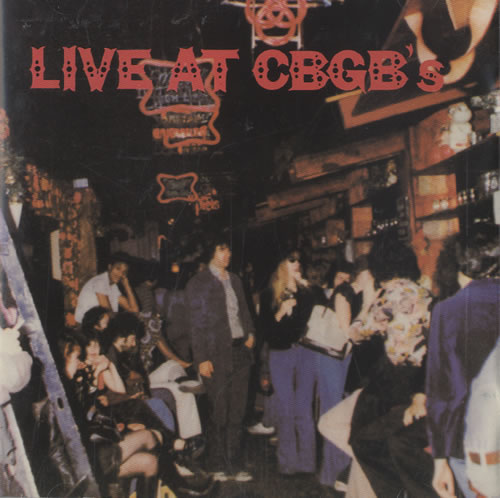
If I told you I had a compilation album from 1976  called Live At CBGB’s, what would you guess would be on it? Blondie? Talking Heads? The Ramones? Dead Boys? Televsion? Nope. Try Tuff Darfs, Manster, The Miamis and Sun, to name a few.

Why are there no big-name acts on this LP? Well by 1976 the majority of those bands, including almost all of the ones I mentioned, were either already signed to major labels or in the process of being signed to the majors, leaving only the lesser-known (but still good…for the most part) bands left behind and available for a compilation like this.

Even though nearly all of the acts on this group vanished into thin air, that doesn’t mean they’re totally without merit. In fact, I’m glad this compilation focuses on the lesser-known and more obscure acts of the CBGB’s club scene. I think it helps to paint a much more accurate picture of the groups that were playing there during that era. It wasn’t all punk, new wave and art-rock. As this compilation shows, there were a ton of power pop, blues-influenced guitar rockers, and even one straight-up metal act playing to enthusiastic audiences at the “punk” club. Discovering these lesser-known obscurities makes me love the now-lost venue even more. I hope you feel the same way after giving these tracks a listen.

Tuff Darts
All For The Love of Rock ‘n Roll
Head Over Heels
Slash
The Tuff Darts did manage to release one album in 1978, although by then they had lost their original lead singer, Robert Gordon, in lieu of replacement vocalist Tommy Frenzy. I think this is the only recording of the group ever released that features Gordon. The band isn’t very punk, isntead they have a slight glam element to their sound. I could totally see Bowie of the era adding some flourish to a track like “All For The Love Of Rock ‘n Roll.” The most punk track of the bunch is “Slash,” a dark, macabre number about preferring suicide over going on a second date with a girl from hell. Speed this track up half a beat and you’d totally have a Ramones number. Tuff Darts are just one of many bands on this album who are still around in some form or another, check out their official site here.

The Laughing Dogs
I Need A Million
It Feels Alright Tonight
The Laughing Dogs are a power pop band, which of course means that they never found any modicum of mainstream success. I can’t even imagine that they found much of a following in the CBGB’s scene, they’re way too poppy and “fun” when compared to a lot of the other bands of the era. The group released two albums in the late 70s/early 80s, and although they never took off they’re apparently still around and performing live, and good for them.

Manster
Over, Under, Sideways, Down
I’m Really Not This Way
I don’t know if you could ever really call a cover of a 60s blues-jam “post-punk” but these guys sure straddle the line with their version of The Yardbirds’ “Over, Under, Sideways, Down,” thanks largely to the batshit manic vocals of lead singer Warren Stahurski. “I’m Really Not This Way,” a heartbreaking song about being homeless,  is even an even weirder tune. It sounds like a lounge act tune from hell. What the hell happened to these guys? It sounds like they were a bit nuts. Love it.

The Miamis
We Deliver
Another power pop act. This song is so damn cute I want to hug it. You can find out more about the group, and buy their only record, at their official website.

Mink DeVille
Cadillac Moon
Change It Comes
Mink DeVille started out as a band, but as they progressed into the 80s they pretty much became a vehicle for lead singer/guitarist Willie DeVille, who became somewhat of a successful musician in the 80s and up until his death in 2004.  Mink DeVille remain a cult band to this day, and I know more than one record nerd who swear by them. I’ve never really gotten into the group, too much of a soul sound for me. They sure as hell don’t fit in on this record. That’s not to say they’re bad, they just stick out like, well, a blues/soul band on a punk/rock compilation.

The Shirts
Operetico
Poe
A.V.M.
One of the most interesting acts on this album, The Shirts have a sound that’s part new wave, part power pop and part 70s rock ‘n roll. And there were apparently like nine people in this group at one point, so I guess there were plenty of genres to go around. “Opertico” is a good tune with an amazing riff, “Poe” is a punky little rocker that fits in with the kind of music one would expect to hear at CBGB’s at the time, while “A.V.M.” is a six-minute banger that definitely has its roots in traditional 70s rock music. All are good tunes.

Another group that hasn’t gone away, The Shirts are still kicking it after 30 some years. You can check out their site here.

Stuart’s Hammer
Everybody’s Depraved
Stuart’s Hammer never got a record deal but they sure seemed to be a mainstay at CBGB’s back in the day. At their official website you can find a few posters advertising their gigs from back in the day, as well as some other cool nuggets from the era. Based on this tune I really wouldn’t call them punk, but they’re good.

Sun
Romance
This is one of the cases where the story/members of the band is far more interesting than the song itself (although I do dig the song).

First of all, if this song is any indication, Sun was a straight-up metal band. No pretense of punk or art-rock here. These dudes loved themselves some crazy guitar solos and howling banshee vocals. They sound like a band out of time and place on this record. They belong in 1983 LA, not 1976 NYC.

From what I could dig up, Sun went through a number of line-up/name changes during its short run. The guitarist in this line-up was a man by the name of Niki Buzz, who some may know for his work with the 80s rock groups M-80 and Vendetta. A more notable contributor to the band, however, would be their bass player Bill Laswell. While that name may not ring a bell for some of you, Laswell is one of the most influential and experimental bass players and producers of the past 30 or so years. He played a key role in Herbie Hancock’s electronic phase of the early-80s, and he formed the experimental rock outfit Praxis in the 90s, a supergroup that had a revolving door line-up that included Mike Patton, Iggy Pop and Buckethead.

I don’t know how long Laswell stuck around in Sun, but at some point the group lost him and Buzz and then changed their name to Son. Then, I assume after more line-up changes, they became Getaway and released a pair of albums in the early 80s for A&M records, one of which included a slightly different version of “Romance” under the name “Getaway.” Someone from the band is on YouTube today, and he has more than a few videos featuring the band in its various incarnations. Check out his channel if you’re interested in learning more about the group.

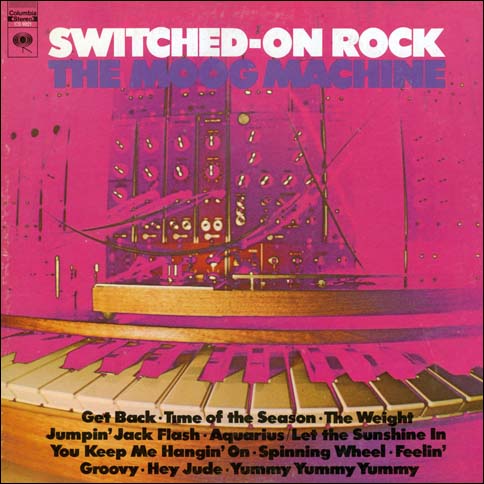
Switched-On Rock – The Belated Return of Moog Monday

Monday, September 10th, 2012

Switched-On Rock
Spinning Wheel
Jumpin’ Jack Flash
The 59th Street Bridge Song (Feelin’ Groovy)
Get Back
Yummy Yummy Yummy
The Weight
Time Of The Season
Aquarius/Let The Sunshine In
You Keep Me Hangin’ On
Hey Jude
Switched-On Rock is an all-Moog covers album, one in a long line that came out in the late 60s and early 70s to capitalize on the surprise runaway success of Wendy Carlos’ Switched-On Bach, the first of its breed. It’s a cash grab, no doubt about it, but it’s a relatively decent cash grab that was obviously made by people with some recording knowledge.

The album was produced by one Norman Dolph. And if you read this blog or follow Velvet Underground news at all, then that name probably sounds familiar. Dolph was an executive at Columbia Records in the 60s and 70s who funded the recording of The Velvet Underground and Nico in 1967. He also served as an uncredited engineer on the album, and it was his test acetate of an early version of the album that found its way onto eBay and eventually into the hands of a collector for the price of $25,200 back in 2006.

It seems like this record was a passion project for Dolph, as not only did he work as the album’s producer and “big twiddler” (that’s the credit he has) but he also wrote the majority of the album’s lengthy liner notes, which I’ve transcribed for you below.  They’re a fascinating glimpse not only into the shockingly complicated recording process (Moogs could only play one note at a time, meaning that many overdubs were needed), but also into the popular views of what electronic music was at the time. Dolph makes sure to go out of his way to explain that these aren’t the creation of some computer, that a group of people actually worked on these compositions.

Download and enjoy the groovy instrumental Moogsrumations (yeah, I made that word up, so what?), and be sure to read these liner notes, they’re something else.


Because I thought up the basic idea for this album (and then contributed little else), I was thrown the bone of writing the liner notes. To give me something to work from, I asked Norman Dolph, the album’s producer, to send me a memo on the subject. The result was so much better and more understandable than anything I could have written that it is simply reproduced below.

Cordially, Russ Barnard

LINER STUFF
I’ll just sit here at the typewriter and spew out odds and ends about the project and let the literary maven sit it right.

To begin, we are a triumvirate: Kenny does all the keyboard work, Alan writes the arrangements, and I tune the machine and perform sundry A&R functions.

The amazing thing about all the sounds is not that they are done one voice at a time, but rather one finger at a time. The silly machine only plays one note at a time and the temptation to play a chord must be overcome…you only get the lowest note if you press more than one key. Improvisation is difficult but far from impossible if you redefine the problem.

We, being faced with the limitations of the Moog as far as chords are concerned, built a gadget called the Protorooter that structures chords above the note the keyboard is playing to alleviate the problem somewhat.

Compared with the old cut-and-splice way of making electronic music, the Moog is a tune boon. As great as we feel the Moog is for making music in the light of what is possible and what Mr. Moog is no doubt cooking up, the Moogs of today are like the Kon Tiki. It takes quite a bit of physical tuning and set-up time to achieve the sounds, though once tuned they go down very quickly.

After kicking the project around in our heads and experimenting, Alan decided to look at the problem as one of orchestration, writing from scratch as though any instrumental texture available or conceivable existed – and then we set about to tune the machine to fit the arrangement.

The charts are such that if acoustic instruments existed to create the sounds, then live men could perform the record as such.

Likewise, we worked all ten tunes at once so that a tuning economy could be effected; e.g., tuning up a basically brass sound and then touching it up for various parts in a couple of songs.

By working on all of them at once we also could take advantage of any auspicious accidents that generated a sound that we had not conceived exactly but had a spot for.

There are hundreds of dials and jacks on the machine and many of the sounds are quite hair-trigger and difficult to re-recreate. Copious were the notes taken of these sounds, but when we found a screaming nugget of sound, we used it where it fit and then went back to the agenda.

One thing that must be stressed: namely, is that this record is virtually 100& Moog – only two instruments are live. One is the drum set; Moog drums are possible, but, in this stage of the art, sound kind of mechanical and ricky-tick…we decided to preserve the firepower in the music by moving it along with real drums. Leon Rix joined us on drums…very tasty. The second real sound we leave to the listener is to spot. We defy him to do so, and welcome his guesses.

This is a synthesized record. All the orchestral textures, somewhere in the vicinity of 150 different varieties, come out of that funnybox.

The semantics of keeping track of the sound from a bookkeeping point of view were kind of testy in that many of the sounds have no natural counterparts, so we coined neo-names to enable communication: e.g., the Gworgan, which is like a Gwiped organ. Gwiping is the act of sweeping a filter with a high regeneration setting (whatever that means) from top to bottom. It makes the sound “gwirp” with millions of variations depending on the rest of the brew. The inverse is Pwee, sweeping from bottom to top.

The Pagwipe sounds like a ferocious, leaky bagpipe.

The Jivehive sounds like a megaton of bees all swarming in tune. And there is the dread Moogoboe. And the Sweetswoop, a back and forth roar of harmonic sounds like a jet plan flying through your head. Other parts were named by their function in the song…the Octangle, an 8-part progression…the Big-Band, the Neoturnsolo, the Dharmilt, a mixture of descending harmonies and a sound that reminds you of a little three-inch-high Milt Jackson playing an equivalent size vibraharp: the thumps, the buzz, the telegraph keys.

In addition, many, many straight instruments: trombones, trumpets, flutes, basses, strings, drums, clarinets, bassoons, bass clarinets, tubas, clarinets, saxes, harps, electric pianos, harpsichords, organs, piccolos, ocarinas and recorders.

About half and half recognizable textures and totally new musical texturues.

No gimmicks though for their own sake, no one-shot gags.

We used a sixteen-track recorder for the job, making several passes, and then a demi-mix to boiled down the results to one track or a stereo pair. The results were parked and then the tracks used over.

Every time the engineer cleaned the tape heads I kept thinking that that’s my music you’re scraping off.

The stereo possibilities are remarkable in that there is no leakage from one side to the other, the sound is quite transparent and the listener can listen through the many layers and focus on whatever he wishes.

One thing to stress to thos unfamiliar with the way the m achine works is that it is not a computer and does not play or tune itself. In fact, having lived with it, we are as conscious of what it won’t do as what it is capable of.

For one thing, constant touch-ups of the tuning is necessary to correct its drifts over a fifteen-minute period.

Moog himself is quite a guy too. Most cooperative and now has a weekly emissary to New York to touch up any fixits and keep everyone up on the new discoveries. Moog really made quite an invention – and how appropriately space-age his name is! How bland would be the “Jones” or the “Irving Spidorsha” as a nickname for the gadget. If he ever comes to town for a lecture, go listen. There is nothing like inventing a synthesizer to give you expertise in its use.

Anyway, the music is human music, and, most important, it is music, not Moog effects.

This album is supposed to be a chuckle. Make sure you convey that we hope the people enjoy it!

All best,
Norman

 

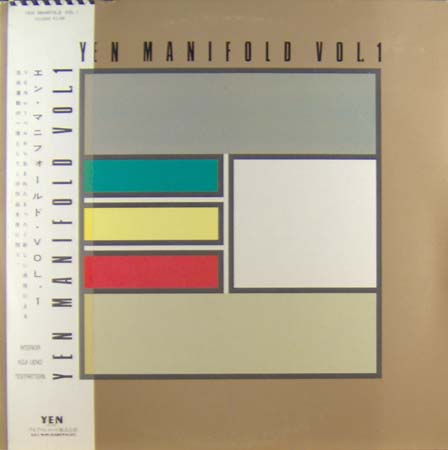
Yen Manifold Vol. 1 – Awesome Japanese Electronic Music

Friday, September 7th, 2012

Yen Records was an imprint of the Japanese label Alfa Records. The label was formed by Haruomi Hosono and Yukihiro Takashi of Yellow Magic Orchestra, a highly influential Japanese electronic group who many consider to be the progenitors of synthpop and electronic dance music.  The label mostly existed as a means for the duo to release albums they were somehow associated with, either as performers or as producers. A good analog would be something like The Beatles’ Apple label or Trent Reznor’s Nothing Records.

Yen Records only existed for a few short years in the early 80s, but what little music they released developed a rather devoted cult following. I found two fan pages dedicated to the label (one in English and the other in Japanese), while I also stumbled upon quite a few pages dedicated to artists who were associated with the label. That’s some pretty impressive staying power for a Japanese vanity label, you can’t say that about most American ones.

From what I can gather, one of the most beloved releases on the Yen label was this record, a 1983 compilation that features three artists who were on the imprint:Interior, Koji Ueno and Testpattern. Since the label went under, many of the songs on this record have gone in and out of print, although none of them have ever gotten a release in the states at all.So I hope you all enjoy reading about, and listening to these great artists, and if you get a chance, check out more Japanese sytnpop/electronic music from the early-80s, a lot of it is really fascinating and out there stuff.

Interior
Hot Beach
Miracle
Hawks
D.T.T.
Interior put out two records. The first was self-titled and the second was called Designs. And to that I say, well played sirs.

Thanks to their generic name it was a bit tricky digging up information on these guys, but I was able to find a few things out I think. Last.fm treats the group as a threesome, featuring the members Eiki Nonaka, Mitsuru Sawamura and Daisuke Hinata. However, Discogs also gives credit to a fourth member, Tsukasa Betto, who I can find nothing about outside of that reference. Of the other three, Hinata seems to be the most active today, doing commercial and TV work as well as producing and performing on a variety of Japanese pop albums. He also appears to have some totally radical glasses.

Musically the group seems to be pretty diverse, running the range from Tangerine Dream-inspired ambient numbers to light 80s pop (complete with English lyrics). I dig the ambient tracks more, but the pop stuff isn’t bad, if entirely generic. Of the four tracks, on the final one, “D.T.T.” is kind of a wash out, thanks to needless 80s saxophone. Although the song came a few years before “Careless Whisper,” so at least you can’t accuse them of being copycats.

Koji Ueno
Tempo di Jazz
Movement Perpetuels
Fu No Oboegaki
These songs are great, and far more experimental/interesting than the Interiors stuff. All are purely instrumental, and run the gamut from jazz-inspired pieces to more ambient/experimental works. I’m digging them.

Unlike Interiors (and the third band on this album), Koji Ueno is a somewhat recognizable name, at least in Japan. He routinely works with Ryuichi Sakamoto, collaborating on multiple scores with the legendary musician, and he has even released a few solo scores for some anime and other Japanese TV shows.

He also has an amazing photo on his Discogs page. Dude is totally rocking the “I’m a tux wearing piano man – oh hey, there’s a desk fan” look.

Testpattern
Ryugu
Friday
A mysterious band, I can find virtually nothing on them, which is a shame because I have fallen in love with what little I have found. These two songs are great. I am especially fond of “Ryugu,” it’s playful and energetic, but it has a modern sound that would fit on a release by Warp Records today. If you want to hear more of their music (and you damn well should) I suggest checking out this page, it links to quite a few YouTube vids that feature the group’s music. Listen to “Technobase,” it’s beautiful.

Sadly, if you want to know more about the actual band itself, I can’t help you there. Aside from that page, I couldn’t find anything of substance about the people behind the music. If you know anything about Testpattern, including where I can get more of their music, please let me know!

And hey, since I”m asking for favors, I might as well get this out of the way…

If you follow me on Twitter then you probably know that I’m planning a big trip to China and Japan later this year/early next. I’m going to China for a wedding and will only be there for a few days, the main focus of my trip will be Tokyo, where I will be spending nearly two full weeks.

If anyone reading this blog lives in Tokyo, has been to Tokyo or knows anything at all about record stores or buying music in the city, please drop me a comment or an email. I want to make the  most out of this trip, and that of course includes buying more records than I can possibly carry back home with me.

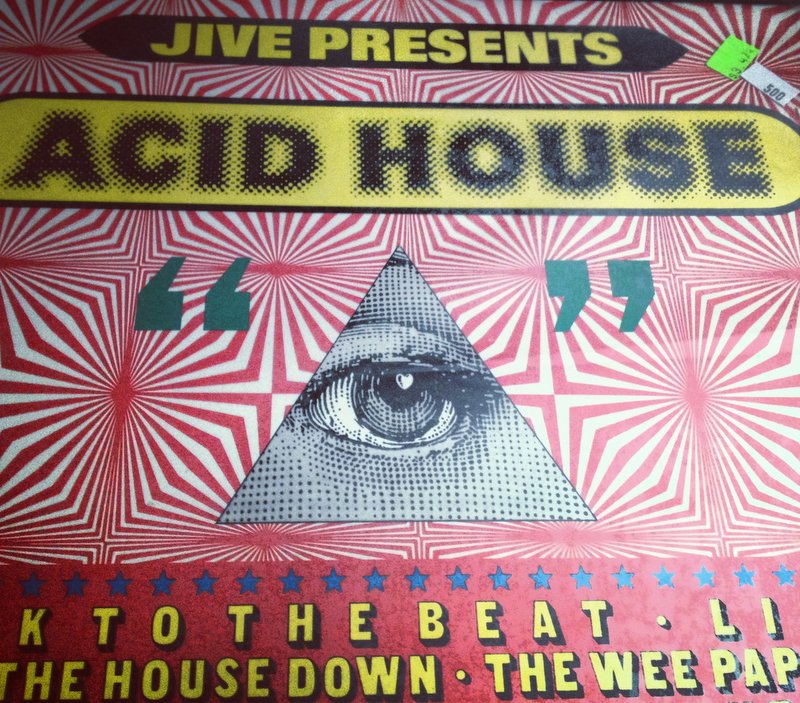
Jive Presents Acid House

Friday, August 3rd, 2012

Are you ready for some acid house?

Acid house, for you young kids out there who may not know, was one of the most influential and important dance sub-genres of the late-80/early-90s. It was an offshoot of Chicago house that employed the unique properties of the Roland TB-303 synthesizer-sequencer to create a sound that was more electronic, bizarre and trippy than anything that had been heard before. If you’re interested in reading more about the genre’s history and its sound, I suggest checking out the wiki, although it barely touches on the importance and lasting impact of the genre.

I think acid house has been kind of forgotten by the younger generation of electronic music fans, which is a shame as it was a key point in the history of electronic music. Before acid house, most dance music still had one foot in disco, relying way too much on four-on-the-floor beats and kick drums. By the time acid house made its way to England in the early 90s, it had stripped all of those aspects away, becoming one of the first purely electronic forms of dance music. Yes, I know other electronic dance music existed well before acid house, but it was one of the first to really catch on with the club crowd in a big way. Hell, as that wiki mentions it’s probably solely responsible for the birth of the UK rave scene (well, that and ecstasy).

That’s the scene that gave birth to Underworld, Fatboy Slim, The Chemical Brothers, The Orb, Prodigy and countless others acts that would go on to dominate electronic music (and to some extent pop music) in the later half of the 90s. Do you like electronic music? Then you should at least respect acid house, because without it your favorite electronic artists of today probably wouldn’t exist.

Which brings us to this album, one of the earliest compilations of the genre that I can think of. All the tracks on this record exemplify what made acid house acid house; simple beats, remixed and sampled vocals; and more 303 “squelch” sounds than you can shake an off-brand drum machine at. All awesome stuff, so let’s get into it.

Lisa M
Rock to The Beat (Short Circuit Mix)
A great seven and a half minute jam that combines the excellent acid sounds of the genre with some amazing vocals by Lisa M, whose full name is Lisa Moorish. She released one album, I’ve Gotta have It All, in 1996 on Go! Beat, but I think that was her only release as a solo artist. Since then the London-based singer has appeared as a backup singer on a few different releases, including singles for Ash, Oasis and Babyshambles. Didn’t see that one coming. This is one of the best songs on the album.

The Wee Papa Girls
Blow The House Down (Hard Core Mix)
The hideously-named Wee Papa Girls were a UK-based pair of rappers who released two albums on Jive in the late 80s and early 90s before calling it quits. I can’t find much in the way in activity for either of the girls after they split up. To be honest, their vocals are the least interesting thing on this excellent track, one again it’s the radical sequencer work that steals the show. Love this tune, it’s a sonic freakout.

Children Of The Night Featuring Rankin’ Roger
We Play Ska (Trojan Horse Mix)
While “We Play Ska” is a really odd name for an acid house tune, it’s a pretty accurate one. If there ever was a ska/house mash-up, it would be this track, thanks to is offbeat combination of 303 acid grooves with reggae vocals, trumpets and what sounds like a sample from a vintage ska track. We’ve been over how I feel about ska, but I do love anything with a hard 303 sequence, so I dig this track.

As for the people behind the music, Children Of the Night were Neil Rushton and Wayne Archbold, two DJ/producers who did more stuff behind the scenes as managers and producers than as artists themselves.  Rankin’ Roger is the MC on the track, and he released two CDs, one in 1988 and another in 2001. So I’m really looking forward to his 2014 release.

Mr. Lee and The Chi Town Posse
Pump It Up (Pump the Acid Remix)
Mr. Lee is a Chicago-born rapper who found some success in London in the early 90s thanks to his dance/rap hybrid style. Other dance hits by Mr. Lee include “Pump Up London,” “Pump Up Chicago” and “Pump That Body.” Apparently, the dude was pumped and wanted you to be as well. I’m not a huge fan of his rapping, but I love the sequencing on this tune.

And before you ask, I have no idea who The Chi Town Posse is.

Big Fun
Living For Your Love (Blow the Amp Mix)
Big Fun were a boy band, but apparently someone in their production group decided they should have an acid house remix. I’ve never heard the original version of this track, but I bet it’s pretty different than this remix, which is over seven minutes long and dissolves into nothing more than a sequencer melody and a drum beat near the end. Not a horrible track, but definitely the weakest song on this album.

Rhythm Is Rhythm
Beyond The Dance
Rhythm Is Rhythm is Derrick May.

Derrick May, in case you aren’t aware, was one of the originators of Detroit Techno. Meaning he’s one of the originators of techno as a genre of music. So yeah, he’s a big deal. Needless to say, this song is fucking fantastic and you should listen to it now.


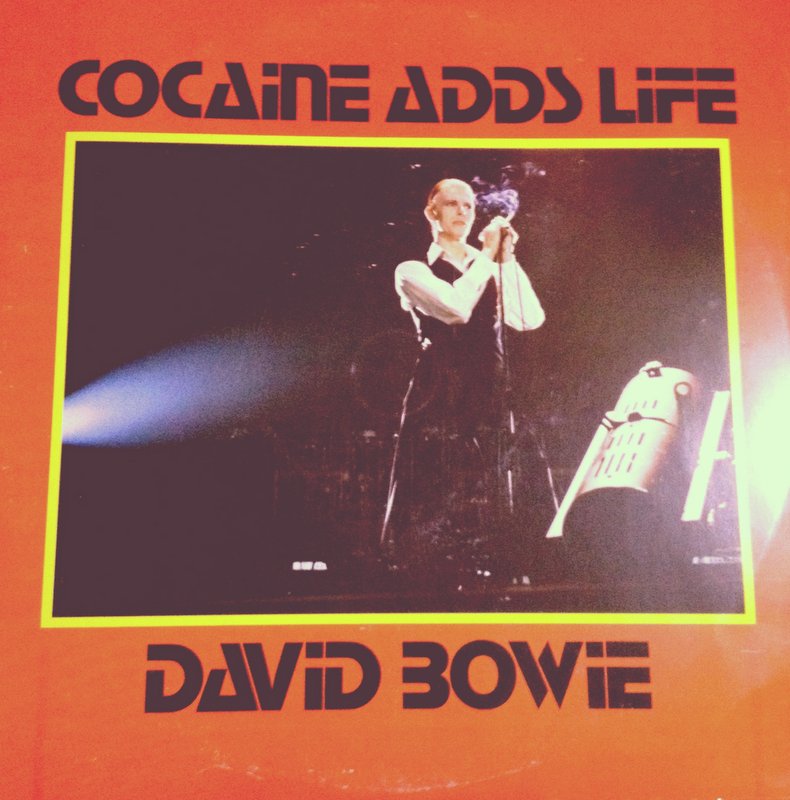
David Bowie’s Cocaine Adds Life (Cocaine Bear Approves)

Monday, July 30th, 2012

Another week, another amazing 2LP bootleg. This time it’s from David Bowie.

Cocaine Adds Life

The wonderfully titled Cocaine Adds Life mostly features tracks from mid-70s Thin White Duke Bowie (hence the title), but it also throws in some random 80s stuff on the last side. While Discogs sites the album as coming out in 2008, I think that’s a repressing, and that the version I have actually came out in 1984 (as this site claims). If the back cover of my version is to believed, the bootleg label responsible for this release only printed 200 of these bad boys (mine is number 66), making it a pretty rare find.

Regardless of where and when it came from, and how rare it is, it’s a great bootleg full of some pretty interesting stuff. The first three sides are a complete concert, recorded live at the Rotterdam Sports Palais Ahoy on May 13th, 1976. The recording is from a soundboard, so it’s crystal clear, if a little flat. Although Bowie complains on the recording that he’s suffering from a bit of bronchitis, he sounds great as the band plays through some of his best material of the time, including “Station to Station,” “TVC15” and “Diamond Dogs.”

The final side of the bootleg is a grab bag of bonus cuts culled from a variety of sources. First up is a recording of Bowie performing “Sweet Jane” with Lou Reed on July 8th, 1972 in London. It’s a real rarity, which makes up for the fact that the recording kind of sounds like garbage. After that there’s another super-rare one, Bowie doing a cover of The Beatles’ “This Boy,” performed on July 18th, 1972 in Aylesbury. It also sounds pretty bad though.

That’s followed by “Sister Midnight,” taken from a performance in Toronto on February 26th, 1976, and a version of “Sound and Vision,” that’s from a show in London on July 1st, 1978. These sound bad, but better than the previous tracks.

Finally there are a pair of tracks taken from two shows in Brussels on April 18th and 19th, 1983. The first is a rare live version of “Joe The Lion” and the second is a cover of The Who’s “I Can’t Explain.” These also sound okay, but not great.

Truth be told, the final side is pretty much a wash when it comes to sound quality, although those versions of “Sweet Jane” and “This Boy” should probably be of interest to Bowie completists out there. Like I said before, the real treat here is the complete concert from 1976. It sounds great and is well worth a listen. I hope you like it.

Complete Track Listing

Rotterdam Concert – 5/13/176

  1. Station to Station
  2. Suffragette City
  3. Fame
  4. Word On A Wing
  5. Stay
  6. Waiting For The Man
  7. Band Introduction
  8. Changes
  9. TVC15
  10. Diamond Dogs
  11. Rebel Rebel
  12. Jean Genie

Additional Tracks

  1.  Sweet Jane – 7/8/72
  2. This Boy –  7/18/72
  3. Sister Midnight – 2/26/76
  4. Sound And Vision – 7/1/78
  5. Joe The Lion – 5/18/83
  6. I Can’t Explain – 5/19/83

Crazy for Dance Craze

Friday, July 27th, 2012

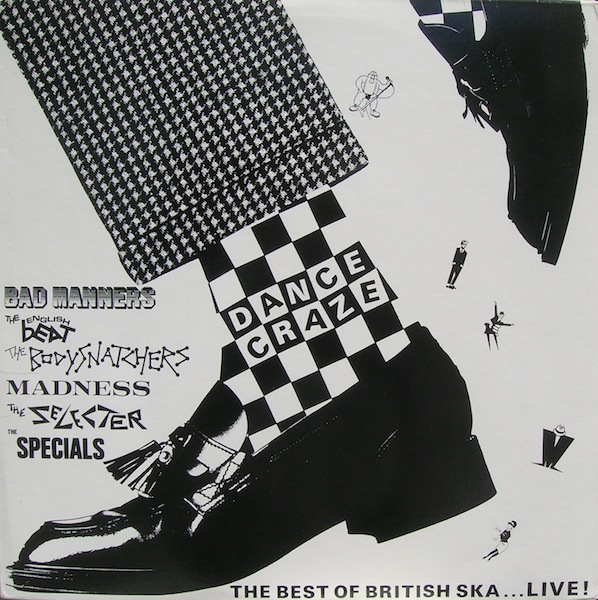
Dance Craze (Complete Album Download)

I love ska!

Okay, that was a lie. I just lied to you, and I apologize.

The truth is, I’ve never loved ska, no matter how much I try. I blame The Mighty Mighty Bosstones. Seriously, it’s all their fault.

Like most stupid Americans, I never heard of ska until the mid-90s, when barely-ska acts like the Bosstones, Reel Big Fish and No Doubt broke the sound through to the mainstream. And, let’s be honest, those bands and others like them were at their best slightly better than horrible. The Mighty Mighty Bosstones remain one of my most-hated bands of all time, right next to Creed and The Nixons (I have my reasons, okay?). I’ve done my best to forget about Reel Big Fish completely, and I only grew to tolerate No Doubt when the abandoned their ska roots for a more electronic sound.

So it’s all their fault, they’re why I hate ska. But I’ve been trying my best to educate myself, broaden my horizons. In doing so I’ve discovered that I actually like early ska! I know, I was shocked too, but the  2 tone (second wave ska) stuff out of England, I’m really beginning to dig that stuff. And this album is a big reason for that.

Dance Craze is like a Ska Urgh, a great compilation of early 80s tracks by artists both big (Bad Manners, The Beat, Madness) and small (The Bodysnatchers, The Selecter). It’s actually the soundtrack to a movie that came out in 1981, although it’s never been released on any format since, aside from VHS and that was only in England. (Although you can watch it on YouTube). The movie has 27 great performances, but the LP soundtrack cut that down to a slim 16 songs, which is a drag, especially considering amazing tracks like Madness’ “The Prince” and “Too Much Too Young” by The Specials were among those cut.

But that doesn’t mean the album was left with nothing but the dregs. The radical “Three Minute Hero” by The Selector is here, as well as an excellent version of The (English) Beat’s “Mirror In The Bathroom.” Thankfully we’re also gifted with a rocking jam of “One Step Beyond” by Madness AKA the greatest ska song of all time ever in the history of anything ever (don’t you dare try to correct me.)

Download and enjoy, and tell me about other 2-tone artists that you think I might dig.

Just don’t try to sell me on the Bosstones okay? Many have tried, and I have destroyed all of them.

And in case you’re wondering, here’s the complete tracklisting:

Side One

  1. “Concrete Jungle” – The Specials
  2. “Mirror In The Bathroom” – The Beat
  3. “Lip Up Fatty” – Bad Manners
  4. “Razor Blade Alley” – Madness
  5. “Three Minute Hero” – The Selecter
  6. “Easy Life” – The Bodysnatchers
  7. “Big Shot” – The Beat
  8. “One Step Beyond” – Madness

Side Two

  1. “Ranking Full Stop” – The Beat
  2. “Man At C&A” – The Specials
  3. “Missing Words” – The Selecter
  4. “Inner London Violence” – Bad Manners
  5. “Night Boat To Cairo” – Madness
  6. “Too Much Pressure” – The Selecter
  7. “Nite Klub” – The Specials

Also, a note to longtime readers of The Lost Turntable. I posted this soundtrack eons ago, but you should still download it again (if you like it). This rip is much better.

And one more thing. I was serious when I said I don’t care if you like the Mighty Mighty Bosstones, Reel Big Fish or any other of those shit bands. If you leave me a comment about how my taste sucks I’ll just delete it, so don’t bother.