Archive for the ‘Complete Albums’ Category

Synthi Bach

Sunday, July 1st, 2018

Yuji Takahashi
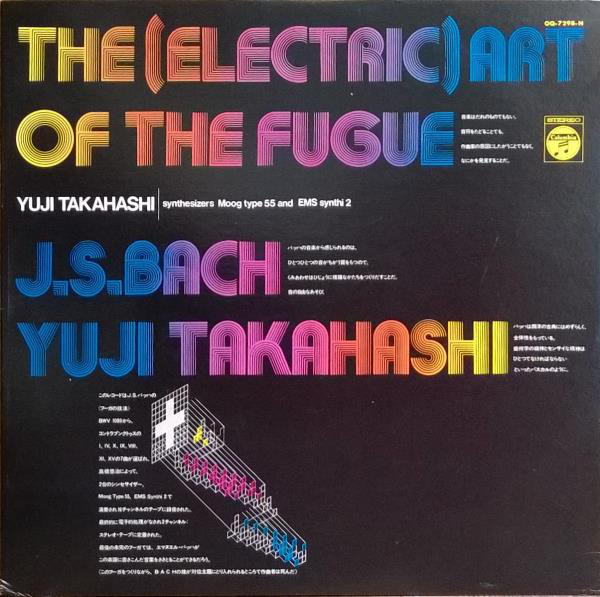
The [Electronic] Art of Fugue (Complete Album Download)

I’ve heard a lot of synthesizer renditions of Bach, so trust me when I say that this one is different.

There were a lot of electronic interpretations of Bach in the 1970s, obviously trying to capitalize off of Wendy Carlos’ Switched-On Bach. Nearly all of them (even the good ones) are pale imitations of that album that lack the sophistication and multi-layered approach that Carlos took when crafting her masterpiece. A reminder, synthesizers back then could only produce one note at a time. To create a proper Bach arrangement meant countless playbacks and tape dubs. Not everyone was up to it. Additionally, nearly everyone at the time was sticking to the similar Moogs that Carlos used. So you ended up with a lot of derivative works.

Yuji Takahashi’s take on Bach is a bit different, probably because Takahashi himself is a bit different. Takahashi is a classically-trained pianist, but he also holds an interest in the avant-garde and experimental. He started putting out albums in the late-60s, his earliest stuff being interpretations of John Cage works, while also releasing avant-garde and experimental works of his own. Even early on in his career he was working in left-field. In 1974 he put out an album with Masahiko Satoh, another acclaimed Japanese pianist, that consisted of performances on synthesizers and prepared pianos. I have no idea what that sounds like but I sure as hell bet it sounds different.

A year later, he released this. As far as I can tell, it’s the first electronic interpretation of Bach’s The Art Of Fugue, which is just one of many reasons why it stands out among the other classical Moog albums of the day. Not only is the material odd, but his arrangements are slightly more off-kilter than what you might hear on other electronic Bach albums.

A lot of that has to do with the instrumentation that Takahashi chose to use. Takahashi doesn’t just limit himself to the “traditional” Moog synthesizers of the day. Added into the mix is an EMS Synthi 2. The Synthi is a strange beast that can produce very unique sound effects, such as stark popping sounds and tones that have a unnatural drop off or arpeggio effect. Used poorly, the Synthi just creates seemingly random noises. Used correctly, it can be Pink Floyd. It has some range. Here, Takahashi uses it to pushes the limits of “music” from time to time, especially on “Contrapunctus XI,” but he shows enough restraint with the device that it never becomes grating, just supremely odd. And the more “normal” sounds of the traditional Moog help reign him in when things get dangerously close to pure noise.

I first bought this on LP a few months back, but that copy was pretty banged up. And it’s hard to digitally restore a record that uses harsh sound effects like the ones used here: they often get removed alongside the record’s scratches and crackles. Thankfully, the record was re-issued on CD a few years back and I managed to find one at not-too-crazy prices. These files are taken from that CD.

If this ain’t your thing, don’t fret. Next post will feature nothing but hot summer jams.
 

Happy Dopey Synths

Saturday, June 23rd, 2018

A few year back I first heard the term “synthwave” and kind of scoffed at it. Seemed to me like another made-up genre like “Nu-Rave” and “grindie.” But it stuck around long enough and I begrudgingly accept it now. Shit, even a few of my favorite artists, such as Survive and Power Glove, fall under the synthwave banner. But as much as I love synthwave, its omnipresent feeling of never-ending foreboding can be just a bit much at times. Like, I get it guys, you all like John Carpenter and Blade Runner. Would it kill you to give your songs more of an upbeat vibe just once in a while?

As I mentioned in my last post, I’ve recently been scouring the record bins for obscure prog and prog-adjacent acts that heavily feature keyboards, sequencers and other early electronic instruments. Through my purchases, I’ve discovered some real gems. I shared Lutz Rahn last time, but I also want to give a shout out to Zeus. His album Europium seriously blows my mind. It’s a perfect amalgamation of late-70s prog and early-80s synthpop. Totally amazing stuff that, much like Rahn, takes concepts and themes you’d find in 70s electronic music and places them firmly in a pop environment.

I’m also currently in love with Roland Romanelli’s 1982 album Connecting Flight. It’s like it was created in a vacuum. It seems to completely ignore the synthpop trends of the era and instead goes for a super energetic and over-the-top sound that sounds a bit like the purely instrumental disco of the early 70s, just played entirely on electronic instruments. Makes sense that this dude was in Space, a group with a similar upbeat and fun style (who I also recommend).

All of these bands are on iTunes. They’re easy to find and at affordable prices, so I won’t share them here. Instead I’m going to share an album that also gives me similar vibes, times a million.

Osamu Shoji
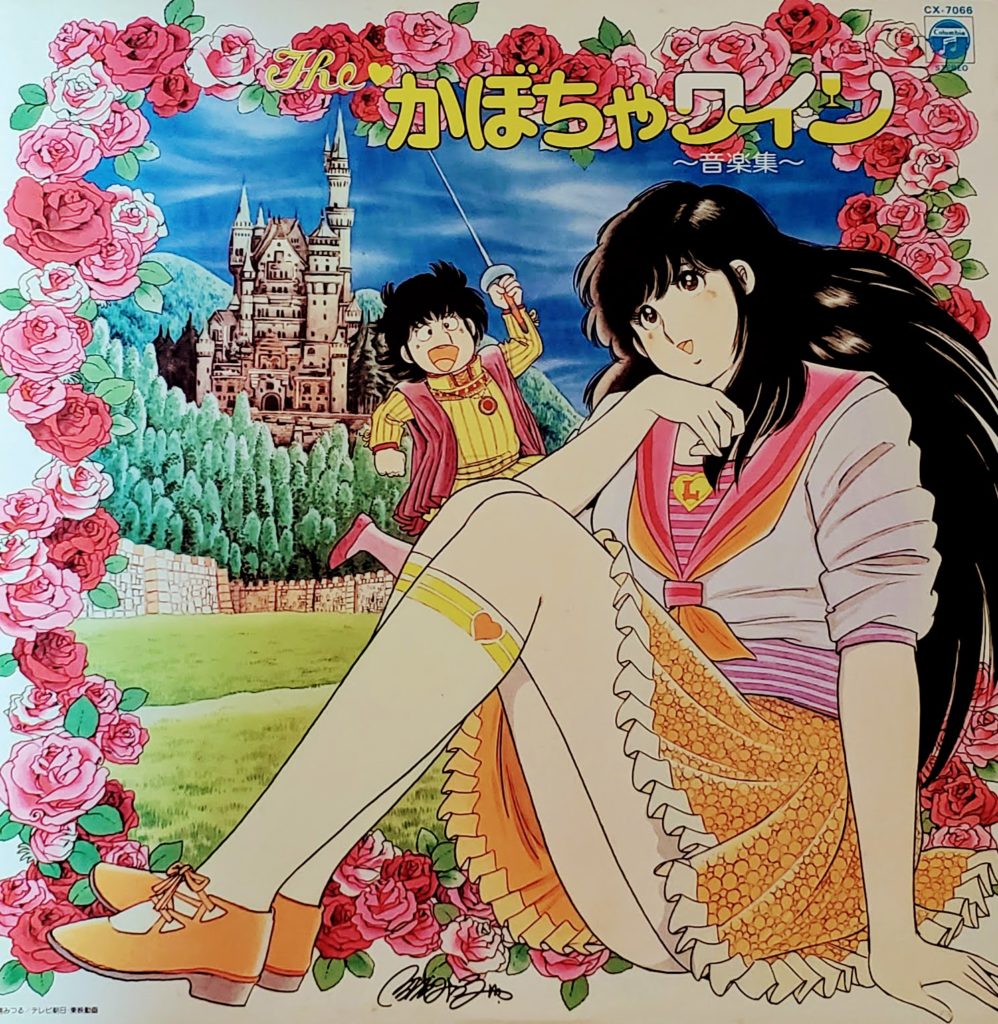
The Pumpkin Wine (complete album download)
The Pumpkin Wine was a manga from the early 80s that got turned into an anime series in 1982, followed by an animated movie in 1984 and a live-action movie in 2007. This is the soundtrack to the manga I believe. That was actually a fairly common thing in Japan in the 80s. They gave manga their own soundtracks. I guess you were supposed to read the manga while listening to the LP.

Of course, I could be entirely wrong as it should be said that I know squat about The Pumpkin Wine in either anime or manga form. I bought this solely for the composer, the legendary Osamu Shoji. He sadly passed away this year, and I long for the day when his robust, eclectic and downright bizarre discography is rightfully rediscovered. He’s mostly known for his score to Wicked City, but I feel that this soundtrack is more indicative of his greater body of work; what I mean is, it’s goofy as hell.

One of the best things about Osamu Shoji was that he wasn’t afraid to go all out with his synthesizers and really try all the sounds they could produce. You don’t just hear the basic synth strings and drum beats on an Osamu Shoji piece, you get weird electronic bongos, non-stop slap bass effects, faux guitar, artificial bells, the works. This album has a track with not one, but two short synth-bongo drum solos. That’s the kind of idiosyncratic delights that Osamu Shoji specialized in.

The result is music that is cheery and upbeat. Sparkly and breezy. It’s not City Pop, it’s not jazzy enough for that, but it’s definitely a close cousin. This is music for a Sunday drive by the beach, or a stroll through an exceptionally charming neighborhood. It’s what you hear when you roll up to a town in an RPG. I get that the tones and textures used by Shoji may not be for everyone, especially those whose only exposure to synthesizer music is grimdark synthwave, but for me it’s a refreshing breath of fresh digital air. Music can be an escape sometimes. I don’t always need to be reminded that the world is a dark and scary place. Sometimes I want to be reminded that it can still, just sometimes, be a fun and happy place. Music like this does that for me. Maybe it’ll do it for you too.

Koto Vivaldi

Friday, June 15th, 2018

What’s your go to music when you need to calm the fuck down? Not chill the fuck out, but calm the fuck down? If I need to chill out, I got plenty. Banks, KLF, The Orb, a multitude of sub-standard prog, lots.

But when I need to calm down, when I need to put the anxiety dogs at bay or I need to stop thinking about any of the multitude of existential crises humanity is currently ignoring, I always gravitate to the same thing.

That’s right, obscure renditions of Vivaldi’s Four Seasons.

I know, you were totally going to guess that.

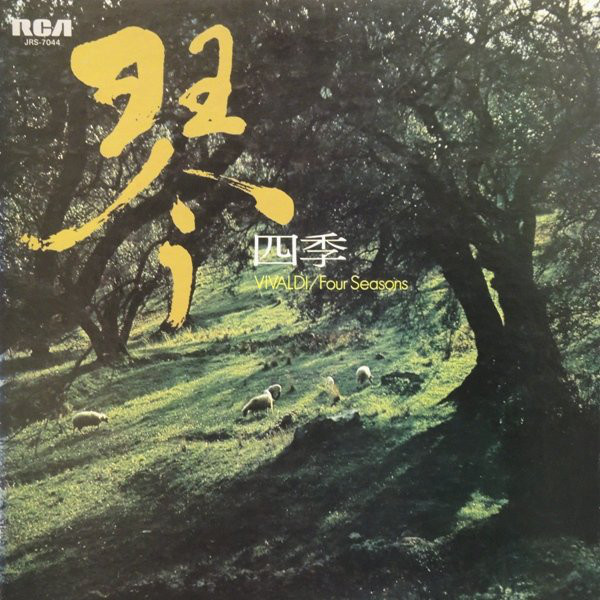
Tadao Sawai & Hozan Yamamoto
Vivaldi’s Four Seasons (Complete album download)
Tadao Sawai was a Japanese koto player. From what I can gather, dude was the Japanese koto player. The Clapton of Koto, expect with dramatically less cocaine (I assume). Hozan Yamamoto was a renowned Shakukachi (bamboo flute) performer who was well-known for his performances and original compositions.

Both often worked outside the realms of traditional Japanese music, and were some of the first classically trained Japanese musicians to work with westerners and perform western music on their respective traditional instruments. Yamamoto was performing with Japanese jazz acts in the late 60s, and in 1968 Sawai released an album of covers, featuring Koto renditions of pop tracks like “Over The Rainbow” and “Johnny Guitar.”

That same year, the two teamed up for Koto Sebastian Bach, a collection of Bach covers (duh) and this album, a full performance of Vivaldi’s Four Seasons. The album isn’t just koto and shakukachi, there’s some drum, guitar, bass along for the ride, but the koto and shakukuchi are definitely given the spotlight. It’s a wonderful interpretation, it goes well with glass of sake.

This is probably not your thing. And that’s okay! But it might be someone else’s thing, and it is my thing. So please think about that before you leave a comment whining about the music I’m sharing for free. And regardless if this is your thing or not, don’t expect many more posts like this in the future. I just thought it would be a good change of pace. Nice relaxing music for your weekend. Maybe it’ll help you calm down too.

Sure is plenty of stuff not to be calm about lately, it seems.


Yoshinori Sunahara’s Airport Of The Future

Monday, June 11th, 2018

I rarely buy albums because they look cool. I’ve probably said this before, but owning over 4,000 records spread across two continents quickly cures you of that habit.

Sometimes though, you come across something so odd or peculiar, that you feel the need to add it to your collection. Last week I came across such a record.

Yoshinori Sunahara
Tokyo Underground Airport
Music For Chicago
Preview
Stinger Stingray

Yoshinori Sunahara is a Japanese musician. I’ve mentioned him tangentially a few times now. He’s a member of Yukihiro Takahashi’s supergroup Metafive, and he’s also a collaborator on Towa Tei’s upcoming album Sweet Robot Against The Machine. Before all that, he was a member Denki Groove, an electronic act here in Japan that is oddly incredibly popular.

Yoshinori left Denki Groove in the mid-90s to go solo. He released albums at a pretty steady clip in the late-90s, but he’s slowed down his solo output as of late. His last album proper came out in 2011. I haven’t listened to all of work, but the stuff I have come across certainly has a flavor of its own, somewhat aligning with the more electronic acts of the 90s “Shibuya Kei” scene that made slight waves in the states at the time, with acts like Pizzacato Five and Cornelius getting some attention internationally.

During the late-90s, Yoshinori went full “lounge pop,” just like his frequent collaborator Towa Tei. I bet their house parties were dope as fuck. In 1998, he released two albums that I feel real exemplify his lounge dance-pop style; The Sound of the 70s, followed by Take Off and Landing. Both are obsessed with the international jet set culture of the 60s and 70s, specifically the style of Pan Am airlines. Hell, The Sound Of 70’s opens with a remix of music Pan Am would play on their flights.

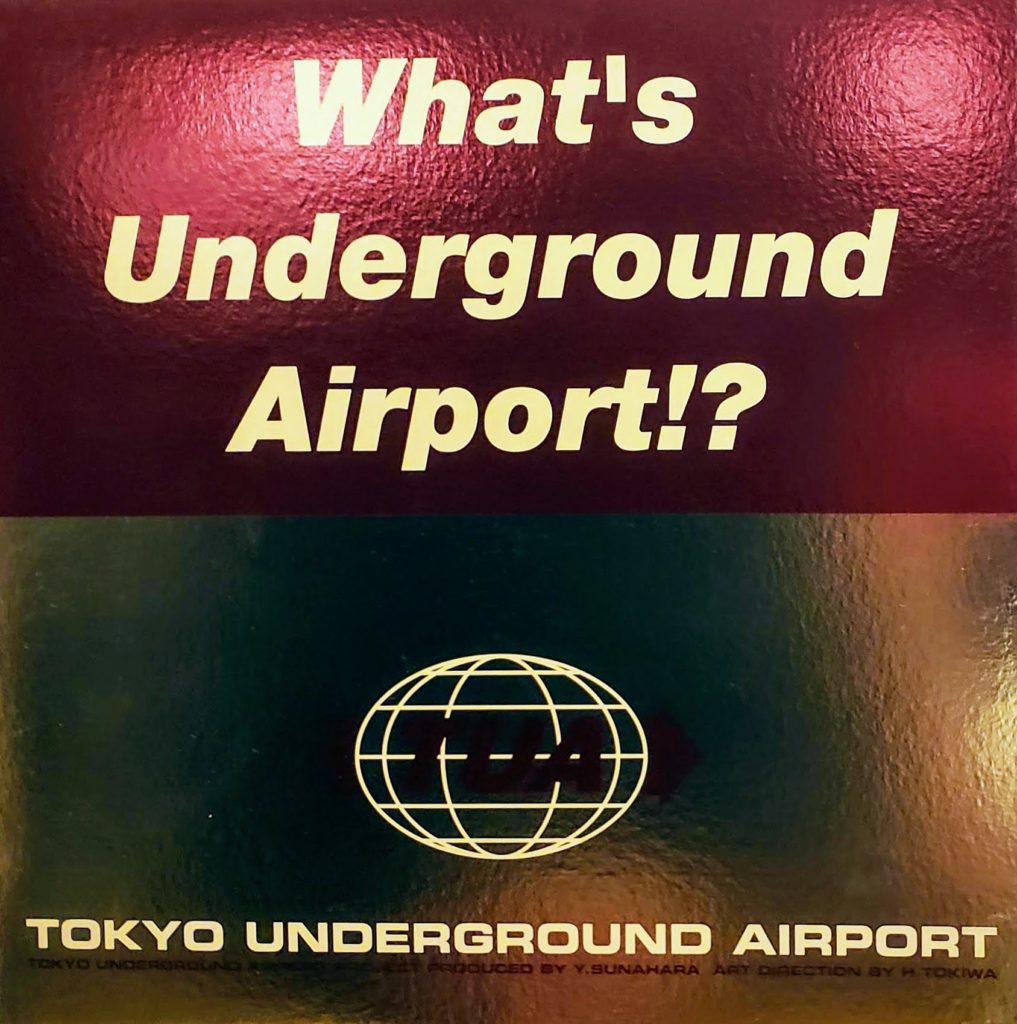
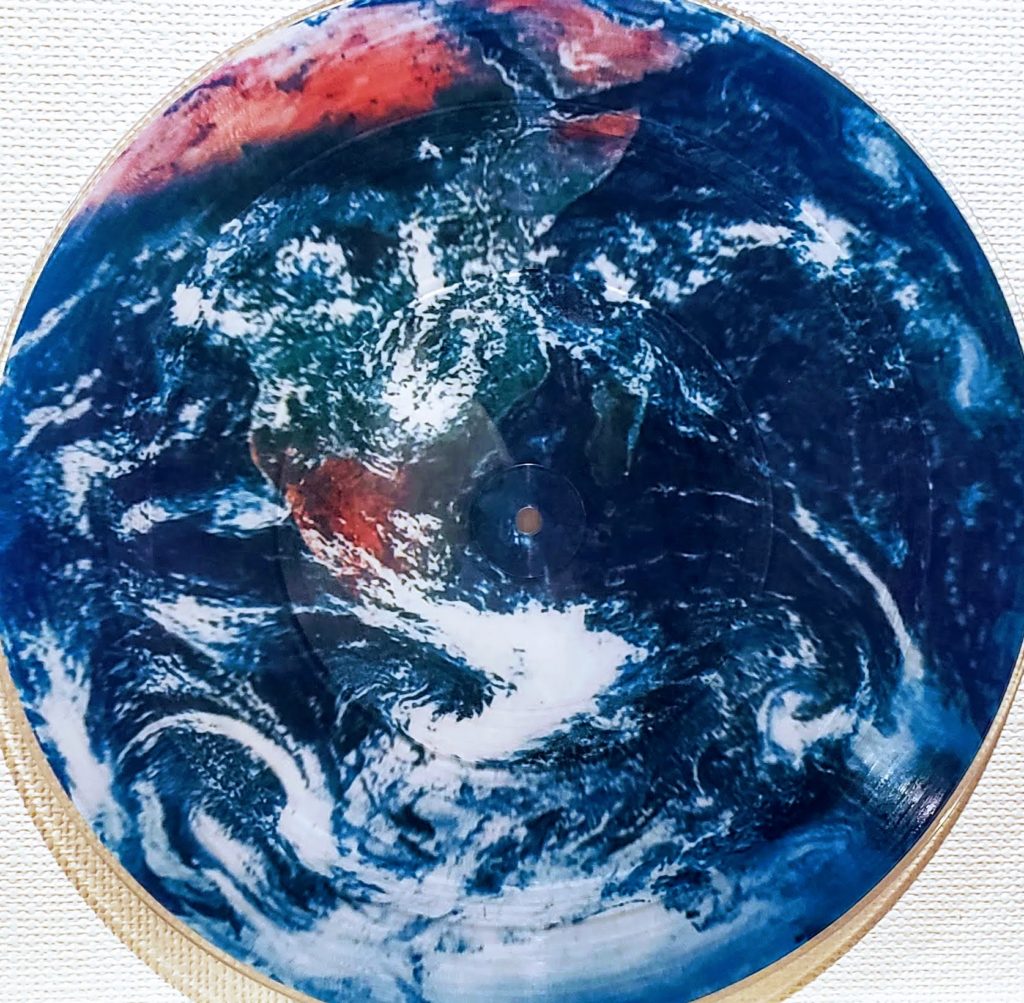
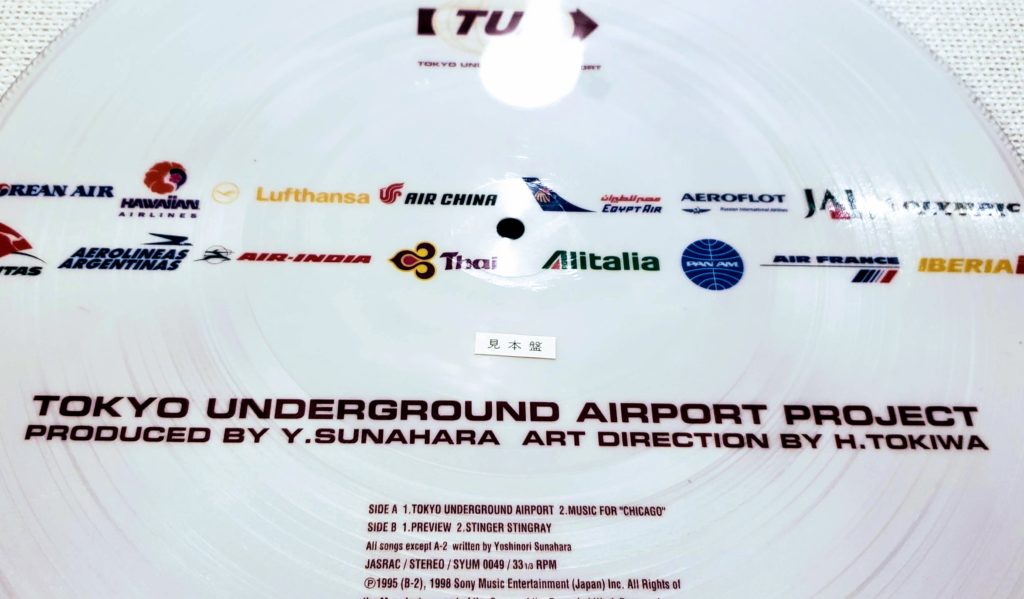
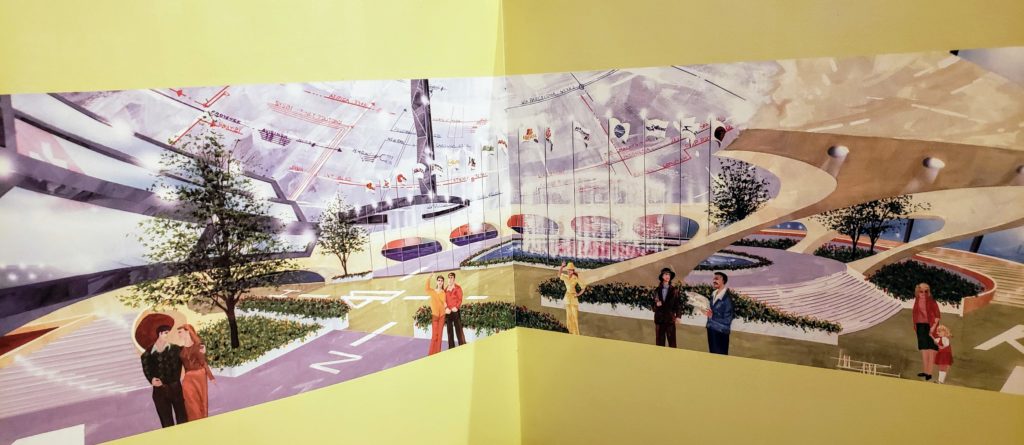
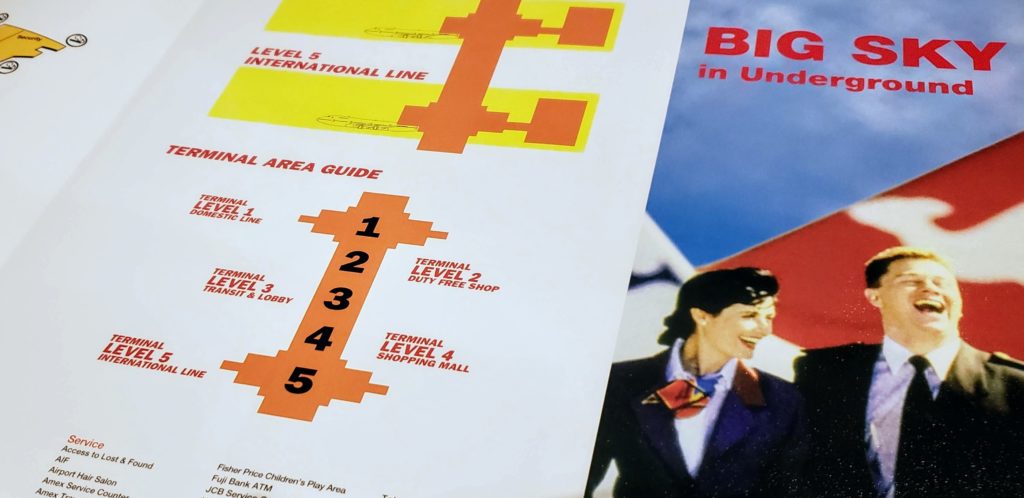
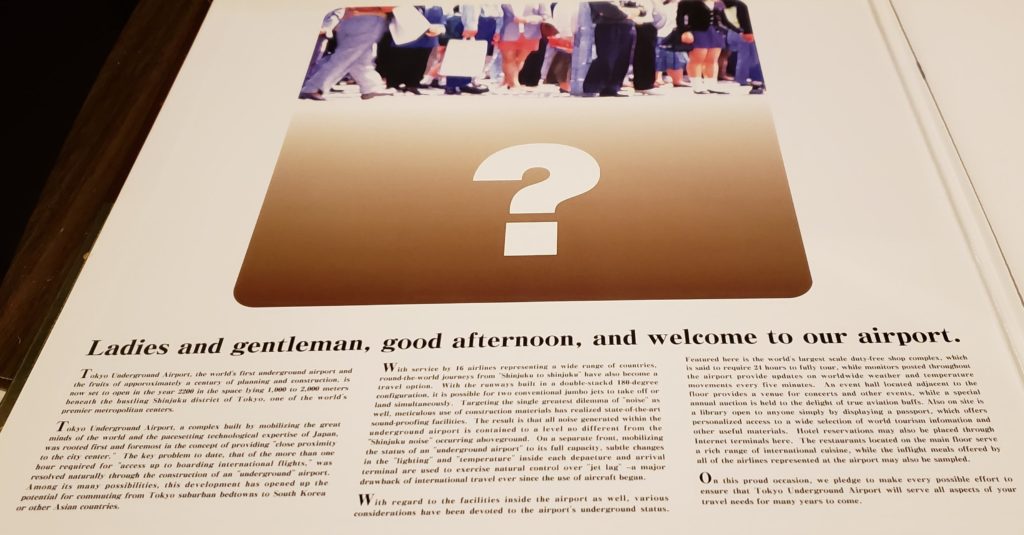
Yoshinori took this obsession to the next level for this single promoting The Sound Of Take Off and Landing, which I’m sharing tonight, an over-the-top deluxe style package that goes out of its way to express the magical retrofuturistic world he wanted to surround himself in.

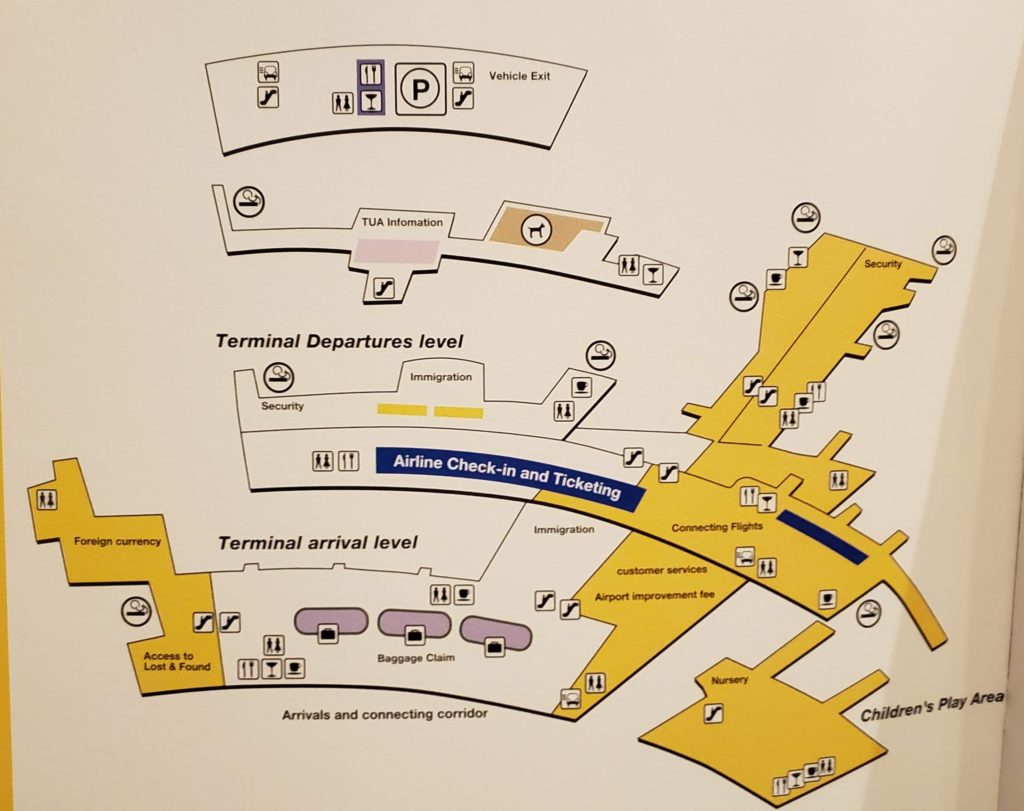
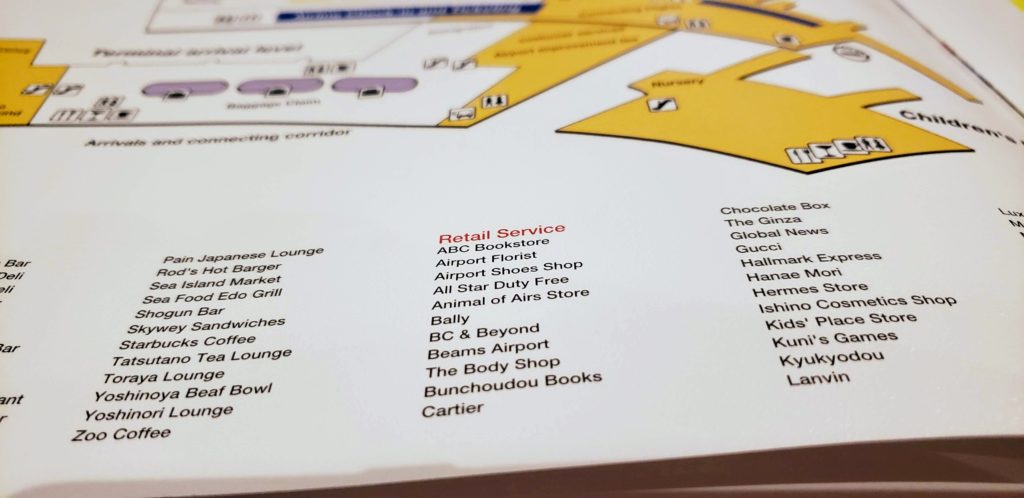
The presentation outweighs the music. Everything here is created to promote the fantastical Tokyo Underground Airport. The booklet inside features a detailed (future) history of the airport, and includes schematics showcasing the airport’s layout (complete with a list of businesses contained in the shopping center) as well as descriptions of every country serviced by the mythical flight center. The package even includes a sticker sheet with the (real) airlines that would travel through the underground depot. This single was available on CD, but I can’t imagine it would carry the same weight or work as well to transport you to the world Yoshinori was trying so hard to create.

The world-building continues onto the record proper. The first track is a nearly 14-minute guide to the Tokyo Underground Airport, and it goes into an insane amount of detail, giving the minutia an in-and-outs of nearly every aspect of the airport. The recording occasionally gets distorted and twisted, giving it a found object feel, like it’s some sort of damaged recording found by archeologists in the distant future.

Track two is a b-side “Music For Chicago,” that I believe is exclusive to this release. It has a vibe that I can’t pin down. But I feel like it’s something that would’ve played at an exhibit in a World’s Fair or something. “Preview” is a preview of the future featuring narration about the uptopian world Sunihara dreamed of, with music from the album proper. Finally, “Stinger Stingray” is an album cut from Yoshinori’s solo debut Crossover, albeit in a slightly different mix. While it’s not taken from the same thematic piece as the rest of the recordings, it’s style fits well enough.

What an amazing piece of design. A lot of deluxe packages today don’t come close to the level of detail in this. And damn, imagining this dream airport of the future does it Narita Airport suck even more.


Easy Going – Claudio Simonetti’s Inappropriate Disco

Wednesday, May 16th, 2018

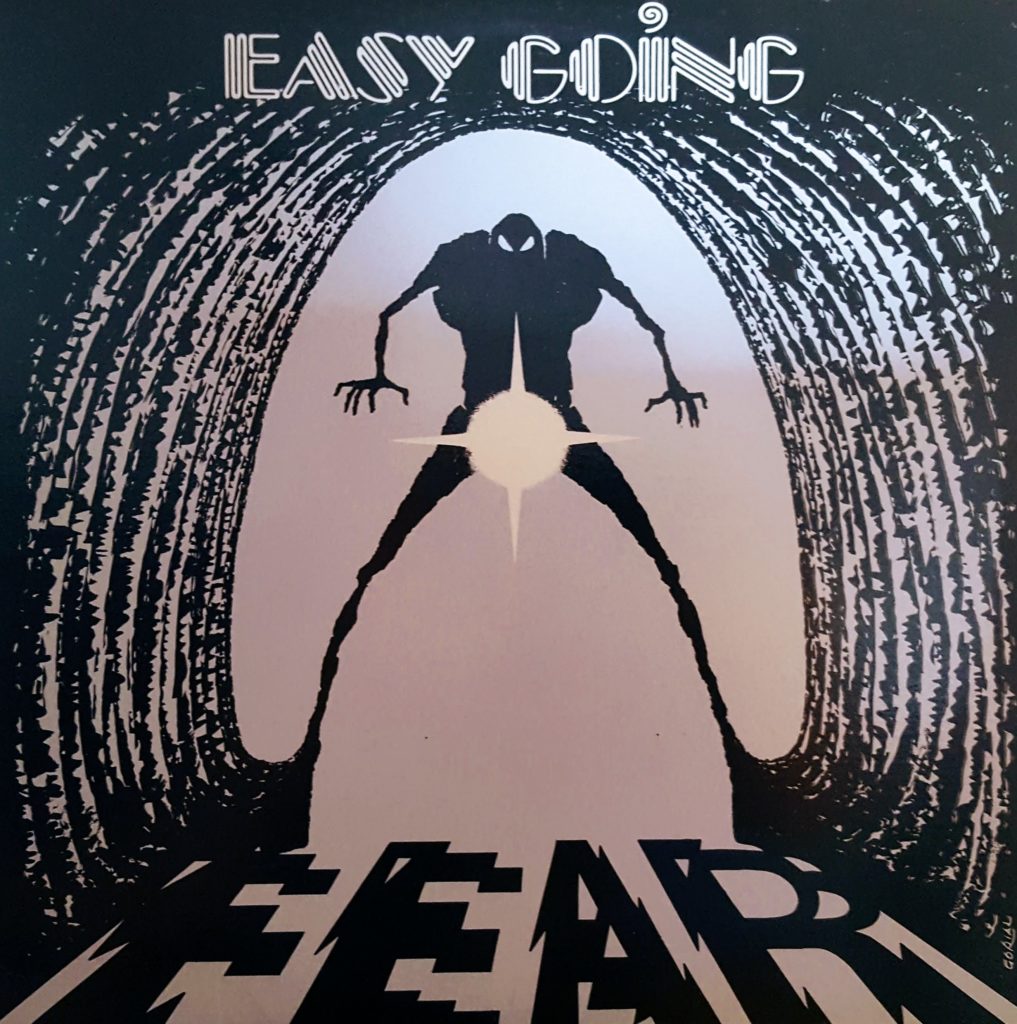
Easy Going
Fear
I Strip You
To Simonetti
Put Me In The Deal

Easy Going was an Italian Disco act that featured horror rock icon Claudio Simonetti. While Simonetti’s involvement with such a project might be surprising for fans of his work with Goblin, it wasn’t the only time that he was involved with dance music. Around the same time of Fear, Simonetti was working as Capricorn, pumping out a few singles from 1980 to 1982. There was also Kasso, probably the best known of his disco aliases. He released three albums as Kasso in the 80s, with the first two being very widely acclaimed by fans of electronic disco. Like Kasso and Capricorn, Easy Going was more or less a Simonetti solo project. The album has a multitude of performers, but Simonetti composed, arranged, conducted and produced the album, with lyrics by Giancarlo Meo.

Also like Kasso and Capricorn, Easy Going is a good example of Italo-Disco. For those not familiar with the genre, it is disco from Italy (duh) that blends the disco sound of the 70s with the Hi-NRG and synthpop sounds of the 80s. The best cuts from this album, the first two tracks, are both very Italo-Disco, very Moroderesque, while the latter two are decent examples of more traditional disco.

“Fear,” sounds like a horror remix of “I Feel Love,” with a pulsing sequencer rhythm wonderfully punctuated by some ominous-sounding strings and intense vocoder-aided vocals (along with some random screaming). And then there’s “I Strip You.” It’s halfway between traditional disco and electronic music, with just as much strings as keyboards and sequencers. It’s a really powerful, funky song with a fantastic groove…that seems to be from the point-of-view of a potential rapist, maybe?

You made a mistake
Don’t play games with me, girl
You made a big mistake
And now you’re staying here

Furthermore, he seems to be willing to commit this crime just because he wants to disprove rumors that he’s gay?

This way you won’t say
That you think I am gay
To the people you won’t say
That you think I am gay

But wait, maybe he is gay! Because as the song ends…

Now that you’re turned on
I don’t want you now, girl
So now you’re free to say
The truth that I am gay
It’s better that I go
I don’t want you no more
You’ve got the reason to say
To say that I am gay

So he was gay all the time and he was just fucking with her? Or he was gay and he was trying to convince himself that he wasn’t? Or he can only be with women when they’re not interested? This is a weird track. It sounds like a treatment to an unmade Argento film that was turned into a club track.

It should be mentioned that Easy Going was named after a gay night club. The cover of their first album is an explicit piece of art that was part of the club’s dance floor. It has a song called “Little Fairy.” Their third album has a cover of “Gay Time Latin Lover.” I have no idea if anyone involved with Easy Going was actually gay, but they were certainly playing with the idea that people must’ve thought they were. I’m sure there’s something icky about the politics of that, but I don’t want to bother going there.

Regardless of all of this, these tracks are certainly better than the Capricorn disco cuts I’ve heard, and actually make me interested in tracking down those first two Kasso records. I assume they have less songs about potential sexual assault and ambiguous sexual orientations.

I mean, I don’t know for sure, but it’s a safe bet.

Disco for exhibitionism – Penthouse’s Let Me Be Your Fantasy

Sunday, April 1st, 2018

The Love Symphony Orchestra
Let’s Make Love In Public Places
Let Me Be Your Fantasy
At The Football Stadium

Oh boy, where to even begin with this one.

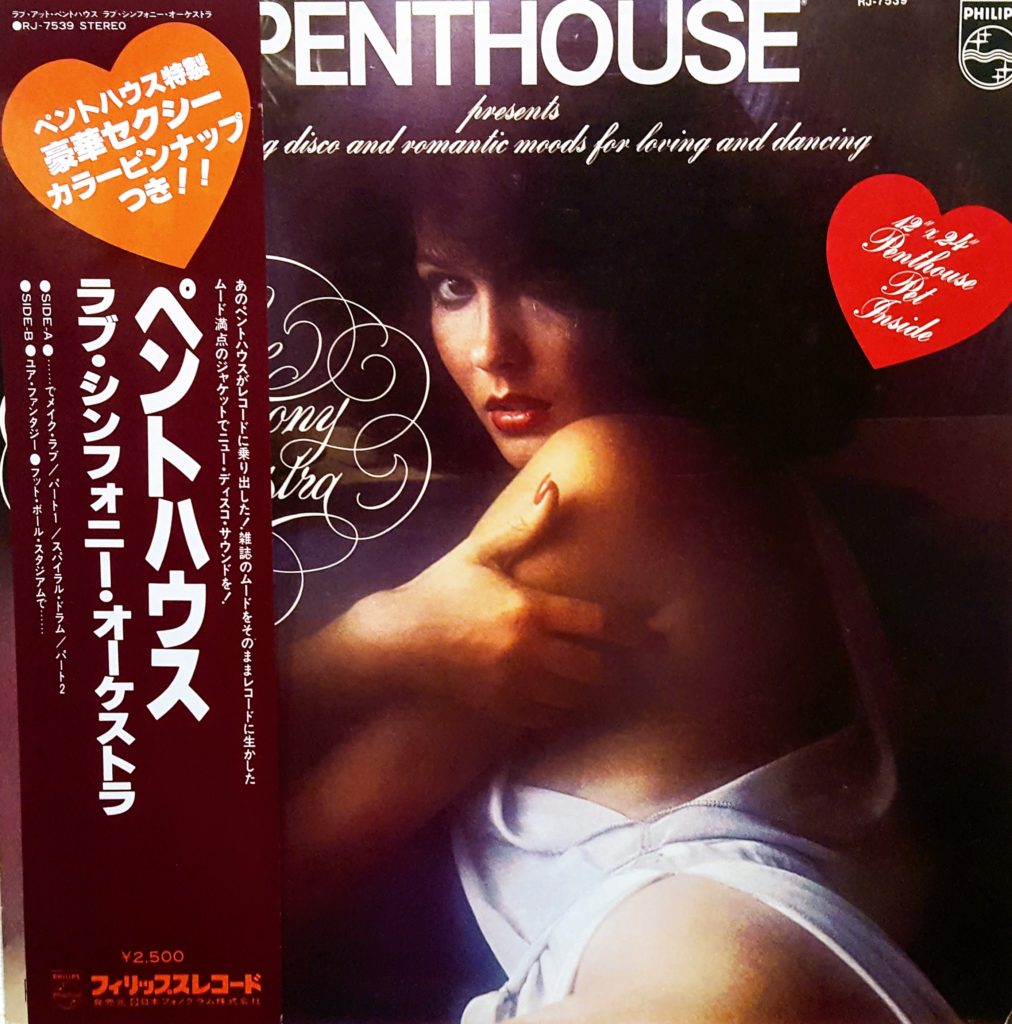
I suppose I should get the obvious out of the way; yes, Penthouse actually released a record. In fact, from what I can gather, they actually released two records. This one in 1978, and a follow-up the year later which also featured The Love Symphony Orchestra entitled Messdames Ce Soir (the typo in “Mesdames” is theirs, not mine). That album is predominately covers, but this one is all original material – and I suspect is all the better for it.

The back cover lists two tracks, “Let’s Make Love In Public Places” and “Let Me Be Your Fantasy.” But that’s actually misleading in multiple ways. Firstly, the album has a third track, the decidedly unsexy-sounding “At the Football Stadium.” But in actuality, all of the tracks are really just sections of a multi-part suite, that for all intents and purposes is “Let’s Make Love In Public Places.” That’s both the thematic and musical glue that holds all three numbers together. The chorus of the main track makes an appearance in the other two tracks.

This is longform disco, which was very much the style of the time. Acts like Donna Summer and Grace Jones were putting out albums that had entire sides dedicated to a single track. This is before the idea of the “dance remix” really took hold. You wanted to craft a 12-to-17 minute banger that would really take hold of the dance floor.

In case you couldn’t already guess by, well, literally every single thing I’ve said about this record, it’s entirely about sex. More specifically, it’s about banging in public. The entire first section, all 13 minutes of it, is an ode to lewd behavior in public, complete with a spoken word interlude by a woman desperate to convince her man to get down to business outside.

Oddly enough, the second part, “Let Me Be Your Fantasy,” offers a slight argument for doing it behind closed doors, with the male counterpart taking the vocals to exclaim that he wants to “make love alone in private.” But his viewpoint is almost immediately shut down once the chorus for the original track returns. This woman wants to get down in public and this dude sure as hell isn’t going to stop her.

And she finally gets her wish with the grande finale “At The Football Stadium,” where the two characters get down to business…at the football stadium (duh). A few absolutely horrible football-as-sex metaphors are exchanged (“On the next play come inside our huddle/don’t care who wins as long as we score”) before the chorus of the title track returns once more and segues into an extended instrumental outro.

The only member of Love Symphony Orchestra that Discogs lists on the group’s page is Matthew Raimondi, a violinist who mostly works on classical music now. But if you dig into the page for this album, you’ll find more detailed information. A lot of people worked on this album, some really talented people at that. Andy Newmark from Sly & The Family Stone played drums, and the Blues Brothers’ Lou Marini is here as a flutist. Everyone on this album is on a billion other albums, many of which you’ve probably heard. Check out their Discogs’ pages and discover the wonderful rabbit hole that is exploring the work of session musicians.

I don’t know if I really like this record all that much, even though it is more than technically proficient and definitely well-produced. But I do know it’s funny as hell. I really appreciate its enthusiasm and commitment to its cause/mission statement of fucking in public. This is more or less a concept album dedicated to lewd public indecency, and I respect that.

Regardless, you certainly don’t hear anything like this these days. So if you want a throwback to a sound that is long forgotten, give it a listen. Just don’t hold me responsible for any laws you might break if you find yourself inspired after the album is finished.


The Konami Famicom Super Medley

Sunday, March 11th, 2018

Osaka was amazing. I saw incredible castles, temples, shrines. I went to two amazing aquariums. I ate so much wonderful food that my stomach is still angry with me. And, of course, I went to as many record stores as possible and bought a billion records and CDs.

Almost everything I bought was obscure and out-of-print. It looks like I have plenty of material for this site for the next few months if not a year. However, very little of it was “traditional” Lost Turntable content. Only got one 12″ single of an artist any of you have probably heard of. The rest of what I found was either obscure electronic music, Japanese prog, Japanese jazz/funk or video game soundtracks. So I hope at least some of that sounds interesting to you, because that’s what you got coming up for the next few months most likely.

Y’know, stuff like this.

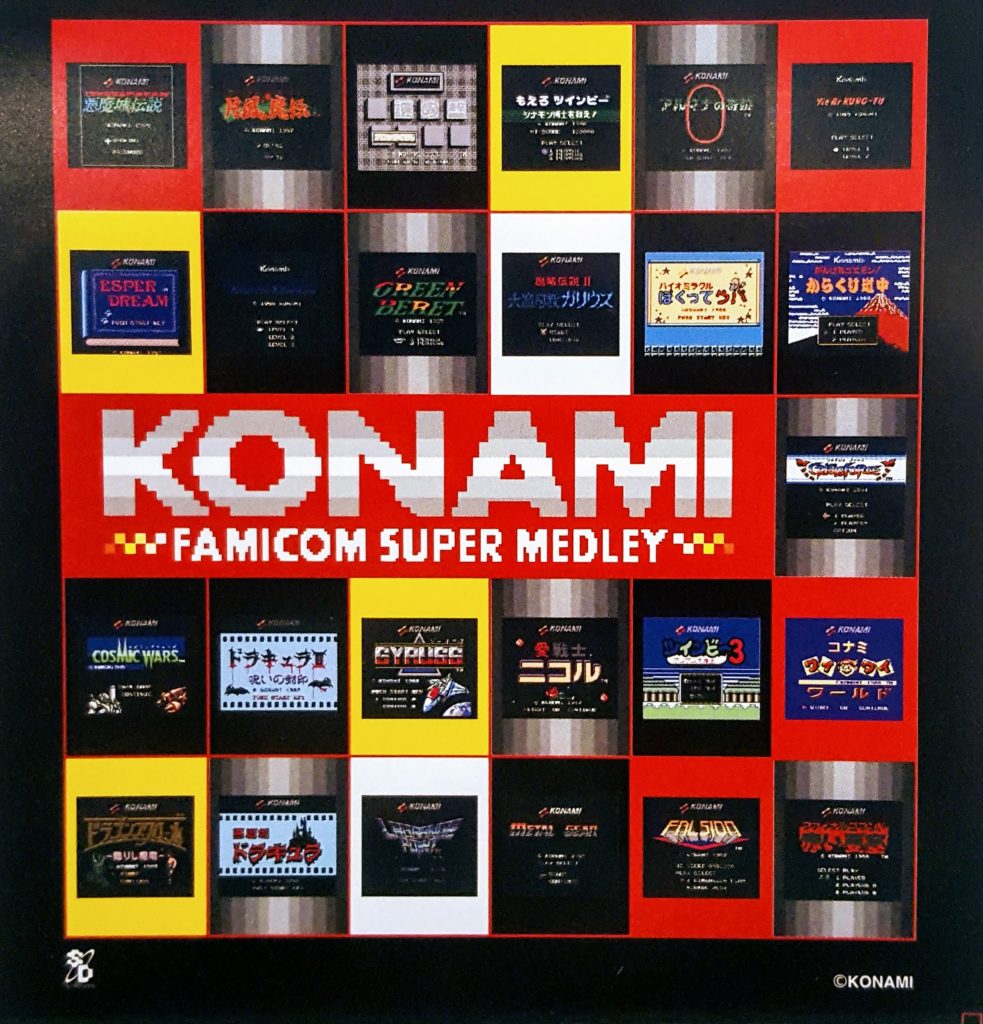
Konami
Famicom Arranged Medley
Famicom Original Remix Medley
Famicom Super Medley
All of these are “arranged” and/or “remixed” so I don’t understand the names behind these tracks. The opening “Arranged Medley” is probably the worst of the three though. It just takes a bunch of arranged versions of Konami tracks and mixes them together while an horribly bland backbeat plays throughout. I mean, it’s not terrible, the source material is certainly great, but when compared to the tracks that follow it certainly falls flat.

Because the other tracks are really great. The “Original Remix Medley” is a much more pure presentation of the source material, using the original game audio alongside some added sound effects and beats. It’s not as smooth as the “Arranged Medley,” some of the cuts are a bit jarring, but the overall experience is much better. The original tunes are so strong that they stand on their own, they don’t need the lame backbeat of the “Arranged Medley’ to support them.

That’s not to say they can’t benefit from the remix or arrangement treatment, because they certainly do with the “Super Medley.” This track takes the most liberties with the original songs, re-recording them entirely with new instrumentation and accompaniment. Of the three, it is the most fun, and works the best as a proper medley. The segues between the tracks are smooth and natural, lacking the out-of-place cuts of the “Original Remix Medley” and not relying on a tired backing track like the “Arranged Medley” does. It’s also super energetic, almost like a stadium house track. If The KLF were given orders to rework Famicom tracks, I think it might sound something like this track. Dope shit all around.

Disco Beatles Octopus

Friday, March 2nd, 2018

I wrote a thing about how Queer Eye pissed me the hell off. Also penned a piece about some recent re-releases of 80s J-pop gems you need to track down. Also have a planned review of the Super Mario Odyssey Soundtrack if I can make my way through all of it enough times in order to form a writable opinion. It’s four discs!

In other news, next week I am going to Osaka for the very first time and I am incredibly stoked. I’m going to go to the massive aquarium. I’m going to check out all the cool museums. I want to see the amazing parks and gardens. And of course, I’m going to go to as many record stores as my boyfriend will allow.

You all saw that coming, right?

I’ve already done my research, I have a map, I got a plan, I’m good to go on this. But if anyone in the know wants to recommend a record store in Osaka to me, I’m going to going to stop you.

Now Disco Beatles. I’m sorry.

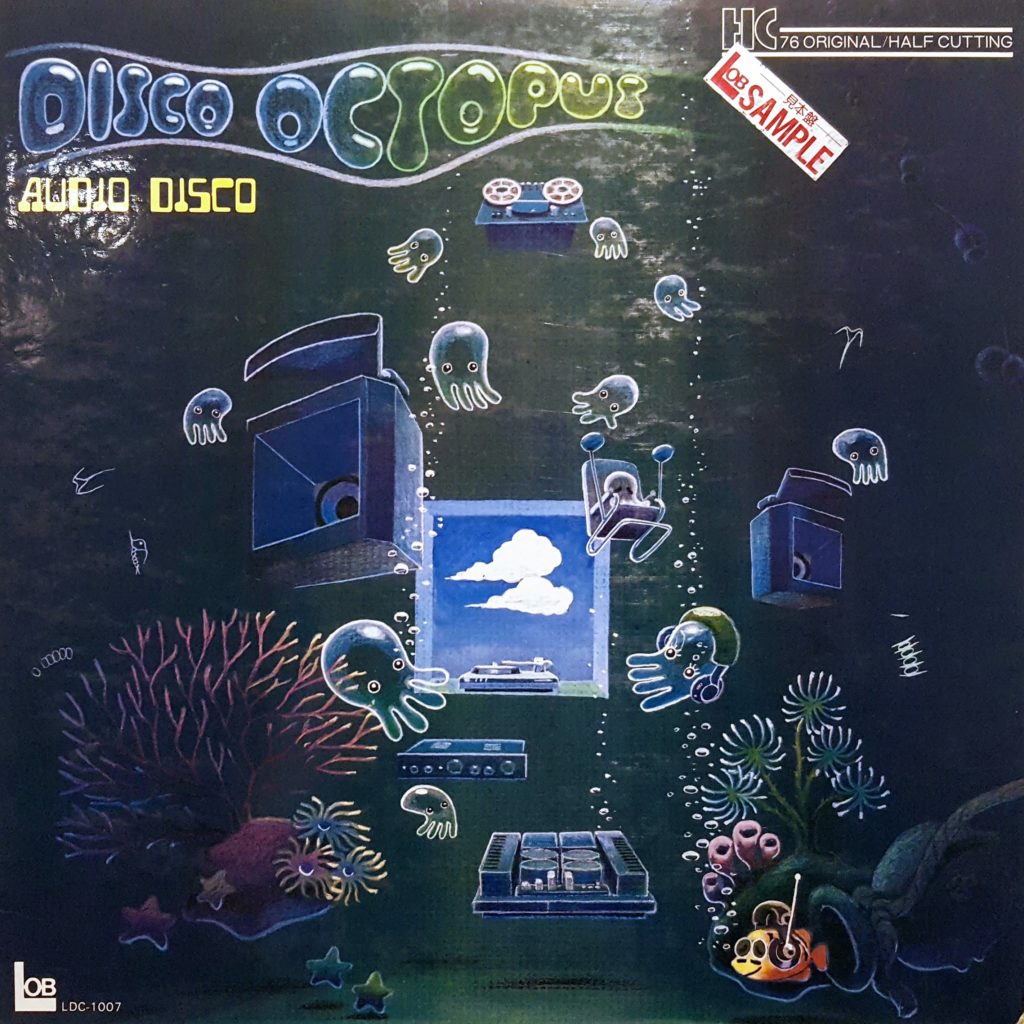
M. Uehara & His Disco Makers – Disco Octopus
Cover caught my eye, “disco Beatles covers” caught my wallet. Although it wasn’t much of a fight, this record was only abut five bucks and I was rather depressed when I saw it. I really should be careful when I go record shopping depressed. On the one hand, I can afford the retail therapy so yay, it makes me feel better. On the other hand, I end up with over a dozen anime soundtracks and I don’t know why.

I bought this hoping for some J-funk. I’ve mentioned before that Japanese funk is the secret best funk because it combines funk, jazz, disco and sometimes even electronic music in really amazing ways. What I ended up getting was much more disco, although I guess I really shouldn’t be surprised or disappointed about that. It’s not like the album was committing false advertising. The name of the group is “Disco Makers” after all.

But it’s still a halfway decent album. The opening cover of “Octopus’s Garden” isn’t great, but the covers of “Lady Madonna” and “Hard Day’s Night” are my jam. The albums closes strong with a funky take on “Sgt. Pepper’s Lonely Hearts Club Band” too. In between those bangers are covers of “Hey Jude” and “Let It Be,” as well as a medley that features “Ob-La-Di, Ob-La-Da,” “She Loves You,” and “Get Back.” The medley isn’t bad, but both “Hey Jude” and “Let It Be” are probably two of my least favorite Beatles tracks. And even the most ardent “Hey Jude” defender would have to admit that it doesn’t really lend itself to the disco treatment. It’s just too slow. Ditto for “Let It Be.” Neither of these covers sound like disco, they sound like bland instrumental versions performed by an airport hotel house band.

But who were the Disco Makers, and who was their frontman, M. Uehara? Great questions, I have no idea! Can’t find anything in English about this dude or his group. I really have to step up my Japanese game at some point so I can at very least track down a modicum of information on acts like this. I’m sure there’s some insane Japanese person out there who has written about stuff like this, i.e. my Japanese doppelganger.


Super Gun Super Funk Super Awesome

Monday, February 12th, 2018

I know I’ve mentioned this a few times already, but writing this blog is becoming increasingly difficult. Three times last week I sat down to write a post only to realize the songs I wanted to write about and share were already in print, or I covered them years ago. I’ve been doing this thing for over ten years after all.

So, don’t expect any rare or hard-to-find cuts by mainstream or even well-known cult acts for a while. Of course, that could change, I could stumble into a lucky 12″ single like I did with that PWEI one. But I don’t expect it. Instead, expect more weird Japanese synth-pop and strange experimental electronic records from the 70s. As that’s what I’m digging the most at the present time.

Also expect really odd shit like like.

SUPER GUN MOTHERFUCKER.

I’m not one for sound effects records, because they’re kind of pointless. I bet if I would’ve been aware of their existence when I was a kid I would’ve dug the shit out of them. But as an adult I really don’t need a collection of car sounds or thunderstorm ambiance.

I certainly didn’t think I needed a compilation of gun sound effects, but hey, sometimes you surprise yourself.

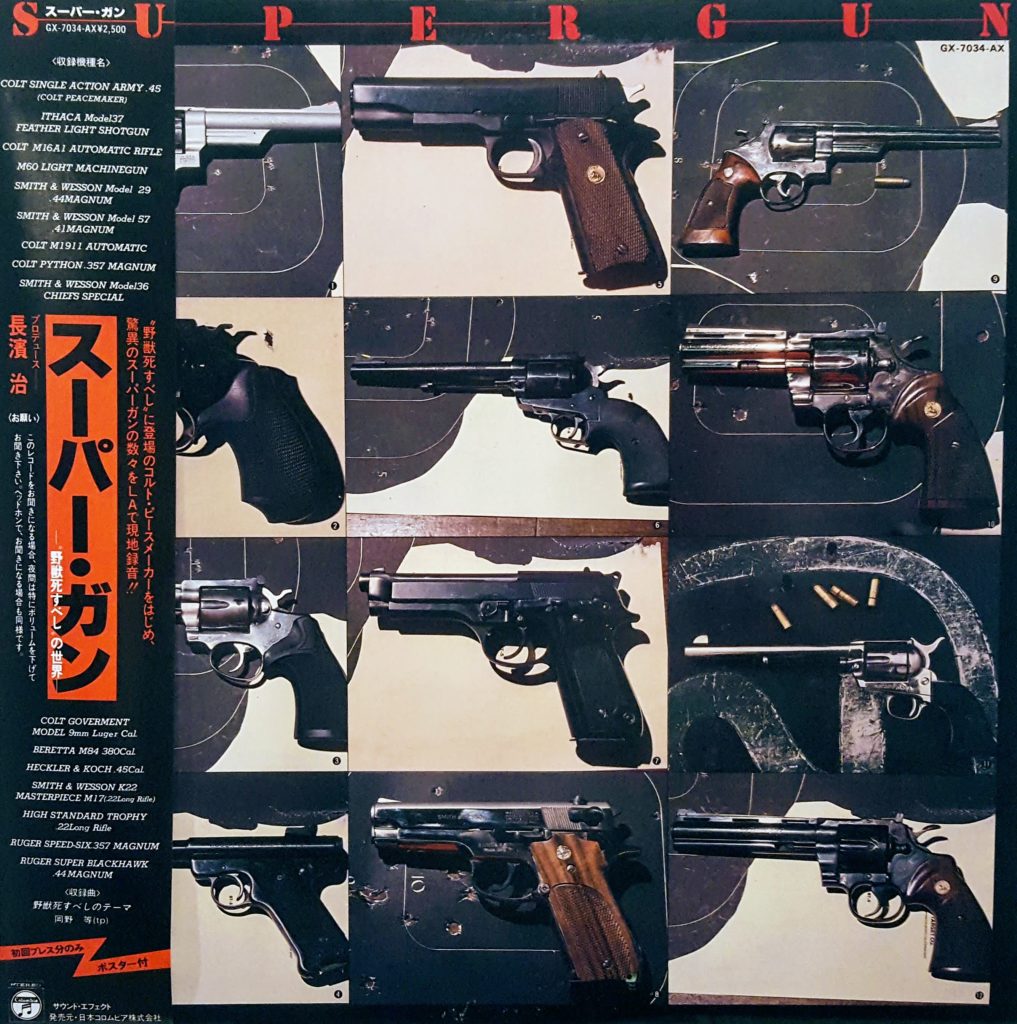
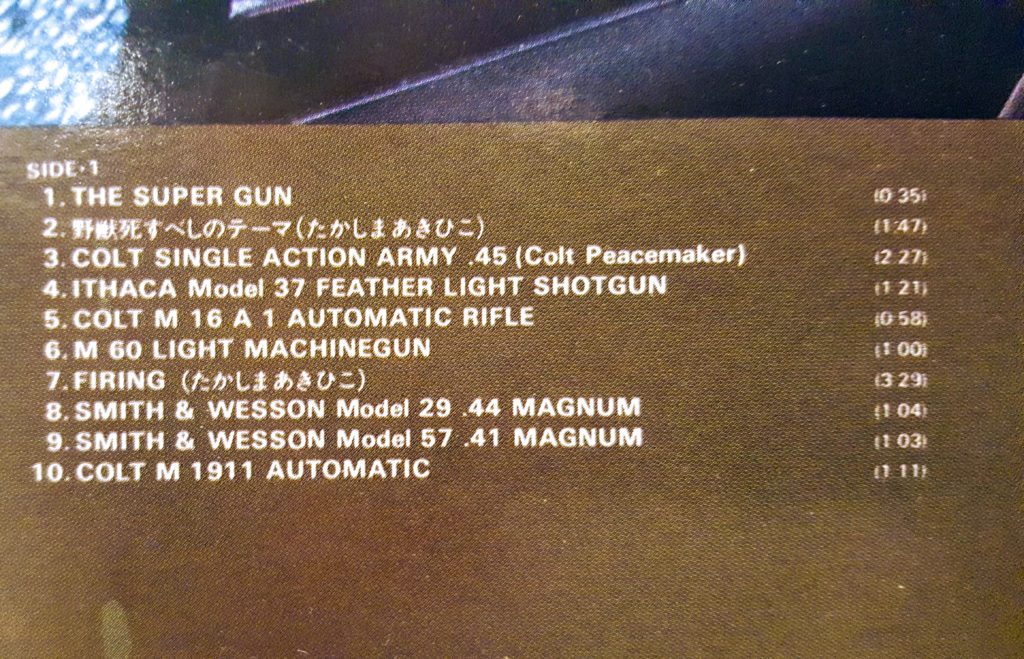
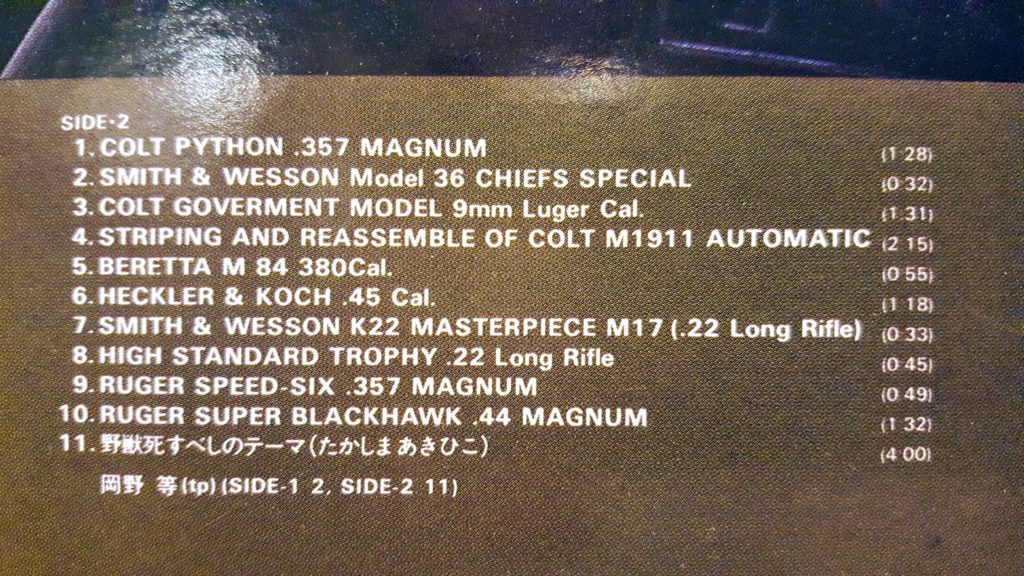
This is actually a bit more than just sounds of guns going off, so don’t quit on me yet. This is Super Gun, and as far as I can gather, it’s a companion album to the film The Beast Must Die, a movie about a reporter who goes off the deep end and embarks on a violent crime spree. What better to accompany a dark and disturbing film than an album that demonstrates various gun sound effects with an almost fetish-like attention to detail? It doesn’t just feature the sounds of the guns when they’re being fired, it also includes introductions (in English) by American gun experts.

Oh, and it also features DOPE FUNK.

The album opens and closes with a slow jam theme that’s good but pretty much forgettable. However, after a few tracks of nothing but dudes blasting guns, we’re given a break from the ballistics and treated to “Firing,” which is three and a half minutes of groovalicious funk for funking things up.

This song is taken from the film’s proper soundtrack album, which credits Akihiko Takashima as the composer. I think this track might’ve been performed by Arakawa Band, a jazz-funk group that’s credited as the backing band on the album. Regardless of who performed it, it’s fucking rad. So much that I’m including it as a separate download.

Super Gun (Complete Album)
Firing (song only)

Want to hear all the music and gunfire that Super Gun has to offer? Click the first link. Just wanna funk out? Then click the second.

I’ve said it before and I’ll say it again, Japanese funk is the secret best funk.

His name is Ryo and he plays guitar synthesizer

Sunday, January 14th, 2018

I wrote a thing on my other site about Japanese “city pop” and how it’s becoming kind of a thing in the states to the degree that it’s now becoming kind of a thing in Japan. It’s weird.

The funny thing to me is that, in my opinion, city pop isn’t all that interesting. That is, of course, working under the assumption that city pop is an actual, definable, genre (and it’s really not). But I’m not going to harp on anyone who does dig on it. It’s different, and that’s cool.

I went through a lot of different city pop acts on YouTube, trying to find a few that might appeal to me. Usually I would find a track or two I would like by artists like Taeko Ohnuki or Junko Ohashi, but my interest would just stop there – at a track or two. They just couldn’t hold my interest.

It bums me out. I wish I could be more into this stuff. It’s funny that some form of Japanese 80s music is starting to catch on in the fringes of the outskirts of mainsteam, but it’s the one type of Japanese 80s music I’m just not that into.

You know what I am into though? Utterly bizarre cross-genre electronic music built on obscure synthesizer technology.

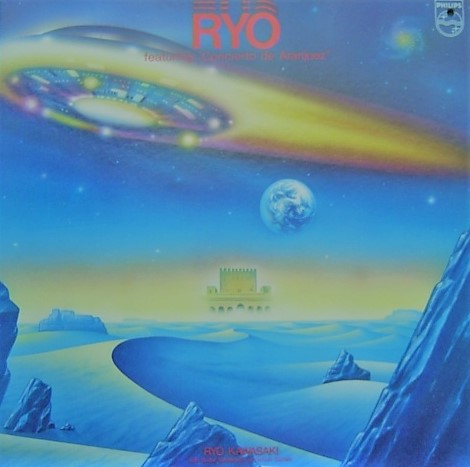
Ryo Kawasaki - Featuring Concierto De Aranjuez
I never heard of Kawasaki until a few weeks back, when I started getting his name in my “recommended viewing” list on YouTube due to all the city pop I was looking up. Aside from being Japanese though, Kawasaki doesn’t have much in common with city pop. While city pop certainly overlaps with jazz in many ways, Kawasaki is a jazz musician first and foremost, working exclusively as a jazz guitarist throughout most of the 70s.

I checked out a few of his 70s albums, and everything I heard was, at the very least, interesting. He’s a jazz guitarist, and some of his stuff is just too jazzy for me, but on some of those albums he branched out into great funk tangents. And throughout all of them his guitar playing is absolute stellar top-notch stuff.

But in the 80s he took a hard turn and embraced guitar synthesizers entirely. Of course, this is what I’m the most interested in and what I’m sharing tonight.

Featuring Concierto De Aranjuez is an experimental electronic album built almost entirely on guitar synthesizers. The linear notes explicitly state that no keyboard synthesizers were used on this record, only guitar synthesizers and a handful of drum machines. The album is split into two halves. The first half, like the title suggests, is based on the Concierto de Aranjuez by Joaquin Rodrigo. It starts out almost entirely acoustic, only using the synthesized melodies as a backdrop at first. But as it progresses the more synthetic sounds rise to the forefront. It’s a bizarre combination, like a Spanish guitarist somehow ended up on a Klaus Schulze record. Really amazing stuff.

Things go full digital on side B, with tracks like “Marilyn” barely using any traditional guitar sounds at all. It’s amazing that all of it was created using only guitar synths and drum machines. At times it really sounds like he’s using sequencers and keyboards. Incredible.

I really wanted to showcase this album tonight because I think it’s a dynamic and intriguing record. This is not simple “new age” music. This is not a fusion album. This is something different. This is something you really got to hear.

Ryo Kawasaki actually did a lot of other fascinating stuff in the 80s and I’m trying to track it down. I hope I can share more in the future.