Archive for the ‘Complete Albums’ Category

The best disco version of Star Trek you’ll ever hear

Friday, March 6th, 2020

Frank Serafine
Star Trek Main Title
Dig It

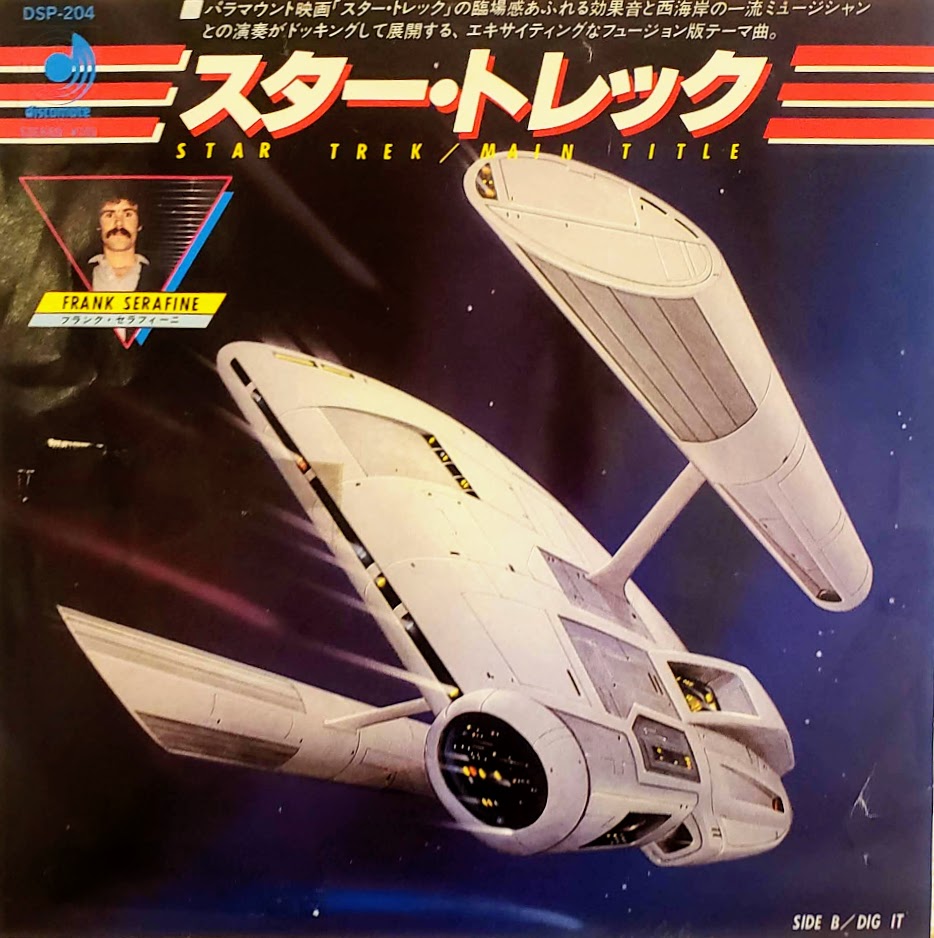
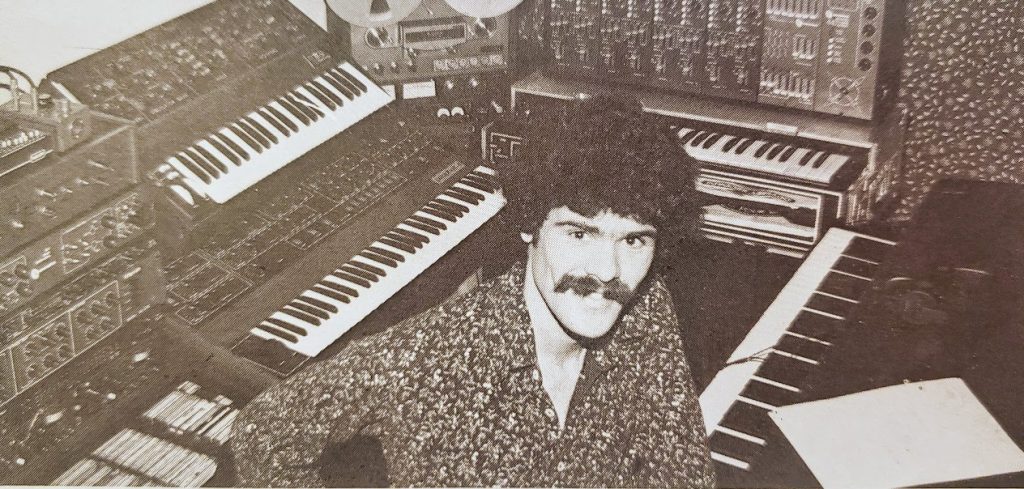
Frank Serafine is a name you have most likely never heard, and a man whose music you’ve probably never heard. However, you have without a doubt heard sounds created by this man. He worked as a sound designer and sound effect man for several huge movies from the 1980s. You know the dope sounds of the bikes in Tron? That was him. He also created sound effects for Pumpkinhead, Short Circuit, and Manhunter. He even won an Emmy for his work on The Day After.

Frank was also the sound effects designer for the first Star Trek film, which came out in 1979. A year later, he released his discofied version of the show’s main title music on a single that came out only in Japan.

It is far better than any disco version of the Star Trek Main Title music has any right to be.

This is an insanely well-produced piece of music with a fantastic sound. The b-side, “Dig It,” is also rad as hell. It’s a groovy, flute-driven piece, with a tight guitar riff, solid bass line, and fantastic accompaniment by an excellent horns section. It’s a shame that this came out as a b-side to a disco version of the Star Trek theme in 1980. Turn the dial back a few years, put this aside “The Hustle” or some other instrumental disco jam, and it could’ve easily been a hit with the same crowd.

This record sounds so amazing that I wanted to find out more about the people who worked on it. Frank is only credited as the flutist and keyboardist here, who else made this sound so good?

The single was produced by Miki Curtis, a big name in Japanese music going all the way back to the 1950s. He’s had a diverse career that includes everything from rockabilly to prog rock, with a notable career in acting as well. I would imagine that by 1980, the dude knew his way around a studio. He’s a solid producer here, that’s for sure.

Credited as an arranger as well as a keyboardist is Ken Shima, a workhorse studio guy who’s appeared on countless albums by Japanese idols, and more internationally-acclaimed acts like DJ Krush, Towa Tei and Pizzacato Five.

But the surprises don’t stop there. As I mentioned before, the guitar on this album is tight as hell, and that makes since considering the guitarist on this record is Robben Ford (credited here as Robin Ford). Another name you probably haven’t heard but whose music you have, Ford’s worked with damn near everyone. He played guitar in the studio for Steely Dan and Kiss. He worked with Miles Davis. He played guitar on motherfucking “Jessie’s Girl” by Rick Springfield. He played with George Harrison and Bonnie Raitt. He’s on a damn Tiffany record. He was even on an album of jazz fusion covers of music from the video game F-Zero, which is a really weird CD. Pee Wee Hill, who plays bass on this single, played on that album as well.
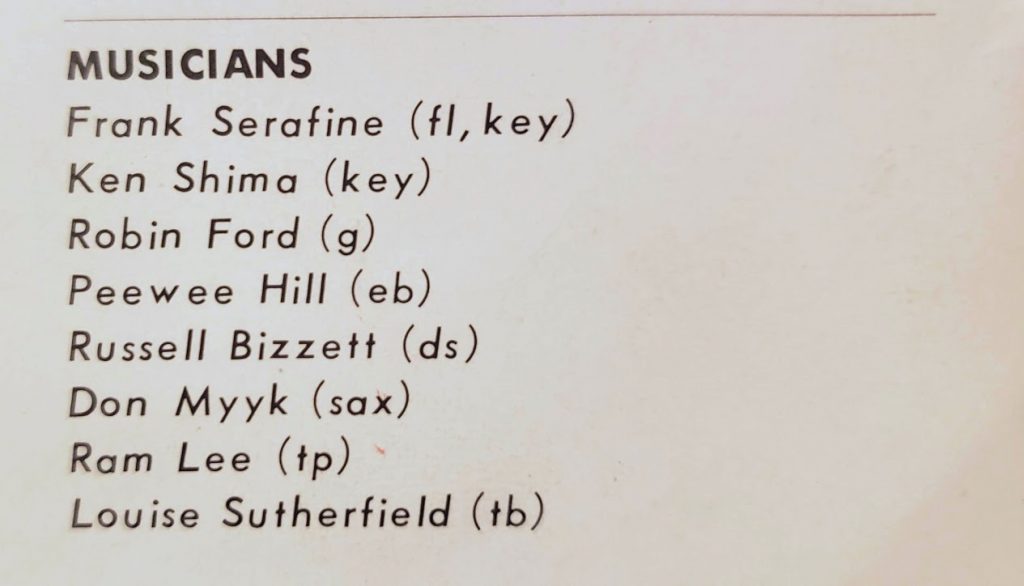
But who plays horns here? They’re so good, I just had to know. Well, according to the liner notes, someone named Don Myyk handled trumpet, while the trombone was played by one Louise Sutherfield. Those people don’t exist. I scoured Discogs and several other music sites, and couldn’t come up with a damn thing.

But you know who does exist? Donald Myrick and Louis Satterfield, both of which played with Earth, Wind & Fire throughout the second half of the 70s and into the 80s. No wonder the horns on this record sound so damn good. So why the false names? That probably has to do more with Japanese pronunciation woes than any attempt at keeping false identities. Translate those names to katakana and then back to English and you’ll end up with butchered spellings like those.

I bought this record as a joke. I figured with would be a lame attempt to capitalize off of the success of Meco’s Star Wars disco cover. Never have I been more surprised. I’ve listened to this cover so much that it’s lost all meaning as a piece of Star Trek music, and has instead taken on a life of its own as a damn fine piece of music in its own right. I’ve also fallen head over heels in love with “Dig It.” What a great melody! Again, a damn shame it never got the audience it deserved.

I don’t know how Frank was able to assemble such a great crew of international talent for such a goofy one-off release, but good for him. The results speak for themselves.

Frank’s only other music release that I can find is a new age album that came out in 2000, although he did do some work with Ravi Shankar as well. Aside from that, he mostly stuck to sound effects and film work. Sadly, the world lost Frank in 2018 in a car accident. He is missed.

The next time you watch Tron and hear those rad bike sounds, think of him.
Koto Bach by a hot koto man

Sunday, January 19th, 2020

Tadao Sawai & Hozan Yamamoto
Koto Sebastian Bach (complete album download)

Fuck new wave, Berlin school, post-punk, electronica, avant-garde, and early-moog albums. Let’s listen to interpretations of classical music on traditional Japanese instruments.

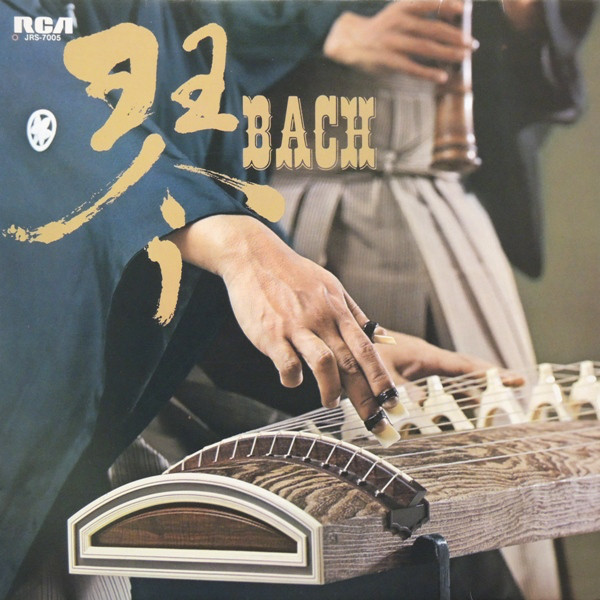
This is the second “classical music but on koto” album that I’ve shared here. The first  was an album featuring Vivaldi’s Four Seasons performed on koto and shakukachi (Japanese bamboo flute). This, as the title suggests, is comprised entirely of koto-centric reworkings of Bach compositions, again with shakukachi (and some light jazz instrumentation) serving as accompaniment.

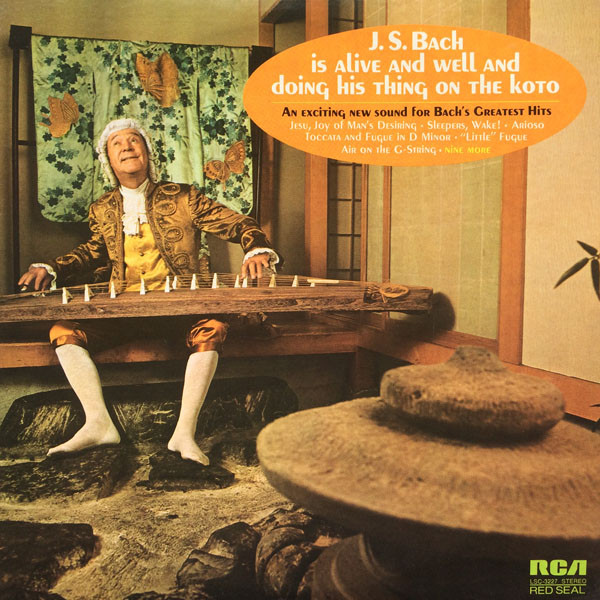
Like the Vivaldi album before it, this record is the work of Tadao Sawai and Hozan Yamamoto. This is actually their first album of classical covers, released a year prior to their 1969  Vivaldi album. Unlike their Vivaldi album, this actually got a release in America, coming out in the states in 1973 under the name J.S. Bach Is Alive And Well And Doing His Thing On The Koto. A ridiculous cover accompanied that ridiculous title change.

Yikes.

Sawai and Yamamoto would go on to collaborate on one more koto classical hybrid, Koto Amadeus Mozart, which was also released in 1969. From there, it looks like Sawai got more interested in koto reworkings of other genres, including some movie themes and Latin music. He apparently performed the theme to The Godfather on koto. I got to hear that shit.

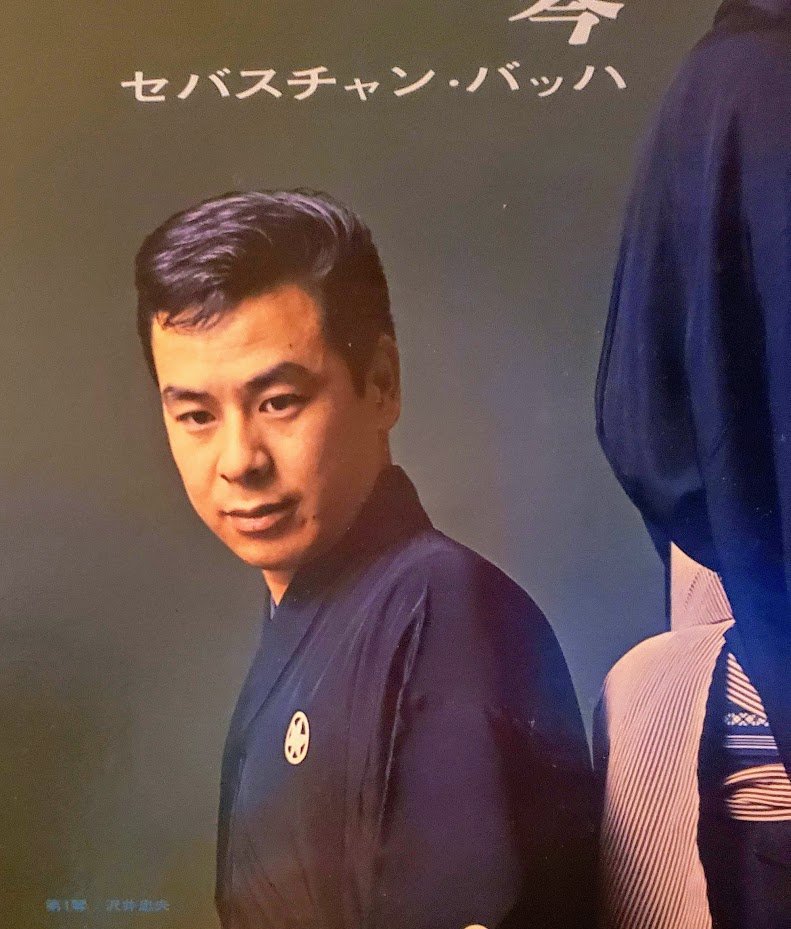
I would also like to mention at this time that I think that Tadao Sawai was hot as hell. I mean, damn, look at this man.

He’s got them hungry eyes. Looking like he wants to take off those finger picks and show you what he can really do with those hands. Looking like he wants you to wait patiently while he properly disrobes from his traditional kimono before he can ravage you Edo style.  He’s got that big bad koto daddy look. He could…um…*desperately tries to think of a sexual koto double-entendre*….pluck me all night long if you know what I mean…and I think you do because that wasn’t very subtle at all was it?

I apologize for the sudden horny turn this post took. Enjoy the koto music.

Osamu Shoji’s Star Wars – May the synths be with you

Wednesday, January 1st, 2020

I got to see Rise of the Skywalker this past Monday and thought it was just absolutely wonderful. It had some pacing and structure issues (so does Empire Strikes Back) but I loved how the movie blended the old with the new. I know it’s not the critical darling that The Last Jedi was, but I don’t care. It had a great story, fantastic character moments, and a terrific final scene. It was the first piece of any Star Wars media since Return of the Jedi that left me wanting immediately MORE Star Wars content. I’m back full-on Star Wars geek. If I had the room, I’d be buying stupid figures again. It inspired me to finally go through all the hurdles and download the “de-specialized” editions of the original trilogy so I can watch them again. It made me want to go back and watch the prequels even (well, maybe I’ll watch Attack of the Clones while doing some chores around the house). It pulled me back in.

There’s been a lot of negativity around this film and I’m still struggling to figure out why. It touched me in a way that no other film in the series had. I feel that a lot of the people who say they hate it can’t even express why. So much nitpicking tiny details, so many people demanding literally every single thing be answered and resolved in a way that matches their own head cannon. I don’t care about those things. I don’t overthink every tiny logistical and scientific detail of a Star Wars film (that’s what Star Trek is for). Yes, the movie is far from perfect, but most of its problems, pacing issues, seemingly random plot twists that don’t entirely hold up under scrutiny, deus ex machina force powers, sudden changes in character motivations, are in the other films too. I didn’t mind them then, I don’t understand why so many people mind them now.

I could keep going, but I already sound like a whiny defensive fanboy so I’ll finish by saying this; the movie made me happy. It hit all the nostalgic beats I wanted. It gave me new things to love. It reminded me why I love this franchise so much. I hope that it’s the sign of more greatness in future installments.

And if you want to comment about how much I’m wrong don’t fucking bother because this is my blog and I won’t approve them. If you have legitimate, interesting criticism of the film, I probably agree with you so there’s no need for you to share it here. If you want to whine about how “Ben Solo deserved better” or some other wanky bullshit, take your negativity to Twitter. That’s what everyone else does these days anyways.

Osamu Shoji’s Star Wars (Complete Album Download)
Buy hey, Twitter isn’t all bad! Today Twitter user @keepingitpeel sent me a link to a blog post about an all-synthesizer Star Wars album, and he asked if I had it.

Of course I do. And I’m just fucking shocked and disappointed with myself that I somehow never got around to sharing it here. Starting off the new year by fixing that mistake right now.

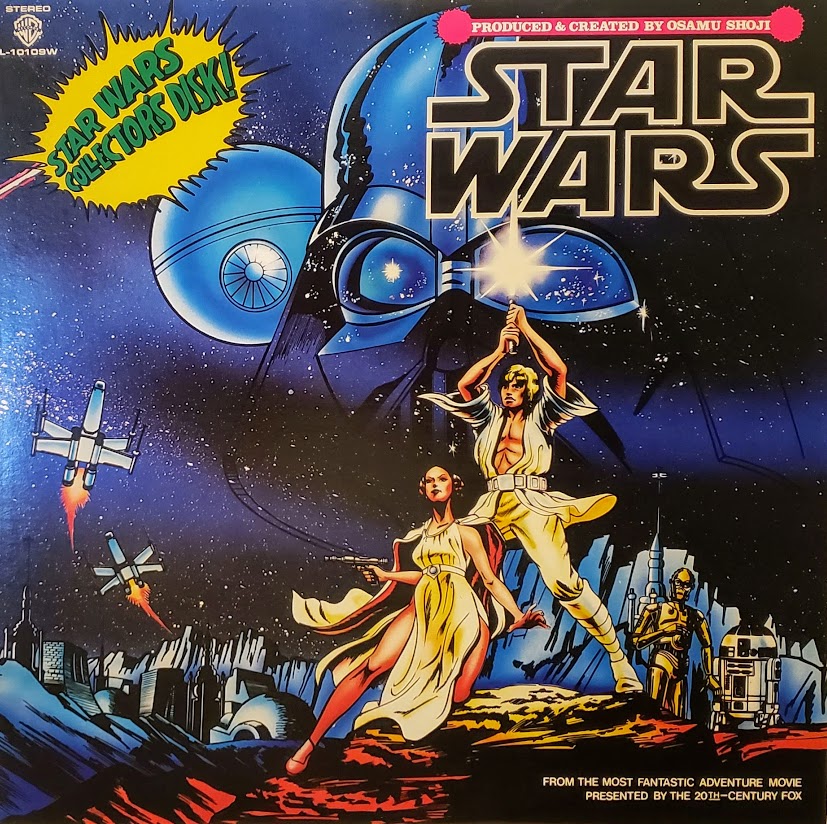
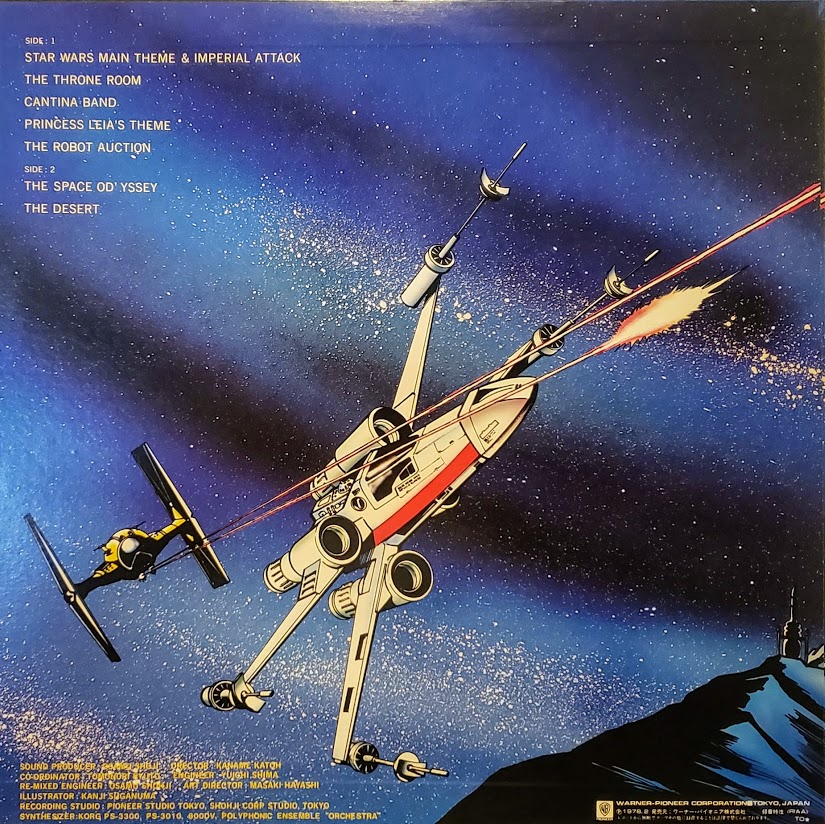
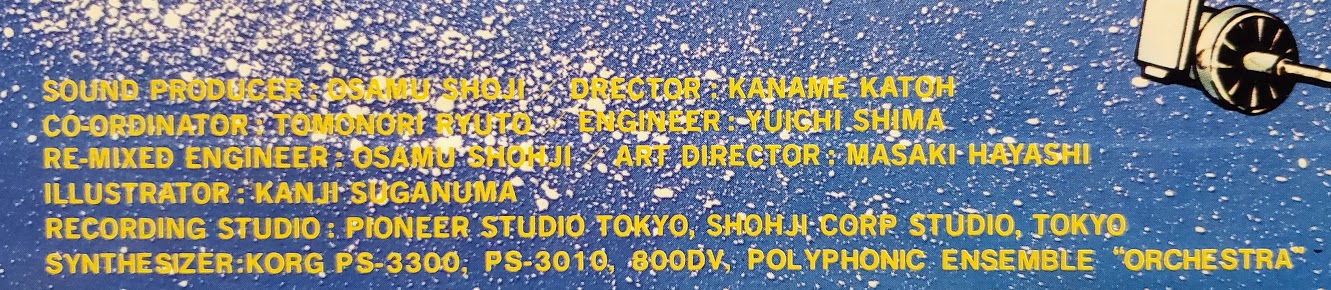
Star Wars by Osamu Shoji was released in Japan only in 1978. It’s not the only synthesizer arrangement of music from Star Wars (hell, it’s not the only one from Japan that came out that year) but it’s my favorite by leaps and bounds, thanks to the wonderful work of Mr. Shoji.

I have probably written more about Osamu Shoji more than anyone else has in English. When he sadly passed away in 2018, I put up a obituary of sorts on my other blog. He was an utterly amazing talent that took the synthesizer sound to places that others simply hadn’t before. Wendy Carlos proved that synthesizer music could sound like actual music, she made it commercially viable. Shoji built on her work to show that synthesizers could be fun, exploiting sounds and styles that were impossible on traditional instruments. It’s electronic music fused with 70s funk and jazz sensibilities. His best stuff just has an indefinable bounce. It’s just groovy, man.

His sense of goofy fun definitely comes across in his renditions of music from Star Wars. Like I said, there were many electronic takes on the Star Wars theme in the years immediately following the release of the film. A lot of the lesser-known ones failed to catch on because they just didn’t do all that much with the source material. They tried too hard to recreate the sound and feel of the original without adding anything to it.

In America, the most famous reworking of the Star Wars theme has to be by Meco, whose disco version of the main theme was actually a number-one hit single when it first came out. But I feel that had a lot more to do with the combined crazes of disco and Star Wars than it did with the actual quality of Meco’s work. I like Meco (really) but his Star Wars theme is little more than the regular Star Wars theme with a disco beat and some added instrumentation layered upon it.

Shoji takes the Star Wars theme and just fucking goes, man. Robot laughter sounds? Sure why not. A wah-wah bass back-beat? Damn straight. A funky breakdown? You better believe it. Like a good jazz musician, Shoji throws in his own flourishes and touches to the theme, all while not deviating from it too much. It always sounds like the theme. He doesn’t let his ego get the best of him. He knows why people are here and delivers what they want. He diverges a bit more on “Throne Room” but the key moments are still there, weaving them in and out with his own elements. And that funky beat keeps the groove constant.

Shoji really lets himself go wild when he gets to the Cantina Band music though. First he plays it through in a relatively standard way, again he gives you what you want. Then, he breaks that motherfucker down and builds it back up again with a series of jams where he finally gives himself the chance to show-off. He’s pushing sounds of out his synthesizer that I just haven’t heard before. Total Emerson vibes here.

Side A of the album continues with two more pieces from Star Wars “Princess Leia’s Theme” and “The Robot Auction” that are also good. However, side B takes things in a different direction. Just like Meco did on his album, the second side of Shoji’s Star Wars album features original work by Shoji, not interpretations of music from the film. Of course, it doesn’t hold the attention like the Star Wars stuff does, but it’s still great. Shoji wasn’t just a musician, he was an extremely talented composer. He worked on countless anime during his lifetime. He also released several albums of original work (that are all super-fun).

The majority of Side B is dedicated to just one piece, the 20-minute “Space Odyssey.” As the title suggests, it’s an odyssey. It starts as a quiet, simple instrumental melody. From there, the synth strings segue in and things get downright sexy before a more eerie sound takes itself to the forefront for a pulsing, sci-fi influenced second half. The album concludes with “The Desert,” a brief coda that features Shoji at his most experimental, mixing ambient soundscapes, some elements of Williams’ score, and odd atonal bursts of noise. (It’s also the only part of the record where the surface noise is noticeable so I apologize about that).

I’m glad to see that this record is getting a bit more attention now. I hope that anyone interested in it checks out other work by Shoji. Like I said in my blog post about him, I highly recommend his album Night Flight, which also came out in 1978. It’s a fun, bright and upbeat record that isn’t afraid to get a little silly at times.  It’s groovy as hell too.

Happy New Year’s everyone! May this be the year that we finally realize that we’re not alone and that we can make a different when we all come together against a common enemy.

Yeah, I really liked the ending to Rise of the Skywalker, is it that obvious?

Switched On East – Electronic Japanese Tunes

Wednesday, December 11th, 2019

Masahiko Satoh
Switched On East (Complete Album Download)

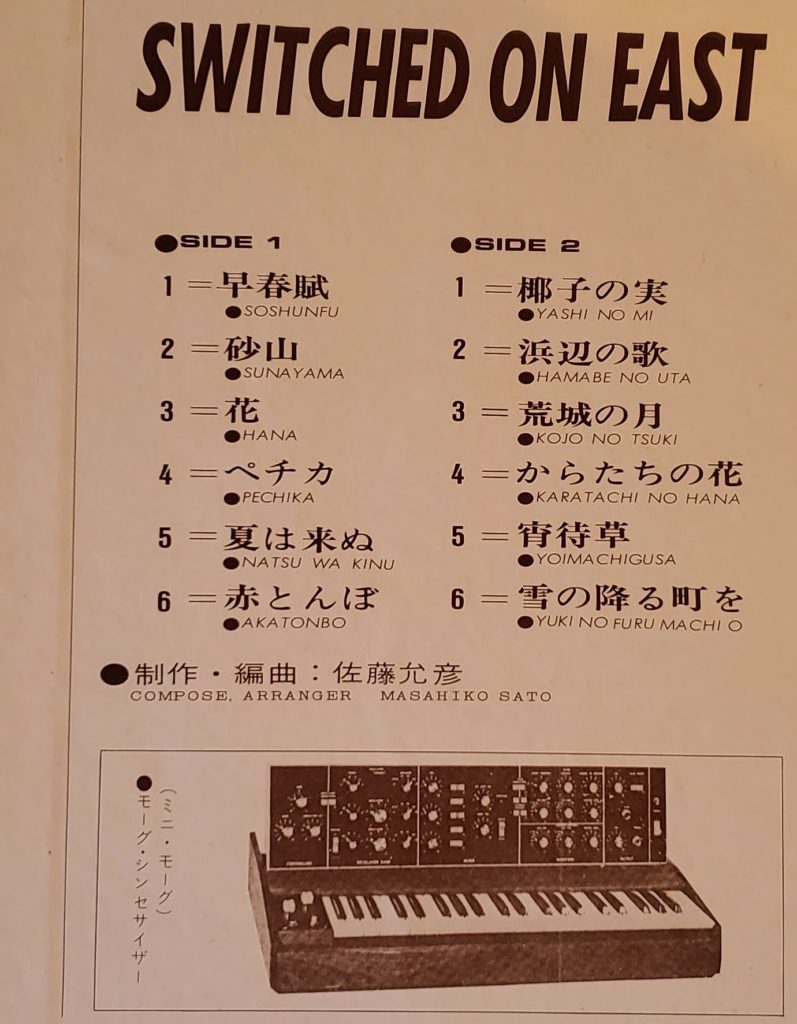
I have accumulated many (many many) Japanese synthesizer albums from the 1970s over the past few years. Finding out anything about any of these releases in English is often impossible. Many times I have to  enter these items into Discogs myself. Which is a real pain in the ass when the majority of the liner notes are in kanji. Thankfully, this one was already there.

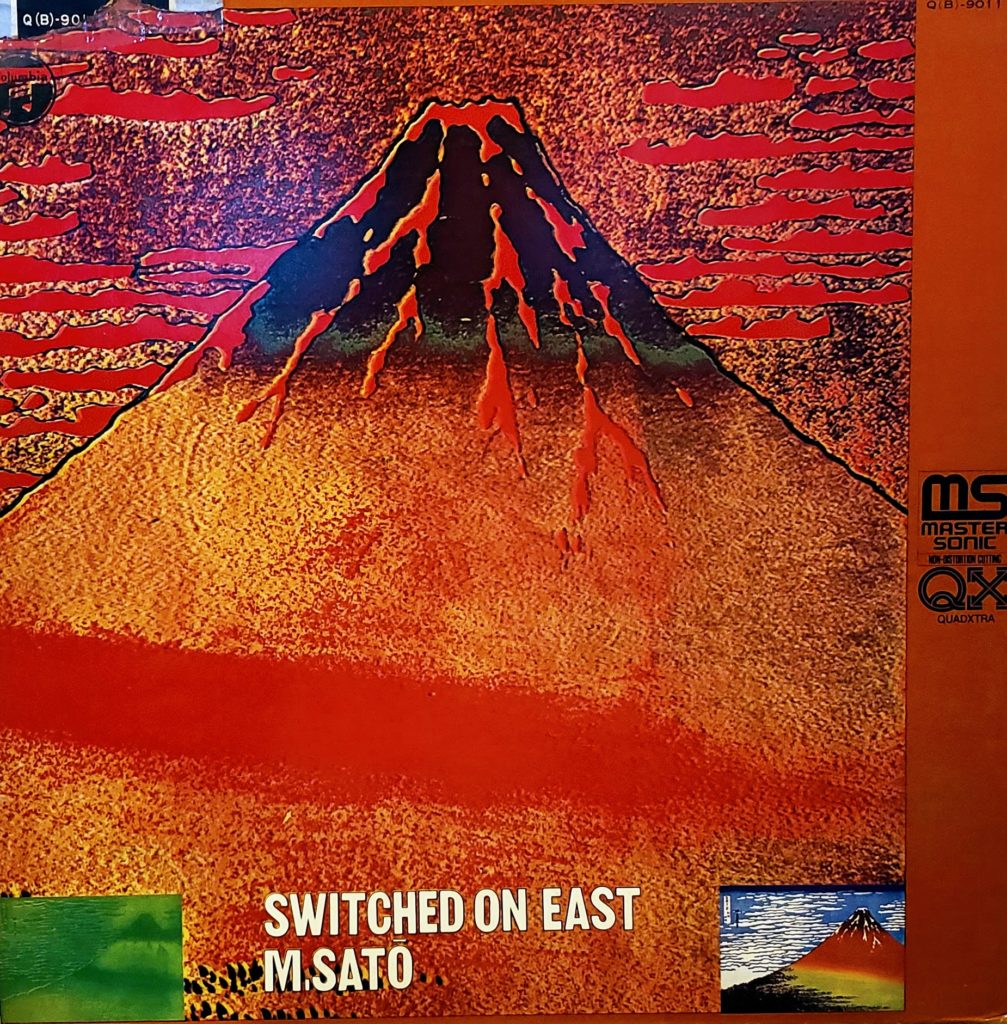
Switched-On East is the earliest example of a Japanese electronic/synthesizer album that I’ve come across. It was released by Denon Records in 1971. To the best of my knowledge, it never received a release in any other country, which makes sense. The album is comprised of nothing but covers of songs by Japanese composers. I’m going to guess that the international market for something like that was pretty slim at the time.

The album was arranged and performed on synthesizer by Masahiko Satoh, who for some reason chose to work under the name M Sato for this release. Satoh is a very prolific composer and jazz pianist in Japan, with dozens of albums to his name ranging from experimental electronic pieces like this, to more traditional jazz recordings. He gets around, I’ve ended up owning six albums that feature him, despite the fact that I’m not really into jazz. He shows up where you least expect him.

He’s the Spanish Inquisition of Japanese jazz pianists.

While Satoh is a brilliant composer and fantastic pianist, I don’t think that he really knew his way around a synthesizer in 1971. Or if he did, he wasn’t fully aware of how to properly take advantage of it in a studio environment. This is a very good record, but, like many similar albums that would be released in the 1970s, his interpretations of these tracks are a little bare bones when compared to the stuff that Wendy Carlos was doing at the same time. Carlos would put forth the effort to really layer her arrangements to make them sound as big and complex as possible. But that took a lot of time (and skill). Early synths were entirely monophonic. Anytime you hear layering or chorus effects, that means that the performer had to go back, record those parts separately, and edit them in later. In the days before digital editing software, that meant a lot of tape. It was probably a real pain in the ass. Carlos should be commended for her patience just as much as her technical ability.

I’m not familiar with most of these tunes outside of this album. I don’t know if Satoh took any major liberties with the source material or if they’re just 100% accurate arrangements that happened to be performed on a synthesizer. Regardless, I enjoy listening to them. They’re sparse, that’s for sure, but that gives many of them an almost ethereal quality. “Sunayama” is downright haunting. Others, like “Yashi No Mi” are bouncy and fun, and their minimal nature give them a video game music vibe, some 10 years before that was even a thing.

This album was never released on CD or digitally (as far as I can tell) and I don’t think that the record was pressed more than once. And from what I can gather, most of the ones that were pressed don’t sound good. Every auction I’ve come across for this record by someone who has actually listened to it seems to echo the same sentiment: “It looks perfect, but sounds a bit scratchy.”

I can certainly attest to that. Despite the fact that my copy looks flawless, and despite the fact that I’ve given it multiple cleanings, parts of it still sound a little scratchy. Since I’m a self-hating perfectionist, I usually don’t share my rips unless they’re near-perfect, but considering the rarity of this record I made an exception.

As I said before, I have a lot of records like this (seriously, it’s a problem). So expect more like them in the future. I hope to get some more complex write-ups done on some of the more interesting ones during my holiday break.

And if you like this, be sure to check out this post from a few months back, where I share something similar by Hideki Matsutake, a synth legend.


Listen to 1998’s remix of 1999 in 2019

Tuesday, December 3rd, 2019

Some news first. I plan on updating my ridiculously huge guide to Tokyo record stores in the coming month or so, with updated photos and added profiles of various stores that I recently discovered. I plan on making this new guide so big that I’ll probably end up breaking it into two parts; one a “best of” highlight reel, and the other a full-fledged “here’s everything” guide that will be well over 15,000 words. If anyone has any suggestions about what they would like to see in either, let me know.

Now, Prince.

Prince
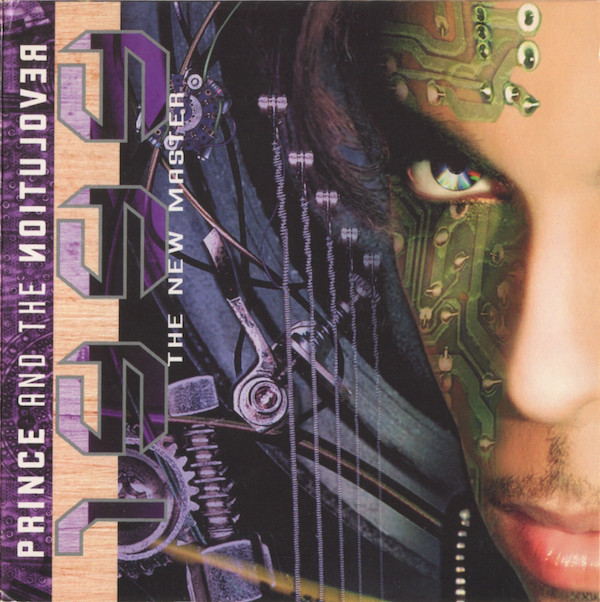
1999 (The New Master)
Rosario (1999)
1999 (The Inevitable Mix)
1999 (Keep Steppin’)
1999 (Rosie & Doug E. In A Deep House)
1999 (The New Master Edit)
1999 (Acapella)

The 1999 super deluxe box set is out and I highly recommend it, even though I haven’t been able to dive into everything that it has to offer. It is five CDs (and a DVD) after all. I haven’t touched much of the live content or archival remixes/edits all that much, I’ve been far more interested in the vault tracks, many of which are downright fantastic. The estate really did a good job with this one, populating those bonus discs with a good mix of legit, finished tracks that just didn’t make the cut; polished demos and raw takes that sound damn good; and a smattering of live cuts that show Prince playing around with his material on the fly in a fun and interesting way. Great shit all around. If you have any interest in Prince’s 80s output at all, it’s a must buy. I’m sure that the die-hard Prince bootleg collectors out there will find holes in it, and have their own “unreleased” material that they would prefer, but I’m not in that scene so I can remain happily ignorant of what I missed.

The above remixes were not included in the 1999 box set, although they really had no right to be. They were released in 1998 as an effort to capitalize on the literal 1999. These remixes arrived with a thundering thud when they came out, failing to make any substantial impact on the charts in damn near every country.

That makes sense on a few levels. The most obvious being that the world did not need a new version of “1999” in 1998, or in any year for that matter. “1999” is a near perfect song, no “new master,” remix, or any other attempt to rejigger or rework it for a modern audience would be a success, in my opinion. Remember that when “1999” first came out, there were no 12″ or dance remixes of it. The only alternate versions of the original track are radio edits. Prince knew he didn’t need to fuck with it then, he should’ve known not to fuck with it in 1998.

But I think that’s not the only reason why these mixes bombed. I think a lot of it has to do with the song itself. Think about the song “1999” in 1982, there could not be a song that was more in tune with the zeitgeist of the time, not only musically (synths galore) but musically (Ronnie’s gonna nuke the world). In 1999, there couldn’t not be a song more out of touch with the state of reality than the song “1999.” The Cold war was over, compared to the periods immediately before and following, the world was relatively at peace. America was in the middle of a ridiculous bubble economy. The internet was bringing us together in fun and exciting ways, as opposed to the sad and depressing ways it does now. Everybody loved the president. Apolitical was a thing you could be.

This showed in the music of the era. Look at the top songs of 1999, they’re dumb as rocks. The biggest song of that year was “Believe” by Cher. Sugar Ray was one of the biggest rock bands in the world. The closest thing to a song with a message reaching mainstream popularity was “Jumper” by Third Eye Blind.

Compare that to 1983 (when “1999” actually charted). Sure there’s a multitude of stupid shit there, but the number one song of the year was “Every Breath You Take” (which some read as a statement on nuclear proliferation) and there were other dark songs that managed to be big hits as well, like “Maniac,” “Dirty Laundry, and “Twilight Zone.” Yeah, these aren’t political or “serious” songs, but they have an edge to them. There wasn’t no edge or commentary in the popular music of 1999. That shit was polished to a happy sheen.

Of course, the pop hits of 1999 (and 1983) blow most pop hits of 2019 out of the water, since they actually have things like melodies, hooks, and emotions aside from “I’m sad about stuff.” Yowza what a shitty year for pop music this turned out to be. But that’s a whole other topic and I don’t want to write another 1,000 words that’ll just piss 20 year-olds off (I do that enough already).

Okay I got sidetracked. These mixes aren’t…well…they aren’t bad. Okay, a few of them are bad. Like, downright bad. About half of them aren’t even mixes of “1999.” “Rosario” is just Rosario Dawson rambling on for a minute or so, and a couple of other mixes are just excuses for Rosie and Doug E. Fresh to freestyle. But the main remix is actually pretty good, and the edited version is a good abbreviated version of that. The others are good enough, and are worth a listen just of out curiosity if nothing else.

Live Tracks, brought to you by Grizzly Beer

Monday, November 4th, 2019

Live Tracks #2
In the above zip, you get live performances of:
Duran Duran – Rio
Fleetwood Mac  – Hypnotized
Romantics – Talking In Your Sleep
The Who – Behind Blue Eyes
Yes – I’ve Seen All Good People
Steve Miller Band – Fly Like An Eagle

Plus beer commercials! Let me explain.

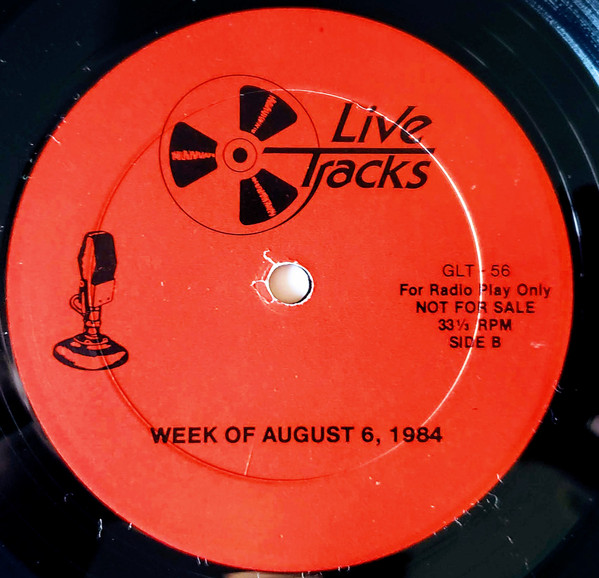
Syndicated radio shows pressed to vinyl for national distribution are something that I sadly do not know much about. They aren’t the kind of records that one tends to easily find in used record stores (especially in Japan). That’s because they were never intended for any kind of commercial release, especially on the second-hand market. When one of these makes it to a used record store or online, I always wonder how it got out into the wild. Maybe a radio station unloaded its vinyl library without bothering to sort out the promos? Or perhaps a DJ snagged a personal copy for their own private collection, and they ended up selling it years later? Or maybe someone just stole it and sold it for cash. Who knows? And who knows how this one made its way to a tiny store outside of Ikebukuro in Japan?

Live Tracks was a syndicated radio program produced by DIR Broadcasting, perhaps most famous for their King Biscuit Flower Hour show. While King Biscuit featured complete (or near-complete) live concerts, Live Tracks was more of a sampler, a bite-sized one-song radio program with a single cut from a live concert. I suspect that a lot of the performances on Live Tracks were just repackaged performances taken from DIR’s substantial back catalog of King Biscuit shows. The radio host on these episodes doesn’t really go exactly when and where the recordings were taken from. Sometimes he gives rough dates (the Duran Duran show was recorded in Madison Square Garden in 1984), but other times he just says something like “here’s an old one…” so pinning down exact information on the songs is tricky. Pinning down much of anything on this show was hard, this episode wasn’t even on Discogs until I added it.

The live tracks of Live Tracks are quite good, recorded professionally and mixed well. Some sound a bit raw, but they capture the energy of a concert well. Just as interesting to me, however, is the wrapping that each episode comes in. The Live Tracks records were complete radio shows on disc. The DJ didn’t have to do anything other than drop the needle and let the show play. The band introductions are handled by DIR’s own emcee, and the LP even has its own commercials included.

For the episodes included on this LP, the sponsor is Grizzly Beer, a long-gone Canadian beer brand who apparently had a penchant for horribly inappropriate commercials. One features comments about college kids drinking beer, another drops in some absolutely cringe-inducing Asian stereotypes, and one even makes jokes about minors getting drunk on Grizzly. Holy shit that wouldn’t fly today.

Since an episode of Live Tracks is really just one song, radio stations got a lot of bang for their buck with each LP. This one features six episodes, each with an intro by the emcee followed by a Grizzly Beer commercial, another bit by the emcee, a complete song performance, and an outro by the host.

Given the format of the show, I had a hard time figuring out how to share it here tonight. I thought about just feature the live cuts, but then you’d lose a lot of the flavor of the beer commercials (which are seriously great). Also, the live cuts often fade in and out with the host, so it would be jarring to not to include them. So, I just went ahead and made the entire thing one zip file, cutting up each episode into separate tracks. I figured y’all would be just as interested in the historical wrappings of the episodes as I was. For the most part, the recordings sound good. There are few crackles here and there, a tiny bit of distortion at the very end of the Steve Miller track, but as a whole, these are well-recorded performances on a damn clean slab of wax.

Enjoy, and if you find a bottle of Grizzly Beer, for God’s sake don’t drink it, that thing is probably 30 years old.


Japanese Ambient Chill Vibes with Dip In The Pool

Tuesday, October 15th, 2019

Dip In The Pool
Silence
Hinamari
Hasu no Enishi
Facing The Sea

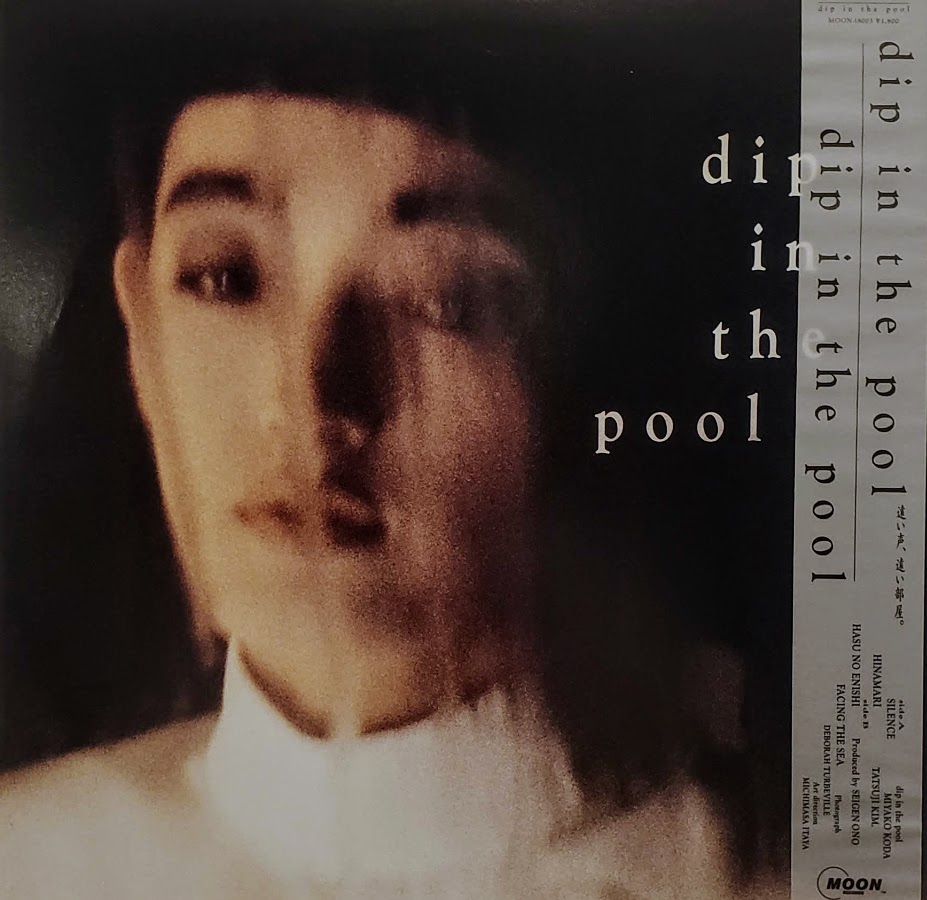
Dip In The Pool is a strange group. One that not many people have heard, yet conversely, many people have written about. They kind of got swept up in that whole “city pop” thing a few years back, despite not even being remotely connected to it. Later on, they were more accurately grouped as “Japanese ambient pop.” I don’t know if there are enough acts around for such a genre to be a proper thing, but the tag fits good enough. Dip In The Pool are chill. Super chill. And quiet. Super quiet. Dip In The Pool have their upbeat numbers and pop tracks for sure, but when they slow things down, they take things so minimal and ambient that they push the very definition of what a pop song can be.

Oh, and did I mention their fucking incredible? Because they’re fucking incredible.

Very few acts pull of “ethereal” quite like Dip In The Pool. I often compare them to Cocteau Twins. Their otherwordly charms and haunting vibe create an atmosphere that is simultaneously comforting and alien. Both relaxing and off-putting. This is almost entirely due to the incredible vocals of Miyako Koda. Yes, the sparse instrumentation does well to create that distant-yet-calming feel, but it’s really her voice that puts it all together. Simply put, its heart-crushingly beautiful. An aural sedative. Nothing, absolutely nothing, rips out my anxiety and throws it into a sonic wading pool of chamomile tea and lavender essence quite like Miyako Koda’s voice. It’s heaven.

Of course, nearly everything the band has ever released is out-of-print. Because of course it is. As of right now, only a handful of singles and remixes on for sale on iTunes. And Spotify only has a smattering of tracks and one album, none of which are their best. Dip In The Pool’s early work, all of which came out in the 80s, is just heaven on earth. And it’s a hell of a situation that we can’t listen to any of it easily.

I’ve been lucky and have been able to snag up quite a bit of their work since I moved to Japan, but even then it’s not easy. I got two albums only because they were re-released (on vinyl only for some reason). Everything else I got is vintage, and I paid accordingly for it. I’ve never even seen a CD of theirs for sale. Some can go for a quite a bit online.

The tracks I’m sharing tonight are some of my favorite by the group, and make up the entirety of their 1985 self-titled debut EP. All of these tracks would later on appear on the band’s 1988 debut album, which was released as Silence in the UK and was self-titled in Japan. Rough Trade actually released the album in the UK, and if it was their decision to name the album after “Silence,” I can totally see why. For me, it is the stand out tune by a group that has loads of them. Koda’s vocals (did I mention that I like them) are absolutely angelic here, and the complete absence of any real beat lets the song just float over you like a cloud.

After the brief interlude “Hinamari,” things kick up a notch with “Hasu No Enishi.” There are actual beats! It has a tempo! A lot of Dip In The Pool sounds like this, honestly. I’ve been focusing a lot on their more minimal and ambient side, but they had their share of upbeat numbers. Still, “upbeat” for Dip In The Pool is rather chill. Koda’s not Madonna, even on a track that has the tempo to qualify as a dance number, she’s still going to take her damn time and deliver a sedate, prolonged vocal that slows the whole thing down to her pace.

The EP closes with “Facing The Sea,” which splits the difference between the purely ethereal “Silence” and more beat-driven track that precedes it. There’s a pulsing beat here, but it’s little more than a click track, pushed back in the mix in exchange for some lovely synthesizer bells that work to match the melody put out by Koda. Again, it’s the kind of lovely, happy, pretty music that, after the reading the news or dealing with an exceptional bad day at work, is all I want to listen to.

Let’s chill.

Universal Energy’s Space Disco

Sunday, July 28th, 2019

Tonight’s post was supposed to go up last week, it was also originally going to be much longer. But while writing it, the post kind of became a whole other thing that was way off topic and much more about disco, disco’s legacy, and anti-disco sentiments, eventually becoming a whole separate piece over at my other blog (that I’m once again trying to get into the habit of updating more often). So if you want to read my thoughts on disco, disco demolition, and why the later was NOT a homophobic racist reactionary movement. Go check that out.

And if you want to hear some goofy disco while reading that, I got you covered here.


Universal Energy
Universal Energy
Space Energy
Disco Energy I
Christmas From Space
Disco Energy II

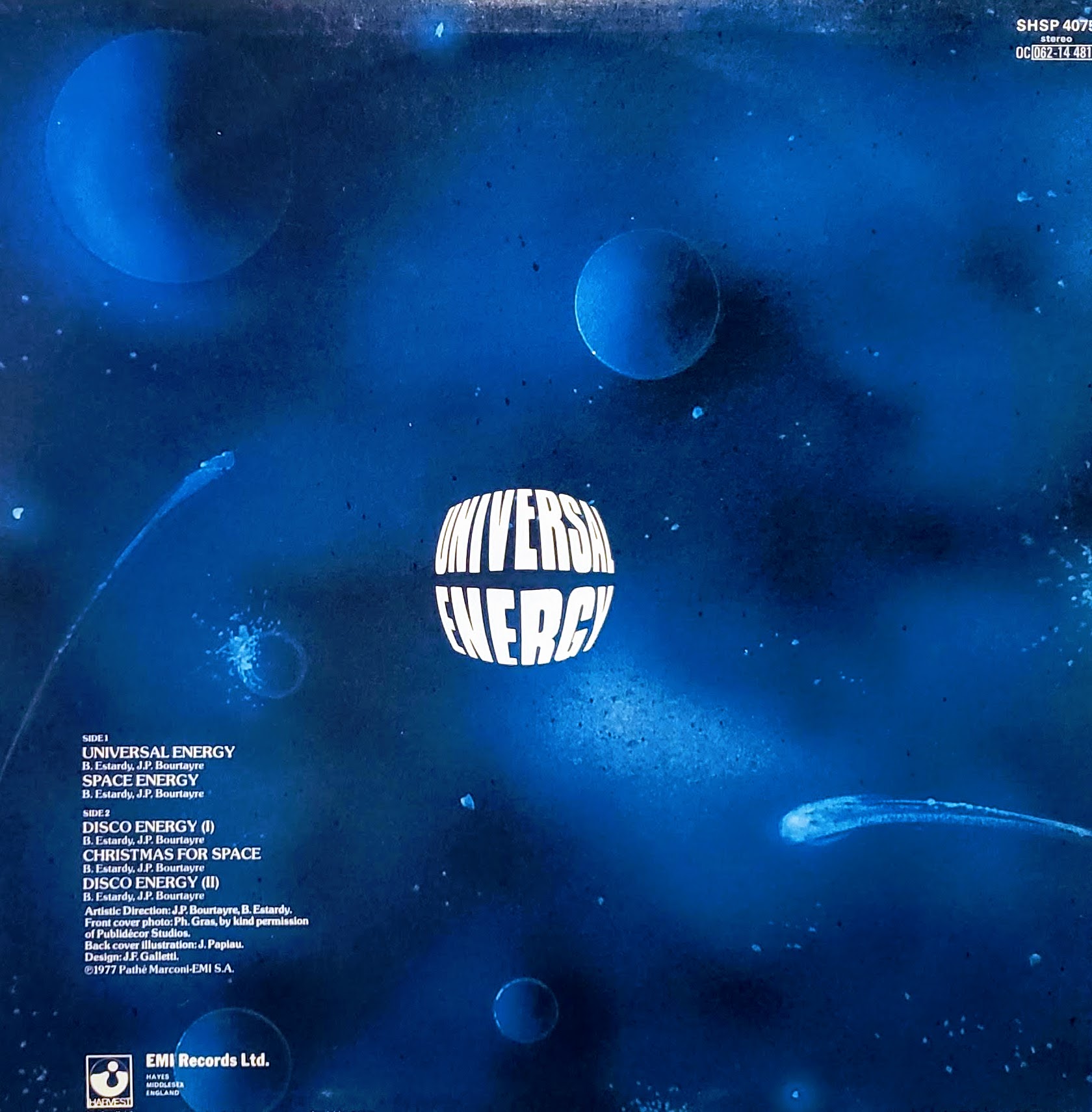
I don’t know much about Universal Energy. Okay, scratch that, I know next to nothing about Universal Energy, because no one knows much of anything about Universal Energy. The group was a collaboration between French composers Jean-Pierre Bourtayre and Bernard Estardy. Their sole self-titled release features just six tracks and is barely more than 30 minutes long, and that’s all they ever did together. Both did a ton of music outside Universal Energy though. Bourtayre is an acclaimed composer and songwriter in France, and Estardy would continue to release dance music under a variety of pseudonyms throughout his career, and worked behind-the-scenes for more acts than I can even count.

I know nothing of their other work, so I can’t speak of it. But Universal Energy is pretty fun. This is prime space disco; combining sci-fi themes and sounds with four-on-the-floor dance beats. Space disco wasn’t the most popular of disco sub-genres at the time. There weren’t many mainstream space disco hits. The only one I can think of is probably Meco’s disco remix of the Star Wars Theme, which is kind of cheating. And actually, I really wouldn’t even call that space disco. Sure, the subject matter is literally space, but there’s nothing “spacey” about the song’s sound aside from the fact that it’s the Star Wars Theme.

A lot of Moroder’s work has been classified as space disco (at least on the subpar space disco wikipedia page it has been) and I don’t know if I agree with that either. Morder’s best disco was almost entirely electronic, obviously, but most of it didn’t really incorporate sci-fi themes or sounds. “The Chase” and “I Feel Love” certainly didn’t. His reworking of theme to Battlestar Galactica did, but again, that’s cheating.

If anyone knows any other space disco (not including disco by the group Space, I have all that), let me know in the comments. I want to hear more of this stuff. I would preferably like music from the 70s, but newer stuff that falls under the space disco moniker would be dope too.

Enjoy the intergalactic grooves. I hope to get a few more posts out in the next couple of weeks. I’m off to the states in the middle of August. If history is any indication, it’ll be hard for me to get more than a post or two online during the month I’ll be away. Family obligations (and alcohol obligations that come after them) usually limit my writing output when I’m in the states.

Enka Electronics by Hideki Matsutake

Sunday, July 14th, 2019

Tonight’s album is one of the most mysterious that I’ve ever shared.

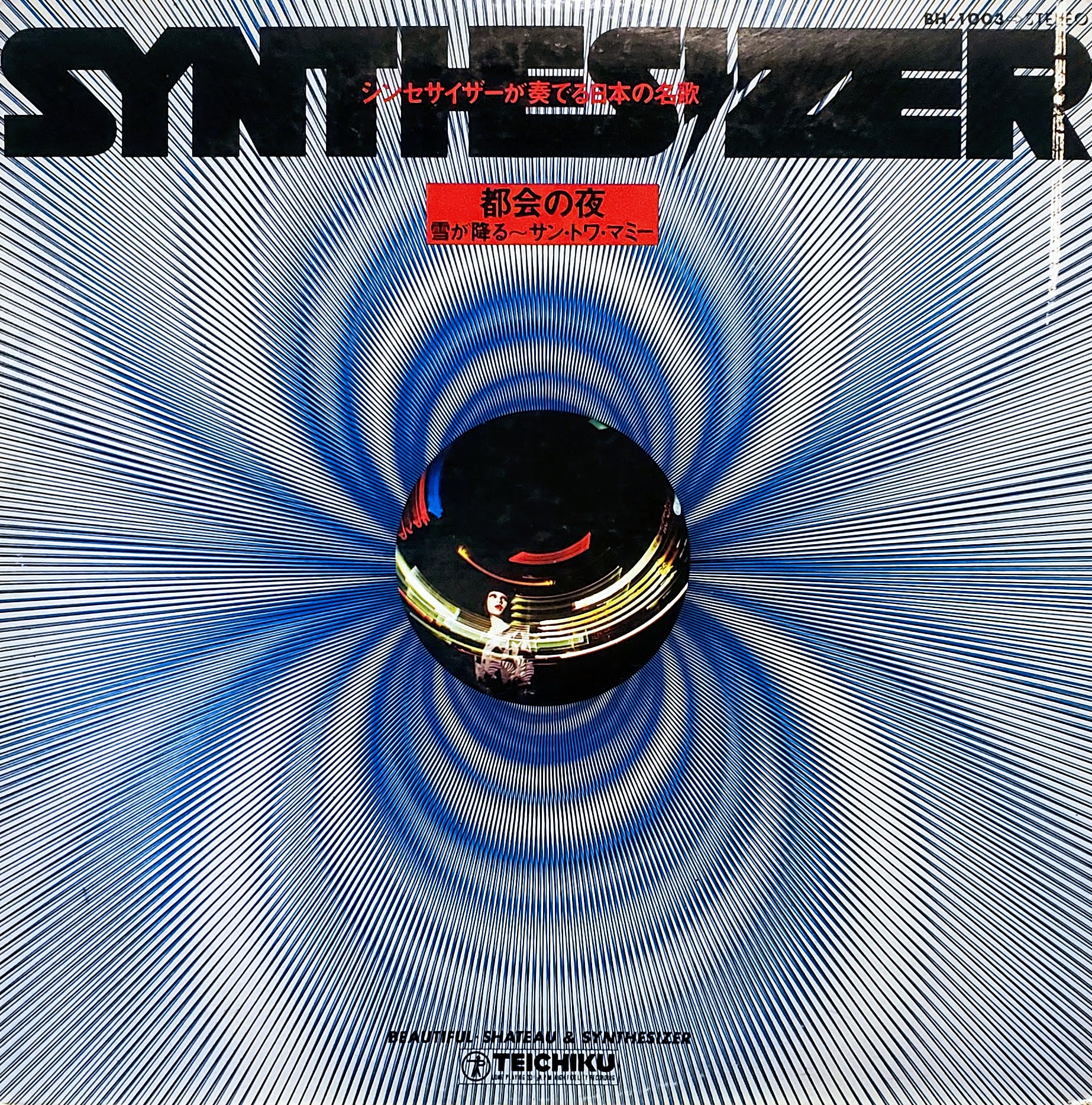
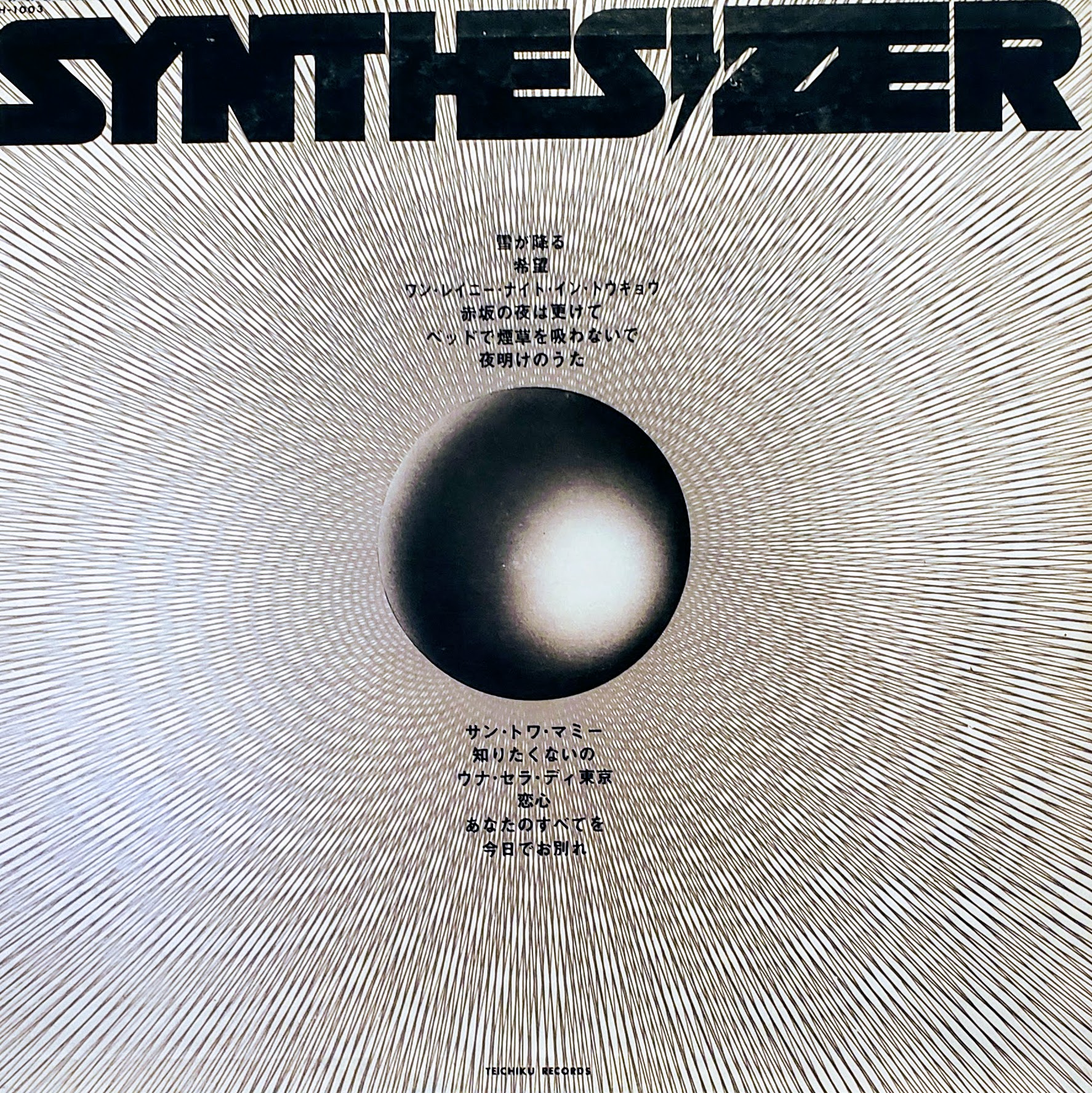
Synthesizer ga Kanaderu Nihon no Meika (complete album download)

Hell of a cover, right? A lot going on there, typeface wise. It was even a struggle for me to figure out the proper title of it at first. But I think my boyfriend and I figured it out. Best we can figure, the name of this record is シンセサイザーが奏でる日本の名歌. That’s pronounced as “Synthesizer ga Kanaderu Nihon no Meika” and translates to “The Greatest Japanese Songs on Synthesizer.”

For the makers of this album (more on them in a bit) “greatest Japanese songs” meant “popular ballads and folk music, mostly from the 1960s.” A lot of the songs here were originally enka tunes. Enka is a bit hard to describe, there really isn’t an analog to it in Western culture. Basically it’s music for your grandparents, sentimental slow-moving ballads without a hint of that newfangled rock and roll the kids go on about. Imagine if someone combined easy listening, folk music, and American standards into one genre, that would be enka. It’s Barry Manilow meets Celine Deon with a hint of Perry Cuomo

I’m not going to be as bold as to say that its uniformly bad, but it’s not for me. I am not that music’s target market. I will refrain from critical comment. I must also refrain as to the accuracy of these interpretations. Maybe they’re as faithful as all-synthesizers cover can be. Maybe they’re radical re-workings that remake the songs entirely (I doubt that). I just don’t know.

Judging them solely on their synthesized versions though, they’re not bad. There are some good melodies here. I dig “One Rainy Night In Tokyo” quite a bit, it has a good groove. “Una Sera Di Tokyo” isn’t half bad either, with a playful yet melancholy sound. The person behind this album sure knew what they were doing when they put it together. All of the songs, even the ones where I can tell the source material ain’t all that, sound good. Excellent choices regarding audio effects and production all around.

So who the hell did this?

The credited artist on the cover is “Beautiful Shateau & Synthesizer.” I assume they meant “Chateau” but that’s what happens when you rely on katakana pronunciation to spell something. Trust me, I know. This is an English teacher in Japan you’re talking to.

A quick web search on them brings up next to nothing. There’s one incredibly crackly YouTube video of a single track from this album, a Discogs page, and the occasional online auction listing. All are pretty sparse in terms of information.

Even their discogs page is a mess. It didn’t even have this album on it (I added it last week). However, the pages for the two albums it did have credit Hideki Matsutake as a “synthesizer conductor.” That didn’t surprise me one bit. I actually suspected these records were of his creation the moment I first listened to them.

I’ve mentioned Matsutake here a few times in the past. He played some synthesizers and sequencers on some of YMO’s albums, and he also released plenty of music as a solo artist under the name Logic System. I think he’s a genius and one of the greatest electronic musicians of all time.

I met him once.

I’m a fan.

He’d be the Wendy Carlos of Japan if Tomita wasn’t already the Wendy Carlos of Japan. He is an incredibly early pioneer of electronic music and deserves far more recognition than he has. Dude is epic. Check out anything he put out, or was even associated with, from the early-70s to mid-80s and just prepare to have your mind blown. He was leap years ahead of his time with the kind of stuff he was pulling off with even the most basic tools.

I imagine that this record, and the others that he put out as “Beautiful Shateau & Synthesizer” have to be some of of his earliest releases. They’re definitely pre-YMO, with their ultra-minimal, definitely monophonic synthesizer sound. However, I can’t confirm this100% because, and here’s the crazy thing, none of the “Shateau” records have any kind of copyright or release date information on them at all. Nothing. Nada. Zip. Zilch. And if you know anything about Japanese albums, that’s pretty odd. Many of them label their release date down to the day. For these records to not even have a basic copyright date is just bizarre. And I know it’s not just my copies missing this information. Everywhere I look, whenever I can turn up anything about these albums, the year is always blank or listed as “unknown.”

They’re records outside of time. Creepy.

This one certainly falls under the “not for everyone” camp, and I know this. I’m not going to complain if you don’t like this (but don’t be a dick and comment about how much you don’t like it, okay?) but I thought that this had to be shared for a few reasons. First of all, it’s probably one of, if not the, earliest release by a true innovator of electronic music. If for nothing else, this deserves to be archived and shared for that alone. Additionally, while I’m an alien to the source material, I still find the versions on this album entertaining and worth a listen. The soothing melodies combined with the harsh synthesizer tunes make it sound like easy listening music from another planet or something. It’s groovy stuff. Beck would sample this shit if he knew about it.

Unfortunately, whoever owned this album before me really fucking loved it and played the shit out of it. Or they hated it and used it as sandpaper. Either way, it’s banged up pretty bad. I did my best to give a good digital polish with scratch and noise removal software, but there’s only so much I can do with an all-synthesizer record like this. The software that removes cracks, crackles and whatnot often picks up the harsh, peaking sounds of an early synthesizer as noise, and tries to remove them too. I’ve done my best to clean this up, but it’s a bit more scratchy than my usual rips and for that I apologize. I do plan on sharing more of the “Shateau” albums in the future, and while the other ones don’t sound great, they all sound better than this one.

Hope you don’t mind the scratches too much, and hope you enjoy some ultra-rare ultra-early ultra-awesome electronic music by an ultra-legend of the industry.

Bleachers – Terrible Thrills Vol. 3 #4 (High Quality Vinyl Rips)

Monday, June 24th, 2019

Bleachers
Foreign Girls (featuring Ani DiFranco)
And, Nothing Is You
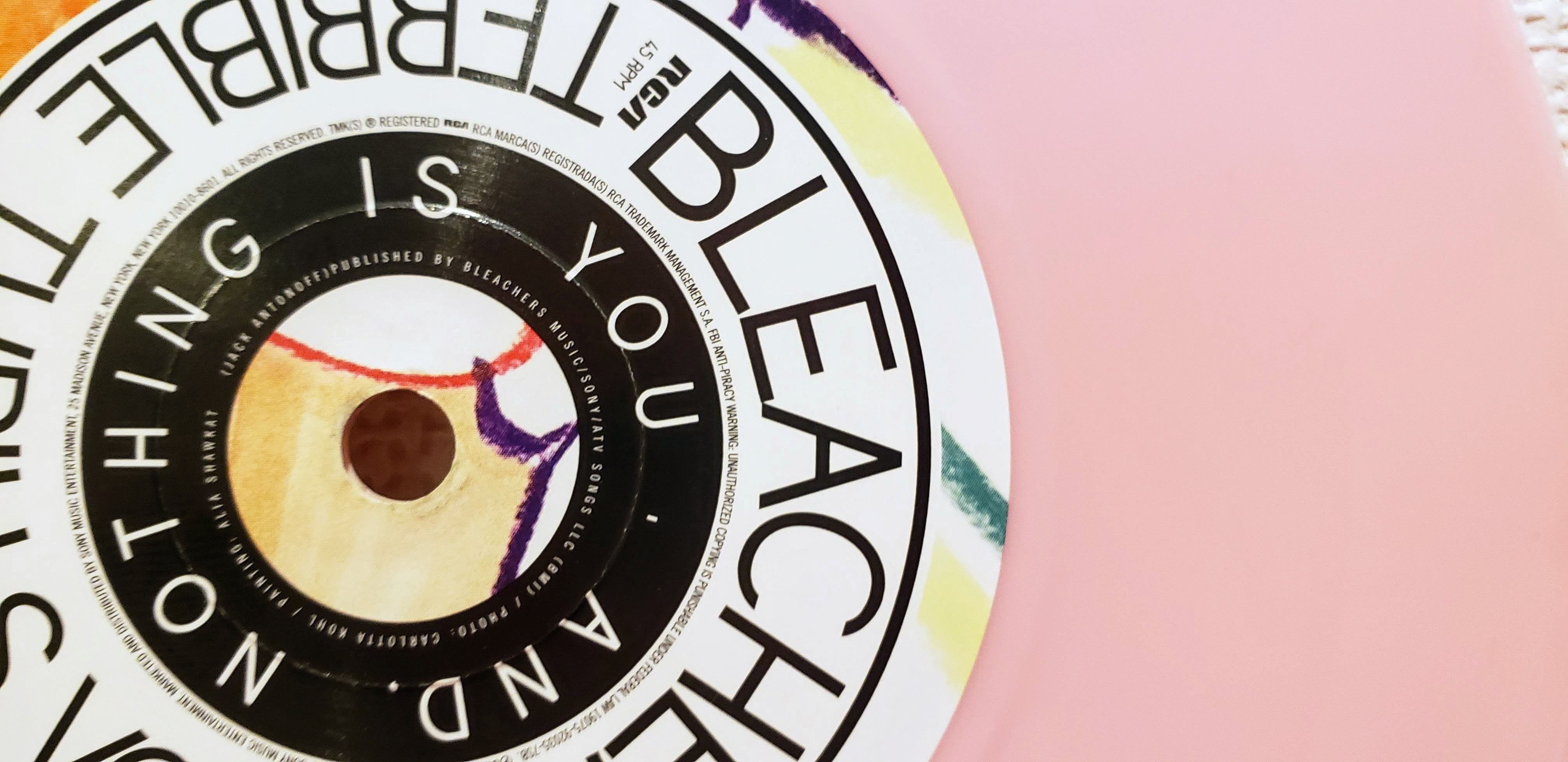
And here we are, the final chapter of Bleachers’ Terrible Thrills Vol. 3. This one brings us a reworking of “Foreign Girls” that features folk rock legend Ani DiFranco, as well as “And, Nothing Is You”  which is a remix of “Nothing Is U” that removes most of the electronic effects from the original and replaces them with more acoustic orchestrations.  Both of these new versions feel like more low-key, intimate versions of the originals. While the album versions both started quiet but then built themselves up to grandiose, bombastic finales, these versions both stay sedate for their entirety. I don’t think either surpass the originals (I like my bombastic pop songs) but they’re still great, and DiFranco’s contributions to the new version of “Foreign Girls” are fantastic.

Like before, I have cleaned these up digitally to remove as many imperfections, scratches and other issues as possible. I also gave both a slight loudness boost. If you load the first track into an audio editor, you’ll notice that the very top of the waveform at the loudest part is clipped off just a little bit, but I can’t imagine that it’s clipped to a degree where anyone could hear a problem with it. If anyone does pick up any audio problems with these though, please let me know and I’ll do my best to fix them. I think they came out pretty great.

As fun and exciting as Terrible Thrills Vol. 3 has been, if Jack decides to do this again for his next album, I hope he forgoes the “record club” format for something a bit more accessible. As I mentioned last time, I had to delay uploading the second volume for nearly a month because my copy came to me completely scratched. That’s not fun. I get the appeal of something like this; it gives the music an emotional value that you don’t get from a stream or digital-only copy. But vinyl is intrinsically an unkind format that is easily damaged and incredibly inconvenient. And while it’s (relatively) easy for me to rip vinyl cuts to a digital format so I can rock them on my MP3 player, not everyone is so lucky. Music should be easy to listen to, don’t you think so? At least the cuts were on standard records that preserved the recording quality relatively well, and Jack didn’t go the Joyful Noise route, saving exclusive cuts for shitty flexi-discs or other novelty formats (seriously, fuck that label).

Anyways Jack, if you’re reading this, maybe for the next series you could try bringing back CDs, the most underrated of formats. It’s only a matter of time before CD nostalgia kicks in, might as well get ahead of the curve!

Just don’t put it on tape. If you put it on tape I swear to god…

So yeah, enjoy the rips everyone! And if you missed the earlier releases in the series, you can find part one here, and parts two and three here!