Holy shit, this blog turned 20 years old this month!
I don’t even know where to begin. My life has changed so much since I first launched this site in 2006. Let’s not even mention how much our nightmare world has changed over that same period of time (I want to keep this positive).
Despite the world being a hellscape, I think that my life has gotten considerably better in the two decades since I first hit “publish” on my very first blog post. I don’t need to go over the litany of ways that my life has changed during that time, do I? I went back to college, got a second (useless) degree, bought a house in Pittsburgh, sold said house in Pittsburgh, moved across the world to Japan, got a boyfriend (who I’m still with, by the way), came out of the closet, and so on and so forth.
I also like to think that I’ve become a considerably better person since starting this site. A lot of my old posts are fucking cringe to me now. I was a borderline edgelord shithead when I started this site in my mid-20s. When I look at right-wing shitheads outline, reactionary sexist gamers, and other assorted pieces of shit across the wastelands of the web, I often think “there but for the grace of several very influential friends go I.” Thanks to commenters back in the day who called me out for my bullshit, you made me a better person.
As I look back on this thing, it’s really clear to me that this blog has three, very distinct eras. First, the early years, when I was posting like crazy, multiple times a week, often focusing on then out-of-print and hard-to-find 80s music. The writing is sloppy, with a lot of ranting and raving about random bullshit. Big time morning DJ vibes. Not a fan.
Then there’s the middle-era, covering the tail-end of my time in the states up to when I first moved to Japan. While a lot of people appreciate and love the early years of my blog, it’s this mid-period that I’m most proud of. I think my writing got better and I started covering a more diverse selection of music around that time. It’s also about the time when everyone stopped going to websites and my readership fell off a cliff, but whatever.
Finally, there’s the current era of Lost Turntable, the “I barely have time to write about anything” era, also known as the “one post a year, usually in December, hurriedly written so I can keep the streak of writing something at least once a year” era. Although I did manage four posts last year!
Yeah, I’m not too fond of this era either. As I’ve said before, it’s just hard to find the time to write these days, between my job, social life, having a boyfriend, and my not-so-great health. Also, it’s harder than ever to find interesting music to share that’s legitimately out-of-print that won’t get my ass sued. My YouTube copyright nightmare from a few years back really scared me away from sharing a lot of major releases by mainstream artists, if you hadn’t already noticed.
I’ve said in recent years that I really do want to get in the habit of writing more. And I still mean that. And I really think that this will be the year that I finally get to…once I finally ditch the idea of this being solely an MP3 blog.
Hey, it had a good run, but it’s just stifling at this point. I want to write more about movies, new music, my life, living in Tokyo, all kinds of stuff. I’ll still share out-of-print music when I can, but it’s going to have to be incredibly rare or obscure at this point, like what I have for you today.
One thing I can say, when I do get back to writing here more often, I can promise you that it will be 100% AI free content, which is a hell of a lot more than you can say about that other vinyl ripping MP3 blog that still exists (and asks for money). I can promise you that I will never use AI for literally anything that appears on this website. The writing will always be 100% human written, warts and all. And if I ever get around to actually updating the tech behind this site, and the graphics along with it, they’ll all be human creations too (although probably not mine, my graphic editing and website creation abilities are firmly stuck in 2006, I’ll pay someone else to do it).
Anyway, wanna download some weird-as-shit MP3s? Sure you do!
I’ve never done a multi-album post before. Let’s cover these in chronological order.
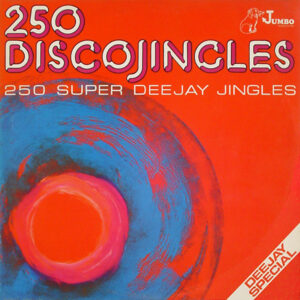
250 Discojngles (right-click to download)
The boyfriend and I don’t do much YouTube, but one of our favorite channels on is Reely Interesting, which is kind of like the video version of this blog – sharing rare and hard-to-find media. Sometimes they share things like rare HD versions of music videos and live concerts, which can be amazing. Check out their rip of Peter Gabriel’s Kiss The Frog video, you’ve never seen mid-90s CGI look so good.
Recently, they shared a really curious find, an HD tape from 1994 of what was either b-roll or test footage recorded for reasons unknown. I suspect it was recorded by Sony to test out their then-new HD cameras.
Stuff like this fascinates the hell out of me. It was something done by an industry professional, most likely to show other industry professionals. But it somehow sneaked out, and we can watch now on YouTube, devoid of any of its original context. Sure, most of it is just Japanese men working in a TV studio, but it has an aura of mystery around it, since any information about where it came from or why it was recorded has been lost.
That’s kind of how I feel about the records I’m sharing tonight. These are all collections of pre-recorded radio jingles, which were made for radio stations to use. They weren’t supposed to end up in stores. And if you told someone who worked on these records that, 40+ years later, they’d be on the internet for anyone to hear they’d be like “what the fuck is the internet and who the hell are you?”
First up, 250 Discojingels.
According to Discogs (which is also where I took the art, as I can’t find my copy of this record right now), this was released in 1977 by Jumbo Records & Tapes. This was a label that was dedicated to releasing material for offshore pirate radio stations. They were one of many labels that did this, it was a whole thing, and there’s even a website dedicated to it if you want to learn even more about it. I think some of these other records might also be for pirate radio stations.
250 Discojingles was one of several jingle collections that Jumbo Records & Tapes put out, and it’s by far the most famous. Content from this collection was later used in a break and beats compilation, which was then sampled for 2 Unlimited’s all-time house classic “Get Ready for This,” which is fucking crazy. To be honest, I can’t find it on the record itself. It’s so short and goes by so fast. Someone made a YouTube video with some clips from this record and you can find it there at about the one minute and 18 second mark. If you can find it on my MP3 rip, please tell me!
The jingles on this are VERY 1970s. Most are just five second (or less) snippets of various ways to say “more music!” or “number one!” but there are also odd little musical interludes, sound effects, and even some absolutely horrible jokes. According to whosampled.com, in addition to 2 Unlimited, this record has been sampled six other artists, including Freddie Goddamn Mercury (on a remix) but I bet there are even more records out there that have cribbed from this one, it has a lot of good bits.

Jingels From USA (right-click to download)
This one is a bit more obscure. Again, using Discogs as a source (and again for the art, because I can’t find this record in my collection at the moment, either), I know that this was first released in 1981 by a Belgium label called USA Import Music, it was then re-released several times throughout the decade by other labels, all of which were based in Europe. So I have no idea why it’s called “Jingels from USA” as it’s clearly from the EU (as if the “jingels” spelling wasn’t big enough a tip-off. This is volume one, by the way, this was part of a series. I might pick up the other ones and share them here at some point.
I can’t imagine that any radio station in the states ever used these “jingels.” While this was released in the 80s, most of it has an amazing mid-70s feel to it, and all the voices are incredibly European, with some even speaking very obviously broken, bad, English with a thick accent that I cannot identify (maybe Dutch)? It also sounds really disco at times. Disco was on its last legs in the states by 1981, but it never died in Europe, it just gradually morphed into house music and a billion other sub-genres. There is some 80s-esque stuff here too though, robot voices, random synths, things like that
I like this one more than 250 Discojingles, just because it’s so fucking weird. Was this intended for offshore radio too? If so, where? No one in the UK or US would be fooled into thinking these were from native English speakers. Maybe pirate radio stations in the Netherlands grabbed onto this one. Who knows? Do you know? Tell me if you know! I want to know!
Oh, and while this technically has no credited artist, I left the artist as Charles Fonderson because he was credited as “concept by” in the liner notes. Finally, while no house classics seemed to have sampled this one, the cover art was by Patrick Gypen, who did design the original cover art for Technotronic’s “Pump Up The Jam,” so there’s that.
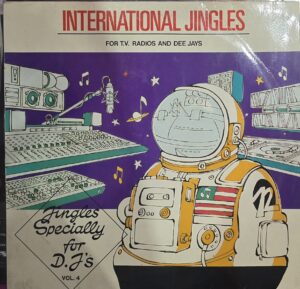
International Jingles For TV Radios and Dee Jays (right-click to download)
Of these three, this is my favorite. Firstly, that cover. That cover is amazing. An American astronaut man is here to deliver you specially made jingles!
It also sounds most like the radio that I grew up with. This came out in 1986, and while I’m sure some of these are recycled from older jingle compilations, it definitely has a stronger “80s vibe” than Jingels from the USA, and lacks any of the 70s cheese that 250 Discojingles is full of. The “Top 40” jingle, for example (the 10th track on side one) 100% sounds like something that the shit Top 40 station in Toledo, Ohio would have played when I was a kid.
I also like it because it’s kind of a hot mess. While 250 Discojingles and Jingels From USA throw you jingles at a non-stop, almost breakneck pace, this one gives you breaks between each jingle and even goes through the hassle of numbering all of them. But the numbering is wrong sometimes? And sometimes the man announcing the numbers stutters and stops, but they just decided “fuck it” and left those verbal blunders on the disc. Brilliant.
Also, some of these are just comically horrible. I’m sorry, Yannick Chevalier, Discogs tells me that you recorded a lot these compilations, but maybe you should have focused on quality over quality. “The Best Music In the City (Long Cut), which is the 15th jingle on side A, goes like this.
“The best music in the city! We got the B, we got the E, we got the S and the T!”
What the fuck does that even mean!? That’s not how acronyms or abbreviations work, Yannick. C’mon man.
I hope you all enjoy these weird audio oddities. I’ll probably be sharing more stuff like this in the future, but don’t worry, I still have some musical posts up my sleeve as well, in addition to the other plans I have in store for this place.
For the few of you who have stuck with me for these two decades, thanks! I’m not promising 20 more years of Lost Turntable, but I’ll do my best to keep this place going as long as my fingers can still type.