Archive for the ‘Hideki Matsutake’ Category

Pop Memories on Moog III – More Vintage Japanese Synths

Tuesday, July 14th, 2026

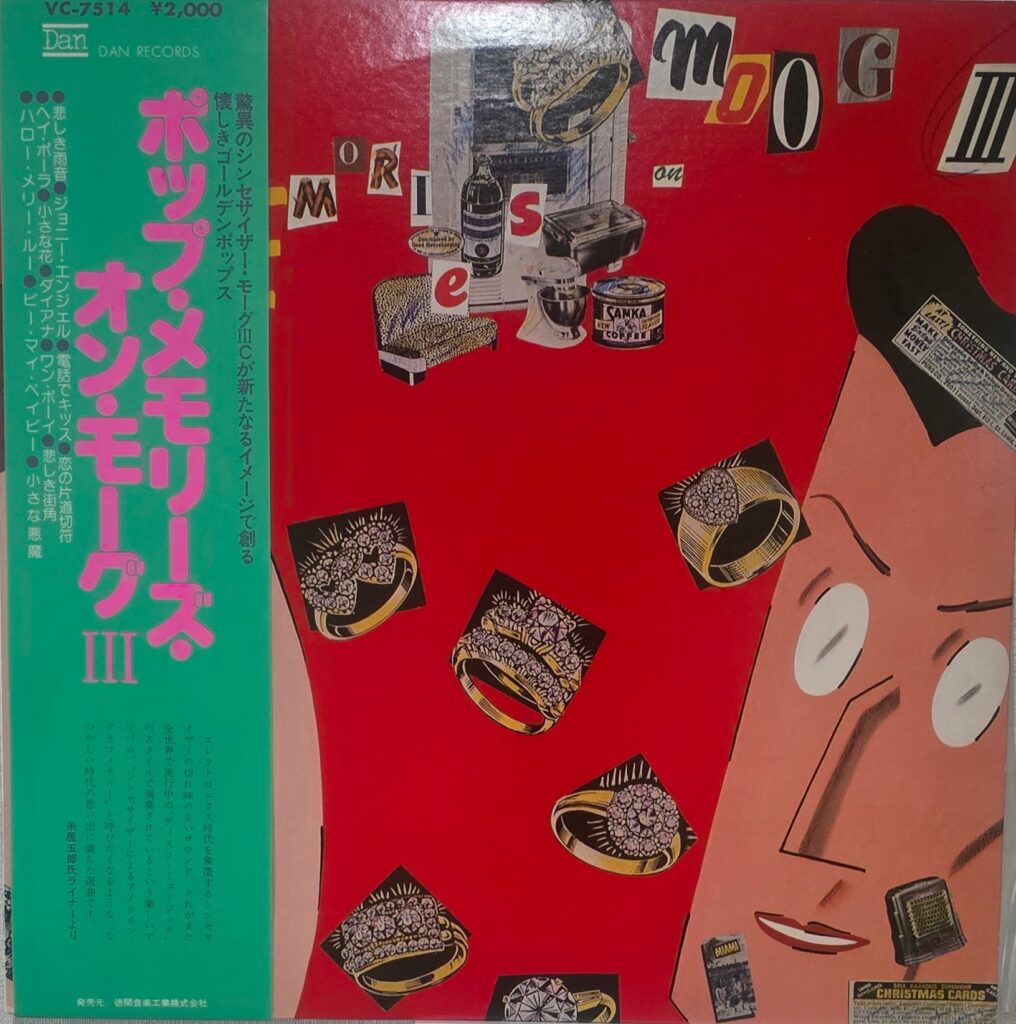
Pop Memories on Moog III (Complete Album Download – Click Here)

I’m back with a new post!

Yes, it’s another complete album download of an obscure Japanese synthesizer covers album from the late 70s.

But this time it’s in FLAC!

To be honest, I really don’t see the big deal about FLAC and hi-resolution audio formats. Our human ears can only pick up so much. Even more to the point, my human ears can only pick up so much. You play me a better-than-CD-quality 32-bit whatever FLAC file and then play me a 256 kbps MP3 of the same track, I’m probably not going to be able to tell the difference.

That being said, a lot of the vinyl rips I plan on sharing from this point on are very obscure, and in some cases I assume high-quality rips of them simply do not exist on the internet. Maybe they do on secret darkweb torrent sites dedicated to out-of-print Moog covers albums, but I don’t have an invite to any of those, so I don’t know. If you do have invites to those sites, yo, I’m on Bluesky.

Tonight’s Moog covers album is Pop Memories On Moog III. Now, if you’re asking, “why is he starting with number three?” The answer is “because volumes one and two don’t exist.”

At least, I can’t find any evidence of them online. Maybe they’re so obscure that they’ve just become completely lost to time, but I don’t think that’s the case. I actually think this album has a roman numeral three on it because it was the third Moog covers album released by Tsuneaki Tone, an artist who I’ve covered on my blog before. In 1976, he released All Of Synthesizer Vol. 1, following it up later in the same year with Cross Over Synthesizer, which had the subtitle All Over Synthesizer Vol. 2 (and the additional subtitle “Listening and Dancing”). I have a copy of Cross Over Synthesizer that’s in very good shape, I’ll probably share that soon. My copy of All Of Synthesizer is pretty beat up, I’ll have to see if my new vinyl restoration software can fix it up before I put it online. Vinyl restoration software often has a hard time fixing old Moog albums, too many square waves, I guess.

Anyways, this third album also came out in 1976, and apparently Tone decided to ditch the All of/over Synthesizer branding for Pop Memories On Moog, but the albums are clearly a series. And now that I think of it, I probably have those other two albums buried somewhere in my apartment, and I’ll get around to sharing them too, someday. I hope.

I don’t know much about Tone (which is probably pronounced to-nay). If the IMDb is to be believed, he composed the soundtrack to a 1973 documentary called Iwo Jima, and according to Discogs he also had a career working as a session musician for other artists in the 1970s. He has an arrangement credit on an album by Akiko Wada, who was a pretty notable singer in Japan in the 1970s. He also worked with Kazumi Watanabe, who was Yellow Magic Orchestra’s first touring guitar player. But Tone didn’t seem to work much after the 1970s. I don’t know if he passed away, retired, or simply moved onto other things.

However, Tone isn’t the only credited artist on this album. While his first two synth albums were solo affairs, for this album he was joined by one Hideki Matsutake! Long-time readers of this blog should know who he is, as he programmed the synths and sequencers on the first few YMO albums! I met him! He’s nice!

This is not Matsutake’s first work on a major label release. He’s credited as a synthesizer player on the 1975 album Time Paradox by Hiroki Tamaki & SMT, but this is his first release as a credited artist, and not just a session musician. Later in the same year, he would release an album under the name Beautiful Chateau & Synthesizer (which you can find here), and then he would release the electronic ambient masterpiece Edo in 1977, working with fellow synth player Masashi Komatsubara and shamisen player Chojuro Imafuji. That album’s amazing! From there, he would start to release his own solo albums, collaborate with a few other artists, and then work with YMO.

But this is where it all began! A vital, important release in the history of Japanese electronic music!
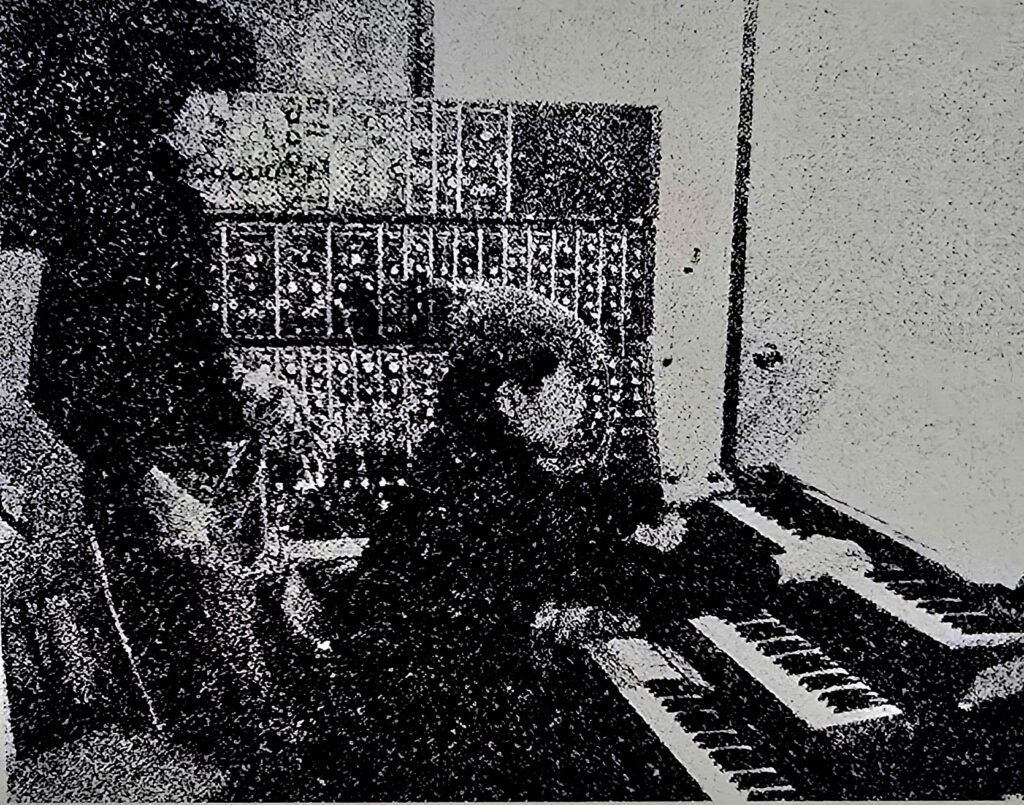
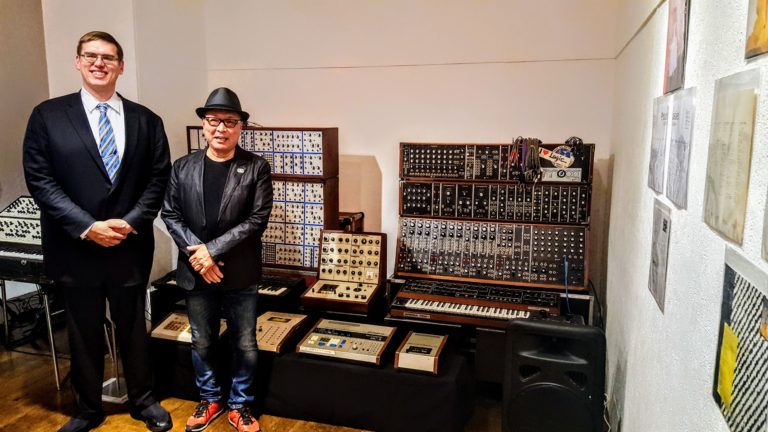
Hideki Matsutake and Tsuneaki Tone, bro-ing out with a mountain of synths. Taken from the back cover of the album.

But is it any good?

Well, I like it. But these are all covers of music from a very specific era. It is very cheesy. Cheesy covers of cheesy tunes. The Japanese liner notes refer to this being a release “full of nostalgic memories,” so that means that nearly all the songs here are pre-Beatles era rock and pop music. I’ll run them down track-by-track.

A1: Rhythm Of The Rain
Originally by The Cascades, a vocal group from the early 60s. They are a one-hit wonder. This is the hit. If you’re over the age of 40, you will recognize the melody. This is a nice version.

A2: Johnny Angel
This was recorded by a few people, but Shelley Fabares made it a hit in 1961. If you google it you’ll recognize it and probably hate it. I hate it. When people talk about how pop music hit a nadir in the post Buddy Holly, pre-Beatles era, this is the kind of shit they were talking about, in my opinion. One of many songs on here that actually benefit from the synth treatment, at least it gives the song some character.

A3: Kissin’ On the Phone 
This is a Paul Anka song, and it’s not the last you’ll see on this album. I don’t think this was a hit in the states. But it apparently was a hit in Japan, so much so that it has a Japanese wikipedia page. I find the melody of this song grating, no matter how it’s performed. And the telephone ringing sounds don’t help. Probably the weakest number on the record. At least it doesn’t have Paul Anka’s gross kissing songs. I can’t believe Paul Anka released a song that was basically about getting a boner with his girlfriend when he talked to her on the phone and society let him keep making records.

A4: One Way Ticket (To The Blues)
What I said about “Johnny Angel” goes double for Neil Sedaka. Sorry, Neil. Although I guess “Love Will Keep Us Together” is kind of a jam if you’re the right level of drunk. This version does kind of slap? There’s a whistle effect that’s very reminiscent of Morricone, and I like the synth train sounds.

A5: Hey Paula
Another example of me enjoying this synth cover a thousand times more than the original. This is also from 1962. If you recall, that’s when American Graffiti is set. And if you also recall, that movie has the line “Rock and roll’s been going downhill ever since Buddy Holly died” and, man, that dude was right. Sometime I think we have to give The Beatles even more credit than they already have. I hate this song so much I didn’t even check out the original on YouTube to compare it to this version, I never want to hear it again. Hey, hey Paula, and Paul, go fuck yourselves

B1: Petite Fleur
This is a jazz instrumental that was originally made famous by Sidney Bechet. I listened to the original, and it ain’t bad! This must have been a huge hit in Japan. There was a bakery near the English school I used to teach at with the same name.

B2: Diana
Okay, Paul Anka, this one’s alright. Although again, I prefer this version.

B3: One Boy
Originally sung by Joanie Sommers, and featured in the musical Bye Bye Birdie. I’ve seen Bye Bye Birdie but I don’t remember this song, let’s be real, it’s not “Kids.”. Sommers is most famous for “Johnny Get Angry” which is right up there with “Hey Paula” as a song that made me want to punch the radio when I was a kid and my dad put on the oldies station.

B4: Runaway
Okay yeah, now we’re talking. “Runaway” by Del Shannon owns hard. And this is a really good version. It slows down the tempo quite a bit, it’s a minute longer than the original version, and that gives it a bit of an easy-listening vibe, maybe something you’d hear in a dentist’s office, except, y’know, good. It’s really hard to fuck up “Runaway.” They don’t fuck up “Runaway.”

B5: Hello Mary Lou
Another huge one, made famous by Ricky Nelson in 1961. This version goes HEAVY on some kind of wah-wah effect, which makes it a little funky? Funky Ricky Nelson? Who knew?

B6: Be My Baby
They don’t even try to emulate the drum beat, and that’s probably a good thing. This is actually a pretty radical reinterpretation of the original song. Again, they slow it down quite a bit, and I think they were trying to emulate a big band sound with some of the synth effects they layered over it. Of course, it absolutely pales to the original, which is one of the top 10 greatest pop songs ever written. I wonder what Brian Wilson would have thought of this version?

B7: Little Devil
Neil Sedaka, AGAIN. That motherfucker got around. This is instantly more tolerable than the original because it doesn’t start with an ear-grating attempt at ripping off The Four Seasons.

A description of all the synths and such used to record the album, also taken from the back cover.

I have at least four more weird synthesizer covers albums that I want to share sometime in the near future, so I hope you all enjoy this goofy stuff. I never get sick of these albums, they got a vibe you just can’t recreate. I’m sure people have tried, but unless your synths take up an entire room and need to be constantly re-tuned because they overheat, it’s just not the same.

Hopefully I’ll be back with a similar post later this month or early next month! Expect a lot more weird synth albums or other Japanese obscurities. It’s just where my head is now and what I got on vinyl that I can share somewhat ethically!
Japanese Moog Disco Covers and More

Friday, August 8th, 2025

Hey, this blogging thing is fun, maybe I’ll try and do it more often again!

I just finished my most ambitious YouTube video to date, a massive 70+ minute look at Tower Records in Shibuya. I was really happy with the video I made about Tower Records a few years ago, but the store has changed so much since then that I thought it was worth re-doing with something a bit more expansive. I didn’t plan for it to be feature-length, it just kind of turned out that way. Give it a watch, leave a comment, click those like and subscribe buttons, you know the drill.

Also, and I’m going to keep saying this until someone responds, I want to work with someone to revamp this website, drastically. It’s a paid gig. If you’re interested, reach out on Blue Sky. Don’t bother leaving a comment here, as they are broken – like most things on this website.

Anyways, music time.

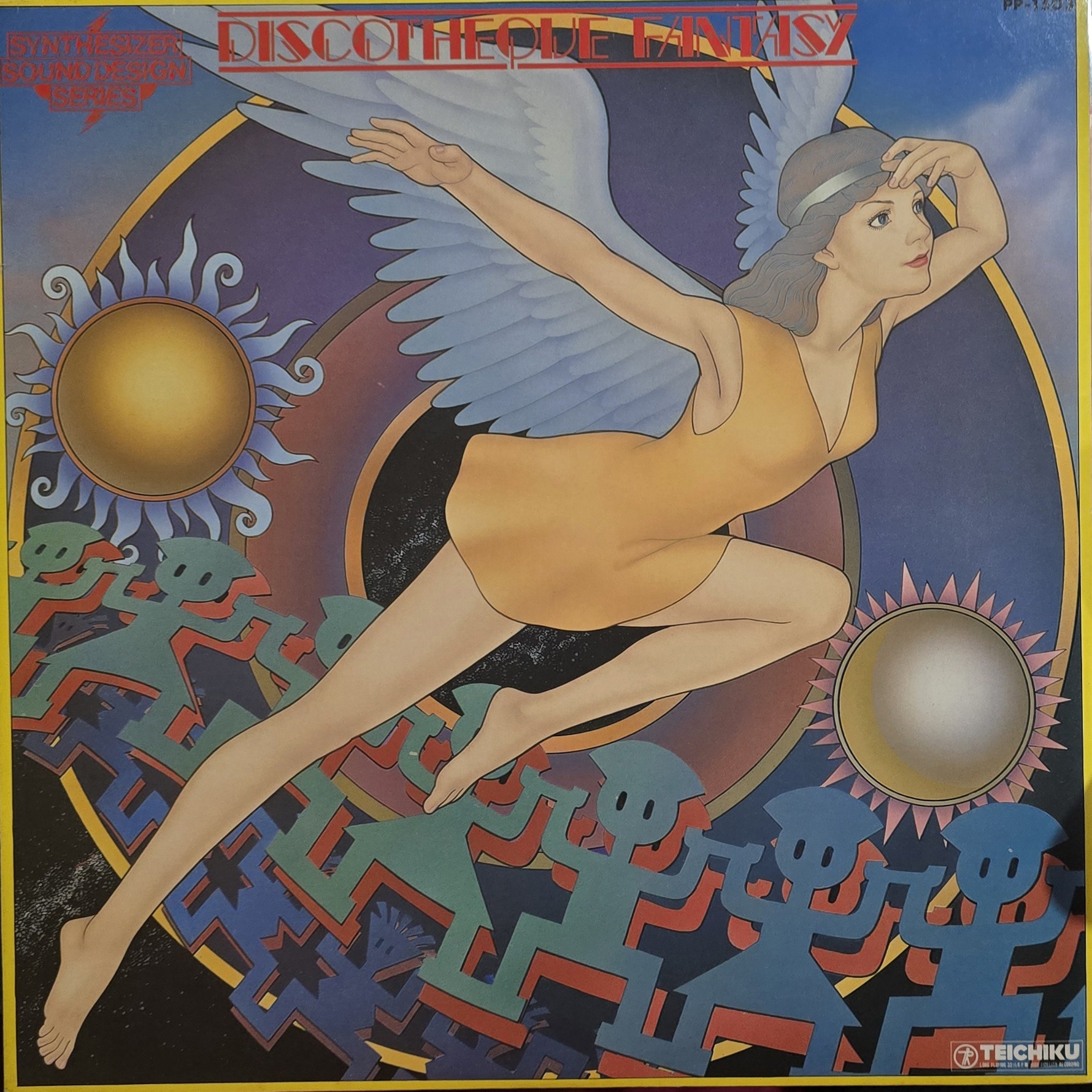
Oriental Mechanic Band – Discotheque Fantasy (Click here for complete album download)

How many times have I featured out-of-print and hard-to-find music featuring Hideki Matsutake (aka Logic System) on this blog? I’ve lost count and my tags are broken as shit (like everything else on this website) so who knows?

For those who may not know, Hideki Matsutake is a very influential Japanese electronic musician who is best-known for his work with Yellow Magic Orchestra and various YMO associates. He got his start in the industry at a young age, working with Tomita when he was still a teenager.

In addition to working on YMO’s first two releases, he also contributed to early albums by many other greats of the Japanese techno-pop and new wave scenes, including Sheena & The Rokkets, Akiko Yano, Rajie, Susan, Mioko Yamaguchi, and many more (as well as solo releases by all the members of YMO). If you have any notable Japanese pop music release from the late 70s or early 80s with prominent synthesizers or sequences on it, odds are he had his hand in it.

I also met him once. I tried not to be that big of a geek about it.

But before his work with YMO and other big-name artists in Japan, he released a few albums under other assorted names, a few of which I know I’ve shared in the past. One of my favorites is The Charm of Synthesizer: Japanese Melody (which you can find here), an album composed entirely of covers of Japanese enka tracks. He release that under the name Beautiful Shateau & Synthesizer. At the time I wrote that, I didn’t know what year that album came out, since then I’ve discovered that it most likely was released in 1976, meaning that it was one of his earliest releases.

This album, released under the name Oriental Mechanic Band, came out just one year later, but it’s a bit different. While that previous record was nothing but Japanese folk songs given the plugged-in/synth treatment, this album features more contemporaneous music, mostly on the disco side of things, hence the name.

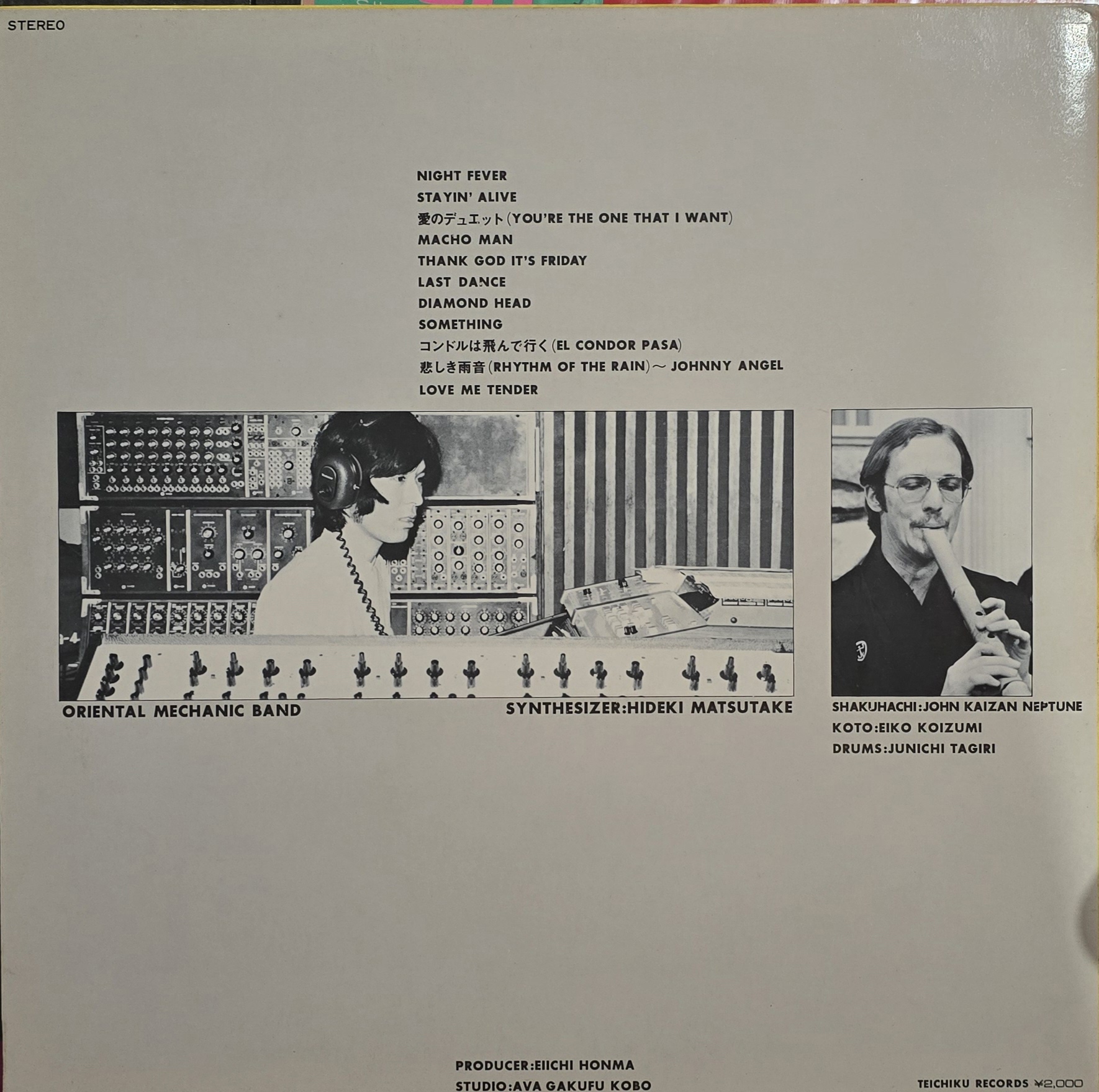
The album opens with two Bee Gees covers, “Night Fever” and “Stayin’ Alive.” I’m an established Bee Gees hater, but I dig these takes on their tunes. Maybe it’s because there’s no high-pitched squealing distracting from the solid melodies or basslines. Or maybe it’s the totally radical shakuhachi playing?

These aren’t purely electronic arrangements. This is not a Wendy Carlos album. In addition to Matsutake’s synths, we also have Junichi Tagiri on drums, Eiko Koizumi on koto, and, most notably, John Kaizan Neptune on shakuhachi (Japanese flute). Most of those people haven’t done a ton, but Neptune has been around. He’s American-born, but lives in Japan and has apparently made the shakuhachi his life. Not only does he play the thing, he makes them. He’s released a ton of albums since the 1970s. I can highly recommend his 1981 album, Shogun, it’s some good jazz-funk with a Japanese edge. If the city pop people ever stumble upon that record, my vinyl copy is going to skyrocket in value, I know it.

Anyways, after the Bee Gees covers we get a take on “You’re The One That I Want” from Grease. Much like the Bee Gees, I’m assuredly not a fan of Grease. But I’m also not deaf and I realize that “You’re The One That I Want” slaps pretty goddamn hard. Matsutake infuses his version of the song with a synth sound that I can only describe as “bouncy as hell” and Neptune delivers a fantastic wavering flute melody over it all.

After that brief lapse into musical theater we go back into full disco mode with a cover of “Macho Man” that has vocoder and tons of random robotic bleeps and bloops. What was an anthem for hyper-masculine presenting gay men in the late-70s club scene now sounds like a declaration of independence by a queer robot. It rules. Disco-mode continues with equally entertaining covers of “Last Dance” and “Thank God It’s Friday.”

Things take a bit of a turn moving onto side B. First, there’s a cover of “Diamond Head,” a Ventures song. I had never heard of it before. I’ve lived in Japan a long time, but not long enough to get into The Ventures. I assume I’ll get there at some point. In case you didn’t know, The Ventures were INSANELY popular in Japan, second only to The Beatles. If the wiki for this song is to be believed, it was the first song to sell one million copies in the country. When people think of the phrase “big in Japan,” the first band that comes to mind shouldn’t be Cheap Trick, it shouldn’t be Mr. Big, it should be The Ventures.

Anyways, I’ve only listened to the original a handful of times after listening to this version. They’re quite different to the point that I didn’t think that they were the same song at first. Matsutake uses the synth like a bass here to good effect, giving it some great percussive energy.

Then there’s a cover of The Beatles “Something.” I have so many covers of “Something.” I have a version played on bamboo flute that I like quite a bit. I have a baroque arrangement by a group called Tokyo Solisten. I have two versions by Shirley Bassey. “Something.” It’s a good song. It’s really hard to fuck up “Something”. Good news, Matsutake and company don’t fuck up “Something.” But there’s only so much you can do with it. It’s fine.

I really like what comes next, however, a cover of “El Condor Pasa,” a Peruvian orchestral song made famous by Simon & Garfunkel. Apparently it was really popular in Japan, because this is the fourth cover I have that’s performed by a Japanese artist. I have a cover by funk musician Akira Ishikawa, one by Tomita, and another by koto (Japanese harp) performer Tadao Sawai. Much like “Something,” it’s a very hard song to screw up. The melody is so powerful and haunting. A basic cover of the tune is going to earn you an easy B+ at the least.

This cover is fantastic. While the main melody is playing on the synthesizer, the koto and flute do a lot of work, and it really transforms the song. This song has always made me think of Morricone, listening to other versions I always imagine a cowboy wandering the desert or something similar. This one evokes the image of a lone samurai wandering the Japanese countryside, sword in one hand…and possibly a keytar in the other.

We go back even further in time after that, with a medley of “Rhythm of the Rain” and “Johnny Angel,” the former by The Cascades and the latter made famous by Shelley Fabares. This is some real golden oldies stuff, pre-Beatles pop tracks from the early 60s. Honestly, not my thing and this doesn’t do much to change that. However, the medley still piqued my interest due to the opening that Matsutake plays on the synth. It’s there for just a second, but you listen to that and tell me that you don’t hear at least the glint of the opening to Yellow Magic Orchestra’s “Behind The Mask.”

Am I crazy? I totally hear it. The earliest version of “Behind The Mask” is from 1978, used for a Seiko watch commercial, and Matsutake worked on that version as well. It would not surprise me if he took the sounds he created for this album and applied them there.

And finally we close with a cover of “Love Me Tender,” another song that I’ve never been a big fan of, but I enjoy what they do with it. Who knew that an Elvis Presley song could be improved with concurrent synth and koto melodies playing along a synth drumbeat and a funky-ass bassline? Makes me want to hear more synth covers of songs Elvis made famous. And honestly, given the shocking number of Beatles-themed synthesizer albums, I’m surprised that isn’t more of a thing.

My copy of this also includes some liner notes. While my boyfriend can speak English and does translate things for me from time to time, the notes here are pretty massive. I went ahead and used Google Translate on them, which is better than nothing. My boyfriend says the translation gets the point across. You can read the translated notes here and here. If you want to read the untranslated original notes, you can see those here and here. I know that machine translation is no substitute for a real human doing it, but I wanted to get this post up relatively quickly.

Give this one a listen and let me know what you think of it. I’ll probably be sharing some albums similar to it later this year. I actually got really lucky since I started writing this post and stumbled upon two other super-early Japanese electronic albums, including what I think is Matsutake’s first ever credited release!

Matsutake released one more album under the Oriental Mechanic Band moniker, Sonic Syncopation, which came out the year after this release. I’m going to try and track that one down and if I find it I’ll be sure to share it here as well.

Adventures From The YMO Family

Sunday, May 1st, 2016

I’m tired, I’m working six days in a row this week and I have to be up to go to work in about seven hours. So of course I decided to randomly write 800 plus words on releases by various Yellow Magic Orchestra associates.

Kenji Omura
Seiko Is Always On Time
The Defector
Maps
Kenji Omura was a longstanding associate of YMO, whose work with members from the group actually pre-dates the band itself; he’s credited as a performer on Yukihiro Takahashi’s solo debut Saravah!, which came out in 1978. Throughout the 70s and 80s he continually popped up on various YMO associate releases, including albums by Akiko Yano, Susan, Logic System (more on him in a second) and Sandii. During YMO’s biggest years he also served as the band’s touring guitarist, performing on their seminal Live At Budokan release.

He was primarily a jazz guitarist (a lot of YMO people have jazz backgrounds) and it shows a lot in his solo work, more than his work as a contributing artist. His 1983 album Gaijin Heaven even goes as far as to have a Steely Dan cover on it, showing that while he was working in the synth-pop field, he was just as interested in rock and jazz fusion as anything else. But, me being me and my interests lying where they are, I’m going to focus on his more synth-pop focused work, specifically these three tracks from his fantastic 1981 album, Spring Is Nearly Here.

While that album is listed as Kenji Omura record, it’s more or less an unofficial YMO release. Not only does it feature all three members of YMO performing their respective instruments, they also contribute as songwriters alongside Chris Mosdell, who served as the group’s English language songwriter for some of their biggest hits, including “Behind The Mask.” The album also features contributions from YMO accomplishes Akiko Yano, Hideki Matsutake and Kazuhiko Kato.

The whole album doesn’t sound like a YMO record (that jazz influence is pretty strong throughout) but the tracks that do sound like YMO really sound like YMO. “The Defector” could have easily been on Naughty Boys, its a pop masterpiece, the kind of track that sounds like it was purposely constructed to be a Top 40 hit and is all the better for it. Unsurprisingly, it was written by Takahashi and his English songwriter, Peter Barakan, two fantastic pop craftsmen.

“Seiko Is Always On Time” is a purely electronic jam, co-written by Sakamoto and obviously channeling “The End Of Asia” with its Eastern influences morphed together with a synthesizer-heavy sound. It’s semi-ambient totally beautiful.

But YMO fans should really take note of “Maps.” If that track sounds familiar, that’s because it’s actually a YMO tune, appearing on both the Budokan and World Tour albums. Those records were recorded in 1980, a full year before this record was released, but close enough for it to be difficult to say if the song was as YMO song first that was later handed off to Omura, or if it was intended for Omura all along. Either way, it’s a great track, and stands up equally with any other classic tune by the group.

Hideki Matsutake & K.I. Capsule
The James Bond Theme
Goldfinger
Hideki Matsutake served as YMO’s programmer, and also worked with electronic music pioneer Isao Tomita in the mid-70s. In the early-80s he went solo under the moniker Logic System, releasing a pair of beautiful albums in the early 80s as well as several…less good albums throughout the remainder of the century (one has a rap track, it’s bad).

For me though, his crowning achievement away from YMO is Digital Moon, a 1979 album composed entirely of James Bond theme covers. I’m not going to say that it’s the greatest album of all time, but it might be the greatest album of all time. You haven’t lived until you’ve heard “Goldfinger” sung through a vocoder. The only way it could’ve been better is if they had gotten Shirley Bassey herself to do it. This is dope shit. If you like dope shit you’ll like this.

Jun Togawa
Suki Suki Daisuki
Late Blooming Girls
An artist so unique that she’s nearly impossible to describe. I think the best I could come up with was “a cross between Madonna, Patti Smith and Klaus Nomi,” thanks to her pop presence combined with her predisposition for violent screaming fits and the occasional foray into operatic bellowing.

Between her solo discography, collaborative efforts and side-projects, she’s released countless records, which makes diving into her discography rather daunting, not to mention incredibly expensive. Any greatest hits compilation is a good jumping off point though, as it will probably feature one of, if not both of these, tremendous songs.

Both of these songs are highlights even if you can’t understand the vocals, thanks to Jun’s amazing vocal range. But if you do know what she’s singing about, they’re even stronger. Thankfully, for “Suki Suki Daisuki” you can find the translated lyrics on this fan-subbed video. As for “Late Blooming Girls,” I don’t have an exact translation with me, but the song is about a woman who’s scared to lose her virginity because she heard it might hurt, only to find the experience quite pleasurable once it happens. You can probably point out the point in the song where that unfolds solely based on how she changes her singing voice.

Jun Togawa is still recording today, and recently released a collaborative noise rock album that includes a new version of “Suki Suki Daisuki.” It’s something else.