I overindulged after finishing my last day of work before a two-and-a-half week vacation and now I’m nursing a hangover and dealing with the regret of consuming a heroic amount of whiskey while watching the Masters of the Universe movie with Dolph Lundgren.
I never said I was a role model.
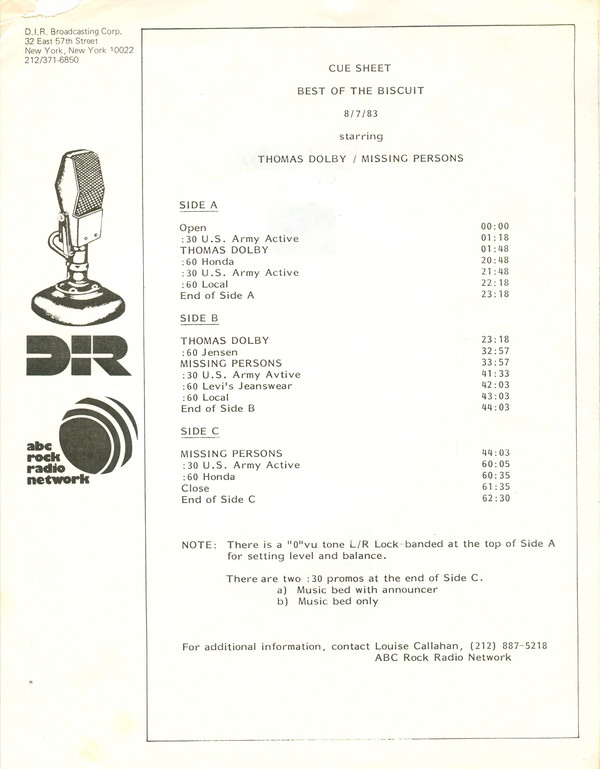
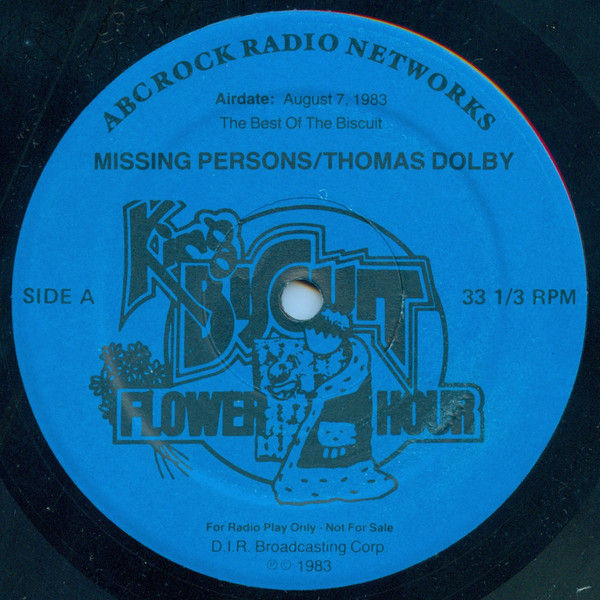
Best Of The Biscuit – Missing Persons
Missing Persons are not good hangover music.
This is the second part of the August 7th, 1983 Best Of The Biscuit radio show. The first part, which was a Thomas Dolby concert, can be found here.
I’m not a Missing Persons enthusiast, so I can’t speak to what die-hard fans would want to find on a Missing Persons’ concert from 1983. Speaking as someone who probably owned their first album at some point (just seems like something I should have bought), I can say that I’m very happy with this short, six song set. We get “Words,” “Destination Unknown,” and the immortal “Walking In LA.” In addition to those all-time classics, the group also performs the bangers “Mental Hopscotch” and “I Like Boys,” which I had never heard before and wish I had so I could’ve put it on a slutty playlist back when I was single (somewhere between Lady Gaga’s “Do What You Want With My Body” and an electro-punk cover of “Boys Boys Boys”). Also here is “Windows,” another lesser-known (to me anyways) piece that’s very good.
I’m once again including the commercials, which are sadly still mostly Army bullshit, with an ad for Honda at the very end. At the end of this side there’s a bit more though. You get some production credits for the show, followed by two 30 second promos for the program. One of them features commentary by an announcer, while the other is just the musical clips playing. I assume the latter is there so local radio stations could put their own DJs on the ad if they so desired.
Happy new year! And stay safe this New Year’s. Don’t drink an entire bottle of whiskey and sure as hell don’t watch Masters of the Universe.
Best Of The Biscuit – Thomas Dolby
Right after I bought and wrote about a radio-only LP live show compilation called Live Tracks, I just happened to stumble upon another one at an entirely different record store. While the previous radio show I bought seemingly a derivative of the King Biscuit Flower Hour, this one is the real deal, a “best of” episode that originally the aired the week of August 7th, 1983. Split into two parts, the majority of the episode is dedicated to a Thomas Dolby concert, while the later bit showcases a few songs from a Missing Persons show. Since there’s so much content here, I’m splitting this into two posts, with the Thomas Dolby up first.
This is not a complete show unfortunately. If Discogs is any indication, King Biscuit broadcasted a more complete (if not entirely complete) version of this very same concert on May 3rd of the same year, just a few months before this “best of” version. That’s some quick repackaging! They might have even repackaged it once more for another program in the following year, or that could just be another Dolby show, hard to say.
Nearly everything Dolby performs here is from his 1983 debut album, or from assorted singles (that would eventually make their way into various permutations of said debut album – it’s been re-issued a lot). The sole exception is “New Toy,” which is a song that Dolby wrote for Lene Lovich for her debut EP. Lene Lovich actually joins Dolby on stage for this one. I have no idea how rare live performances with both of them are for this one, maybe they toured together and played it all the time, or this was a one-off special appearance. Regardless, it’s cool.
Just like the last radio show I shared, this too has commercials. Unfortunately, this time around they aren’t horribly inappropriate beer commercials that feature racist stereotypes and encourage underage drinking. Instead, they’re just commercials for the US Army (boo!). I remember these commercials though, so while I won’t say that it was cool to hear them again (again, boo military-industrial complex!) it did trigger a nostalgia dopamine response. Haven’t heard that “be all that you can be” jingle in ages. It’s also hilarious to me that the army sponsored a radio show with the aggressively anti-imperialist “One Of Our Submarines Is Missing.”
Also, how many die-hard synthpop fans from the early 80s were down with the thought of joining the armed forces? I feel that the military’s advertising budget could’ve been better spent on radio shows featuring AC/DC or Ted Nugent.
Enjoy the show (this one is “properly” numbered by the way) and, for those of you who celebrate Christmas, merry Christmas. I’ll be back next week with the second half of this radio show, hopefully.
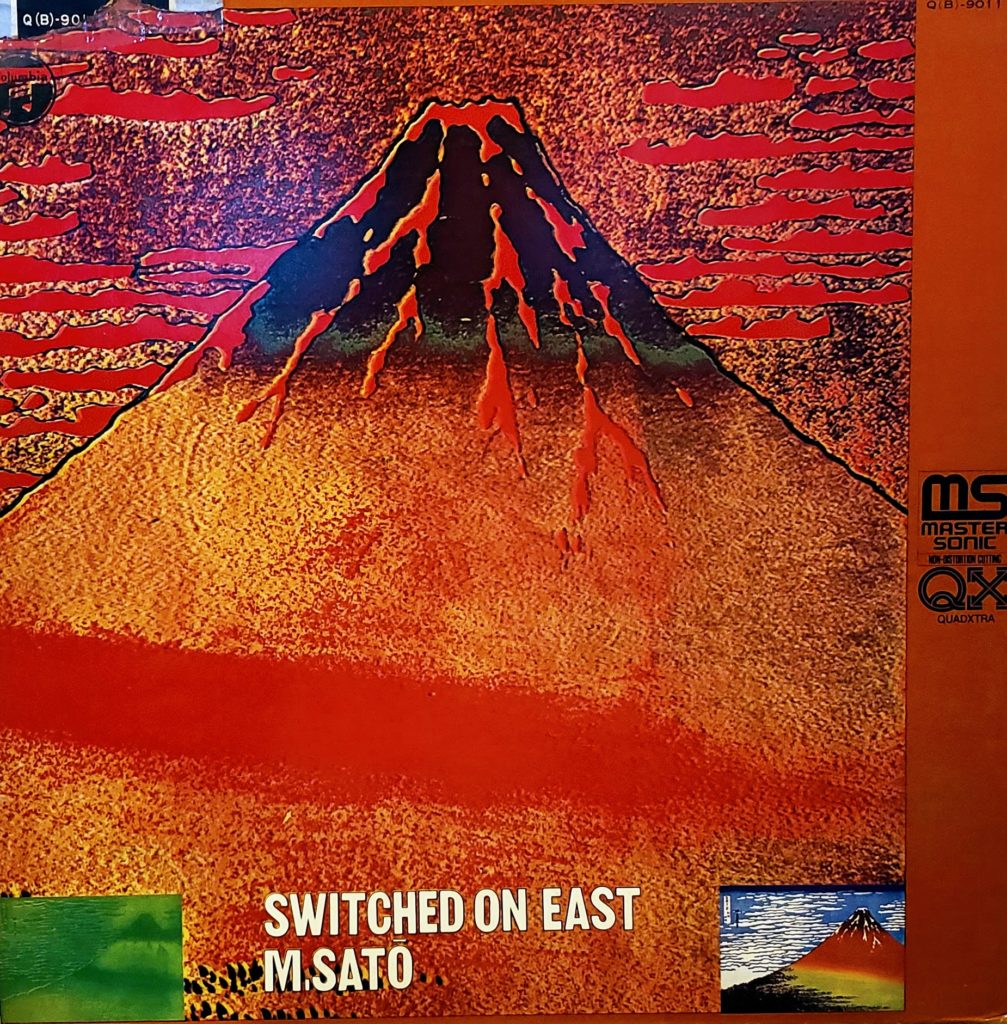
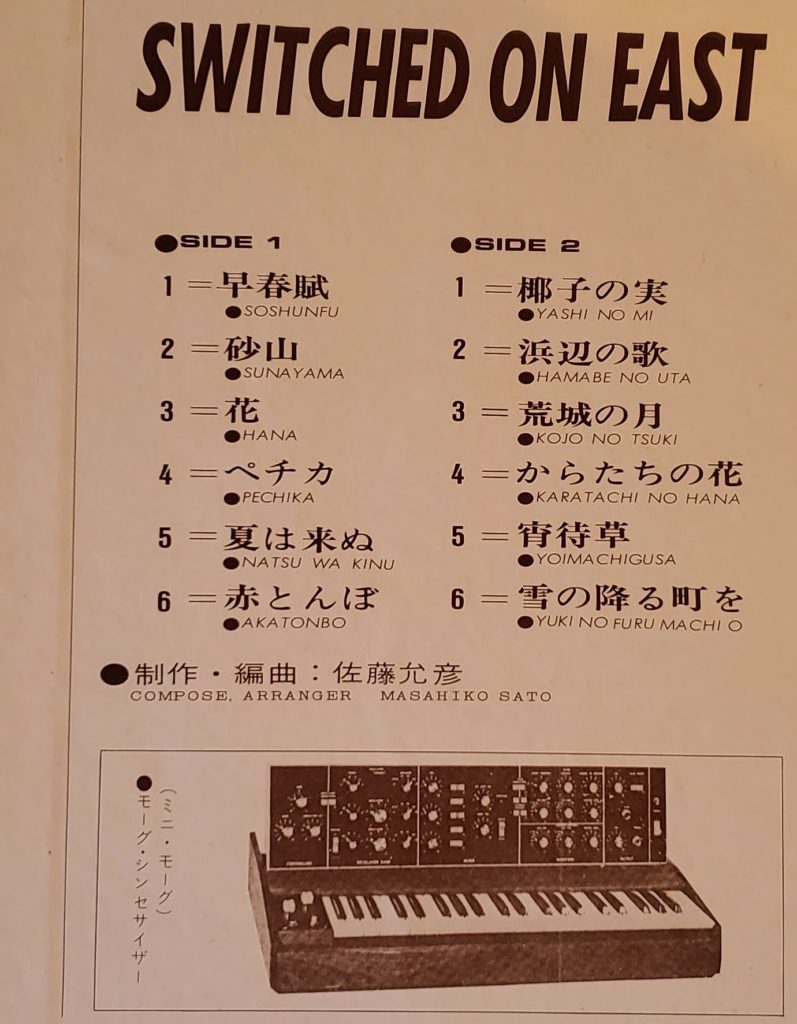
Masahiko Satoh Switched On East (Complete Album Download)
I have accumulated many (many many) Japanese synthesizer albums from the 1970s over the past few years. Finding out anything about any of these releases in English is often impossible. Many times I have to enter these items into Discogs myself. Which is a real pain in the ass when the majority of the liner notes are in kanji. Thankfully, this one was already there.
Switched-On East is the earliest example of a Japanese electronic/synthesizer album that I’ve come across. It was released by Denon Records in 1971. To the best of my knowledge, it never received a release in any other country, which makes sense. The album is comprised of nothing but covers of songs by Japanese composers. I’m going to guess that the international market for something like that was pretty slim at the time.
The album was arranged and performed on synthesizer by Masahiko Satoh, who for some reason chose to work under the name M Sato for this release. Satoh is a very prolific composer and jazz pianist in Japan, with dozens of albums to his name ranging from experimental electronic pieces like this, to more traditional jazz recordings. He gets around, I’ve ended up owning six albums that feature him, despite the fact that I’m not really into jazz. He shows up where you least expect him.
He’s the Spanish Inquisition of Japanese jazz pianists.
While Satoh is a brilliant composer and fantastic pianist, I don’t think that he really knew his way around a synthesizer in 1971. Or if he did, he wasn’t fully aware of how to properly take advantage of it in a studio environment. This is a very good record, but, like many similar albums that would be released in the 1970s, his interpretations of these tracks are a little bare bones when compared to the stuff that Wendy Carlos was doing at the same time. Carlos would put forth the effort to really layer her arrangements to make them sound as big and complex as possible. But that took a lot of time (and skill). Early synths were entirely monophonic. Anytime you hear layering or chorus effects, that means that the performer had to go back, record those parts separately, and edit them in later. In the days before digital editing software, that meant a lot of tape. It was probably a real pain in the ass. Carlos should be commended for her patience just as much as her technical ability.
I’m not familiar with most of these tunes outside of this album. I don’t know if Satoh took any major liberties with the source material or if they’re just 100% accurate arrangements that happened to be performed on a synthesizer. Regardless, I enjoy listening to them. They’re sparse, that’s for sure, but that gives many of them an almost ethereal quality. “Sunayama” is downright haunting. Others, like “Yashi No Mi” are bouncy and fun, and their minimal nature give them a video game music vibe, some 10 years before that was even a thing.
This album was never released on CD or digitally (as far as I can tell) and I don’t think that the record was pressed more than once. And from what I can gather, most of the ones that were pressed don’t sound good. Every auction I’ve come across for this record by someone who has actually listened to it seems to echo the same sentiment: “It looks perfect, but sounds a bit scratchy.”
I can certainly attest to that. Despite the fact that my copy looks flawless, and despite the fact that I’ve given it multiple cleanings, parts of it still sound a little scratchy. Since I’m a self-hating perfectionist, I usually don’t share my rips unless they’re near-perfect, but considering the rarity of this record I made an exception.
As I said before, I have a lot of records like this (seriously, it’s a problem). So expect more like them in the future. I hope to get some more complex write-ups done on some of the more interesting ones during my holiday break.
And if you like this, be sure to check out this post from a few months back, where I share something similar by Hideki Matsutake, a synth legend.
Some news first. I plan on updating my ridiculously huge guide to Tokyo record stores in the coming month or so, with updated photos and added profiles of various stores that I recently discovered. I plan on making this new guide so big that I’ll probably end up breaking it into two parts; one a “best of” highlight reel, and the other a full-fledged “here’s everything” guide that will be well over 15,000 words. If anyone has any suggestions about what they would like to see in either, let me know.
Now, Prince.
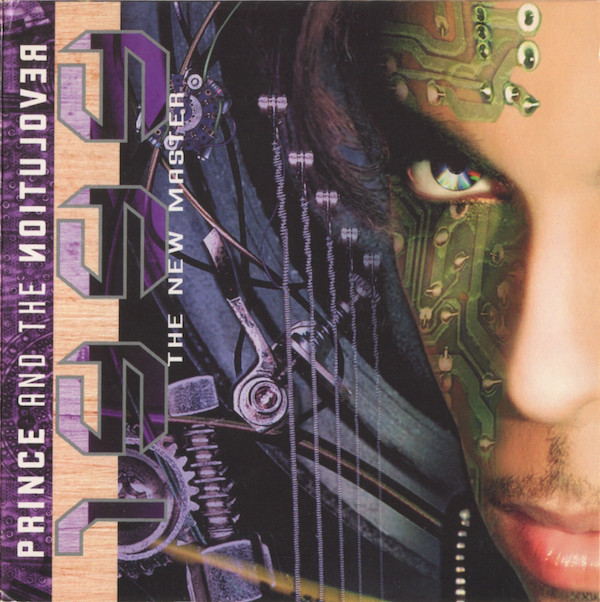
Prince 1999 (The New Master)
Rosario (1999)
1999 (The Inevitable Mix)
1999 (Keep Steppin’)
1999 (Rosie & Doug E. In A Deep House)
1999 (The New Master Edit)
1999 (Acapella)
The 1999 super deluxe box set is out and I highly recommend it, even though I haven’t been able to dive into everything that it has to offer. It is five CDs (and a DVD) after all. I haven’t touched much of the live content or archival remixes/edits all that much, I’ve been far more interested in the vault tracks, many of which are downright fantastic. The estate really did a good job with this one, populating those bonus discs with a good mix of legit, finished tracks that just didn’t make the cut; polished demos and raw takes that sound damn good; and a smattering of live cuts that show Prince playing around with his material on the fly in a fun and interesting way. Great shit all around. If you have any interest in Prince’s 80s output at all, it’s a must buy. I’m sure that the die-hard Prince bootleg collectors out there will find holes in it, and have their own “unreleased” material that they would prefer, but I’m not in that scene so I can remain happily ignorant of what I missed.
The above remixes were not included in the 1999 box set, although they really had no right to be. They were released in 1998 as an effort to capitalize on the literal 1999. These remixes arrived with a thundering thud when they came out, failing to make any substantial impact on the charts in damn near every country.
That makes sense on a few levels. The most obvious being that the world did not need a new version of “1999” in 1998, or in any year for that matter. “1999” is a near perfect song, no “new master,” remix, or any other attempt to rejigger or rework it for a modern audience would be a success, in my opinion. Remember that when “1999” first came out, there were no 12″ or dance remixes of it. The only alternate versions of the original track are radio edits. Prince knew he didn’t need to fuck with it then, he should’ve known not to fuck with it in 1998.
But I think that’s not the only reason why these mixes bombed. I think a lot of it has to do with the song itself. Think about the song “1999” in 1982, there could not be a song that was more in tune with the zeitgeist of the time, not only musically (synths galore) but musically (Ronnie’s gonna nuke the world). In 1999, there couldn’t not be a song more out of touch with the state of reality than the song “1999.” The Cold war was over, compared to the periods immediately before and following, the world was relatively at peace. America was in the middle of a ridiculous bubble economy. The internet was bringing us together in fun and exciting ways, as opposed to the sad and depressing ways it does now. Everybody loved the president. Apolitical was a thing you could be.
This showed in the music of the era. Look at the top songs of 1999, they’re dumb as rocks. The biggest song of that year was “Believe” by Cher. Sugar Ray was one of the biggest rock bands in the world. The closest thing to a song with a message reaching mainstream popularity was “Jumper” by Third Eye Blind.
Compare that to 1983 (when “1999” actually charted). Sure there’s a multitude of stupid shit there, but the number one song of the year was “Every Breath You Take” (which some read as a statement on nuclear proliferation) and there were other dark songs that managed to be big hits as well, like “Maniac,” “Dirty Laundry, and “Twilight Zone.” Yeah, these aren’t political or “serious” songs, but they have an edge to them. There wasn’t no edge or commentary in the popular music of 1999. That shit was polished to a happy sheen.
Of course, the pop hits of 1999 (and 1983) blow most pop hits of 2019 out of the water, since they actually have things like melodies, hooks, and emotions aside from “I’m sad about stuff.” Yowza what a shitty year for pop music this turned out to be. But that’s a whole other topic and I don’t want to write another 1,000 words that’ll just piss 20 year-olds off (I do that enough already).
Okay I got sidetracked. These mixes aren’t…well…they aren’t bad. Okay, a few of them are bad. Like, downright bad. About half of them aren’t even mixes of “1999.” “Rosario” is just Rosario Dawson rambling on for a minute or so, and a couple of other mixes are just excuses for Rosie and Doug E. Fresh to freestyle. But the main remix is actually pretty good, and the edited version is a good abbreviated version of that. The others are good enough, and are worth a listen just of out curiosity if nothing else.
Yes Owner Of A Lonely Heart (Wonderous Mix)
Owner Of A Lonely Heart (2 Close To The Edge Mix)
Owner Of A Lonely Heart (Not Fragile Mix)
Ever buy something that just leaves you confused about how the world works?
These remixes are from a CD single that I found last week. It has left me with so many questions that will forever remain unanswered that I don’t even know where to begin with writing about it.
Why does this exist?
Who thought the world wanted remixes of “Owner of a Lonely Heart?”
Who thought that the world wanted remixes of “Owner of a Lonely Heart” in 1991?
Was this the part of a larger remix project that fell through?
What Yes fans in 1991 would be interested in dance remixes of Yes?
Who are those people and what drugs were they taking?
Did any club DJ in the world actually play these remixes for a dance audience?
Was said club DJ immediately killed for such a transgression?
Why the hell didn’t they recruit The Orb for this?
Why the hell did they recruit 808 State for this (yes really)?
Why the hell did 808 State say yes (to Yes)?
Those last two questions are the most pressing for me. Two of the three remixes on this single were done by 808 State. Not only that, at the time 808 State were at the absolute peak of their popularity and critical acclaim, coming right off the release of the ex:el album the same year. I assume that Trevor Horn, who produced this single, was responsible for getting 808 State and was able to do so because both he and 808 State were on ZTT Records at the time.
It’s funny how just one person can serve to be a connection between two acts that are so widely disparate in every way possibly imaginable. Trevor Horn is the Kevin Bacon of music, and not just in terms of artists he’s worked with, but in genres he’s crossed as well. You could probably connect a zydeco artist to a breakbeat DJ within six degrees by using Trevor Horn as a connecting point.
But of course, the most important question; are these remixes any good?
And to that I can firmly say; I dunno? Kinda? I guess?
They’re okay. The Wonderous Mix is very ambient and chill. It actually sounds like what I think a remix of Yes by The Orb would sound like. Most of it is original production and instrumentation that uses Anderon’s vocals and the guitar solo from the original tune as an accompaniment. It’s chill. I dig it.
Things radically switch gears for the 2 Close To The Edge Mix, which sounds less like a remix to “Owner of a Lonely Heart” and more like an original 808 State song that has a few samples of “Owner of a Lonely Heart.” If I heard this without knowing it where it was from, I would have never guessed the source material. It’s such a drastic deviation. It’s not terrible. If you dig this era of acid house then you’ll probably dig it. It’s just weird.
The Not Fragile Mix, on the other hand, doesn’t fuck around in letting you know that it’s a remix of “Owner of a Lonely Heart.” It doesn’t have the same structure or flow as the original, but elements from it are all over the thing. When the song’s signature guitar riff isn’t playing, you’re getting snippets of Jon Anderson’s vocals or quick explosions of the song’s notable synthesized sound effects.
Strangely (sadly), this is not the only Yes remix release. In 2002, Yes released the entirely unrelated Yes Remixes album. An even more baffling affair, that album tried to turn classic Yes prog anthems like “Starship Trooper” and “Heart Of The Sunrise” into standard techno bangers. I mean, say what you will about the remixes I’m sharing tonight, they’re not the greatest idea in the world, but at least the source material lends itself to remixes in theory. “Owner of a Lonely Heart” is a synthpop track. Synthpop tracks are remixed all the time into club-ready dance tunes.
Hella complex prog rock is not.
That album is a complete disaster in all the ways you might imagine (and then some). However, I at least I understand how that came into being. The remixes on that album were by The Verge aka Virgil Howe aka the son of Yes guitarist Steve Howe. Good old fashion nepotism giving the world something it never asked for yet again.
I assume that Yes Remixes is long out of print but don’t hold your breath for me to share that here. I like you all way too much to subject you to that.
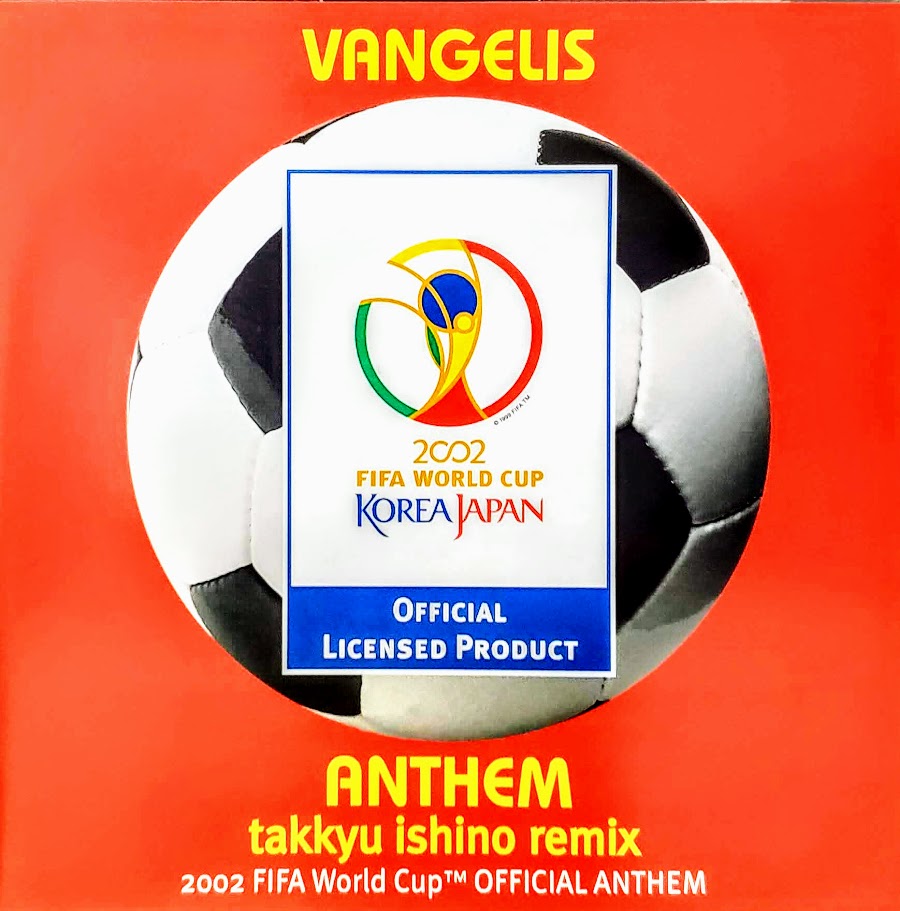
Vangelis Anthem [Orchestra version with choral introduction]
Anthem [Synthesizer Version]
Anthem (JS Radio Edit)
Anthem [Takkyu Ishino Remix]
Anthem [Takkyu Ishino Remix Radio Edit]
I’m a stupid American so I don’t know anything about “football” and the World Cup (aside from it being horribly corrupt, complacent in countless human rights violations, and vehemently anti-LGTBQ), so could someone tell me, are World Cup themes/songs a “thing?” Meaning, do people care about them at all? Are they played at the games? Is it a big deal when an artist announces they are involved in one?
I’m guessing no?
The above track is from the 2002 World Cup, which was co-hosted by Japan and South Korea. You would think that FIFA would’ve wanted South Korean and Japanese musicians to perform the theme to that games. It could have been a powerful moment, two countries with such a contentious relationship, working together to communicate via the international language of music. Or at the very least you would’ve hoped they called Ryuichi Sakamoto because duh.
Instead they got Vangelis.
I hope it was because someone at FIFA was a big Aphrodite’s Child fan and not because of “Chariots of Fire.”
Usually naming a song “Anthem” is a sign that a musician has their head up their ass (looking at you, Good Charlotte) but since this was literally an anthem to an actual event, it gets a pass. It also sounds anthemic as fuck. It earns the name. Those soaring riffs, that chorus, this is a song custom-made to be rousing like a motherfucker. I close my eyes, listen to this and I can imagine a highlight reel of…I dunno, whatever soccer players do to earn themselves on highlight reels. (Successful flops? Ignored penalties? Abiding the poorly implemented offside rule?) Even without the techno remixes, I would dig this tune. It goes on my workout playlist for sure, right next to “No Easy Way Out” from Rocky IV.
Of course, my interest in this track has absolutely zero to do with any interest in soccer (again, stupid American) or the World Cup (again, horribly corrupt to the point of being cartoonishly evil). I bought it because of Takkyu Ishino’s remix. Ishino is a member of Denki Groove, a Japanese dance/techno act that I love. He also did a great remix of New Order’s fantastic track “Tutti Frutti” a few years back, and in the 90s he contributed a fantastic song to the dope-as-fuck soundtrack to the shitty-as-hell PS1 Ghost In The Shell video game. Ishino is old-school techno, and I mean techno as an actual genre of music not as a blanket word for “electronic music.” If you like your dance music robotic and high-energy, give his stuff a listen. His remix here is fantastic. I liked it so much that, after buying one single that only included a radio edit of the remix, I did a Discogs impulse buy and bought another single that included the full remix, which is even better than the edit. Them techno beats always get me.
Live Tracks #2
In the above zip, you get live performances of:
Duran Duran – Rio
Fleetwood Mac – Hypnotized
Romantics – Talking In Your Sleep
The Who – Behind Blue Eyes
Yes – I’ve Seen All Good People
Steve Miller Band – Fly Like An Eagle
Plus beer commercials! Let me explain.
Syndicated radio shows pressed to vinyl for national distribution are something that I sadly do not know much about. They aren’t the kind of records that one tends to easily find in used record stores (especially in Japan). That’s because they were never intended for any kind of commercial release, especially on the second-hand market. When one of these makes it to a used record store or online, I always wonder how it got out into the wild. Maybe a radio station unloaded its vinyl library without bothering to sort out the promos? Or perhaps a DJ snagged a personal copy for their own private collection, and they ended up selling it years later? Or maybe someone just stole it and sold it for cash. Who knows? And who knows how this one made its way to a tiny store outside of Ikebukuro in Japan?
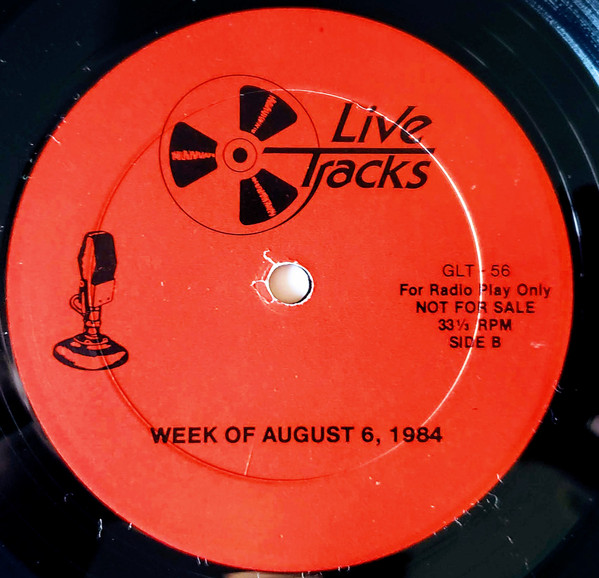
Live Tracks was a syndicated radio program produced by DIR Broadcasting, perhaps most famous for their King Biscuit Flower Hour show. While King Biscuit featured complete (or near-complete) live concerts, Live Tracks was more of a sampler, a bite-sized one-song radio program with a single cut from a live concert. I suspect that a lot of the performances on Live Tracks were just repackaged performances taken from DIR’s substantial back catalog of King Biscuit shows. The radio host on these episodes doesn’t really go exactly when and where the recordings were taken from. Sometimes he gives rough dates (the Duran Duran show was recorded in Madison Square Garden in 1984), but other times he just says something like “here’s an old one…” so pinning down exact information on the songs is tricky. Pinning down much of anything on this show was hard, this episode wasn’t even on Discogs until I added it.
The live tracks of Live Tracks are quite good, recorded professionally and mixed well. Some sound a bit raw, but they capture the energy of a concert well. Just as interesting to me, however, is the wrapping that each episode comes in. The Live Tracks records were complete radio shows on disc. The DJ didn’t have to do anything other than drop the needle and let the show play. The band introductions are handled by DIR’s own emcee, and the LP even has its own commercials included.
For the episodes included on this LP, the sponsor is Grizzly Beer, a long-gone Canadian beer brand who apparently had a penchant for horribly inappropriate commercials. One features comments about college kids drinking beer, another drops in some absolutely cringe-inducing Asian stereotypes, and one even makes jokes about minors getting drunk on Grizzly. Holy shit that wouldn’t fly today.
Since an episode of Live Tracks is really just one song, radio stations got a lot of bang for their buck with each LP. This one features six episodes, each with an intro by the emcee followed by a Grizzly Beer commercial, another bit by the emcee, a complete song performance, and an outro by the host.
Given the format of the show, I had a hard time figuring out how to share it here tonight. I thought about just feature the live cuts, but then you’d lose a lot of the flavor of the beer commercials (which are seriously great). Also, the live cuts often fade in and out with the host, so it would be jarring to not to include them. So, I just went ahead and made the entire thing one zip file, cutting up each episode into separate tracks. I figured y’all would be just as interested in the historical wrappings of the episodes as I was. For the most part, the recordings sound good. There are few crackles here and there, a tiny bit of distortion at the very end of the Steve Miller track, but as a whole, these are well-recorded performances on a damn clean slab of wax.
Enjoy, and if you find a bottle of Grizzly Beer, for God’s sake don’t drink it, that thing is probably 30 years old.
Madonna Papa Don’t Preach (Edit)
Lucky Star (Single Version)
A few months back I promised to finish the long-delayed third part of my guide to Madonna’s remixes, covering the 2000s. (Here’s Part 1 and Part 2 if you’re interested). But that proved to be much harder than I anticipated thanks to the utterly confusing of digital-only, promo-only and (possibly) streaming-only remixes. I do still plan on getting it done, but I have no idea when that will be.
I also have to update the first two parts of my guide, thanks to (usually very polite) commenters pointing out small mistakes and lesser-known remixes that I missed. But even that’s been a bit of an issue since a lot of them don’t site their sources or provide any evidence for their claims.
For example, many have told me that there’s an exclusive remix to “Open Your Heart” that’s only on the 7″ single to that song. Make sense, a lot of Madonna tracks have 7″ single remixes, and many of those single mixes have yet to find their way to any CD at all. I went ahead and bought the “Open Your Heart” seven inch a few months back, which even has “(Remix)” in the title.
I had to listen to it several times before I was able to pinpoint any differences between that mix and the mix on the Immaculate Collection. From what I can tell, the main difference is that the ending fade out is a little different. The actual mix/master of the song might be different too, but that’s hard to judge when comparing a vinyl rip to a CD version. It’s so similar that I’m not comfortable sharing it here unless someone can’t point out another worthwhile difference I’m missing.
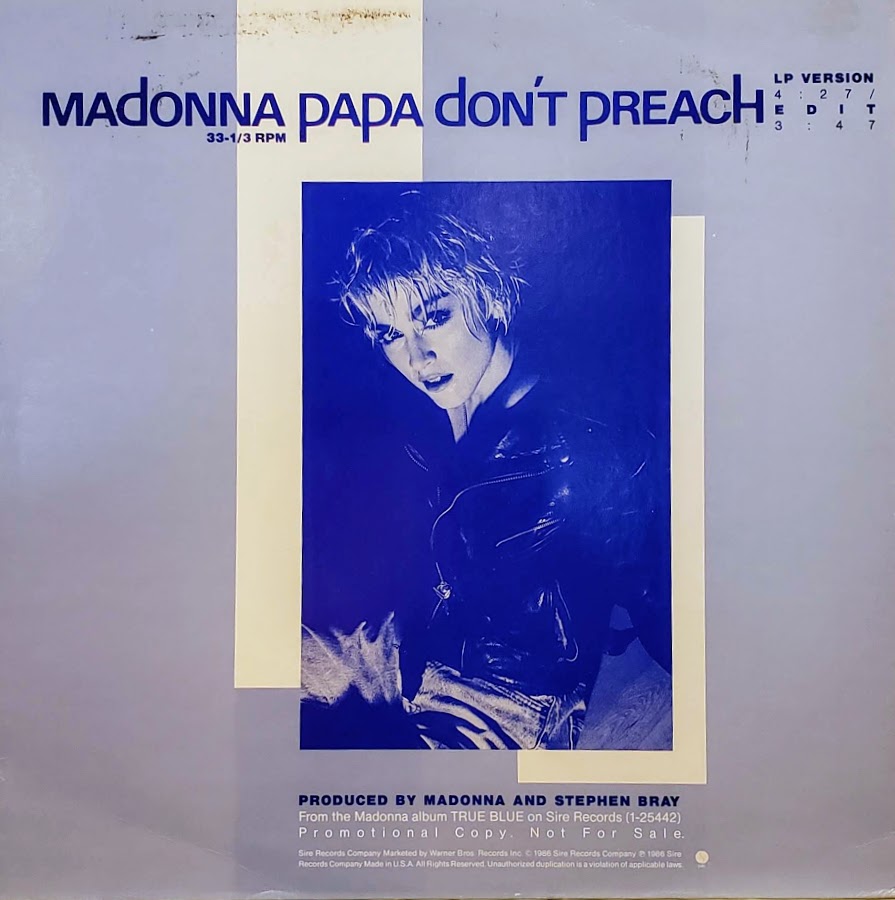
I had the same problem when I picked up a very rare promo 12″ single for “Papa Don’t Preach.” Again, I read that it had an exclusive remix, but I couldn’t figure out exactly how it was different until I listened to it and the album version back-to-back. Turns out that, once again, it’s nearly identical to the album version until the very end, where the fade out is different. However, unlike the “Open Your Heart” remix, it’s a pretty radical difference so I’m sharing it here.
The B-Side to the “Papa Don’t Preach” single is just the album version of the track. However, the B-side to the 7″ single of “Open Your Heart” is “Lucky Star.” Thankfully, it’s also the 7″ version, which has never been released on any Madonna CD. Unlike the “Open Your Heart” remix, it’s easier to hear how this one is different, as it is substantially shorter than any other mix of the track.
It absolutely maddening to me that Madonna has never bothered with a proper re-issue campaign of her classic albums with at least a few of these mixes included. Sure, remixes like the promo edit of “Papa Don’t Preach” are minor and only the die-hard (i.e. gay) fans like me really care about them, but there are plenty of other rare cuts and mixes that regular people would probably care to hear.
There are rumors about that a new 4CD deluxe edition of Like A Prayer is in the works, with a supposed catalog number being leaked a while back. If that does come to pass, it’ll be interesting to see what is included on it. I can imagine that some of those demos that were shared online would be part of it. But what remixes would be included? There are at least 10 remixes of “Like A Prayer” and while I can’t possibly imagine all of them would be there (some of the differences are just too minor to care about) I think that at least half of them are different enough to warrant inclusion. Same goes for “Express Yourself.” An entire CD could be filled of remixes of just those two tracks, but would they even bother with the effort?
Are they looking for someone to help? Yo, Madonna people, I’m available and I work for 12″ promo singles.
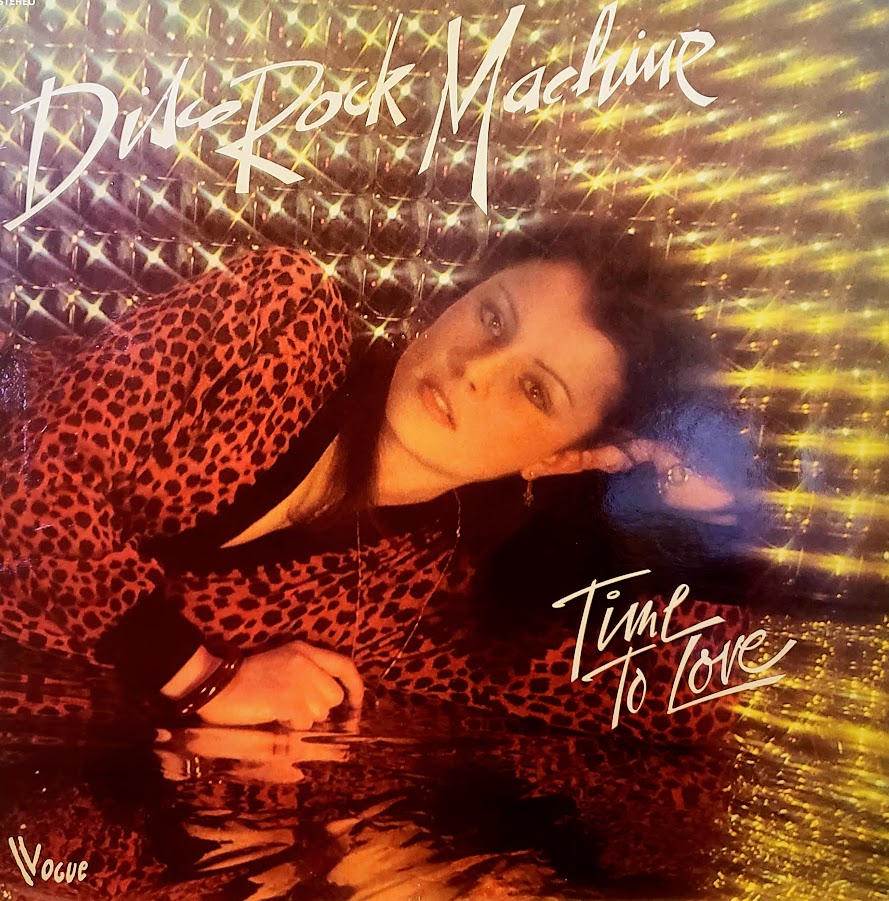
Disco Rock Machine You Keep Me Hangin’ On
Living For The City
You Really Got Me
Gimme Some Lovin’
Mr. Magic
Trevor Rabin joined Yes in the early 80s (it’s actually a long story that involves Yes breaking up, a new band called Cinema being formed, and then that band becoming Yes again but I don’t want to get into all of that). For audiences in the UK and US, Rabin was a relative unknown, with just a handful of albums to his name, none of which made any dent on the charts on either side of the Atlantic.
But Rabin’s career actually went back a bit further than that. Before he made his way to the UK to start his solo career, Rabin was already an established musician in his native country of South Africa (he was anti-apartheid by the way, just to get that out of the way) as a member of the pop/rock group Rabbitt. I don’t know much about Rabbitt, but they seem to have a rather eclectic discography that includes sappy 70s cheese, prog rock covers, and tracks that wouldn’t sound out of place on a record by Sweet.
Rabbitt had a few hits in South Africa, but they didn’t break through internationally and they broke up in 1977. Rabin started his solo career just a year later with his first record. But at the same time he was trying to make it as a rock-n-roller, he was also plugging away with multiple disco projects. One such project was The Tee Cee’s, who released a sole album the same year Rabbitt called it quits.
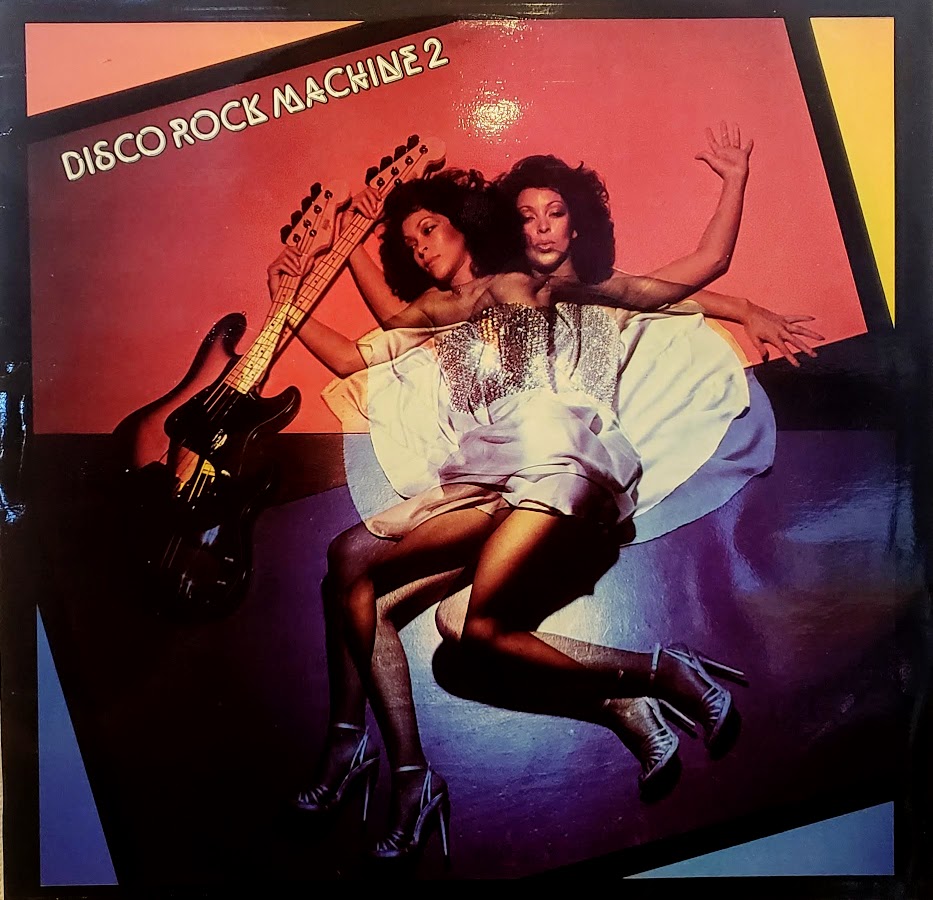
The other was Disco Rock Machine. Under that name, Rabin pumped out two albums in just two years. While The Tee Cee’s album featured entirely original material written by Rabin, the Disco Rock Machine were heavy with covers. And like their name suggests, most of their covers were of rock songs, redone in a disco arrangement.
Disco Rock Machine’s first album features just four tracks, each clocking in a dance-floor friendly seven minutes. Sandwiched in between two forgettable Rabin originals are covers of Stevie Wonder’s “Living For The City” and “You Really Got Me” by The Kinks. The second album was a bit more pop friendly, with shorter tracks that would play better on the radio. Among the albums six tracks were three Rabin originals, alongside covers of “You Keep Me Hangin’ On,” “Higher Ground,” and “Gimme Some Lovin’.”
Albums comprised almost entirely of discofied rock covers were definitely a thing in the late 70s. Rabin even served as a session musician for Hot RS, another South African act that specialized in extended disco takes of classic rock tunes. And one thing I’ll say about Disco Rock Machine (and Hot RS for that matter) is that their disco remakes of rock tunes sound a hell of a lot better than others that I’ve heard. I have two disco covers of “In A Gadda Da Vida,” one by Hot RS and another by an act called Disco Circus. The version by Hot RS absolutely blows the Disco Circus one out of the water.
A disco cover of “You Keep Me Hanging On” or “You Really Got Me Now” is intrinsically stupid bullshit. There’s no way around that fact. The world did not need disco covers of Kinks songs. Or Steve Winwood songs. Or (multiple) Stevie Wonder songs. But if someone was going to attempt them, at least it was Trevor Rabin, who clearly shows his studio mastery with these tracks. Disco Rock Machine’s cover of “You Really Got Me” simply does not fuck around. Rabin channeled that song’s natural intensity and energy and skillfully transmorphed into a banger of a dance tune thanks to a groovy bassline, excellent high-hat beat, and some shredding guitar. Ditto for their take on “You Keep Me Hangin’ On.” Stretched out to seven minutes, the track builds and builds, breaks down and then explodes back up to a feverish conclusion, with a killer beat and some truly inventive guitar work by Rabin backing the whole thing up.
These are cheesy tunes, for sure. And they haven’t exactly aged all that well. But they’re fun! And in my opinion they serve as a preview of the studio wizardry and production prowess that Rabin would become known for in the following decade. Most of the tracks I’m sharing from these two albums are the covers, they’re the highlights. But “Mr Magic,” a Rabin-penned original, ain’t half bad so I’m throwing that one in too. It’s also a good example of Veldsman holding it back a notch to show she’s more than capable of delivering a more varied, subdued vocal performance as well.
After calling it quits with Disco Rock Machine and his assorted other disco acts, I don’t think that Rabin ever went back to dance music. After leaving Yes in 1994, he went on to mostly do film scores. Right now, he’s working with former Yes members Jon Anderson and Rick Wakeman as Yes featuring Anderson, Rabin, and Wakeman. They’re allegedly going to tour again soon, and I hope that they stop by Japan before calling it quits (Wakeman has repeatedly referred to his next tour as his “farewell tour”).
I’m not holding by breath for any Disco Rock Machine covers to make their way into the set, however.
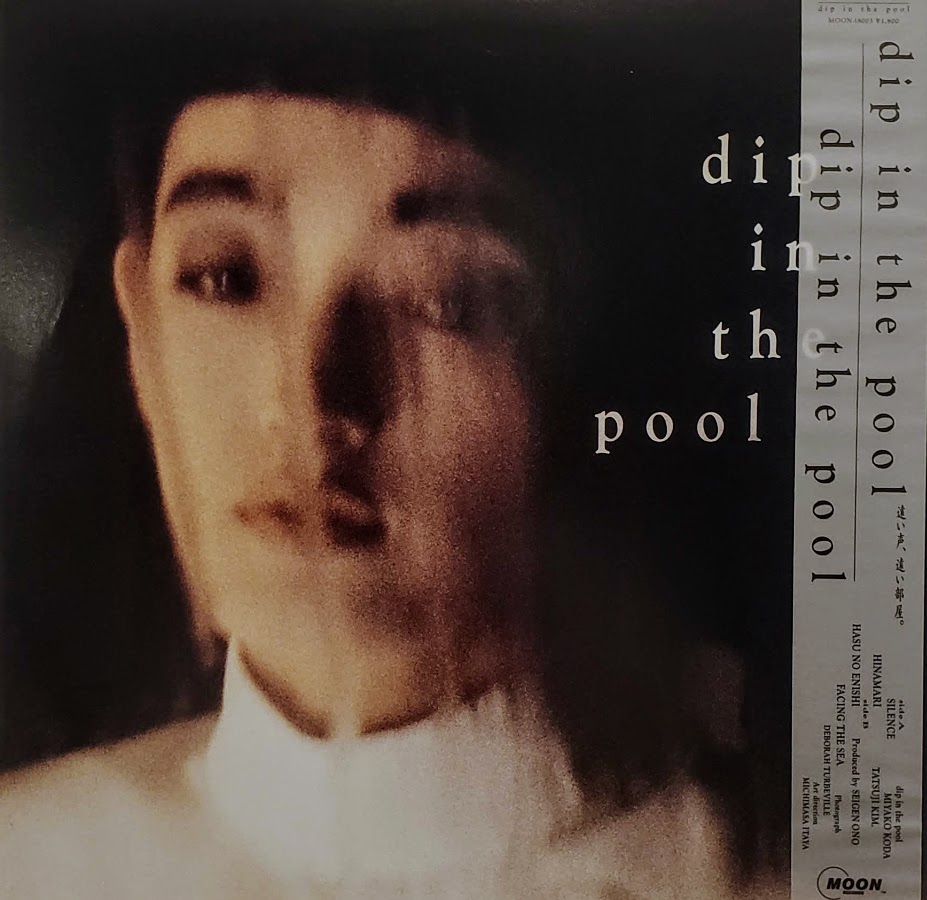
Dip In The Pool Silence
Hinamari
Hasu no Enishi
Facing The Sea
Dip In The Pool is a strange group. One that not many people have heard, yet conversely, many people have written about. They kind of got swept up in that whole “city pop” thing a few years back, despite not even being remotely connected to it. Later on, they were more accurately grouped as “Japanese ambient pop.” I don’t know if there are enough acts around for such a genre to be a proper thing, but the tag fits good enough. Dip In The Pool are chill. Super chill. And quiet. Super quiet. Dip In The Pool have their upbeat numbers and pop tracks for sure, but when they slow things down, they take things so minimal and ambient that they push the very definition of what a pop song can be.
Oh, and did I mention their fucking incredible? Because they’re fucking incredible.
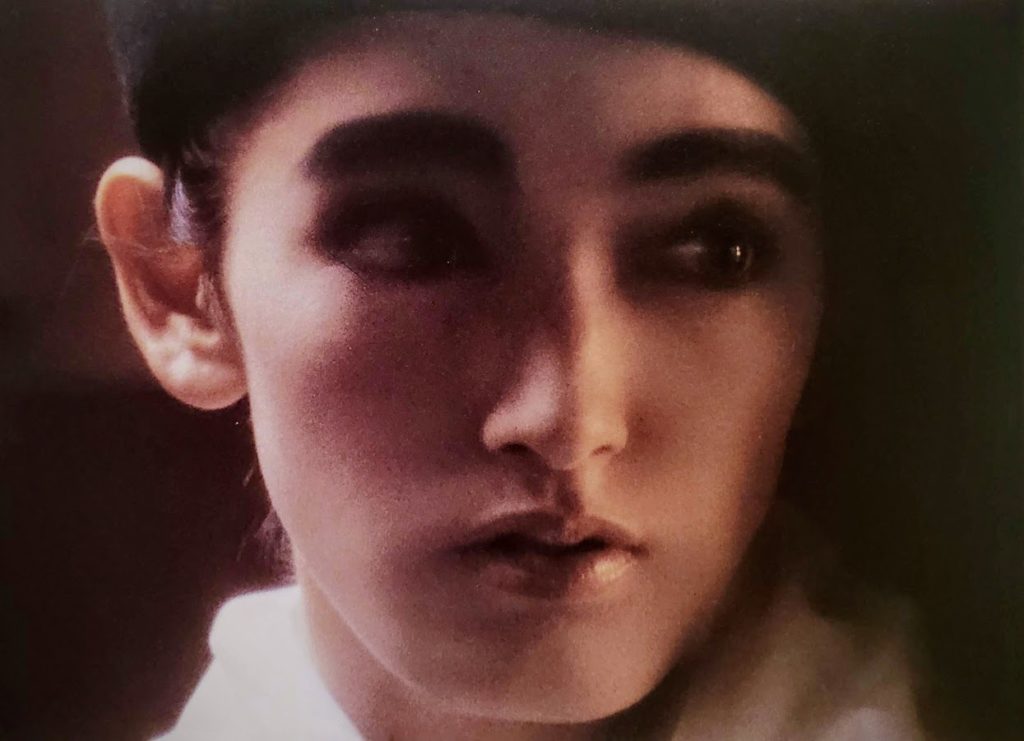
Very few acts pull of “ethereal” quite like Dip In The Pool. I often compare them to Cocteau Twins. Their otherwordly charms and haunting vibe create an atmosphere that is simultaneously comforting and alien. Both relaxing and off-putting. This is almost entirely due to the incredible vocals of Miyako Koda. Yes, the sparse instrumentation does well to create that distant-yet-calming feel, but it’s really her voice that puts it all together. Simply put, its heart-crushingly beautiful. An aural sedative. Nothing, absolutely nothing, rips out my anxiety and throws it into a sonic wading pool of chamomile tea and lavender essence quite like Miyako Koda’s voice. It’s heaven.
Of course, nearly everything the band has ever released is out-of-print. Because of course it is. As of right now, only a handful of singles and remixes on for sale on iTunes. And Spotify only has a smattering of tracks and one album, none of which are their best. Dip In The Pool’s early work, all of which came out in the 80s, is just heaven on earth. And it’s a hell of a situation that we can’t listen to any of it easily.
I’ve been lucky and have been able to snag up quite a bit of their work since I moved to Japan, but even then it’s not easy. I got two albums only because they were re-released (on vinyl only for some reason). Everything else I got is vintage, and I paid accordingly for it. I’ve never even seen a CD of theirs for sale. Some can go for a quite a bit online.
The tracks I’m sharing tonight are some of my favorite by the group, and make up the entirety of their 1985 self-titled debut EP. All of these tracks would later on appear on the band’s 1988 debut album, which was released as Silence in the UK and was self-titled in Japan. Rough Trade actually released the album in the UK, and if it was their decision to name the album after “Silence,” I can totally see why. For me, it is the stand out tune by a group that has loads of them. Koda’s vocals (did I mention that I like them) are absolutely angelic here, and the complete absence of any real beat lets the song just float over you like a cloud.
After the brief interlude “Hinamari,” things kick up a notch with “Hasu No Enishi.” There are actual beats! It has a tempo! A lot of Dip In The Pool sounds like this, honestly. I’ve been focusing a lot on their more minimal and ambient side, but they had their share of upbeat numbers. Still, “upbeat” for Dip In The Pool is rather chill. Koda’s not Madonna, even on a track that has the tempo to qualify as a dance number, she’s still going to take her damn time and deliver a sedate, prolonged vocal that slows the whole thing down to her pace.
The EP closes with “Facing The Sea,” which splits the difference between the purely ethereal “Silence” and more beat-driven track that precedes it. There’s a pulsing beat here, but it’s little more than a click track, pushed back in the mix in exchange for some lovely synthesizer bells that work to match the melody put out by Koda. Again, it’s the kind of lovely, happy, pretty music that, after the reading the news or dealing with an exceptional bad day at work, is all I want to listen to.
This blog is intended to shine light on music that has been unjustly lost through the years. If you can find the stuff here, buy it. Songs are only available for a limited time.
If you own the copyright to anything here, email me at lostturntable AT yahoo DOT com and I will have them removed.
RANT
For the love of God don't leave random requests in my comment section. If I have it, I'll post it here eventually, nothing you say is going to make me buy a record you're too damn lazy to find yourself.