Archive for the ‘Complete Albums’ Category

The Wrestling Album – AKA The Worst Album Ever Recorded

Tuesday, October 14th, 2014

I got a few new followers it seems, so I’d like to let all of you know that I actually have another website called Mostly-Retro, where I ramble about all things music, movies and games (but mostly music). Check it out. Right now I’m writing about obscure grunge rock. I’m sure that appeals to someone either than me. Maybe.

Moving on. When I posted Hulk Hogan & Itch-Band a few weeks back I had a sneaking suspicion that it would catch on and gain some traction with the online wrestling community. However, I didn’t suspect that it would be the most popular thing I’ve written all year. Like, by a lot. My hits usually hover in the mid-to-high hundreds. That one garnered me a few thousand. And if I’m anything I’m a sucker for attention so, congratulations you all, you made me do this.
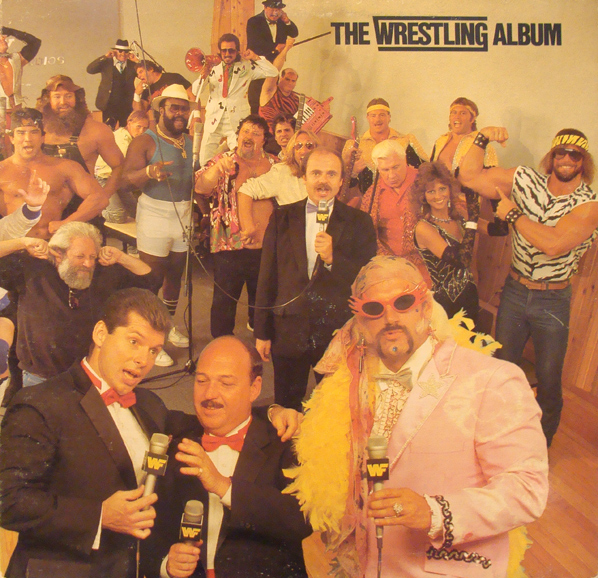
wwf

The Wrestling Album (Complete Album Download)
The Wrestling Album, released in 1985 and the he first WWF/WWE album. It was produced mostly by Rick Derringer with some assist by Cyndi Lauper, under the pseudonym of Mona Flambe. It features 10 tracks in total, and is a combination of wrestler theme music, oldies covers, a few comedic bits and original tunes. All singing duties on the album are performed by either wrestlers or other WWF personnel, with appearances by Junkyward Dog, Jimmy Hart, ‘Captain’ Lou Albano, and many others. The album is mostly known for its all-star single, a cover of “Land Of 1,000 Dances ?!!?” that features pretty much every wrestler the WWF had at the time.

Oh. And its the worst album I’ve ever heard in my entire life.

And that’s really saying something! Because A: I’ve listened to a lot of shitty albums and B: I actually like two tracks on this record. But it goes to show you just how damn bad the rest of it is.

But before I get to the dogshit, the good tracks. First up, Derrenger’s “Real American.” While it’s most famous for being Hulk Hogan’s theme music during the majority of his time in the WWF, here the song is billed as the theme music to the U.S. Express tag team. However, they bailed on the WWF not long after this album came out, so the song was re-purposed as the Hulkster’s theme music. Still a classic, I get goosebumps of nostalgia every time I play it. Not just that, I do think it’s an honest-to-goodness good song. Not many songs can be blatantly patriotic while avoiding sounding nationalistic, so good job on Derringer for pulling it off.

Trivia note: the backup vocals are by Cyndi Lauper!

The other good track is “Hulk Hogan’s Theme.” This served as the theme to Hulk’s cartoon and was, as the title suggests, was also Hulk’s theme song for about five minutes in 1984. This track was written by Jim Steinman of Meat Loaf fame, and would go on to be reworked as “Ravishing” by Bonnie Tyler. So yeah, it’s an alright tune.

Okay, now that I got that out of the way – everything else on this album is dogshit of the worst variety. “Mean” Gene Okerlund covers “Tutti Frutti” and it’s abysmal. Jimmy Hart drops the dis track “Eat Your Hart Out Rick Springfield” and – wait a second, “Hart?” Is Jimmy Hart asking Rick Springfield to eat…okay I’m gonna move on now before I get incredibly unfortunate mental pictures stuck in my head.

One of the stranger tracks on the album is “Rowdy” Roddy Piper covering the obscure Mike Angelo & The Idols’ track “Fuck Everybody” renamed to “For Everybody.” This, of course, completely changes the meaning of the song into complete nonsense, but that’s the least of its problems as Roddy can’t sing for shit. Seriously, he sounds like someone is pulling out his testicle hair with a pair of tweezers. There’s a reason why They Live didn’t have a musical number.

Junkyard Dog, Hillbilly Jim’s , and Nikoli Volkoff all have songs too, but they’re just run-of-the-mill horrible and barely worth talking about. What is worth talking about, however, is “Captain Lou’s History Of Music/Captain Lou.” This is the worst song I’ve ever heard in my entire life. No question. The constant wailing by The Animal, the hideous carnivalesque music, the bland production (thanks to Cyndi Lauper) and, at the forefront of the shit, Captain Lou’s atrocious, hideous, craptastic singing. If you have any esteem for Captain Lou, wrestling, Cyndi Lauper or pretty much “the 80s” as a singular thing, you’ve been warned – this might destroy all of that.

As for the all-star rendition of “Land of 1,000 Dances ?!!?,” well, that’s just kind of cute. I mean, yes, its horrible and not a single wrestler who makes an appearance on the track can actually sing, but none of them are really trying to. It’s just a joke track, a novelty number and nothing more. Yeah, the joke is horrible and the novelty wears off after about one minute, but it’s a hard song to outright hate. Or maybe my hatred for it is just dulled because, when compared to the sonic manure that makes up the rest of the record, it’s downright Grammy-worthy.

The WWF certainly thought the track was noteworthy. It was the only song from the album to get a video, and they even released it as a 12″ single, complete with an extended version and an instrumental. Now, I know what you’re thinking, what idiot would be dumb enough to buy that?

Yo.

The Wrestlers
Land Of 1,000 Dances (Dance Version)
Land Of 1,000 Dances (Instrumental Version)
So if you were listening to the album version of this track and thought, “you know what? This needs to be about two minutes longer and end with a wicked drum solo,” then you are in luck. As for the instrumental, you should download it just so when people ask you “what’s the dumbest, most pointless song in your MP3 collection? you have an easy answer.

Enjoy the horribleness. One more wrestling album coming soon.

It’s slightly better than this one.

Slightly.
Hulk Hogan & Itch Band

Wednesday, October 1st, 2014

001

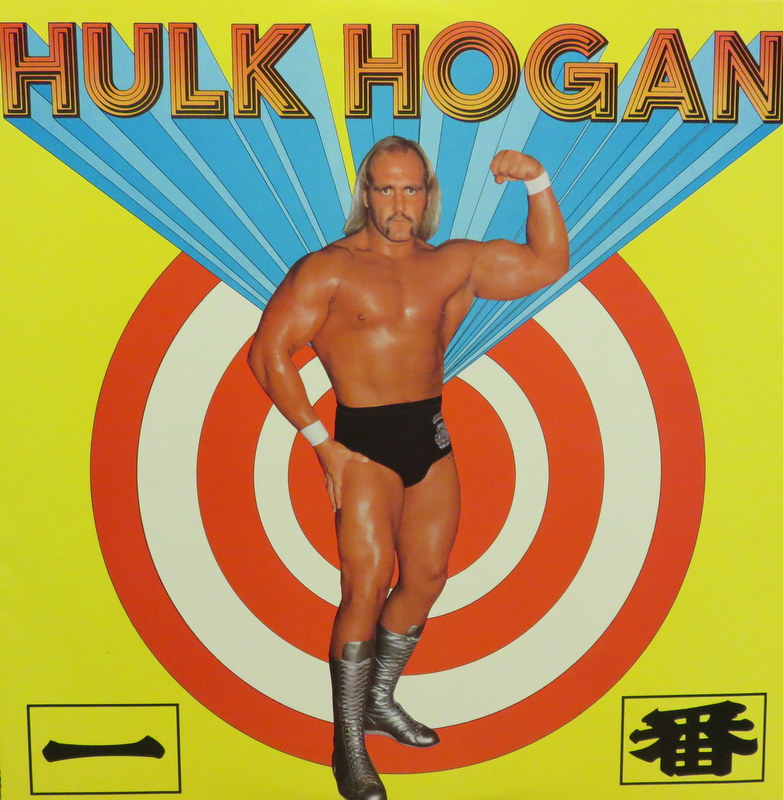
Hulk Hogan & Itch-Band
Itch Ban
Night Home
You’ve Got To Leave
Axboomba

From 1972 to 1976, Telly Savalas, better known as TV’s Kojack, released four albums. All of them are generally regarded as being horrible mistakes that should have never existed in this reality or another. Today they are forgotten, and justly so. However, I remember reading once that, when asked years later, why he released not one, but FOUR horribly hideous albums, Savalas replied simply, “they let me.”

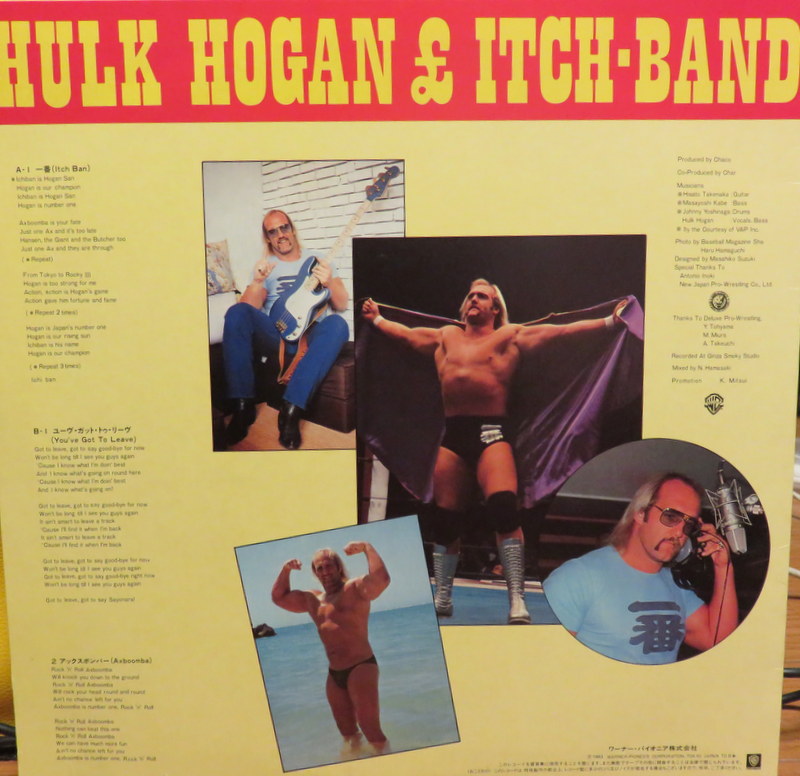
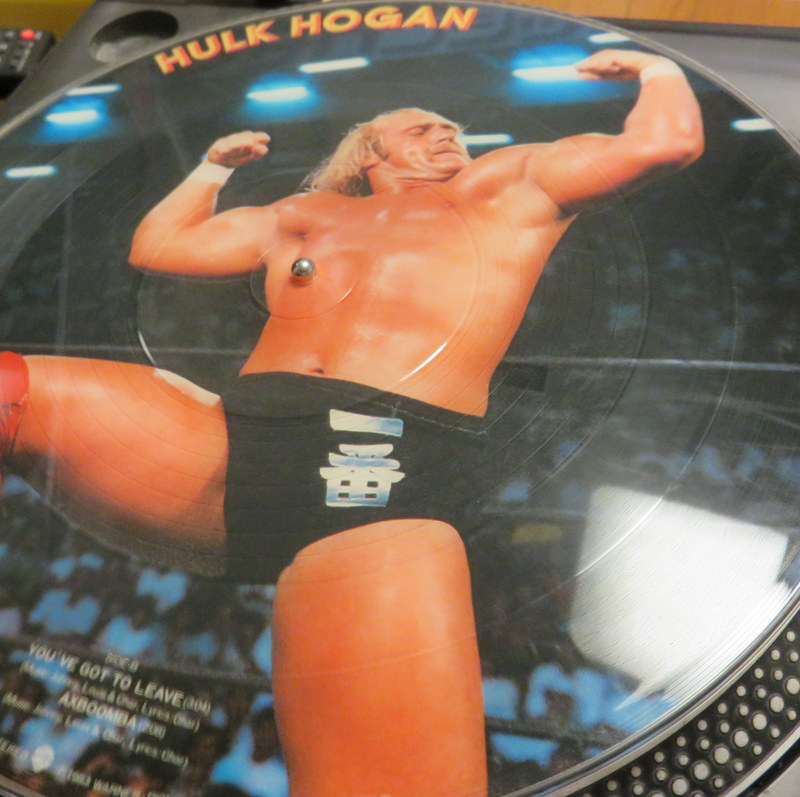
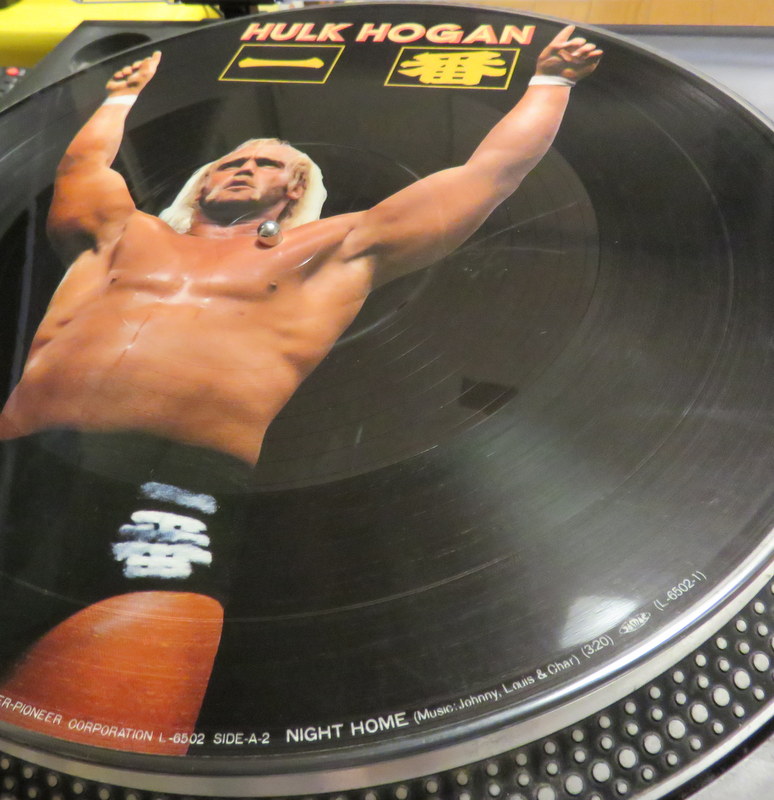
I feel that a similar explanation probably lies behind Hulk Hogan & Itch-Band, the Hulkster’s 1983 self-titled EP that was released only in Japan. He must have said to someone “I want to release an album” and that someone had enough power somewhere to let that happen. That person must be put on trial for crimes against humanity.

The album was recorded and released during the tail end of Hulk’s run in the New Japan Pro Wrestling League, where Hogan was so damn popular that his nickname was simply “Ichiban” which means “Number One.” I guess that partially explains why Hogan’s band name is “Itch-Band,” but why they just didn’t go with “Ichiband” is beyond me.

004

There are four songs on Hulk Hogan & Itch-Band. The first is “Itch Ban,” a self-aggrandizing boast track where Hogan exalts the power of his wrestling skills; his massive wealth; and even his cameo appearance in Rocky III, all to a disco-funk beat and a chant-like chorus of “Ichiban is Hogan San! Hogan is our Champion! Ichiban Is Hogan San! Hogan is number one!”

And it must be said, right up front, that Hogan’s singing voice is one of the most atrociously awful singing voices I have ever had the extreme displeasure of hearing in my entire life. It is so horrific that I didn’t actually recognize it as his voice the first time I listened to the record. I guess I expected Hogan to sing like he talks, all deep and gutteral and “what’s you gonna do brother!” But instead he sings in this bizarre high-pitch with a strange accent that sounds like…I don’t even know how to describe it….like a mentally handicapped Hanna-Barbara cartoon villain? You know how the bad guys in cartoons always make that “bwa ha ha” laugh? That’s Hogan’s singing voice…maybe with a touch of Jimmy Hart thrown in for good measure.  It’s something that has to be experienced, it escapes words.

028

After that nightmare abortion from hell we’re treated to “Night Home” a quiet instrumental number where Hogan gets to showcase his…surprisingly decent bass skills. That’s right, Hogan plays bass, and he’s not that bad! Who knew? Actually, as a whole the music on Hulk Hogan & Itch-Band isn’t horrible – it’s just Hogan’s singing voice and the ridiculous lyrics that sink it, both of which return after that instrumental interlude.

First, we’re treated to “You’ve Got To Leave,” where Hogan laments his upcoming departure back to the states, followed by “Axboomba,” an ode to Hogan’s then-finishing move of a running arm lariat (and totally not as cool as the flying leg drop). Throughout both Hogan’s vocals rest somewhere between the sound of nails on a chalk board and the howls of a cat in heat in terms of annoyance and auditory displeasure.

031

Hulk Hogan & Itch-Band might be one of the worst records I’ve ever bought. Although musically benign, Hogan’s horrific howling, matched up with some inane self-important lyrics, truly outshine any talent that was put into the music. Beyond hideous from start to finish, its only saving grace is that, with a brief four tracks and a running time under 12 minutes, it manages to stay firmly in so-bad-it’s-entertaining territory simply because of its brevity.

But it’s still better than WWF’s Wrestling Album. At least it doesn’t have Mean Gene singing “Tutti Frutti.”

Fight Music For The Fight – Bare Knuckle DJ Mix by Yuzo Koshiro

Saturday, September 6th, 2014

I came to Japan for a lot of reasons. I wanted to teach people and try and do something that actually can make a difference in people’s lives. I wanted to expand my comfort zone and try new and exciting things. I wanted to meet new people, make new friends and go on exciting new adventures.

All that and, y’know, buy DJ mixes of classic video game music.

The important shit.

Bare_Knuckle_Original_Soundtrack_A

Yuzo Koshiro
Bare Knuckle Legend Mix 
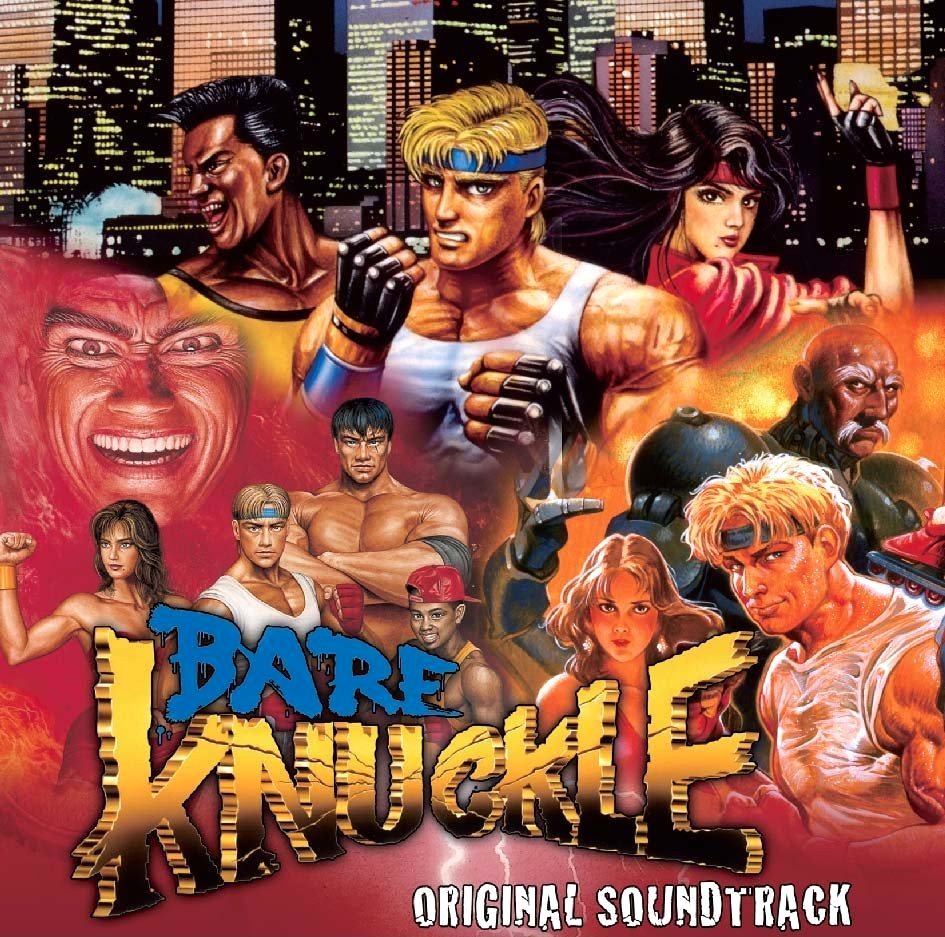
One of the first game music CDs I bought when I came to Japan for vacation last year was a copy of the Bare Knuckle II (AKA Streets of Rage II) soundtrack. It cost me nearly 50 bucks, but it was worth it, because that game’s music is, no doubt, some of the best music ever put on a cartridge. I want Yuzo Koshiro to score my life. I’m sure if he did it would be hella exciting, and feature 50% more dropkicks. And we all know dropkicks are the most dope kicks.

At least, I thought it was worth it, but that was because no one ever told me there was 4 CD VERSION WHAT THE FUCK.

Four CDs of Streets of Rage music. God. Damn. That’s my jogging soundtrack for the next month (that and the Pointer Sisters’ Break Out, did you know that’s one of the greatest albums of ll time, cuz it totally is). How do you fill up 4 CDs of music from Streets of Rage?

GOOD QUESTION allow me to answer it.

Not only does this set have the entire soundtrack to Streets Of Rage and Streets of Rage II for the Sega Genesis (Mega Drive), but it also includes, in their entirety, the complete soundtracks to the Game Gear versions of both games. That’s the kind of attention to completist overkill that I can really get behind.

The cherry on top is the fourth CD, which includes an exclusive DJ mix of the music from the series by Koshiro himself. That is what I’m sharing tonight. He apparently mixed this live at some game music club event in 2002. That’s incredible. Are game music DJ mixes a regular thing in Tokyo? If so, then fuck I’ve been going to the wrong clubs. I want to get my groove on to a non-stop Mega Man mix.

Wait, YOU KNOW WHAT WOULD BE GREAT? Gradius DJ mix. No, wait, a Darius DJ Mix. On second thought, no, that would just be too damn weird. On third (fourth? I’m tired) thought, I just want someone to do a DJ mix that combines all of the greatest game music of all time. Double Dragon, Tempest 2000, Shinobi, Afterburner, Pac-Man DX, you name it. Girl Talk that shit. Mash it up. That would be epic.

And they have to end it with Vib-Ribbon. Because there’s no time hurry up everything is so fantastic.

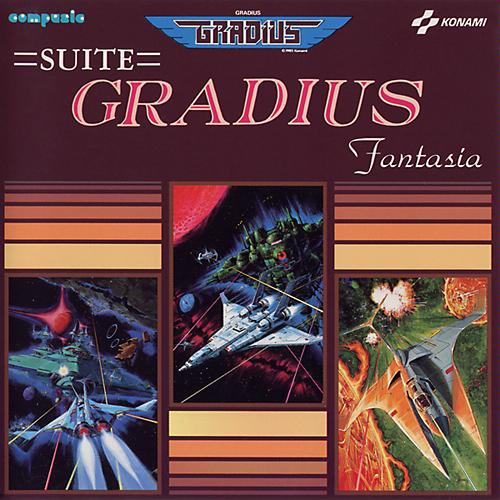
Suite Gradius Fantasia (It’s Sweet)

Thursday, July 31st, 2014

In keeping with my “needlessly symphonic” theme… gradius Suite Gradius Fantasia
Overture
Navigation
The Ancient Planet
Gradius Sonata
Return to The Planet
Perpetual Aria

Gradius Fantasia
Farewell
Okay, so I’m not saying that the “Overture” to Gradius, redone with a full motherfucking symphonic orchestra (because why the hell not?) is one of the greatest pieces of music ever pressed to vinyl. I’m not saying that, okay?

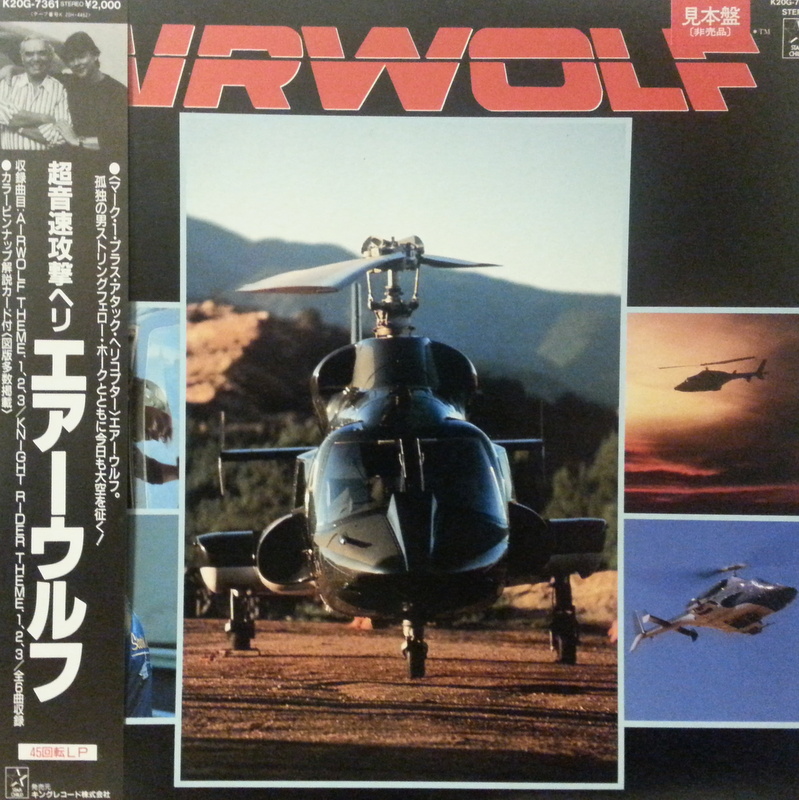
But I am saying that it definitely, without question, kind of sort of holds its own to the symphonic version of the Airwolf theme – in as much as that I could totally see it as the theme song to an mid-80s sci-fi space drama. It’s certainly better than that bullshit theme music to the V series from 1984.

Anyways, I’m getting off topic, Suite Gradius Fantasia was released in 1988, near the tail-end of the big craze of game soundtracks in Japan. Now, don’t get me wrong, game soundtracks continued to be a pretty big deal over here, but in the mid-80s they were fucking huge. Countless games got full-fledged, prestige soundtrack releases, many times redone with full symphonies. And as I’ve mentioned before, many game publishers, both big and small, worked with game music label GMO to put out compilations featuring original and remade versions of themes from their most popular games.

The most well-known symphonic game scores of this time are most likely the Dragon’s Quest ones, but a lot of other games got the symphonic treatment as well- including Gradius. Although to be honest, this release really isn’t a proper symphonic album. Only two of the tracks (the Overture and the 10+ minute “Gradius Fantasia”) feature a proper full orchestra, the rest just feature a string quartet – but they’re also quite good.

I’m no maestro, I don’t know much about classical music, but I think this is a damn good album, one that can certainly hold its own against major movie soundtracks of the era. Hope you enjoy it too.

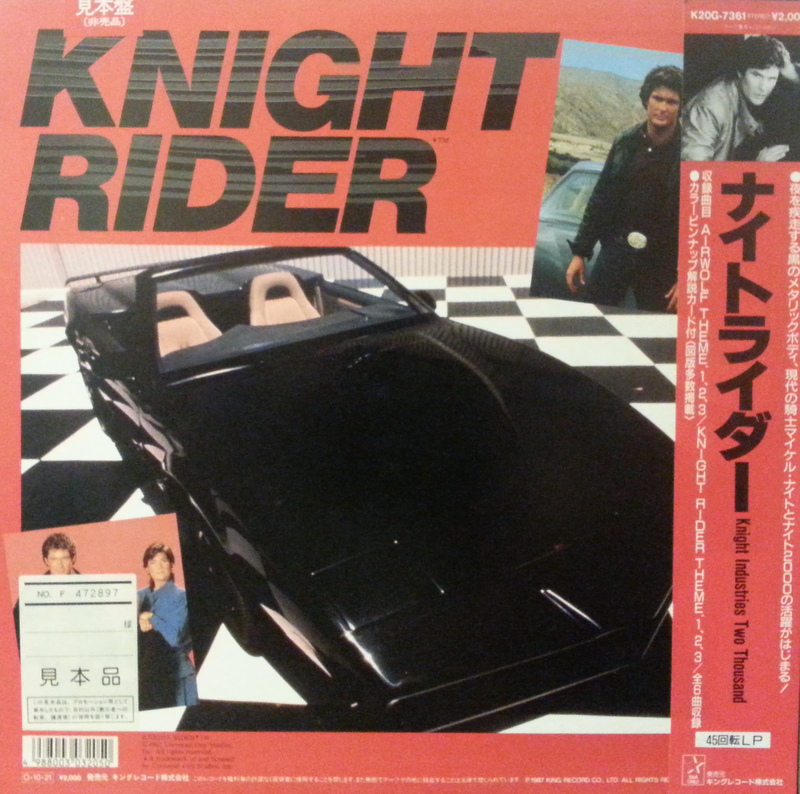
Now that I have these themes to Knight Rider and Airwolf I feel that I can do anything

Tuesday, July 29th, 2014

Somewhere, buried in a scrapbook, photo album or shoebox is a photo.

It is a photo of me at the (then) happiest moment of my life.

It is a photo of seven year old me in motherfucking K.I.T.T.

Goddamn that was a good day.

Man, remember when TV was awesome? TV used to be awesome. And I don’t mean bullshit critically acclaimed awesome of today’s TV. I mean talking cars, flying motorcycles, shapeshifting detectives, cyborg secret agents, electro-kinetic guitarists and Night Court.

What’s on TV now? Shitty sexist sitcoms, non-stop reality TV, and over-the-top exploitation garbage disguising itself as art.

Yeah, there’s a lot of good stuff out there I guess. TV shows with nuance, interesting, complex characters, dramatic tension, and amazing acting. But fuck that shit. When I turn on the TV, I want to escape from reality completely and without question. I want to be free of tension, depression, anxiety and sadness. I don’t want to be reminded of anything horrible, any of mankind’s ills, and of the horrible problems in the world. I want to see a man and a talking car fight crime. I want to see a helicopter take out…whoever the bad guys in Airwolf were (it’s been a while). And I want to see it without a hint of pretense, without any suggestion that the people behind the scenes are thinking for one second they are making art (which was the problem with Lost, Heroes, and just about any other “serious” sci-fi show of the past 15 years).

And I’m sure there are a lot of TV fans reading this right now thinking that I’m full of shit. Fine, maybe I am full of shit. Maybe you (and everyone else) was right and Breaking Bad was actually a great show; maybe Game of Thrones is actually a well-written fantasy that doesn’t bank on controversy and sexism to bring in the ratings; maybe the Big Bang Theory actually is funny (FUCK YOU NO IT’S NOT).

Maybe all that is true. But I’ll tell you one thing; none of those shows, not a single one, have a theme song as epic as the theme song to Airwolf.

20140729_205420

20140729_205407


The Japan Symphonic Orchestra/K.R. Right Project
Airwolf Theme 1
Knight Rider Theme 2
Knight Rider Theme 1
Knight Rider Theme 3
Airwolf Theme 3
Airwolf Theme 2
I fucking love Japan and stuff like this is why. An EP comprised entirely of cover versions of theme music from Knight Rider and Airwolf, two shows that had absolutely nothing in common, not even networks, aside from the fact that both had utterly amazing theme music (and completely radical vehicles as the title characters). Why release something like this? Because the Japanese know amazing music when they hear it.

The first track is an extended, very extended (eight minute!) symphonic take on the Airwolf theme. And yes, it is as unbelievably amazingly spectacularly stupendous as you think it is.

The other five tracks are primarily synthesized versions of the music from both TV shows, featuring elements from the series’ incidental music as well as the main themes.  They’re all amazing, but hey, when you lead with an eight minute symphonic version of the motherfucking Airwolf theme, other shit just seems weak in comparison.

By the way “K.K. Right Project” is actually Kenji Kawai, a Japanese composer who worked on about a billion different Patlabor projects.

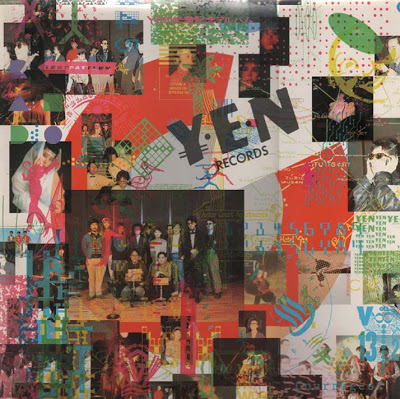
Yen Memorial Album

Thursday, July 24th, 2014

yen

I’ve written about Yen Records before, but in case you’re just joining us for the first time – Yen Records was a sub-label of Alfa Records, launched in the early-80s by Japanese electronic superstars Yellow Magic Orchestra (YMO).

The label pretty much became a clearinghouse for YMO to release music by their friends and colleagues. YMO members Yukihiro Takahashi and Haruomi Hosono often performed on many Yen releases, as did Ryuichi Sakamoto, albiet to a lesser extent.

In 1984, Yen Records founder Kunihiko Murai passed away, and this record is a tribute to him – featuring many exclusive tracks and remixes by a wide variety of Yen artists. It’s a great record, and an excellent summary of the Yen label. I hope you like it.

Yen Artists
God Be With Us Till We Meet Again
Platonic Stochastic
I don’t know who the “Yen Artists” are, but if the rest of this album’s tracklisting is any indication, I suspect that these tracks include all three members of YMO, Tachibana, Koji Ueno and Jun Togawa, among others. The first track is, I think, an adaptation of an old hymn, and it was written by Yukihiro Takahashi and Haruomi Hosono. The second is a very unusual, almost musique conrete, composition that was written by Ueno.

Yellow Magic Orchestra
Rydeen (Remix Version)
I own 27 different versions of “Rydeen,” so I’m fairly confident in saying that this remixed version is exclusive to this album. It’s not all that different than the original cut, it actually comes off more like a single edit with some really random sound effects thrown in, but goddamn if it isn’t a great piece of synthpop.

Hajime Tachibana
Rock (New Recording)
Previous Tachibana I unearthed featured him sounding like Art Of Noise. This has him sounding like Art of Noise meets 80s-electro era Herbie Hancock. Robot vocals! Sweet keyboard riffs! Sequencers! Loving every minute of this.

I bet Daft Punk have this track on vinyl.

Sandii & The Sunsetz
Sticky Music (Remix French Version)
I posted some Sandii stuff a few months back. I’ll probably be deleting those links in a day or so. So if you’re interested in them, check that post out.

Sandii is fucking great though and I love her. So expect more Sandii on Lost Turntable in the near future.

Guernica
Maronie Dokuhon (Remix Version)
Guernica is Kenji Ueno and Jun Togawa. Seperately they released classical piano music, synthpop, prog rock and damn near everyting in between. Combined they sound like some bizarre fusion of opera, cabaret and YMO backing tracks. Like Klaus Nomi? You’ll probably like this.

Miharu Koshi
Petit Paradis (English Version)
One of the many idol-type singers who Haruomi collaborated with during the Yen years. I don’t know how popular she was during her peak, but she’s continued to be incredibly prolific, sometimes going through periods of releasing albums on a near annual basis. This is a cute song, very typical of the kind of stuff that Hosono was releasing with other artists at the time.

Inoyama Land
Pokala (Remix Version)
Inoyama Land were a duo comprised of Makoto Inoue and Yasushi Yamashita. In 1983 they put out their first album, Danzindan-Pojidon, on Yen Records. It’s a pretty great collection of ambient electronica, and if you dig Tangerine Dream, Diskjokke or The Orb, I think you might like it. It’s never been released on CD outside of the super-pricey Yen Box though, so it’s probably a bit hard to find. I’ll probably put it up here someday.

The group also has two other releases, both coming out years later in the late 90s. I think at least one is a compilation of unreleased material. Outside of Inoyama Land both Yamashita and Inoue were members of a group called Hikashu, one of the only Japanese synth-pop acts from the era who don’t seem to have any YMO connections.

Keiichi Ohta
Seean No Kodomoichiba (Remix Version)
This man only released one album, the utterly strange collaborative effort with no English title that is based on an obscure Japanese novel. This track is a remix of a song from that album, and features operatic vocals by Makito Hayashi, who never released anything on her own. The track was written by Keiichi, but was produced by Hosono and Takahashi, and features keys by Koji Ueno, practically making this a YMO track.

Koji Ueno
Adagietto (Remix Version)
Ueno is on so many tracks on this record that it’s nearly an Ueno LP. All this Ueno has left me wanting to know more about him, so I went digging on Discogs. Apparently this man is (or at least was) a goto studio player in Japan, and has appeared on dozens of albums, including many from YMO members and associates. From what I can gather, he’s an accomplished pianist, violinist and bass player – but I wouldn’t be surprised if he’s an accomplished marimba, saxophone and flutist as well. Dude seems like the type.

This is a very mellow piece, unlike just about anything else on the album – classical almost. Very relaxing.

Yukihiro Takahashi
It’s Gonna Work Out (Remix Version)
This is a remixed version of a track that appears in its original version on Takahashi’s 1982 album What, Me Worry? Like pretty much all things Takahashi-related from the 80s, it’s pure gold. The more of Takahashi’s solo stuff I hear, the more I think he was the most talented pop musician in YMO. Sure Hosono and Sakamoto may be more technically gifted and diverse than Takahashi, but I’ve never heard pop music by either that’s as good as some of the stuff on Takahashi’s solo records. The man is incredible.

Super Eccentric Theater
Beat The Rap (Remix Version)
Super Eccentric Theater (Or S.E.T.) was a comedy troupe that was on Yen Records. I think I can hear Yukihiro on this track in the chorus.

This is their send-up of rap music.

It’s not funny.

Testpattern
Modern Living (Remix Version)
Testpattern released one album, 1982’s Apres-Midi, which I snagged a while back. I love it, even if they do sound a bit like YMO also-rans with a more mellow, easy-listening sound. This is a remixed version of a track from that album, and it’s better than the album version thanks to some nice added synths.

Jun Togawa
Do Not Renai (New Recording)
The singer of Guernica strikes again, this time with a nice synthpop ballad. This sounds like early Kate Bush. So those with a low tolerance for squeaky vocals may want to proceed with caution.

Interior
Hawks (Remix Version)
Interior put out a couple of records in the early 80s. I have one, and to be honest it’s nothing to write home about. Their instrumental tracks were okay, but whenever they tried to add vocals to the mix they just sounded bland and boring. This is an okay song, but nothing really memorable either.

Tamao Koeike
Kagami No Naka No Jugatsu (Remix Version)
The name may read Tamao Koeike in the LINER notes, but this is a YMO track. They wrote it, and they perform all the instrumentation on it. Koeike is just the singer. And she apparently didn’t really impress anyone at Yen Records, as the single for this track was the only thing she ever released. A shame, as it’s not a bad tune and she has a nice voice.

Haruomi Hosono
Yunemiru Yakusoko (Original Version)
Typical Hosono stuff from the 80s – meaning that it’s really damn good.

The Super Flyest

Wednesday, July 23rd, 2014

I NEED HELP SOMEONE HELP ME.

There is an insanely awesome super deluxe edition of Frankie Goes To Hollywood’s Welcome To The Pleasuredome coming out later this year via PledgeMusic. However, do to stupid bullshit lawyer shit, it can’t be purchased by anyone living in the US or Japan. As those are the only two billing addresses I have, I’m screwed.

Would any of my UK/Australia/wherever readers be so kind as to buy it in my stead and mail it to me? I’ll pay for everything, including shipping, of course. I’ll even send you some tunes if you so desire.

If so, leave a comment with your email address. I won’t approve it, I’ll just use it to contact you. Thanks!

Someone helped me out! Thanks for all the offers everyone!

And now for something completely different.

tnt

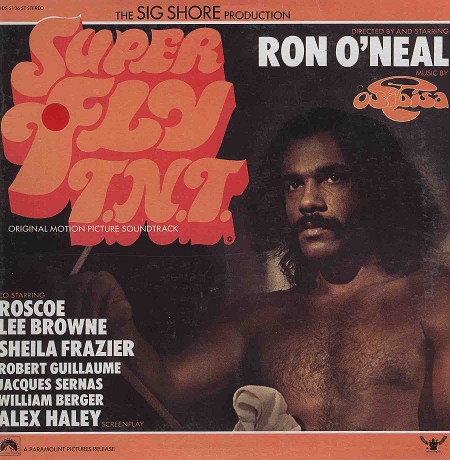
Super Fly TNT – Original Motion Picture Soundtrack

The original Super Fly is widely regarded as a classic of the “Blaxploitation” era of films, and is typically mentioned in the same breath as other classics such as Shaft, Foxy Brown and Cleopatra Jones. But here’s the thing about Super Fly – it’s really not that good a movie.

I mean, yeah, it’s not a bad movie. It certainly oozes style, and Ron O’Neal is one of the coolest motherfuckers who ever graced the silver screen. But it’s a pretty boring flick. It meanders for far too long, the acting is at times incredibly weak, and it’s not even directed all that well. And it’s entirely lacking in Antonio Fargas, who was literally in every other blaxploitation movie from 1969 to 1978. The only reason why we still talk about Super Fly to this date is because of its soundtrack, which is still probably one of the top five greatest soundtracks of all-time (a list that, for me, includes Purple Rain, The Crow and Flashdance and I will not budge on that).

But while Super Fly isn’t a great movie by any stretch of the imagination, I’m going to assume that it’s better than the sequel Super Fly T.N.T., which came out just a year after the 1972 original.

I say “assume” because, while I’ve read a great deal about the flick and have watched the odd clip on YouTube, I’ve never actually seen the movie in its entirety. It’s barely been seen by anyone since it’s original theatrical release, in fact. It would occasionally resurface on VHS throughout the mid-80s (I know my dad’s video store had a copy) but that was about it. As far as I know it has never been aired on cable television and its never been released on Blu-ray, let alone DVD, or even freakin’ laserdisc. It belongs in the pantheon of great lost films still searching for a new home video release, alongside other classics such as Willard, Rad and Meatballs III, y’know – classics.

Equally rare is the film’s soundtrack, which was performed and composed by African band Osibisa. It was released on LP alongside the film in 1973 and that was it for that. Judging from its rarity it appears that it never even got a second pressing on vinyl, and to date has never had an official CD release. And it’s a damn shame, because while I can’t speak to the quality of the film from which it came, the soundtrack to Super Fly T.N.T. is some dope shit. An amazing combination of funk, African music, and even some rock elements, it holds up amazingly well.  Check it out.

But whatever you do, don’t check out anything that’s even remotely involved with the second Super Fly sequel; The Return of Super Fly. Amazing VHS box art aside, that is not a quality flick.


Bakersfield Boogie Boys WTF

Thursday, July 17th, 2014

bakers

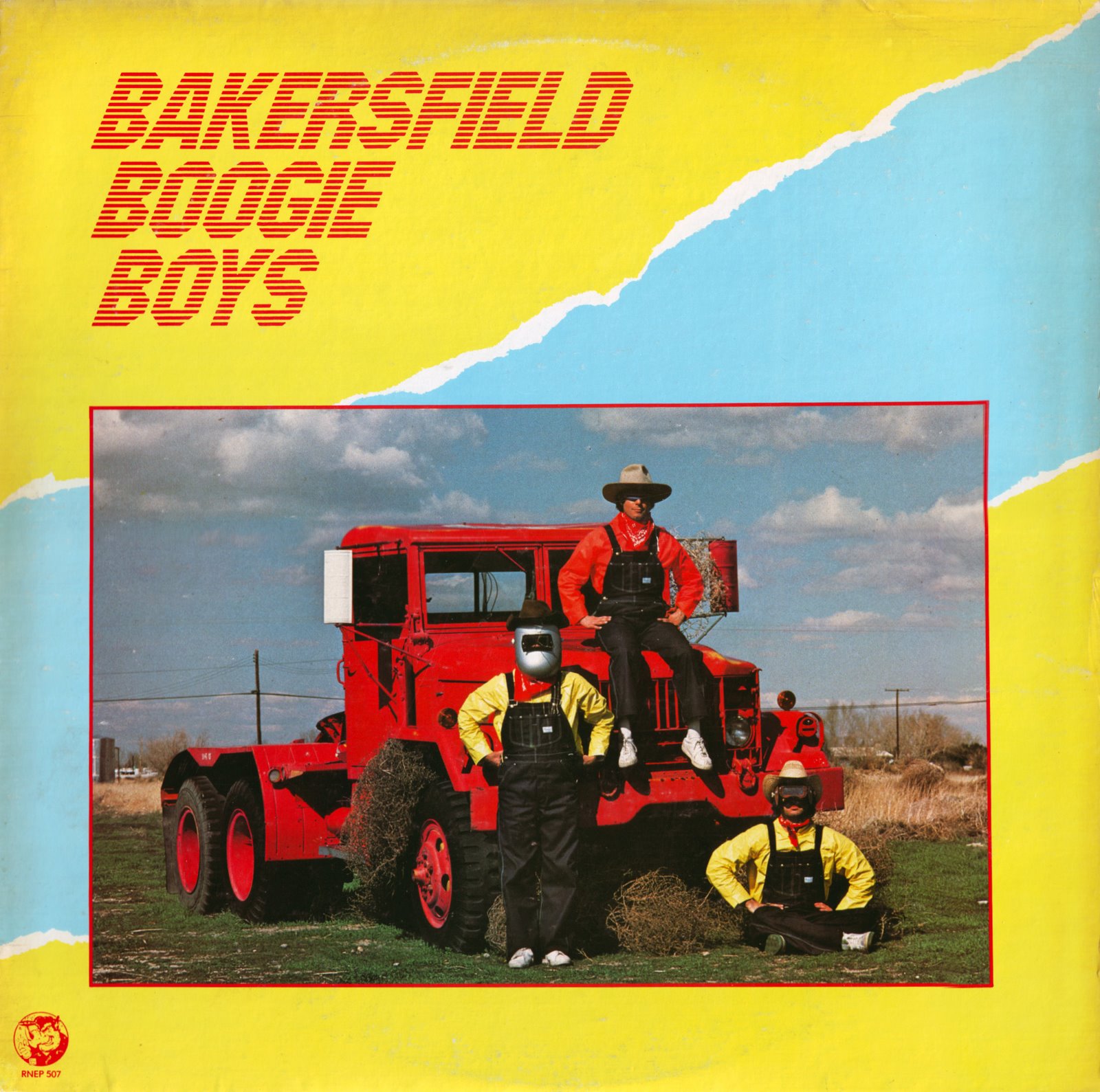
Bakersfield Boogie Boys
Okie From Muskogee
Get Off My Cloud
I Get Around
Flying Tigers
Okay, so this is a thing.

Don’t know much about this one, I bought it in Pittsburgh several months before I headed off to Japan. I can’t even remember why. Probably because it was stupid.

Yeah, that’s probably why. That’s why I buy a lot of things.

I guess this would be early electro? Maybe early electro combined with some new wave, post-punk and art-rock thrown in together. All mixed with some Dr. Demento style humor as well.

What I’m saying is, it’s fucking weird.

There are almost no performance credits on the album, but if I had to hazard a guess, I would suspect that two of the group’s members were Richard Foos and Harold Bronson – the co-founders of Rhino Entertainment, which was previously a novelty record label before becoming the world’s goto re-issue label. They’re both credited as producers on the LP’s limited linear notes and they both contributed to a few other novelty and comedy records of the era.

The only performer credited at all on the album is Shari Famous, the vocalist for the covers of “Get Off My Cloud” and “I Get Around.” When searching for info on her online I found that her full name is Shari Famous Foos, so I assume that she is/was Richard Foos wife. She also was in a shitload of never-made-it groups during the early years of punk, as this interview with another punk also ran, Rich La Bonte, points out.

If you couldn’t gather from the song titles, the first three tracks on this EP are covers, with “Flying Tigers” being the only original track (at least I think it is). That last track actually features some pretty good guitar work, and some of the strangest lyrics I’ve ever heard (“plastic waffles of my dreams”).

The next time someone says to me “Oh, you live in Japan? That place is so weird, right?” I’m going to show them this.


Disco Space Invaders! Mario Bros.! Wow! Exclamation Points!

Tuesday, July 15th, 2014

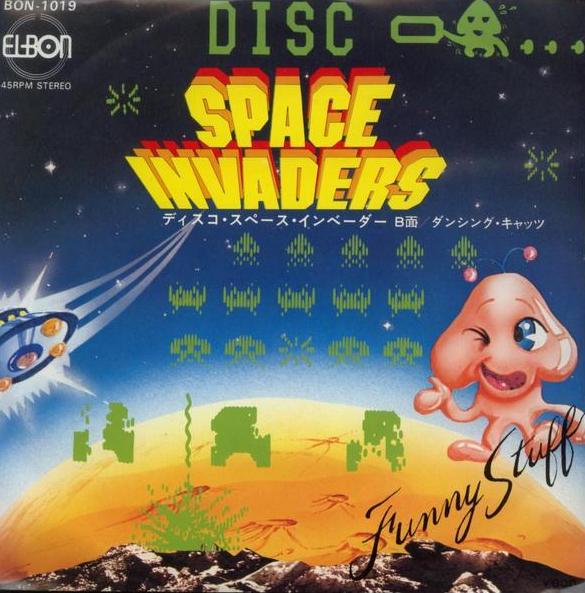
Disco Space Invaders

disco

Funny Stuff (Seriously, that’s the credited artist)
Disco Space Invaders
Dancing Cats
Disco Space Invaders is not game music per say. In fact, it barely has anything to do with the game from which it was allegedly inspired. The title track only features sound effects from the game for a few brief seconds before diverging completely into an entirely unrelated (and entirely amazing) disco track. And from what I can tell, the hilariously-titled b-side “Dancing Cats” has absolutely nothing to do with anything (except for dancing cats).

However, it did come out in 1979, one year before the first Pac-Man children’s records were released in the states; two years before the similar-in-tone “Pac-Man Fever,” and several years before Yellow Magic Orchestra’s Haruomi Hosono would release the first proper video game music single – Super Xevious Hardcore Mix. As such, Disco Space Invaders holds the dubious distinction of being the very first game music-themed release.

It’s historical significance far outweighs its musical quality. But if you enjoy idiotic disco as much as I do (AND DO I), then you’ll probably find some joy in this.

The sleeve for Disco Space Invaders surprisingly has full production credits, complete and in English. I did a search of the people who worked on it, hoping that they would include some pioneer of Japanese electronic music or perhaps a YMO associate, but I don’t think anyone who worked on this went onto do anything of note.

Also, I really hope that thing on the cover is supposed to a mushroom-shaped alien or something.


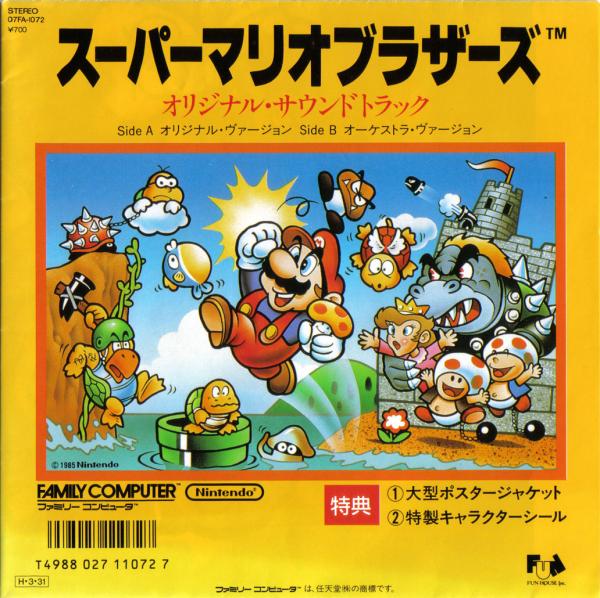
Super Mario Bros. Soundtrack

mario

Koji Kondo
Super Mario Bros. Theme
Super Mario Bros. Theme (Orchestra Version)
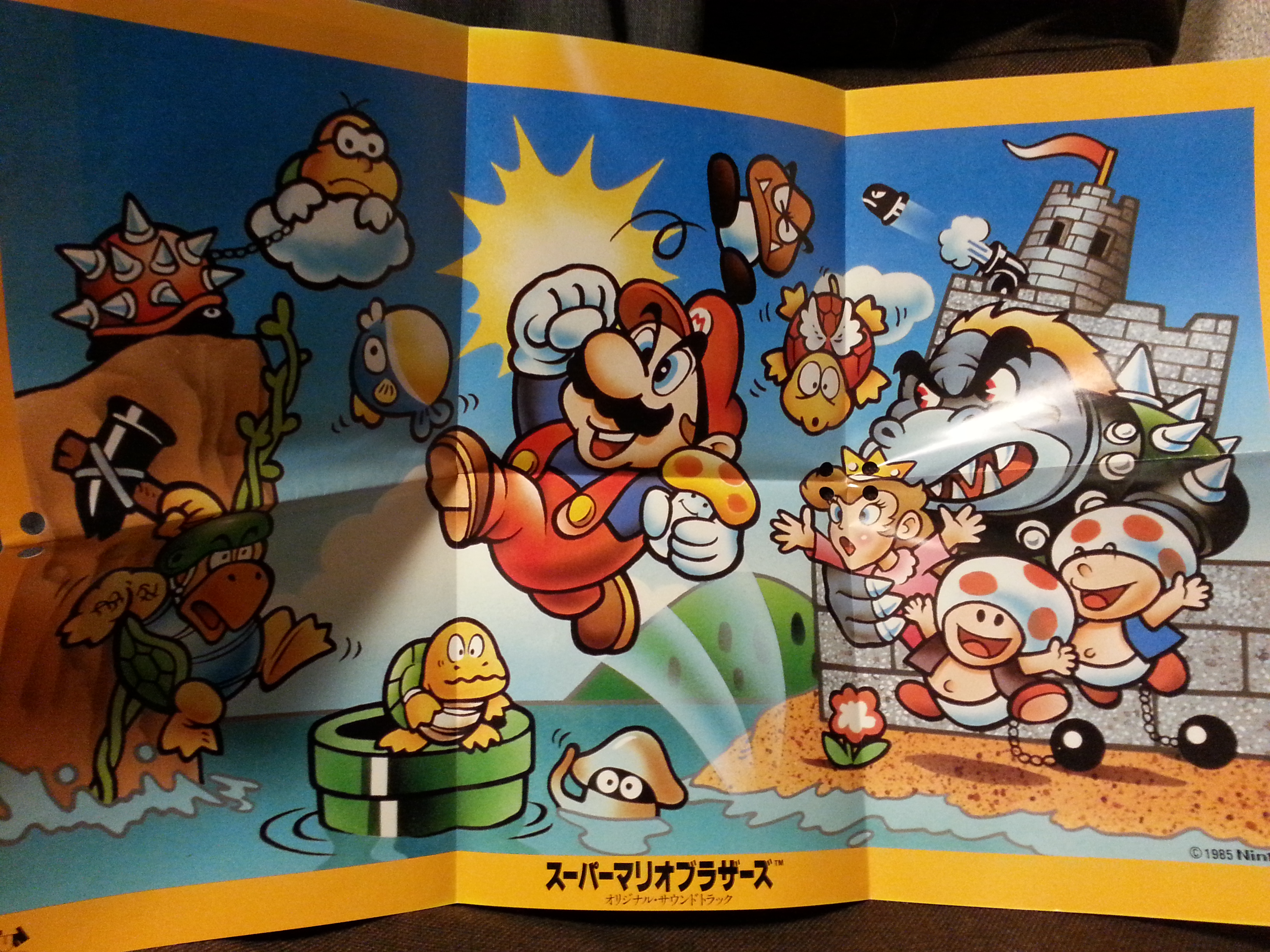
Both of these tracks are from a 7″ single that’s simply titled Super Mario Bros. Soundtrack. This came out in 1986, and was one of many Mario-themed musical releases to be released that year. I’m fairly certain this was the first one though, and it was also probably the first record put out by Nintendo, although many would follow in the late 80s, as it was really a prime time for game music in Japan.

The first track is exactly what you think it is, a straight-up rendition of the Super Mario Bros. theme. Its different than the one that’s included on the Famicom Music album though. Firstly, it’s much shorter, only including the music from the first stage. Additionally, it features no game sound effects, it’s just music. Oddly enough, it doesn’t end with the stage complete fanfare, instead ending with the music that plays when Mario dies.

The b-side is interesting. While the direct translation of the track is “Orchestra Version,” there’s really not much orchestral about it. I think I hear some chimes in there somewhere, but it’s pretty much a souped up electronic version of the original theme. It’s really different than other arranged versions of the Mario theme that I’ve heard, and it’s actually pretty damn great. I hope they re-use it at some point.

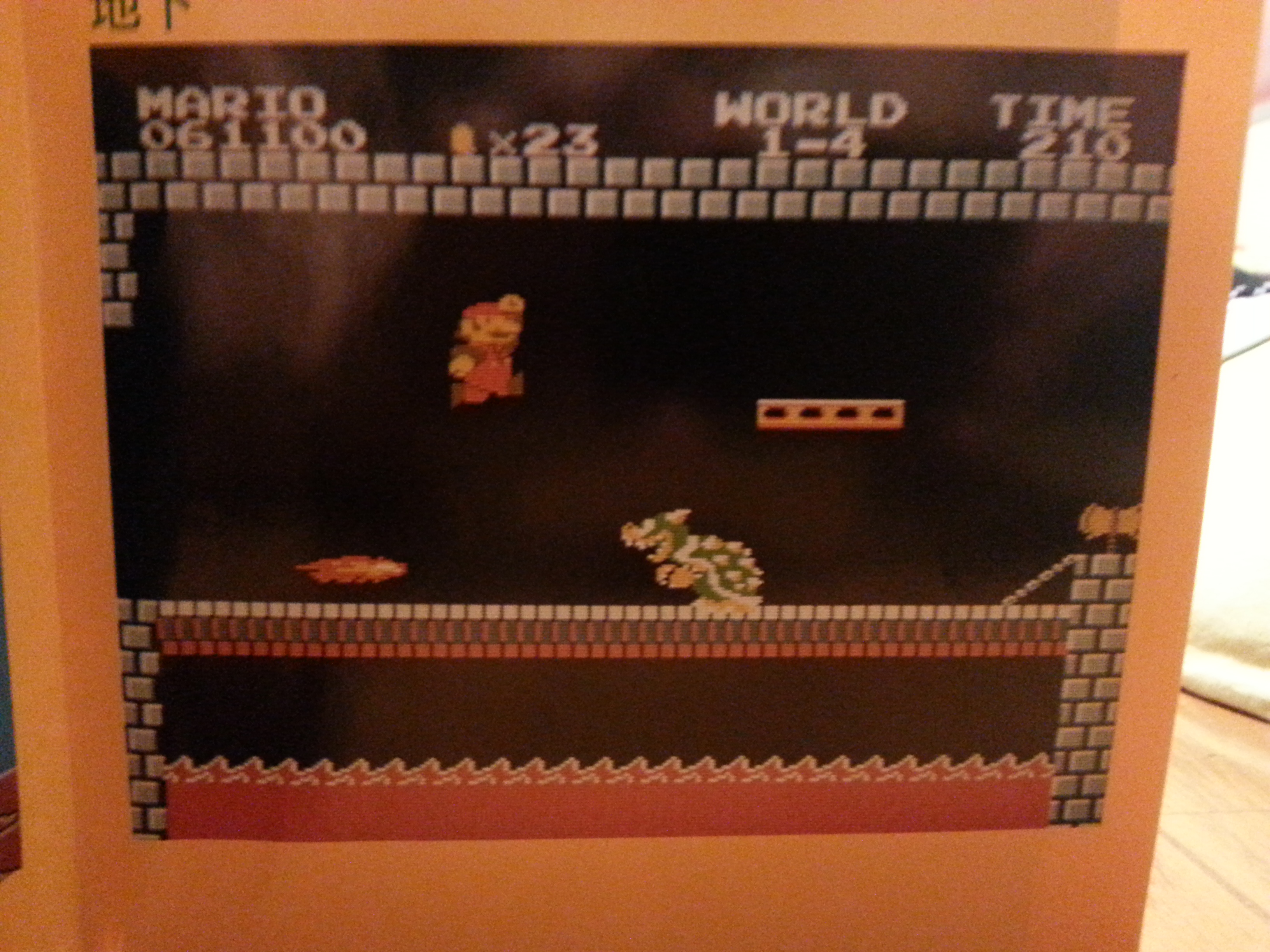
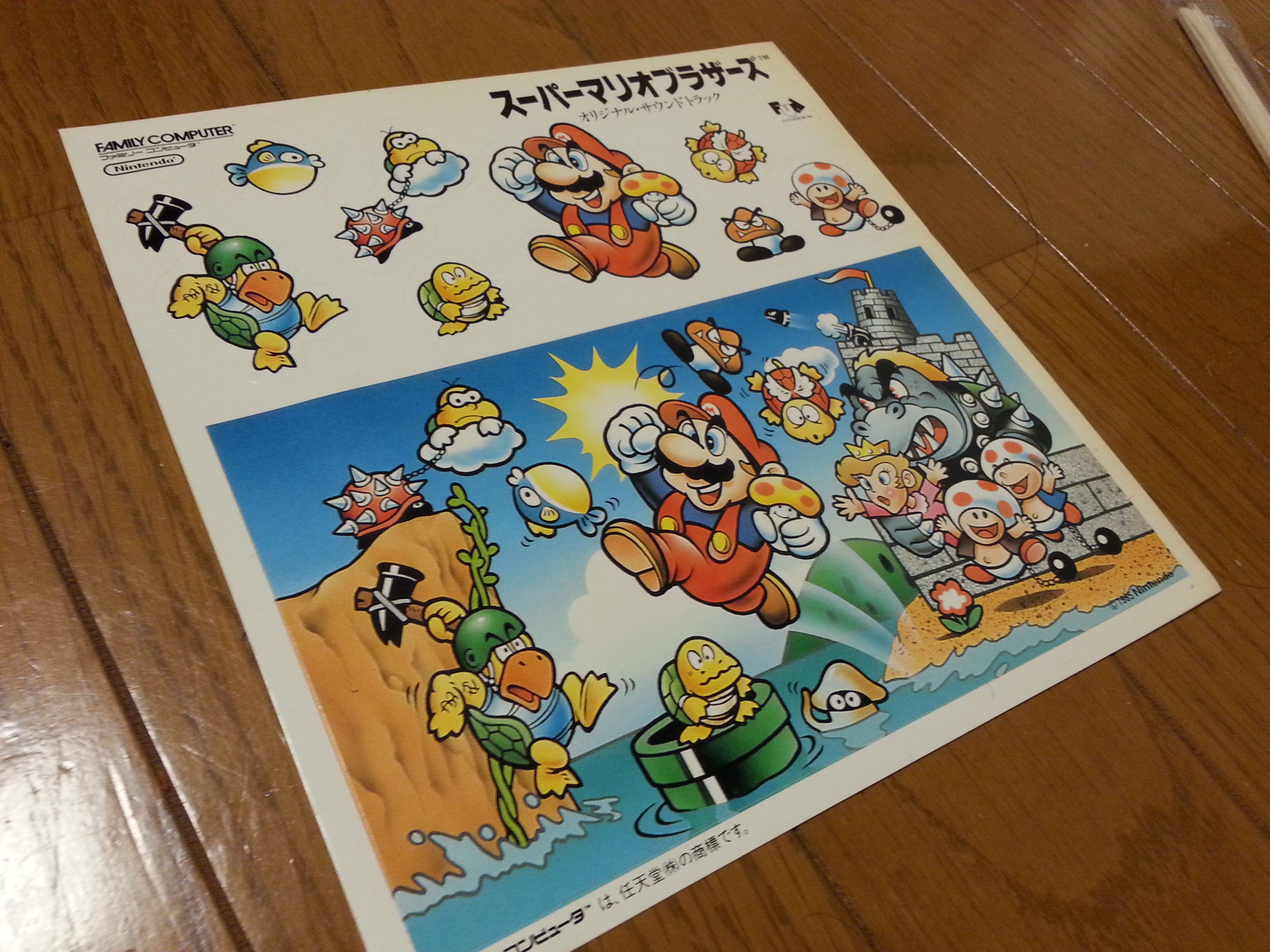
Sadly this release doesn’t feature any linear notes, so I can’t tell you who worked on it. However, it did include a rad poster and some amazing stickers, so check them out!

20140715_212233

Full size poster. Very cool.

20140715_212254

Game shots obviously taken by someone pointing a camera at a TV.

20140715_212309

STICKERS!


The Lady Or The Tiger

Tuesday, July 8th, 2014

ladytiger

Toyah & Fripp
The Lady Or The Tiger
Discourager Of Hesitancy
I’ve been meaning to post these tracks for about five years now. Seems like now is a good time to finally get around to doing that.

In case you couldn’t already figure it out, Toyah & Fripp are Toyah Wilcox and Robert Fripp. The former being one of the most unjustly forgotten 80s new wave frontwomen of all-time, and the later being the frontman of King Crimson and part-time collaborator of Brian Eno, David Bowie, Talking Heads, Blondie, Daryl Hall, Andy Summers, David Sylvian, The Orb, Van Der Graff Generator, Peter Gabriel, The Future Sound of London and Porcupine Tree (to name a few).

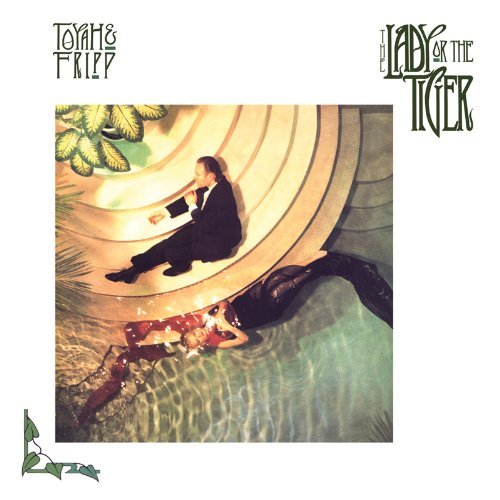
As prolific as both are, I feel safe in saying that neither have ever put out another album like The Lady Or The Tiger, which first came out in 1986 and has yet to be re-released digitally or on CD. Because while both have put out some wacky experimental shit in their days, this has to be the only spoken word album ever released by either of them.

Each track on the album isn’t a song, they’re short stories, both written by American author Frank R. Stockton. Both are equal parts logic puzzle as they are short stories, presenting readers with a near-impossible “what would you do” scenario at each story’s end.

Toyah recites both stories, while Fripp provides his trademarked ambient guitar Fripptronics, layer-upon-layer of distorted, manipulated guitar effects that help to give both stories the dream-like, otherworldly quality that the author no doubt had in mind.

Even in the experimental realm of Fripp solo records and side projects, this album is a little out there and probably isn’t for everyone (or most people for that matter). But I find it fascinating, and I’d listen to Toyah recite a phone book with that voice, so I hope you like it too.