
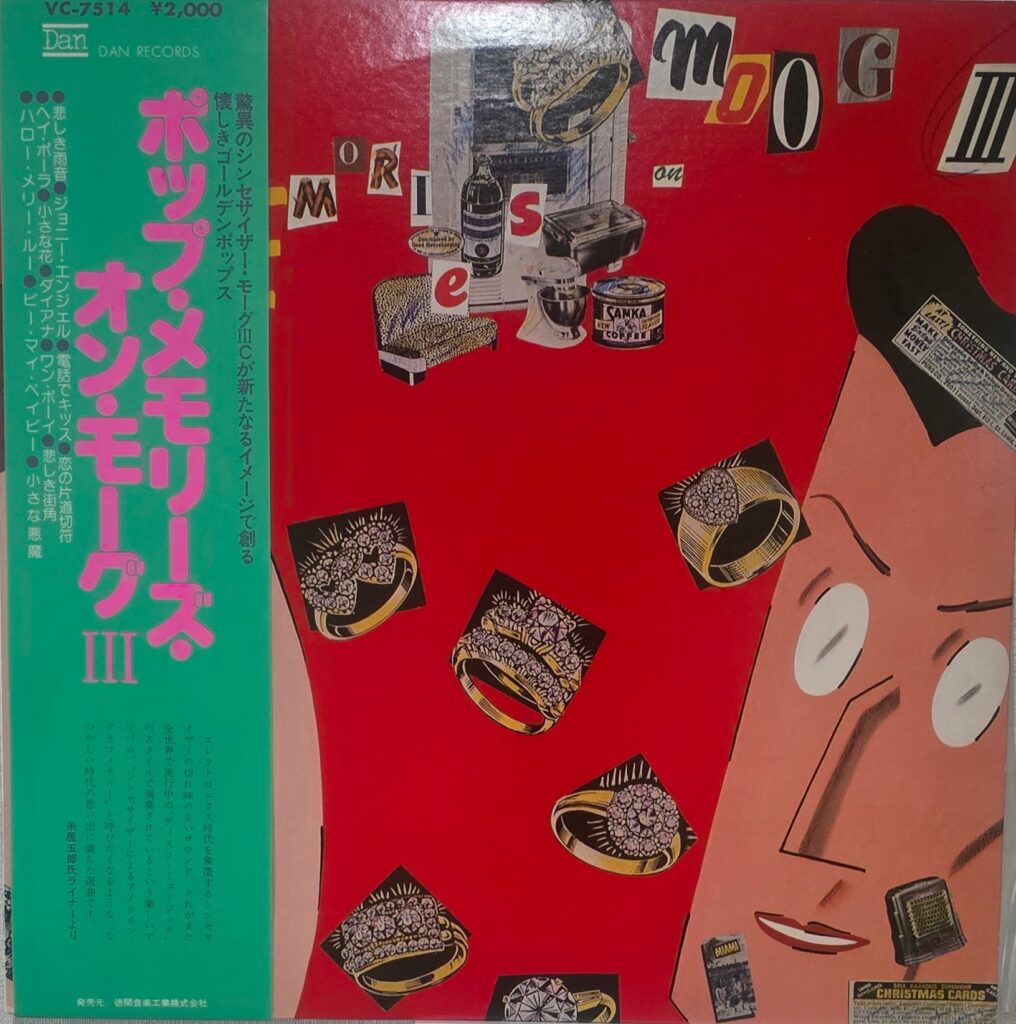
Pop Memories on Moog III (Complete Album Download – Click Here)
I’m back with a new post!
Yes, it’s another complete album download of an obscure Japanese synthesizer covers album from the late 70s.
But this time it’s in FLAC!
To be honest, I really don’t see the big deal about FLAC and hi-resolution audio formats. Our human ears can only pick up so much. Even more to the point, my human ears can only pick up so much. You play me a better-than-CD-quality 32-bit whatever FLAC file and then play me a 256 kbps MP3 of the same track, I’m probably not going to be able to tell the difference.
That being said, a lot of the vinyl rips I plan on sharing from this point on are very obscure, and in some cases I assume high-quality rips of them simply do not exist on the internet. Maybe they do on secret darkweb torrent sites dedicated to out-of-print Moog covers albums, but I don’t have an invite to any of those, so I don’t know. If you do have invites to those sites, yo, I’m on Bluesky.
Tonight’s Moog covers album is Pop Memories On Moog III. Now, if you’re asking, “why is he starting with number three?” The answer is “because volumes one and two don’t exist.”
At least, I can’t find any evidence of them online. Maybe they’re so obscure that they’ve just become completely lost to time, but I don’t think that’s the case. I actually think this album has a roman numeral three on it because it was the third Moog covers album released by Tsuneaki Tone, an artist who I’ve covered on my blog before. In 1976, he released All Of Synthesizer Vol. 1, following it up later in the same year with Cross Over Synthesizer, which had the subtitle All Over Synthesizer Vol. 2 (and the additional subtitle “Listening and Dancing”). I have a copy of Cross Over Synthesizer that’s in very good shape, I’ll probably share that soon. My copy of All Of Synthesizer is pretty beat up, I’ll have to see if my new vinyl restoration software can fix it up before I put it online. Vinyl restoration software often has a hard time fixing old Moog albums, too many square waves, I guess.
Anyways, this third album also came out in 1976, and apparently Tone decided to ditch the All of/over Synthesizer branding for Pop Memories On Moog, but the albums are clearly a series. And now that I think of it, I probably have those other two albums buried somewhere in my apartment, and I’ll get around to sharing them too, someday. I hope.
I don’t know much about Tone (which is probably pronounced to-nay). If the IMDb is to be believed, he composed the soundtrack to a 1973 documentary called Iwo Jima, and according to Discogs he also had a career working as a session musician for other artists in the 1970s. He has an arrangement credit on an album by Akiko Wada, who was a pretty notable singer in Japan in the 1970s. He also worked with Kazumi Watanabe, who was Yellow Magic Orchestra’s first touring guitar player. But Tone didn’t seem to work much after the 1970s. I don’t know if he passed away, retired, or simply moved onto other things.
However, Tone isn’t the only credited artist on this album. While his first two synth albums were solo affairs, for this album he was joined by one Hideki Matsutake! Long-time readers of this blog should know who he is, as he programmed the synths and sequencers on the first few YMO albums! I met him! He’s nice!
This is not Matsutake’s first work on a major label release. He’s credited as a synthesizer player on the 1975 album Time Paradox by Hiroki Tamaki & SMT, but this is his first release as a credited artist, and not just a session musician. Later in the same year, he would release an album under the name Beautiful Chateau & Synthesizer (which you can find here), and then he would release the electronic ambient masterpiece Edo in 1977, working with fellow synth player Masashi Komatsubara and shamisen player Chojuro Imafuji. That album’s amazing! From there, he would start to release his own solo albums, collaborate with a few other artists, and then work with YMO.
But this is where it all began! A vital, important release in the history of Japanese electronic music!
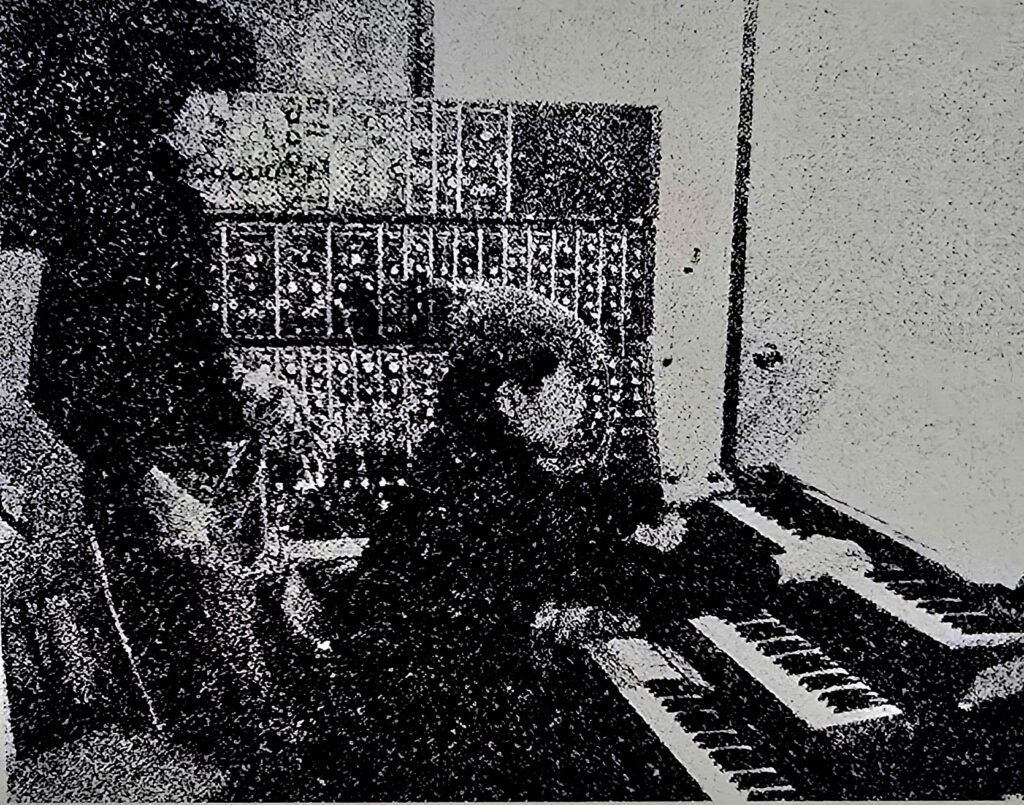
Hideki Matsutake and Tsuneaki Tone, bro-ing out with a mountain of synths. Taken from the back cover of the album.
But is it any good?
Well, I like it. But these are all covers of music from a very specific era. It is very cheesy. Cheesy covers of cheesy tunes. The Japanese liner notes refer to this being a release “full of nostalgic memories,” so that means that nearly all the songs here are pre-Beatles era rock and pop music. I’ll run them down track-by-track.
A1: Rhythm Of The Rain
Originally by The Cascades, a vocal group from the early 60s. They are a one-hit wonder. This is the hit. If you’re over the age of 40, you will recognize the melody. This is a nice version.
A2: Johnny Angel
This was recorded by a few people, but Shelley Fabares made it a hit in 1961. If you google it you’ll recognize it and probably hate it. I hate it. When people talk about how pop music hit a nadir in the post Buddy Holly, pre-Beatles era, this is the kind of shit they were talking about, in my opinion. One of many songs on here that actually benefit from the synth treatment, at least it gives the song some character.
A3: Kissin’ On the Phone
This is a Paul Anka song, and it’s not the last you’ll see on this album. I don’t think this was a hit in the states. But it apparently was a hit in Japan, so much so that it has a Japanese wikipedia page. I find the melody of this song grating, no matter how it’s performed. And the telephone ringing sounds don’t help. Probably the weakest number on the record. At least it doesn’t have Paul Anka’s gross kissing songs. I can’t believe Paul Anka released a song that was basically about getting a boner with his girlfriend when he talked to her on the phone and society let him keep making records.
A4: One Way Ticket (To The Blues)
What I said about “Johnny Angel” goes double for Neil Sedaka. Sorry, Neil. Although I guess “Love Will Keep Us Together” is kind of a jam if you’re the right level of drunk. This version does kind of slap? There’s a whistle effect that’s very reminiscent of Morricone, and I like the synth train sounds.
A5: Hey Paula
Another example of me enjoying this synth cover a thousand times more than the original. This is also from 1962. If you recall, that’s when American Graffiti is set. And if you also recall, that movie has the line “Rock and roll’s been going downhill ever since Buddy Holly died” and, man, that dude was right. Sometime I think we have to give The Beatles even more credit than they already have. I hate this song so much I didn’t even check out the original on YouTube to compare it to this version, I never want to hear it again. Hey, hey Paula, and Paul, go fuck yourselves
B1: Petite Fleur
This is a jazz instrumental that was originally made famous by Sidney Bechet. I listened to the original, and it ain’t bad! This must have been a huge hit in Japan. There was a bakery near the English school I used to teach at with the same name.
B2: Diana
Okay, Paul Anka, this one’s alright. Although again, I prefer this version.
B3: One Boy
Originally sung by Joanie Sommers, and featured in the musical Bye Bye Birdie. I’ve seen Bye Bye Birdie but I don’t remember this song, let’s be real, it’s not “Kids.”. Sommers is most famous for “Johnny Get Angry” which is right up there with “Hey Paula” as a song that made me want to punch the radio when I was a kid and my dad put on the oldies station.
B4: Runaway
Okay yeah, now we’re talking. “Runaway” by Del Shannon owns hard. And this is a really good version. It slows down the tempo quite a bit, it’s a minute longer than the original version, and that gives it a bit of an easy-listening vibe, maybe something you’d hear in a dentist’s office, except, y’know, good. It’s really hard to fuck up “Runaway.” They don’t fuck up “Runaway.”
B5: Hello Mary Lou
Another huge one, made famous by Ricky Nelson in 1961. This version goes HEAVY on some kind of wah-wah effect, which makes it a little funky? Funky Ricky Nelson? Who knew?
B6: Be My Baby
They don’t even try to emulate the drum beat, and that’s probably a good thing. This is actually a pretty radical reinterpretation of the original song. Again, they slow it down quite a bit, and I think they were trying to emulate a big band sound with some of the synth effects they layered over it. Of course, it absolutely pales to the original, which is one of the top 10 greatest pop songs ever written. I wonder what Brian Wilson would have thought of this version?
B7: Little Devil
Neil Sedaka, AGAIN. That motherfucker got around. This is instantly more tolerable than the original because it doesn’t start with an ear-grating attempt at ripping off The Four Seasons.
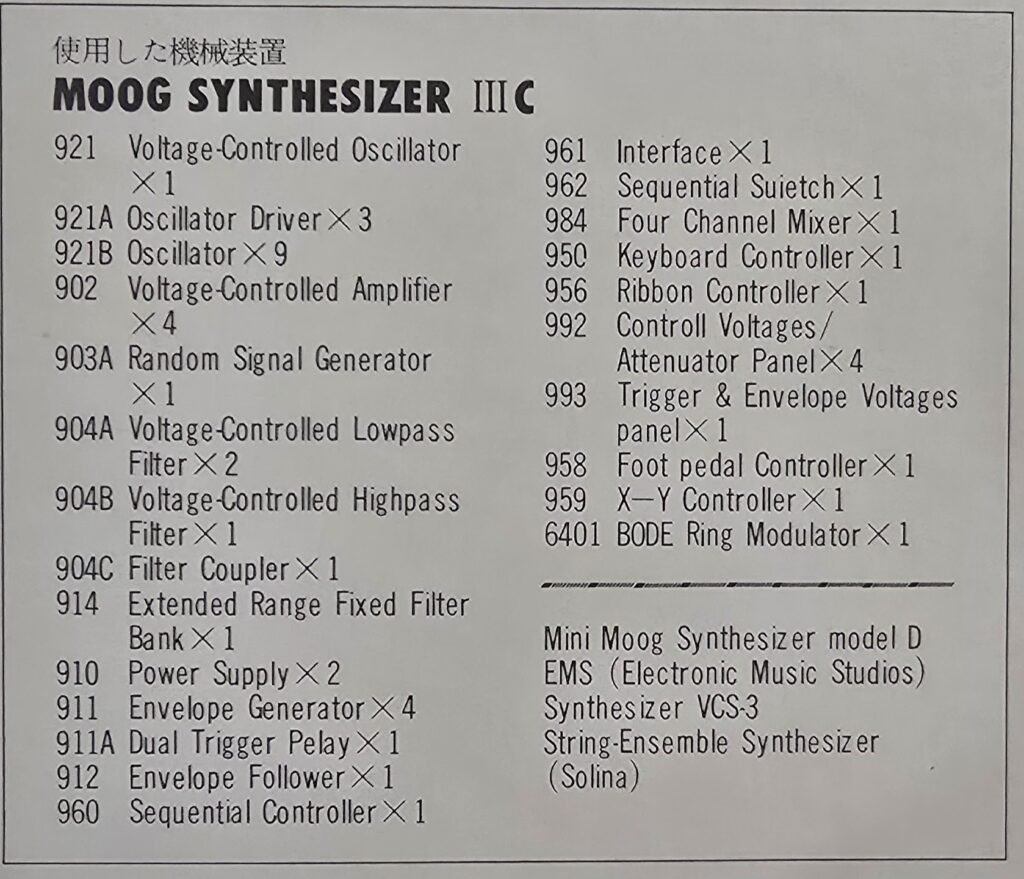
A description of all the synths and such used to record the album, also taken from the back cover.
I have at least four more weird synthesizer covers albums that I want to share sometime in the near future, so I hope you all enjoy this goofy stuff. I never get sick of these albums, they got a vibe you just can’t recreate. I’m sure people have tried, but unless your synths take up an entire room and need to be constantly re-tuned because they overheat, it’s just not the same.
Hopefully I’ll be back with a similar post later this month or early next month! Expect a lot more weird synth albums or other Japanese obscurities. It’s just where my head is now and what I got on vinyl that I can share somewhat ethically!