Switched-On Rock – The Belated Return of Moog Monday

September 10th, 2012

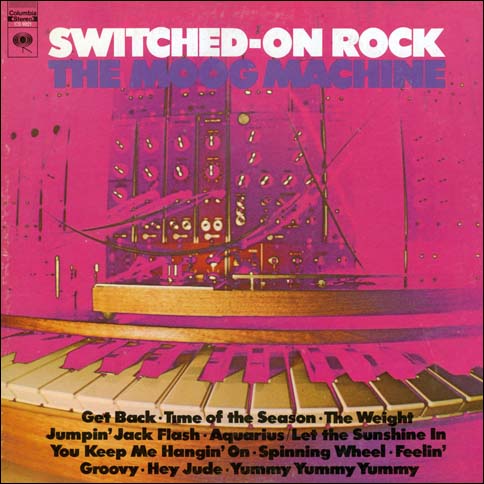
Switched-On Rock
Spinning Wheel
Jumpin’ Jack Flash
The 59th Street Bridge Song (Feelin’ Groovy)
Get Back
Yummy Yummy Yummy
The Weight
Time Of The Season
Aquarius/Let The Sunshine In
You Keep Me Hangin’ On
Hey Jude
Switched-On Rock is an all-Moog covers album, one in a long line that came out in the late 60s and early 70s to capitalize on the surprise runaway success of Wendy Carlos’ Switched-On Bach, the first of its breed. It’s a cash grab, no doubt about it, but it’s a relatively decent cash grab that was obviously made by people with some recording knowledge.

The album was produced by one Norman Dolph. And if you read this blog or follow Velvet Underground news at all, then that name probably sounds familiar. Dolph was an executive at Columbia Records in the 60s and 70s who funded the recording of The Velvet Underground and Nico in 1967. He also served as an uncredited engineer on the album, and it was his test acetate of an early version of the album that found its way onto eBay and eventually into the hands of a collector for the price of $25,200 back in 2006.

It seems like this record was a passion project for Dolph, as not only did he work as the album’s producer and “big twiddler” (that’s the credit he has) but he also wrote the majority of the album’s lengthy liner notes, which I’ve transcribed for you below.  They’re a fascinating glimpse not only into the shockingly complicated recording process (Moogs could only play one note at a time, meaning that many overdubs were needed), but also into the popular views of what electronic music was at the time. Dolph makes sure to go out of his way to explain that these aren’t the creation of some computer, that a group of people actually worked on these compositions.

Download and enjoy the groovy instrumental Moogsrumations (yeah, I made that word up, so what?), and be sure to read these liner notes, they’re something else.


Because I thought up the basic idea for this album (and then contributed little else), I was thrown the bone of writing the liner notes. To give me something to work from, I asked Norman Dolph, the album’s producer, to send me a memo on the subject. The result was so much better and more understandable than anything I could have written that it is simply reproduced below.

Cordially, Russ Barnard

LINER STUFF
I’ll just sit here at the typewriter and spew out odds and ends about the project and let the literary maven sit it right.

To begin, we are a triumvirate: Kenny does all the keyboard work, Alan writes the arrangements, and I tune the machine and perform sundry A&R functions.

The amazing thing about all the sounds is not that they are done one voice at a time, but rather one finger at a time. The silly machine only plays one note at a time and the temptation to play a chord must be overcome…you only get the lowest note if you press more than one key. Improvisation is difficult but far from impossible if you redefine the problem.

We, being faced with the limitations of the Moog as far as chords are concerned, built a gadget called the Protorooter that structures chords above the note the keyboard is playing to alleviate the problem somewhat.

Compared with the old cut-and-splice way of making electronic music, the Moog is a tune boon. As great as we feel the Moog is for making music in the light of what is possible and what Mr. Moog is no doubt cooking up, the Moogs of today are like the Kon Tiki. It takes quite a bit of physical tuning and set-up time to achieve the sounds, though once tuned they go down very quickly.

After kicking the project around in our heads and experimenting, Alan decided to look at the problem as one of orchestration, writing from scratch as though any instrumental texture available or conceivable existed – and then we set about to tune the machine to fit the arrangement.

The charts are such that if acoustic instruments existed to create the sounds, then live men could perform the record as such.

Likewise, we worked all ten tunes at once so that a tuning economy could be effected; e.g., tuning up a basically brass sound and then touching it up for various parts in a couple of songs.

By working on all of them at once we also could take advantage of any auspicious accidents that generated a sound that we had not conceived exactly but had a spot for.

There are hundreds of dials and jacks on the machine and many of the sounds are quite hair-trigger and difficult to re-recreate. Copious were the notes taken of these sounds, but when we found a screaming nugget of sound, we used it where it fit and then went back to the agenda.

One thing that must be stressed: namely, is that this record is virtually 100& Moog – only two instruments are live. One is the drum set; Moog drums are possible, but, in this stage of the art, sound kind of mechanical and ricky-tick…we decided to preserve the firepower in the music by moving it along with real drums. Leon Rix joined us on drums…very tasty. The second real sound we leave to the listener is to spot. We defy him to do so, and welcome his guesses.

This is a synthesized record. All the orchestral textures, somewhere in the vicinity of 150 different varieties, come out of that funnybox.

The semantics of keeping track of the sound from a bookkeeping point of view were kind of testy in that many of the sounds have no natural counterparts, so we coined neo-names to enable communication: e.g., the Gworgan, which is like a Gwiped organ. Gwiping is the act of sweeping a filter with a high regeneration setting (whatever that means) from top to bottom. It makes the sound “gwirp” with millions of variations depending on the rest of the brew. The inverse is Pwee, sweeping from bottom to top.

The Pagwipe sounds like a ferocious, leaky bagpipe.

The Jivehive sounds like a megaton of bees all swarming in tune. And there is the dread Moogoboe. And the Sweetswoop, a back and forth roar of harmonic sounds like a jet plan flying through your head. Other parts were named by their function in the song…the Octangle, an 8-part progression…the Big-Band, the Neoturnsolo, the Dharmilt, a mixture of descending harmonies and a sound that reminds you of a little three-inch-high Milt Jackson playing an equivalent size vibraharp: the thumps, the buzz, the telegraph keys.

In addition, many, many straight instruments: trombones, trumpets, flutes, basses, strings, drums, clarinets, bassoons, bass clarinets, tubas, clarinets, saxes, harps, electric pianos, harpsichords, organs, piccolos, ocarinas and recorders.

About half and half recognizable textures and totally new musical texturues.

No gimmicks though for their own sake, no one-shot gags.

We used a sixteen-track recorder for the job, making several passes, and then a demi-mix to boiled down the results to one track or a stereo pair. The results were parked and then the tracks used over.

Every time the engineer cleaned the tape heads I kept thinking that that’s my music you’re scraping off.

The stereo possibilities are remarkable in that there is no leakage from one side to the other, the sound is quite transparent and the listener can listen through the many layers and focus on whatever he wishes.

One thing to stress to thos unfamiliar with the way the m achine works is that it is not a computer and does not play or tune itself. In fact, having lived with it, we are as conscious of what it won’t do as what it is capable of.

For one thing, constant touch-ups of the tuning is necessary to correct its drifts over a fifteen-minute period.

Moog himself is quite a guy too. Most cooperative and now has a weekly emissary to New York to touch up any fixits and keep everyone up on the new discoveries. Moog really made quite an invention – and how appropriately space-age his name is! How bland would be the “Jones” or the “Irving Spidorsha” as a nickname for the gadget. If he ever comes to town for a lecture, go listen. There is nothing like inventing a synthesizer to give you expertise in its use.

Anyway, the music is human music, and, most important, it is music, not Moog effects.

This album is supposed to be a chuckle. Make sure you convey that we hope the people enjoy it!

All best,
Norman
 

Yen Manifold Vol. 1 – Awesome Japanese Electronic Music

September 7th, 2012

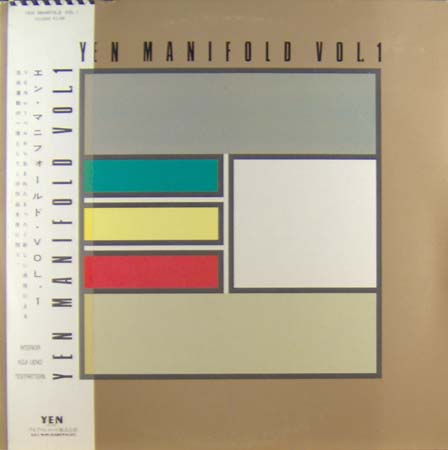
Yen Records was an imprint of the Japanese label Alfa Records. The label was formed by Haruomi Hosono and Yukihiro Takashi of Yellow Magic Orchestra, a highly influential Japanese electronic group who many consider to be the progenitors of synthpop and electronic dance music.  The label mostly existed as a means for the duo to release albums they were somehow associated with, either as performers or as producers. A good analog would be something like The Beatles’ Apple label or Trent Reznor’s Nothing Records.

Yen Records only existed for a few short years in the early 80s, but what little music they released developed a rather devoted cult following. I found two fan pages dedicated to the label (one in English and the other in Japanese), while I also stumbled upon quite a few pages dedicated to artists who were associated with the label. That’s some pretty impressive staying power for a Japanese vanity label, you can’t say that about most American ones.

From what I can gather, one of the most beloved releases on the Yen label was this record, a 1983 compilation that features three artists who were on the imprint:Interior, Koji Ueno and Testpattern. Since the label went under, many of the songs on this record have gone in and out of print, although none of them have ever gotten a release in the states at all.So I hope you all enjoy reading about, and listening to these great artists, and if you get a chance, check out more Japanese sytnpop/electronic music from the early-80s, a lot of it is really fascinating and out there stuff.

Interior
Hot Beach
Miracle
Hawks
D.T.T.
Interior put out two records. The first was self-titled and the second was called Designs. And to that I say, well played sirs.

Thanks to their generic name it was a bit tricky digging up information on these guys, but I was able to find a few things out I think. Last.fm treats the group as a threesome, featuring the members Eiki Nonaka, Mitsuru Sawamura and Daisuke Hinata. However, Discogs also gives credit to a fourth member, Tsukasa Betto, who I can find nothing about outside of that reference. Of the other three, Hinata seems to be the most active today, doing commercial and TV work as well as producing and performing on a variety of Japanese pop albums. He also appears to have some totally radical glasses.

Musically the group seems to be pretty diverse, running the range from Tangerine Dream-inspired ambient numbers to light 80s pop (complete with English lyrics). I dig the ambient tracks more, but the pop stuff isn’t bad, if entirely generic. Of the four tracks, on the final one, “D.T.T.” is kind of a wash out, thanks to needless 80s saxophone. Although the song came a few years before “Careless Whisper,” so at least you can’t accuse them of being copycats.

Koji Ueno
Tempo di Jazz
Movement Perpetuels
Fu No Oboegaki
These songs are great, and far more experimental/interesting than the Interiors stuff. All are purely instrumental, and run the gamut from jazz-inspired pieces to more ambient/experimental works. I’m digging them.

Unlike Interiors (and the third band on this album), Koji Ueno is a somewhat recognizable name, at least in Japan. He routinely works with Ryuichi Sakamoto, collaborating on multiple scores with the legendary musician, and he has even released a few solo scores for some anime and other Japanese TV shows.

He also has an amazing photo on his Discogs page. Dude is totally rocking the “I’m a tux wearing piano man – oh hey, there’s a desk fan” look.

Testpattern
Ryugu
Friday
A mysterious band, I can find virtually nothing on them, which is a shame because I have fallen in love with what little I have found. These two songs are great. I am especially fond of “Ryugu,” it’s playful and energetic, but it has a modern sound that would fit on a release by Warp Records today. If you want to hear more of their music (and you damn well should) I suggest checking out this page, it links to quite a few YouTube vids that feature the group’s music. Listen to “Technobase,” it’s beautiful.

Sadly, if you want to know more about the actual band itself, I can’t help you there. Aside from that page, I couldn’t find anything of substance about the people behind the music. If you know anything about Testpattern, including where I can get more of their music, please let me know!

And hey, since I”m asking for favors, I might as well get this out of the way…

If you follow me on Twitter then you probably know that I’m planning a big trip to China and Japan later this year/early next. I’m going to China for a wedding and will only be there for a few days, the main focus of my trip will be Tokyo, where I will be spending nearly two full weeks.

If anyone reading this blog lives in Tokyo, has been to Tokyo or knows anything at all about record stores or buying music in the city, please drop me a comment or an email. I want to make the  most out of this trip, and that of course includes buying more records than I can possibly carry back home with me.

Beep! Magazine video-game flexi-discs!

September 4th, 2012

In recent years I have developed quite a fascination with video game soundtracks that have been released on vinyl. Unfortunately, these are pretty rare in the states, with only a few marquee titles like Halo and some cult hits like Sword & Sworcery getting the vinyl treatment.

However, in Japan things are different. There, video game music gets the respect it deserves. Back in the 80s, nearly every game that was worth a damn had a soundtrack release, either in its original form or as an arranged (remixed/reproduced) version. Either they were given an album of their own, or highlights were included on compilation LPs that featured a selection of video game music from a particular game company such as Namco or Sega.

Some were even given away for free in flexi-disc form as bonuses to readers of Japanese video game magazines like Beep!, a popular magazine from the 80s that stuck around in some form or another until this year.

I know this because I have a very awesome friend named Anna Hegedus. And she got me two of these amazing discs for my birthday! So let’s take a look at them, shall we?


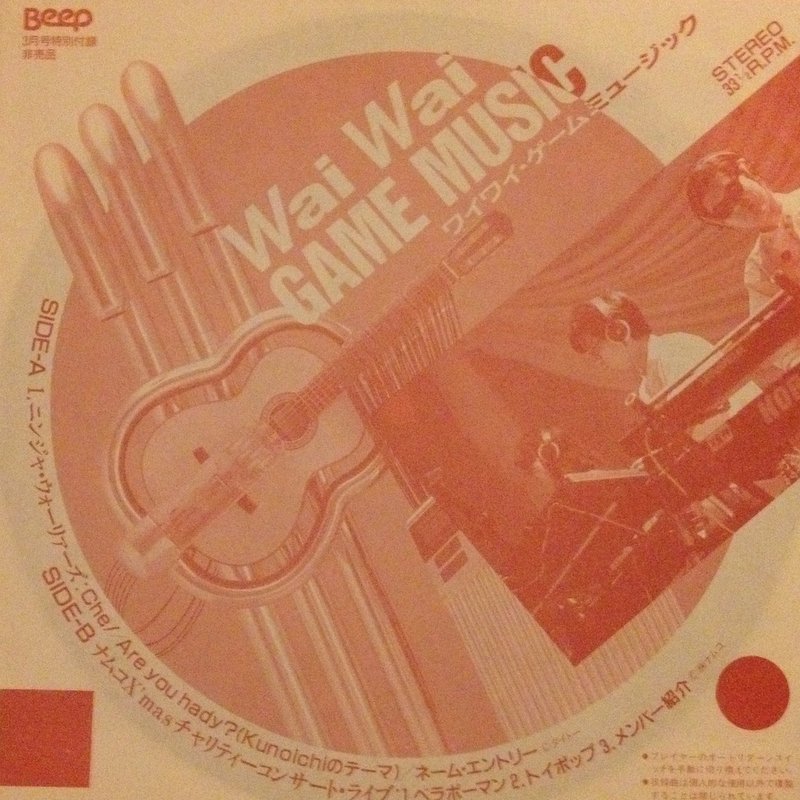
Wai Wai GAME MUSIC (March 1988)
Music From Ninja Warriors
Che!
Are you Lady? (Kunoichi’s Theme)
Name Entry

Namco x-Mas Charity Concert Live
Berabo-man
Toy Pop
Member Introduction 

According to VGMdb, this flexi was a supplement for the March, 1988 issue of the magazine. Side A is a collection of original music from the Taito arcade game Ninja Warriors, a uniqe beat-em-up that used three monitors to create a widescreen-style experience. (You can find out more about the game at this site). I never played any incarnation of this game from what I can remember, but this music is great, an excellent example of the kind of diverse and shockingly complex tunes that games of the time were able to produce.

On side B we find three more tracks, but instead of music taken directly from a game, they are live reproductions that were performed at a special Namco charity Christmas concert! I don’t know anything about this concert, or what charity it was supporting, so if anyone out there who does know anything about it is reading this, please let me know!

As far as the songs themselves go, the first is the theme music to Berabo-man, an arcade shooter that never made its way out to the states. Judging from the sound of this recording, it sounds like the live version still used a fair bit of synthesizers and drum machines, but I think I hear some live strings and other instruments in there as well. The second track is for another Japanese exclusive title, Toy Pop, and it’s a purely piano arrangement of that game’s theme music. It’s cute. The final track features the MC announcing the concert’s performers (each of whom perform their own quick little solos).  All very interesting stuff and something I bet most gaming fans have never heard before!

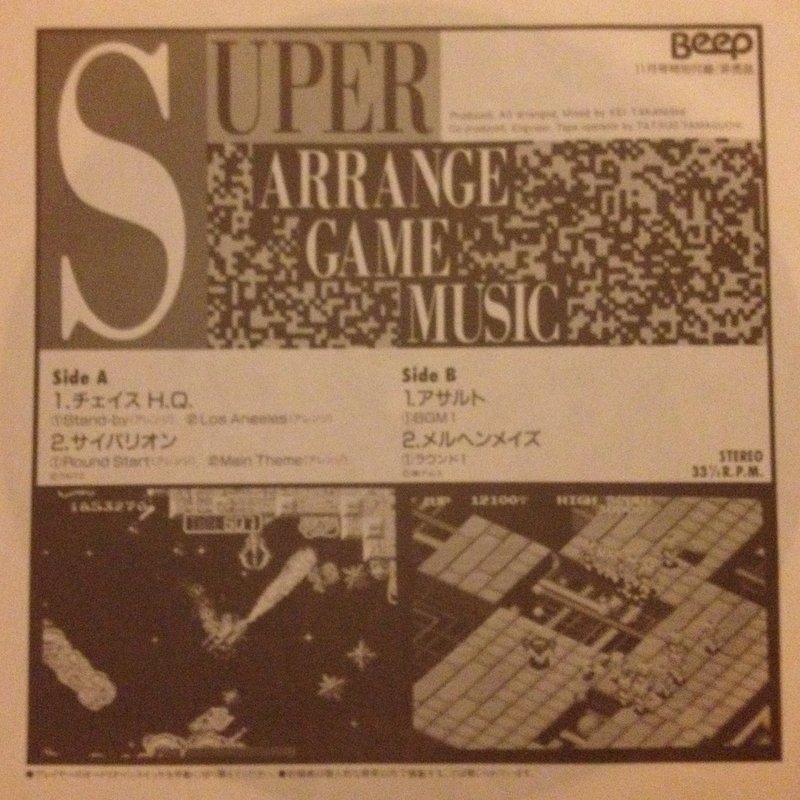
SUPER ARRANGE GAME MUSIC (November 1988)
Chase H.Q. – Stand By (Arrange)/Los Angeles (Arrange)
Syvalion – Round Start Arrange)/Main Theme (Arrange)
Assault – BGM 1 (Arrange)
Marchen Maze – Round 1 (Arrange) 
Next up we have this flexi disc, which was originally included with the November 1988 issue. Unlike the Ninja Warrior tunes from the previous disc, these songs are arranged (remixed/re-recorded) versions that sound substantially more complex and intricate than the original game versions.

The disc really starts things off with a showstopper, both in terms of music quality and in game reputation, with an amazing arrangement of music from the car pursuit classic Chase HQ. I don’t know if the bassline in this version is real or the work of a synthesizer, but if it is legit, then Squarepusher and Les Claypool could learn something from whomever is responsible for it, as it’s freaking unbelievable.

Paling in comparison but still worthwhile is the theme to the Japanese-only Syvalion, which has a great sci-fi feel that fits its space shooter genre very well. After that there’s an arranged version of the background music (BGM) for the generically titled Namco game Assault, another title that never saw a US release from what I can gather. It’s probably the second-best track on the disc, thanks in large part to its awesome synth guitar solo. MIDI shredding is the best shredding.

Finally there’s the stage one music for Marchen Maze, an isometric platformer based on Alice In Wonderland. As you may have guessed considering its source material, the music is rather jaunty.

All in all this is excellent stuff, and a peek into the era. If you like it, remember you have Anna to thank for it, and if you want to make her happy, follow her on Twitter and visit her website, where she often posts crazy technical videos that are so awesome they make my brain hurt.

And I’ll be back later this week with another Japanese-themed post! Until then, enjoy this 8/16-bit goodness!

Prescription medication and dance music

August 27th, 2012

I’m in Toledo, drinking Bloody Marys and watching John Carpenter’s Vampires on TV. What the fuck are you doing?

Aphrodite
All Over Me (Freq Nasty Remix)
All Over Me (Beanie Remix by Jimmy T)
So, true story…

A few years back I cracked a rib while trying to move my fish tank (no, it wasn’t full). That hurt. A lot. It hurt so much that my doctor did me a solid and prescribed me some crazy strong painkillers.

At the same time I had a gig reviewing electronic CDs for Limewire’s MP3 store (remember Limewire!?!). Under the influence of not one, but two prescription painkillers, I got to work that night writing a review for a compilation of early Future Sound Of London singles called The Pulse EPs.

I’m digging the album, as I love me some FSOL, but about two tracks in I’m finding that I’m really digging the album. As Limewire is no more I can’t cite that old review, but I recall it being nothing but euphoric praise, concluding that the collection is “absolu-bleeping-lutely essentinal.” By the time I had finished writing the review, I was convinced that I found the best electronic release of the year.

A few days later I dove back to the CD, eager to experience its greatness once more, only to come to the sad realization that it’s not hitting me like it was just a couple days before. I’m still digging it immensely, but I feel like it’s missing something, some key factor that took it over the edge before.

Then I look down and realize that I’m out of my painkillers.

My point? I don’t know if I have one. I do know, however, that these remixes of “All Over Me” make me feel nearly as good as that combination of painkillers and FSOL did, and I’m not even on drugs anymore. So I guess that’s a pretty ringing endorsement for them. (The remixes, not painkillers…I think.)

Death In Vegas
Hands Around My Throat (For The Throat Mix)
If I listened to the “All Over Me” remixes while under the influence I feel like I would just jump up and dance non-stop. If I listened to this creepy/hard-as-hell remix while on drugs, I suspect I would probably piss my pants and lock myself in my closet. And that’s why I never do drugs. Just say no kids.

Dieselboy
The Descent (Decorder Remix)
He should really convert to ethanol, better for the environment.

Sorry. I’ll see myself out.

Satellite Of Dumb

August 22nd, 2012

Toledo trip delayed by two days! Thank [insert fictional deity here]!

Beck
Mixed Bizness (Nu Wave Dreamix by Les Rhythmes Digitales)
Mixed Bizness (Dirty Bixin Mixness Remix by Bix Fender)
Mixed Bizness (Cornelius Remix)
Dirty Dirty
Sexx Laws (Malibu Remix)
Sexx Laws (Wizeguyz Remix)
Salt In The Wound
My first draft of tonight’s post included a huge rant on how I think that Midnite Vultures is Beck’s best work, an underappreciated masterpiece of cheesy funk and fun time silliness that only gets better with age. My words were starting to sound familiar, so I did a quick search through my older posts and discovered that I already said a year ago. Oh well, it was true then and it’s true now. As far as I know I never posted these remixes and B-sides though, which I culled from 12″ singles to “Mixed Bizness” and “Sexx Laws,” so at least I’m not doubly redundant tonight.

Lou Reed
Satellite Of Love ’04 (Dab Hands Retouch)
Satellite Of Love ’04 (Dab Hands Radio Edit)
Satellite Of Love ’04 (Groovefinder Remix)
Beck’s Midnite Vultures is what I would consider to be a great example of “good stupid,” something that’s purposely dumb and works because of it. On the other hand, I consider these remixes of this classic Lou Reed song to be “bad stupid,” something that no doubt seemed like a good idea at the time but ended up making everyone involved look like a dumb-ass in the aftermath.

If you had me write a list of songs I would like to see remixed, I don’t think any Lou Reed tracks would make the cut. And if you made me choose one, I think I would choose “Sweet Jane” “White Light/White Heat” or even “Heroin” over “Satellite Of Love.” I don’t think glam and techno make good bedfellows.

If there is one good thing about these mixes, however, is that they really bring Bowie’ backing vocals out to the forefront. So if you love yourself some sweet, sweet Bowie, then they’re not all for naught. Actually, the “Groovefinder Remix” has some good moments, but still, it’s entirely unnecessary.

(And in case you’re wondering, my list of songs I’d love to see remixed includes “Empire State Human” by The Human League, Fugazi’s “Waiting Room,” and “Rebel Girl” by Bikini Kill, because why the fuck not?)


80s Synthpop, 90s Electronica and 00s Trance – Not in that order

August 20th, 2012

I have to head to the lovely (not really) city of Toledo, Ohio next week. So I’m going to churn out a few quality blog posts this week and get a few in the can for the following week before I take off. I have a feeling that once I find myself in Toledo I’ll be too busy seeing family/drinking to get any meaningful work done. Yay.

Tears For Fears
Mothers Talk (Extended Version)
Apparently Tears For Fears really wanted people to know their opinions on the talk of mothers, because there are a ton of different versions of this song. Obviously there’s the album version, but there’s also a single edit, a US remix, the Beat Of The Drum Mix and finally, this version, which is the only mix of the classic tune that has not seen a re-release on CD or digital platforms. It’s a shame, as it’s probably my favorite take of the song, since it’s pretty much just a longer version of the already great album mix. I still have no damn clue what the hell the song is about, however. I assume it’s something depressing thanks to the phrase “when the wind blows.”

Hybrid
Burnin’ (Breakbeat)
I haven’t posted some trance/dance tunes in a while, so I thought I’d finally share this tune, which I scored from a compilation called Koma & Bones Present: Y4K – Next Level Breaks EP3. I’m going to cop to my trance ignorance here and admit that I have no idea who Koma & Bones are, I just got this EP because it had a Hybrid track on it. I love me some Hybrid.

I’m not sure where the original version of “Burnin'” first made an appearance. I only have a live version from the 2CD version of Wide Angle, as well as another remix that’s a bit shorter than this eight-minute monster. Regardless, it’s a great song and an excellent remix; my favorite kind of trance music, complex and hypnotic, so good that you don’t need the assistance of recreational medication to make it better. And I write about electronic music for a living (kind of) so trust me, that’s really saying something.

Björk
Pagan Poetry (Infusion Mix)
Pagan Poetry (Music Box)
Sun In My Mouth (Recomposed by Ensemble)
And rounding out today’s clearing house of stuff that’s been in my backlog for way too long are these Björk remixes. Like most Björk tunes, I love these mixes even though they don’t really fall into the realm of “easy listening.”  Well, I guess the Music Box version of “Pagan Poetry” could, as it is literally a music box version of that song, but I digress.

I got the “Pagan Poetry (Infusion Mix)” from a bootleg 12″. It was available for a bit on a few different Björk singles, but they’re all out of print now. Both “Pagan Poetry (Music Box)” and “Sun In My Mouth (Recomposed by Ensemble)” are available on Amazon, but as only part of a three-track single for “Cocoon” that costs nearly 20 bucks, so I really don’t feel bad about sharing them here. That shit is nuts. Björk really needs to go ahead and release a proper box set with all her various remixes and B-sides. Sure, it would be about 100 discs, but I’d buy it and I’m sure other idiots like me would too.

That Post With Music I Was Talking About

August 17th, 2012

I felt kind of silly trying to tack on music to that last post. So here you go.

Shelia E.
Holly Rock (Extended Version)
Holly Rock (7″ Single Edit)
This is one of Shelia E’s lesser known tunes, but one of her best. It’s a fan favorite according to an uncited claim on Wikipedia! Assuming that’s true I can totally see why, it’s an amazing jam of funk and drums, featuring some pretty good rap-style vocals by the legendary Shelia. The seven-minute extended version is nuts crazy insane awesome, with more breakdowns than a tumblr blog dedicated to self-diagnosed mental illness. I’m fairly certain that this version was exclusive to the 12″ single. The 7″ version was on the Krush Groove soundtrack, but that’s been out of print forever (which is a damn shame, by the way).

Debbie Harry
I Want That Man (12″ Remix)
I Want That Man (Instrumental)
Question: Are any of Debbie Harry’s solo albums any good at all? I own Koo Koo and…ugh that thing is a mess. This song is decent enough, with the 12″ remix adding some much needed energy to the tune, but I can’t imagine an album of similar tunes holding any water at all.

Sinead O’Connor
Mandinka (Jake’s Remix)
According to Discogs, this remix is by Paul “Groucho” Smykle, and not by someone named Jake. I feel abused and lied to.

On the plus side, Paul “Groucho” Smykle did the 12″ remixes for Big Audio Dynamites “Medicine Show” and “E=MC2” so I think I can find it in my heart to forgive him. Furthermore, this is a pretty great mix, and very reminiscent of early BAD, with its semi-random vocal samples and obvious dub influences.  Great stuff all around and worth the download.

Google Hates You.

August 16th, 2012

Longtime readers of The Lost Turntable may know that for the longest time this site was on Blogspot, the free web-publishing platform that is owned by Google. I started this blog on Blogspot back in 2006, but I cut the cord and went solo in 2010, when my blog got three DMCA notices over the course of the year. You can read all about here. Go ahead, I’ll wait.

You back? Good. For those of you who decided not to revisit history, I’ll sum up. Starting in 2009, the IFPA (International Federation of the Phonographic Industry) decided that certain posts on my blog violated their copyright (and they were probably right) so they sent out a DMCA (Digital Millennium Copyright Act) notice to Google, requesting that the offending posts be removed. This is in their right. I have no problem with that.

The problem was that Google did that without question, accepting it without ever contacting me. Furthermore, during the process I was never given an opportunity to defend myself, nor was I allowed to look at the DMCA that was levied against me. The IFPA had all the power. I had none.

The fact that I was called out for copyright infringement was fine, I get that. But the fact that I was never once given a chance to look at the claims against me was total bullshit. That was the reason why I decided to migrate my site to my own servers and my own domain in 2010. Since then, I haven’t gotten a single DMCA notice, this is because organizations like the IFPA are as lazy as they are greedy, and only search easily indexed sites like Blogspot and WordPress.

For two years I kept the old blog up, with little more than a “yo, update your bookmarks” post left behind. But I was sick of getting emails about it from idiots who couldn’t find this site, so I finally decided to deactivate and delete the blog earlier this year. Apparently it wasn’t gone for long though, because if you go there now, you’ll see that someone else snatched up the name and is now using my old site address as a spam bot. I found this out only because a few of my readers who never removed the old Blogspot RSS feeds from their aggregators were suddenly getting flooded with spam from this site.

This is relatively harmless, of course. But I don’t like my brand name being tarnished and associated with shit like this. I own the name Lost Turntable. It may not be a registered trademark, but since I used it, it’s mine. It would be like starting a new magazine with the name Newsweek. You can’t do that. And you shouldn’t be able to take an established blog and create your own spam blog using its name.

So, being a fan of irony, I decided to file my own DMCA against Blogspot, claiming that this spam blog was infringing on my trademark. I figured the case was pretty cut and dry, and besides, it’s a worthless spam blog, it should be taken down regardless.

Well, a lot of stuff should happen, here’s the response I got from Google in regards to my claim:

Thanks for reaching out to us.

Thank you for writing in regarding
http://lostturntable.blogspot.com/2012/08/business-management-effective-strategic.html.
We would like to confirm that we have received and reviewed your inquiry
dated 8/13/2012.

Blogger is a provider of content creation tools, not a mediator of that
content. We allow our users to create blogs, but we don’t make any claims
about the URLs or content of these pages. In cases involving trademark, if
a contact email address is listed on the blog, we recommend you working
directly with the author to have the information in question removed or
changed.

Sincerely,

The Blogger Team


There’s a key line there I want to focus on.

“Blogger is a provider of content creation tools, not a mediator of that content. We don’t make any claims about the URLs or content of these pages.”

That is a bold faced, dirty filthy stinking rotten lie.

Let us go back to the DMCA notice I was served with back in 2009.

“We are in the process of removing from our servers the links that allegedly infringe upon the copyrights of others. If we did not do so, we would be subject to a claim of copyright infringement, regardless of its merits.”

That is a blatant example of them mediating content and making a claim to the what the content is. They are literally working as a mediator there, removing content that allegedly infringes on the IPFA. So they lied to me, pure and simple.

It would appear that if you’re a massive corporation with millions of dollars behind you, Google will do whatever you want at the drop of a hat and remove any blog that is allegedly infringing on your copyright/trademark. They’ll do so without allowing the owner of the blog to challenge it, and they’ll make it nearly impossible for them to find out what exactly they’re being charged with.

However, if you’re a single individual who doesn’t have an army of lawyers, then you can just fuck right off as far as Google is concerned.

So if you are the owner of any kind of content at all, any brand name, any publication, any YouTube video series, anything like that, and you give a shit about how your content is represented on the Internet, then I would strongly recommend you set up a Blogspot account and create a blog there using that name. You don’t have to update it, just make sure you’ve claimed it. Because if someone else does Google won’t do a damn thing to stop it.

(And by the way, if you could all go to Google’s support and report that site as spam, I would greatly appreciate it. Hopefully if enough people complain it can get removed for good.)

My RSS feed has NOT been hacked

August 13th, 2012

Holy Shit!

If you’re seeing spam on my RSS feed that’s because someone has hijacked my old Blogger domain and is using it to send out spam. Delete that feed! The only Lost Turntable feed you need can be found on the right tool bar!

Actual post with music later this week.

My fifth favorite Belgium EBM act. Also Blondie.

August 12th, 2012

I guess NBC borked the Closing Ceremonies, cutting out Muse, The Who, Kate Bush and a ton of other amazing performances. I didn’t even bother watching it, because  I knew that would happen. I’ll just download the BBC’s broadcast in a few days. Once I do that, I’ll probably convert the whole thing to audio and then make MP3s out of the best songs. I probably can’t share them here though, because I hear the IOC cracks down pretty hard on any blogs that put up that stuff.

…

You guys know I’m on Twitter right? I mean…you should totally follow me on that.

*whistles innocently and walks away*

Front 242
Rhythm Of Time (12″ Remix)
Rhythm Of Time (Anti-G Mix)
Rhythm Of Time (Victor The Cleaner)
I’ve been trying to get into Front 242 for a long time, and will occasionally buy a 12″ single when I see one used, hoping it will be the track that finally gets me to appreciate them, but it’s always been to no avail. That is, until now, I think I finally found the song that will get me to dig into their actual records. Of course, it’s “Rhythm Of Time,” the closest thing the band ever had to a hit, so I guess that makes me a mainstream-leaning poser, but whatever, I like my hardcore industrial electronic body music to have a slight pop edge. Blame Nine Inch Nails.

Blondie
Call Me (The Ben Liebrand Remix)
Backfired (Remix)
I was going to start this description by saying that it would be impossible to find any connection between the Front 242 tracks and these Blondie remixes by producer Ben Liebrand, but then I went and found one. Liebrand is from the Netherlands. Front 242 is from Belgium. They are literally connected, sharing a border. So there you go.

These remixes are from 1989, several years after Blondie called it quits, and several years before they eventually reformed in the 90s. I think that Chrysalis Records just occasionally put these things out whenever they needed a quick buck. Still, I guess there are worst ways to pay the bills. At least they scored some great producers to have a go at these tracks. Ben Liebrand is a stellar producer/remixer who has worked with Genesis, TLC and Grace Jones, to name a few,  the fact that he’s still making and releasing mixes shows that he’s doing something right. As for the “Backfired” mix, that was done by Bruce Forest, a DJ who did mixes for The Soup Dragons, OMD and a ton of other great artists from the late 80s and early 90s. It’s good, but of the two I think I prefer Liebrand’s take on “Call Me,” thanks to its extended synth sections that really work to Moroder it up in a great way.