Archive for the ‘Complete Albums’ Category

Moog – The Final Frontier

Sunday, June 11th, 2017

Welcome Retronauts listeners who are discovering this blog for the first time thanks to my recent appearance on that show. It was a lot of fun to be back after a long hiatus from it!

I do occasionally post game music here. I’ll probably be sharing some in the coming week or so. A good one too, something extra bizarre, so hold tight on for that. In the meantime, be sure to check out my other site, Mostly-Retro.com. I post a lot more gaming and Japan-related stuff there.

In the meantime, here’s an obscure album of synthesizer covers. Y’know, the hottest latest.

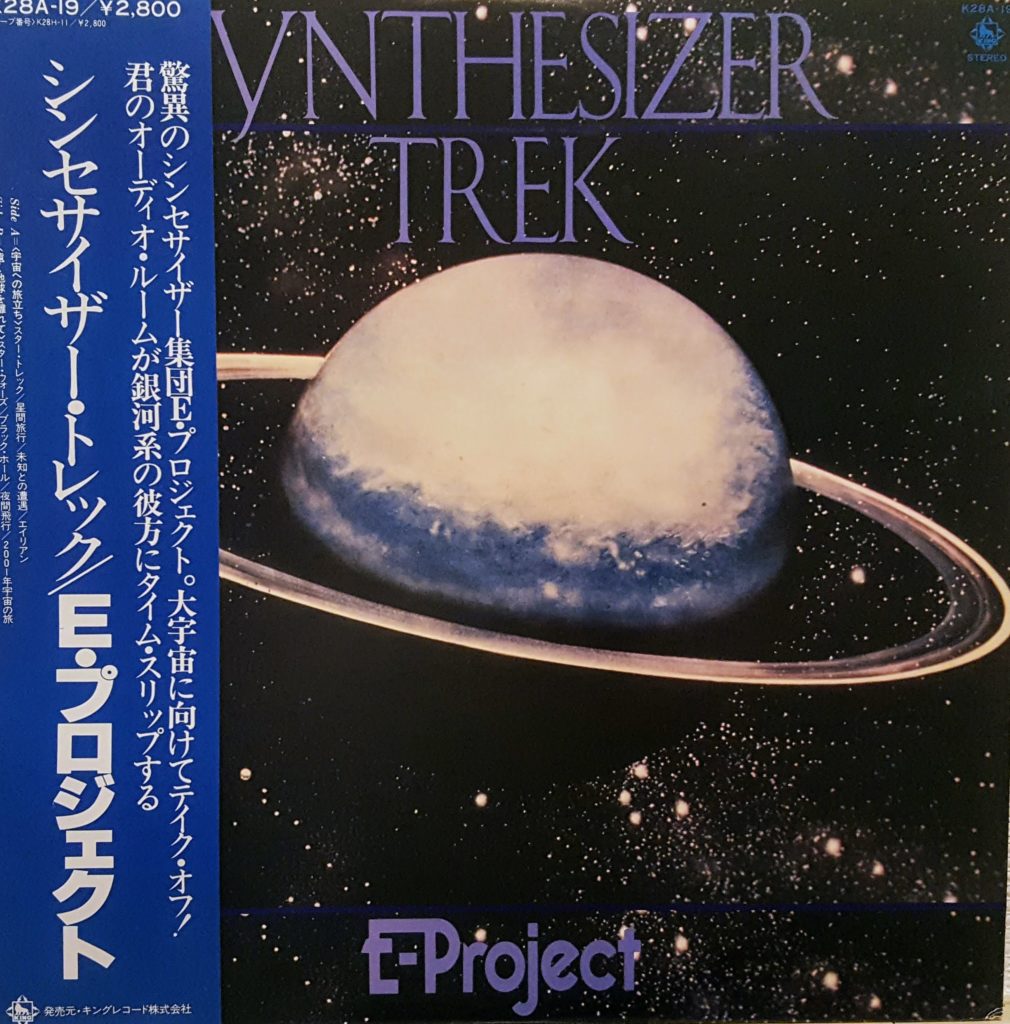
E-Project – Synthesizer Trek
The liner notes on this release don’t have a lot of details regarding who E-Project exactly is. But from digging around on the internet I discovered that E-Project is a duo comprised of Susumu Hirasawa and Takashi Kokubo. At least, that’s what a random website said.

It would certainly make sense though. Hirasawa is an incredibly influential and eclectic musician. He’s best known in Japan for his work with P-Model, an amazing group that did a bit of everything from prog rock to new wave synthpop, but he also has an extensive solo discography that I’ve been meaning to dive into a bit more.

Takashi Kokubo has also been around. He was in a prog rock act called Ring, but I don’t know anything about them. What I do know is that after this album was released in 1980 he started pumping out the amazing Synthesizer Fantasy anime/manga “soundtrack” LPs that I often mention here. He put out 10 of those bad boys in a scant three years. I own half and I can personally attest to how utterly amazing they are. Fucking rad shit even if you don’t give a shit about the anime they originate from (I certainly don’t). He also released a Bach covers album called Digital Bach, which I have, and I’m certain I’ll share here at some point.

Anyways, unlike a lot of the other synthesizer albums I’ve featured here recently, this one is almost entirely focused on newer (at the time) compositions, specifically it focuses on themes and songs from big sci-fi epics. That means you get synthesized covers of the Star Trek and Star Wars themes, as well as all-electronic takes on tunes from Close Encounters, Black Hole and even Alien. The main theme from 2001 is also included, because how couldn’t it be. Also along for the ride is the original track “Intergalactic Journey,” and “Night Flight,” a cover of an obscure song I’ve never heard of.

My favorite number on the album is the batshit interpretation of the Star Trek theme. It incorporates this wacky, weird synthesizer springy effect into the mix. Sounds like noises you’d hear if you came across Q-Bert fucking or something.

Sorry for that mental picture.

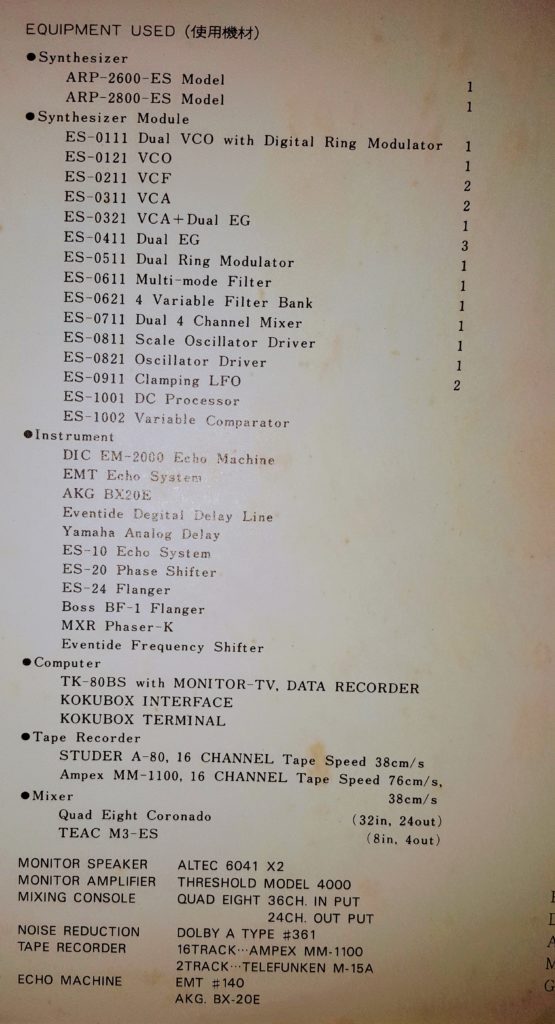
Please enjoy. And if you’re interested to find out what synthesizers were used on this album, you’re in luck, they listed them all.

Holy shit.

All Bound For Mu

Wednesday, June 7th, 2017

I’ve been ridiculously productive this past week. I revived Game Music Revue to write about the Famicom Game Sound Musuems, and I wrote a blog post about my struggles with converting analog-to-digital. I can’t believe I’ve been doing that for over ten years now. Does that make me an expert? I don’t feel like an expert.

Here’s a cassette tape. I hate them.

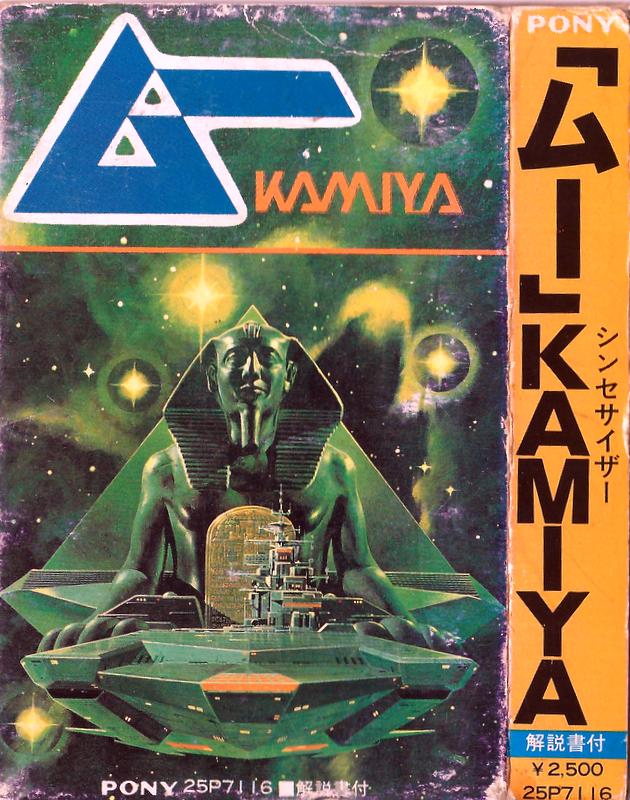
Kamiya- Mu
I hate cassette tapes, did I mention that? So I feel like such a hypocrite whenever I buy one. I was just on a podcast (coming soon) and I literally spent a good five minutes rallying against tapes and their unexpected and inexplicable revival here in Japan, only to then go out and immediately buy one.

It wasn’t my first choice though, if I would’ve seen this one on vinyl I definitely would’ve chosen that format first. I mean, look at that cover. That deserves the full 12″ treatment. (Yikes, that sounded like a euphemism.)

Anyway, I didn’t really know what it was when I bought it. I just saw that cover and assumed it was some crazy newage/synthesizer/jazz/funk thing. And I assumed right. I know that sounds like a stretch, but seriously, it feels like every other Japanese album from 1978-1981 fits in that genre.

This album is a real rollercoaster, swinging across all of those genres with some experimental and dissonant stuff thrown in as well. While it does run the gamut, its certainly more towards the easy listening, smooth newage side of the spectrum. If Kamiya was from the states, this would’ve been released on Windham Hill Records.

My favorite cut on the album is without question “Appalachian Road,” a jaunty jazzy little number with excellent vocoder use and a killer melody that’ll get stuck in your head for days. Peter Frampton by way of Herbie Hancock. “Barbarella” is a choice cut too. I imagine playing this in my space lounge, sipping space martinis with my space boyfriend – who is just my current boyfriend but with a jetpack.

Kamiya’s full name is Shigenori Kamiya and I found out after buying this that I actually have another one of his records. In 1982 he released a “soundtrack” to the manga Tomb Of The Pharoh. It was part of the Synthesizer Fantasy series, a collection of albums that present synthesized versions of popular anime themes, as well as a few original soundtracks inspired by manga. I’ve shared some Synthesizer Fantasy records before, they’re on the shortlist of my favorite things ever. If you ever find yourself shopping for vinyl in Japan and you come across any record with that label on, I suggest buying it. You probably won’t be disappointed.

Moog (Technically ARP) Tchaikovsky

Sunday, June 4th, 2017

My continued self-imposed Twitter exile has brought me more joy than I could’ve possibly imagined. Not only am I now joyfully unaware of what millions of worthless fuckball asshats have to say about important issues regarding society and the environment, I also have more time to dedicate to my writing and even some art projects I’m working on.

I mean, as I write this, it’s 7:30 on a Sunday morning. This is usually the time where I would be diving headfirst into Twitter, not only using it as a launching board to read several news stories across the web, but also to read reactions to said stories. And let me tell you, there’s no worse way to start your day than reading what Nazis think about climate change. In addition to being needlessly rage-inducing, it also is a real shitter on my productivity.

So now, instead of me wasting an hour of my life on needless bullshit that doesn’t matter, I can instead use that time to write about late-70s electronic covers of classical music.

You know, the important stuff.

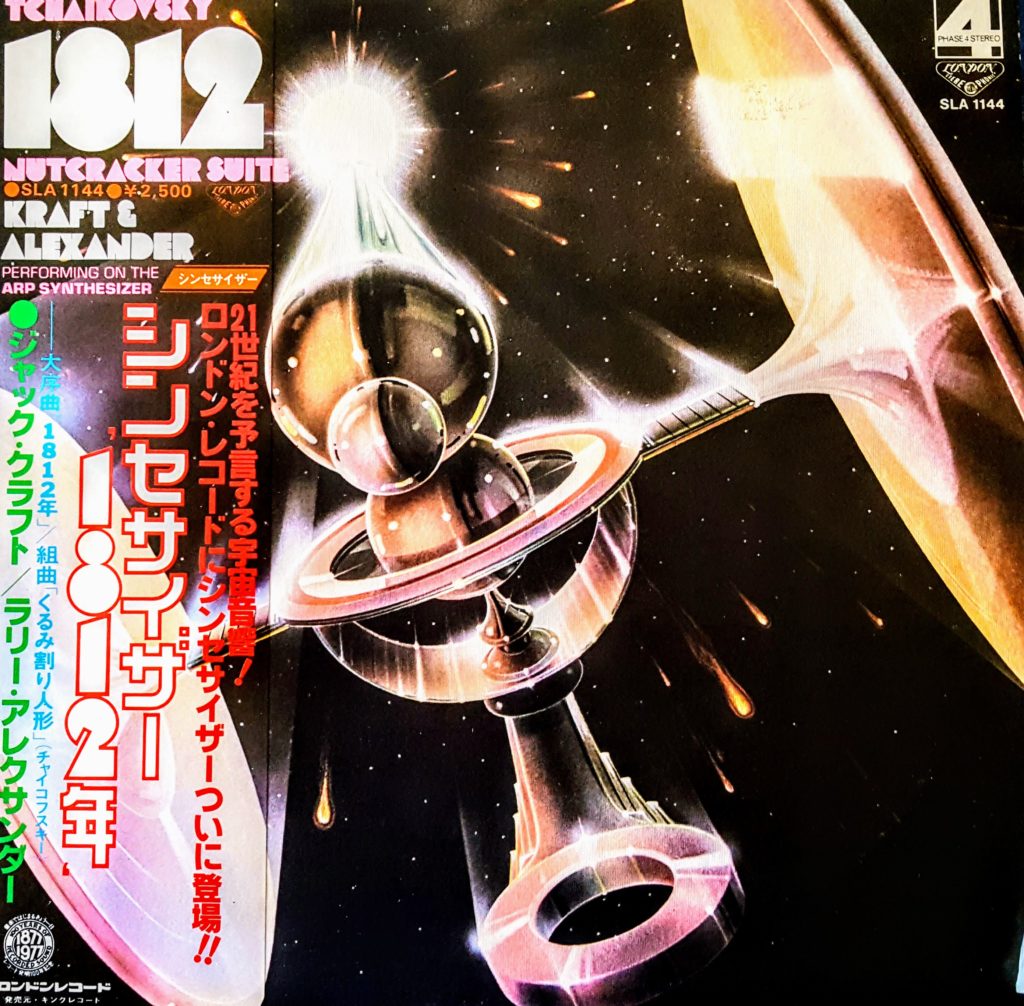
Kraft & Alexander
1812 Overture, Op. 49
Nutcracker Suite, Op. 71a
I’ve lost track of how many Moog and Moog-like (new phrase, I coined it) albums I’ve covered and written about in the 10+ years of Lost Turntable. I’m fairly certain one of my very first posts was a write-up on a Beatles Moog record. I’m not going to look that far back because it’s just embarrassing.

Regardless, I’m sure I spend many of those posts talking about how nearly all of these albums came in the wake of Wendy Carlos’ massively successful “Switched-On” series, which took classical compositions (and other works) and reworked on the then-new technology of modular synthesizers.

This doesn’t surprise me, it never surprises me when a trend, no matter how obviously limited, is milked for all its worth by the less-creative peers of the originator. But I am continually surprised by just how many of these albums there were, and for how long they were made.

1812/Nutcracker Suite (herein referred to as 1812) was released in 1977, nearly a decade after Carlos’ original Switch-On Bach album. Could there have really been an audience for this stuff for so long? And for so much of it? I’ve lost track of how many Mooglike albums I own, probably over a dozen at this point, and I routinely see more that I don’t buy; either because they look too stupid even for me (I don’t need Moog Nashville, thanks) or because they’re so rare in my resident country of Japan that they’re priced beyond the point of me caring (I refuse to spend $30 on an album of Moog pop music covers). If I went out of my way to buy every single Mooglike album on the market, even just limiting myself to the initial wave that came out in the 1970s, I’d probably fill an entire record shelf with them. I just can’t believe they lasted as long as they did.

Like I said, 1812 came out in 1977, which is rather late in the game for this genre. As such, its rather advanced when compared to similar releases. For example, this was not recorded on a Moog. It was record on various ARP synthesizers, including the Odyssey which was actually able to play more than one note at the same time, unlike the earlier synthesizers used on the Switched-On records. It also makes use of the ARP Pro Soloist, a super-early example of a preset electronic synthesizer (no big bulky patch units required). As such, it has a slightly more lush and “big” sound than some previous albums of its type.

That doesn’t necessarily mean its better. I still prefer the early works of Carlos. Her performances have more personality, and I appreciate the (relative) stripped down sound they have compared to this. But I do enjoy this record quite a bit, if nothing else for the rather ambitious subject matter. I’m sure a lot of other “Switched-On” type records tried to tackle The 1812 and Nutcracker Suites, but I think this is the only one to perform both in their entirety.

1812 is credited to two performers, Jack Kraft and Larry Alexander. It’s hard to find much on Jack Kraft, that’s what happens when you share a name with a college basketball coach, but I think this was his only credited release.

This is also Larry Alexander’s only album, although he has a long list of credits working behind the scenes. He did remix work for Paul McCartney and Lou Reed, among others, and also worked in the studio with artists like Sisters Of Mercy and Diana Ross. He was an engineer at The Power Station, a famous studio where artists such as Bruce Springsteen, The Rolling Stones and, yes, The Power Station all worked at one point or another.

I wonder if any of them ever heard this record?

Fretting over the remote possibility of nuclear war with help from The KLF

Sunday, April 16th, 2017

Okay, look.

I appreciate concern, I really do. I like that people out there are looking out for me and care for my well-being, I really do. But if one more motherfucker out there asks me if I’m worried/going to do anything about the increasingly heated conflict brewing between China, North Korea and the United States (with Japan, and by extension me, stuck in the middle) then I’m going to go nuclear and vaporize someone.

Allow me to nip your concerns and questions in the bud right now. No, I’m not worried about the possibility of any kind of military strike against Japan. This is mostly because I have enough, far more tangible things, to worry about. But I also just don’t think it’s going to happen. While I’m rarely the kind of person who says things like “the media is hyping this new story too much,” well, guess what; the media is hyping this story too much. Calm the fuck down.

Additionally, even if I had some inkling that something (whatever that might be) might happen. No, I’m not leaving Japan. This is my home and my boyfriend’s home.

Besides, there are enough dope record stores here to make the distant threat of thermonuclear war worth it. Seriously, look what I found today.

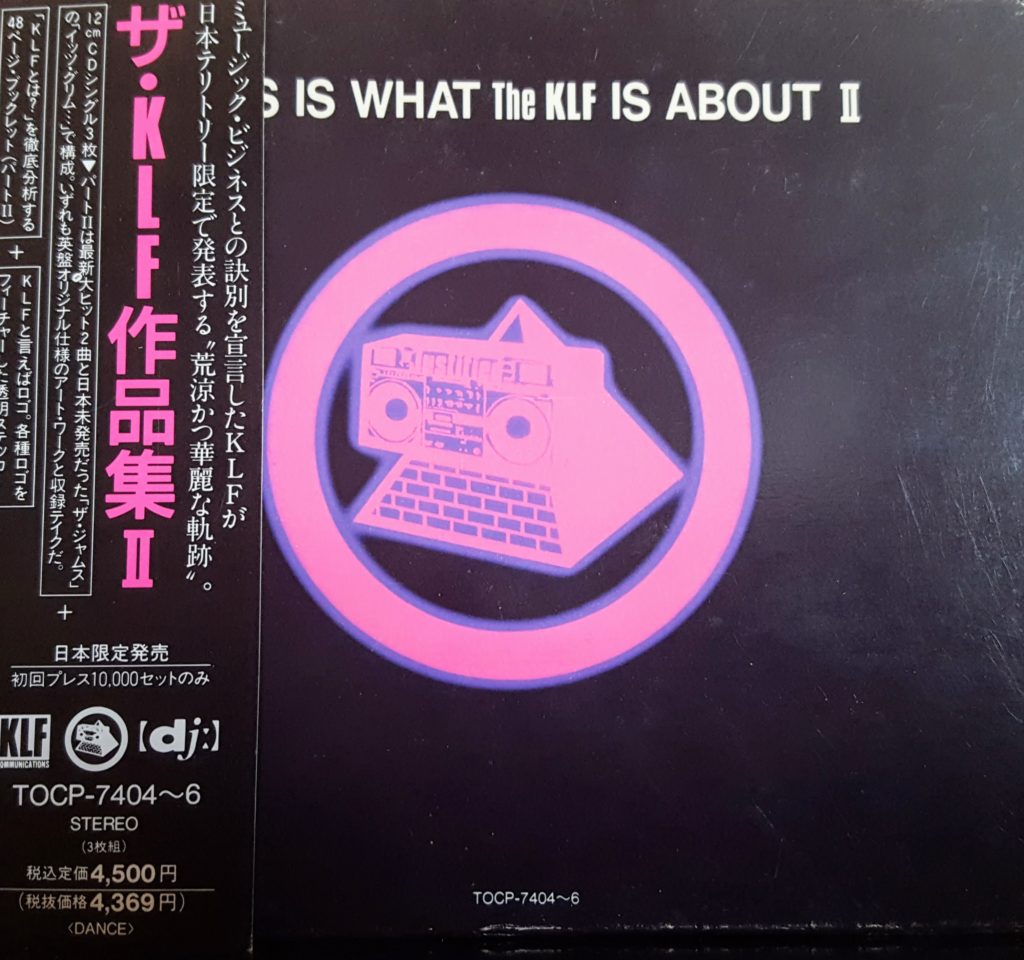
The KLF
It’s Grim Up North (radio edit)
It’s Grim Up North (Part 1)
It’s Grim Up North (Part 2)
Jerusalem on the Moors
America: What Time Is Love? (radio edit)
America No More
America: What Time Is Love? (Uncensored)
America No More (Just the Pipe Band)
Justified & Ancient (Make Mine a “99”)
Justified & Ancient (Let Them Eat Ice Cream)
Justified & Ancient (“The White Room” Version)
Justified & Ancient (All Bound for Mu Mu Land)
Justified & Ancient (Stand by the Jams)
Maybe I’ve said this before (it feels like something I would’ve said before), but one of the best things about living in Japan is walking into a random record store and seeing an “import” that you first heard about on the internet 15 years ago and never thought you’d buy. And seeing it on clearance for less than $20. I just hope I can find part one for a similarly cheap price someday. Because this thing is fucking dope.

I have probably shared many of these tracks over the years here at Lost Turntable. In fact, I’m positive that I have. However, those were all vinyl rips and many were done back when I was still learning how to rip my vinyl, so a lot of them sound like garbage. If you’ve ever downloaded these tracks from me before, you should probably download these too, they sound a hell of a lot better.

Okay, change of plans. If the possibility of a nuclear conflict does increase, then I’m gonna put my boyfriend in a suitcase (he’s tiny) and hop on a plane for Mu Mu Land. Dope beats, acid house and Tammy Wynette await me.

Soviet Synth

Thursday, June 30th, 2016

20160629_194237


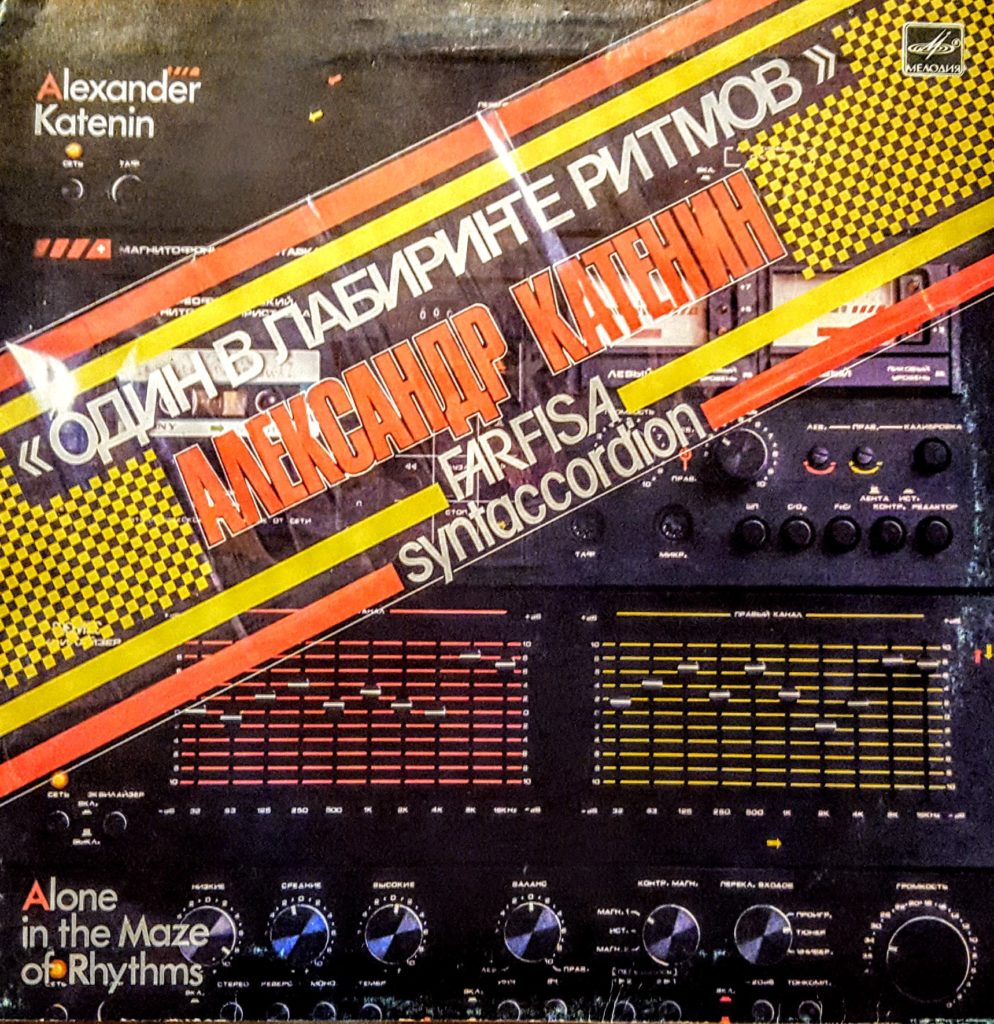
Alexander Katenin – Alone In The Maze Of Rhythms
I’ve been trying to write about this one for a few weeks now. First I was distracted by the horrible Boom Boom Satellites news and then work. But to be honest, most of the delay in posting this came not from external forces, but simply from the fact that this album is so weird that I’m kind of a loss of words as to what to say about it.

This is Alone In The Maze of Rhythm. It’s a synthesizer covers album. There’s nothing entirely unique or weird about that. There were a ton of these in the wake of Wendy Carlos’ seminal 1968 masterwork Switch-On Bach, “let’s take some classical and pop tunes and play them on Moog” was practically a genre in the early 70s. I have quite a few of them. All Moog Hair? Got it. Wanna hear Gershwin on Moog? How about Handel, Beethoven or even the theme to Flesh Gordon? Guess what, a Moog version of it probably exists.

But Alone In The Maze of Rhythm is unique, and just downright weird, for a few reasons. Firstly, while most Moog covers albums were released in the late-60s to mid-70s, this one came later. It came way later. It came 1986 later.

That’s weird. You see, the Moog covers album craze was mostly born out of the fact that most people had never even heard a synthesizer before, and that their sound was so alien that you could record damn near anything on them and someone would want to hear it, at least once. But by 1986, that just wasn’t true. Synthesizers had won. Shit, not only had the world become accustomed to synthesizers, but they were quickly becoming played out. By 1986, most of the innovation that the synthesizer brought to the pop world had been sullied and watered down to the point of banality. We weren’t getting “Cars” anymore, we were getting “I Just Died In Your Arms Tonight.” Synthpop was on its last legs.

I guess no one told the Soviet Union though, because that’s where Alone In The Maze Of Rhythm comes from.

20160629_194250

Yes, from behind the Iron Curtain comes Alexander Katenin, a man who…I know absolutely zilch about. Turns out there isn’t a lot of English information on the web about mid-80s electronic covers albums from the Soviet Union. Everything I know about the guy I dug up on Discogs. He released two albums a solo artist, both synthesizer-focused cover records, and one as a part of a duo by the name of…Гоги И Гия Бешитаишвили.

Yeah, I don’t know how to say that. You’re on your own.

So what we have here is a synthesizer-covers album composed in 1986 in Soviet Russia. And yet, we still haven’t reached the actual weird parts of this record.

One of them is the instrumentation behind the record. Not all synthesizer covers albums used Moog synthesizers, but an overwhelming majority of them did, so much that for some, Moog is shorthand for synthesizer. But there are all kinds of synthesizers out there, and this was especially the case in the 80s, with the rise of digital synthesizers like the Synclavier and the Fairlight CMI, two machines that literally defined the very sound of the 80s.

But Katenin didn’t use those. No. He chose the Farfisa Syntaccordion. That’s an accordion/synthesizer combo unit. Now, I don’t know how much of a synthesizer it really is. No way it has the range or capabilities that you might find in a Moog or Fairlight unit, but it was definitely advertised as a synthesizer, as this ad from Retro Synth Ads proves. And the album certainly has a synthesizer feel to it, far more than than an accordion one to be honest.

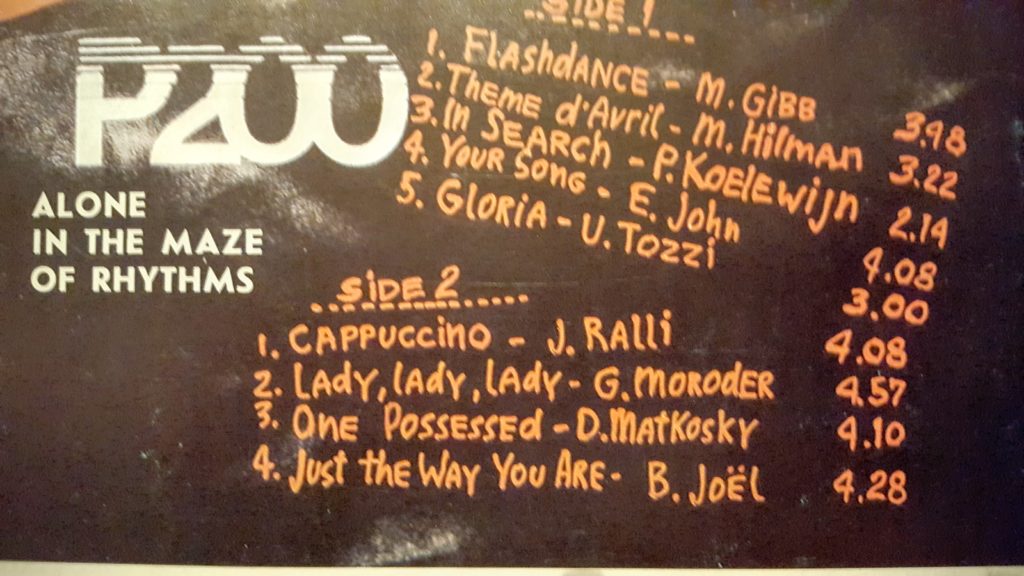
And so if you were ever thinking “I hope one day I can hear Frank Stallone’s ‘Far From Over’ performed on a strange accordion/synthesizer hybrid,” well then you’re in luck! Ditto if you were ever hoping to hear Soviet-electronica interpretations of Elton John’s “Your Song,” “Gloria” by Laura Branigan, and the theme to “Flashdance,” among others.

20160629_194254

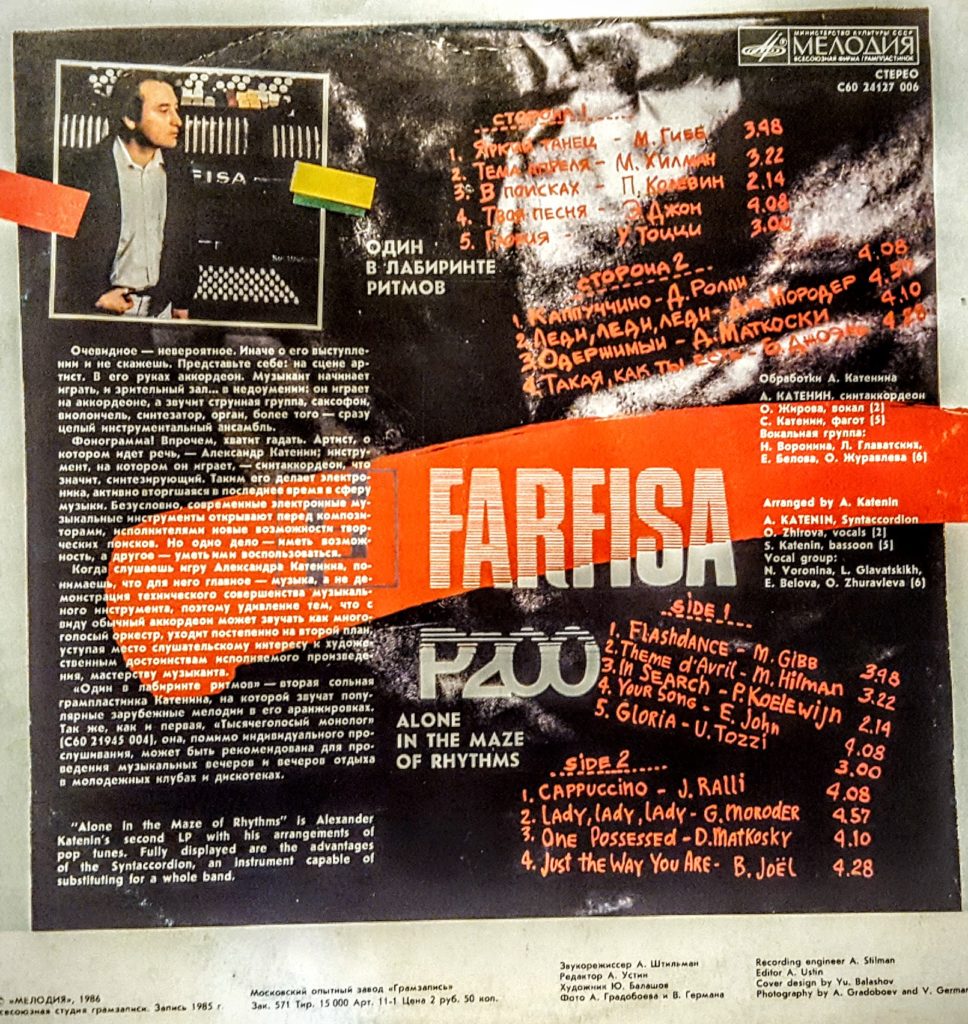
This album has an incredibly strange tracklisting, one that I can’t 100% verify, as the liner notes and record label are just straight-up wrong, with tracks in the wrong order and credited to the wrong songwriters. I did my best to fix them on my MP3s, but a few tracks, specifically “Theme d’Avril,” “In Search Of” and “Cappuccino” could still be wrong. So if you give them a listen and know what their real names/point of origins are, please inform me in the comments.

So it’s a weird record with a weird point-of-origin, a weird instrument of choice and a weird tracklisting, but is it any good? Well, I mean…no? It’s cheesy as hell. The cover of “Just The Way You Are” sounds like it was taken out of a compilation of elevator music. But it does have it’s charm. “Gloria” is a dope track that’s hard to fuck up regardless, and the tracks that I can’t properly identify are legit good. “Theme d’Avril” features an absolutely haunting vocal track that sounds all the more unreal when matched up to the cheesy beats coming out of the syntaccordion. And then there’s “Cappucino” which features a rad proto-acid house grimey bass-line paired up with odd, slightly creepy vocalizing that wouldn’t be out of place on a Goblin record.

Give it a listen. And remember that in Soviet Russia, records listen to you.

Hey, I’ve been writing about 1980s Soviet pop culture for the past two hours, I’m allowed one Yakov Smirnoff reference.

10 Years Of Being Lost: Berlin’s Information

Monday, March 21st, 2016

berlin

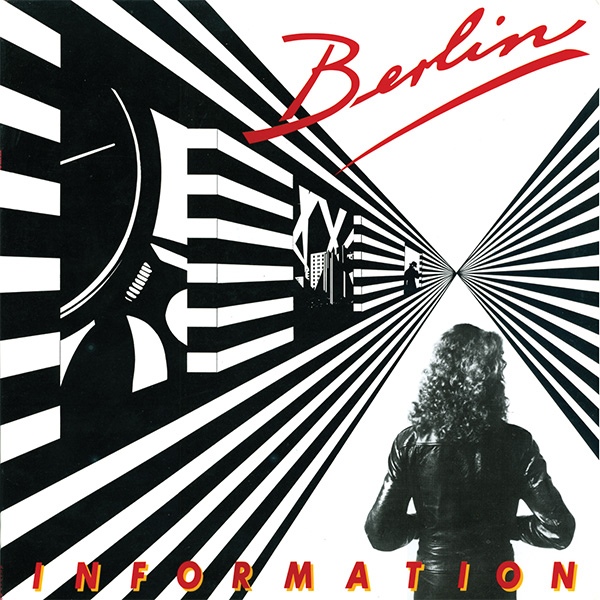
Berlin – Information

“Hey cool, Berlin. I like Berlin and this is cheap I’ll buy this” I thought, as I stumbled upon this LP in a record store nearly a decade ago.

Berlin remains one of my favorite new wave acts, and I’ve always thought they’ve fallen through the cracks of history for no good reason. They’re usually dismissed as a one-hit wonder, but that’s not the case at all. Sure, “Take My Breathe Away” was a mega-hit that made any other success they had seem minute in comparison, but before that Moroder-penned tune launched them to super-stardom, the group scored a few minor hits with awesome tracks like “No More Words,” “Dancing In Berlin,” and the incredible “Metro.”

All those songs are from the group’s 1982 major-label debut Pleasure Victim. And if you check them out on iTunes, any record store, or even on Berlin’s own webpage, that’s usually regarded as their full-length debut. But that was not the case, as I discovered when I bought this record. Turns out that Information was Berlin’s first album, recorded and released in 1980.

Although to be fair, it’s barely a Berlin album. Most notably, Terri Nunn is nowhere to be found here, having left the group for a short time to pursue an acting career. Replacing her is one Virginia Macolino, whose vocal stylings are notably different than Nunn’s. While Nunn dipped her toes in a more detached and robotic vocals to match her band’s all-electronic sound, she was never afraid to let herself go and really belt it out when needed. Macolino, on the other hand, is full new wave, almost punk rock, in her approach. Her style reminds me heavily of Patty Donahue from The Waitresses, detached with an aura of irony throughout.

Macolino isn’t the only change. This early incarnation of the group also features a different bass player by the name of Jo Julian, who also served as the album’s primary songwriter, alongside guitarist Chris Velasco (who did stick around for the band’s more well-known records) and original vocalist Toni Childs (!!!) who is credited as a songwriter for four of the album’s tracks. Keyboardist John Crawford, who served as the primary creative force for the band’s biggest years, only contributes to a handful of tracks here.

The result is a drastically different sounding record when compared to what would come just two years later. While Pleasure Victim is clearly influenced by the poppier side of synthpop that was just beginning to make itself known thanks to acts like The Human League and Flock of Seagulls, the Berlin of Information is far more robotic and futuristic. Again, comparisons to The Waitresses could be made here, as well as Gary Numan and pre-Dare Human League. Pleasure Victim was all about sex and romance, Information is far more of a socially conscious record, touching on themes like nuclear war and the drollness of middle class life, while bouncing back and forth sci-fi themes like robots and mind control as well. The only song on Information that sounds like the Berlin we would come to know is “A Matter Of Time,” which actually was a pre-Macolino track that was originally recorded with Nunn, with that version appearing on their greatest hits album.

Aside from that one track, everything on Information remains woefully out-of-print and hard to track down. It was only released in 1980, and from what I can tell it only got a single pressing. Turns out that I was lucky to score my copy for less than five bucks, good copies online usually go for between $20 and $40. Not a buried treasure by any stretch of the means, but a bit on the pricey side.

Equally hard to come by is information by the band members who left after Information. According to Discogs Jo Julian went on to work with some metal acts, including Alkatrazz and Samson, but that’s a pretty big geographic/style switch, so I suspect that might be another Jo Julian.

As for Virginia Macolino, for someone who never broke through to the mainstream she certainly got around. Before Berlin she fronted the punk act Virginia And The Slims, of which you can find an incredibly in-depth write-up on by a former band member here. After Information she returned to her punk roots with the hardcore act Beast Of Beast. They never made it anywhere either, but they did manage to record one album, 1983’s Sex, Drugs and Noise. It pretty rare now and goes for a mint online and one listen will tell you why – it’s a pretty damn great hardcore punk album, totally revolutionary and ahead of its time. More people need to hear that one.

After that, I can’t find much else. Apparently she dated Joey Ramone for a while in the 90s, so even though she wasn’t recording music professionally she was probably still involved in the scene at that point. Sounds like she’s had one hell of a life.

Information isn’t Berlin’s best, I still think that would go to Pleasure Victim, but it’s a great time capsule showcasing the pre-MTV era of synthpop, a darker, more eccentric sound that was still a couple years away from the shine and polish that acts like Duran Duran would give it. Of all the out of print albums I’ve found by accident while writing this blog, it’s one I treasure the most.

Let’s Get Ill With Rappin’

Tuesday, February 16th, 2016

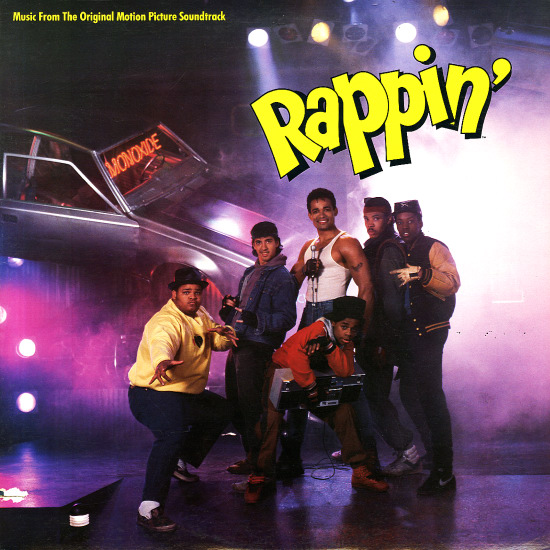
rappin

Rappin’ is the poor man’s Breakin’. No, strike that – it’s the poor man’s Breakin’ 2: Electric Bugaloo.

An all-but-forgotten 1985 hip-hop musical drama, it’s mostly known today for featuring an early starring role for Mario Van Peebles, as well as an early vehicle for Ice-T, whose featured more prominently in the film’s amazing trailer than the film itself. I’ve never seen the movie, but from what I’ve skimmed on YouTube I don’t think I’m worse for it. The soundtrack certainly is…something else.

I’ll be honest…this is one of those nights where I’m not sharing music that I would call good. I’m more…exposing you all to some musical history, artifacts if you will, from a bygone era that time has largely forgotten, rap’s first foray into the pop landscape.

It has not aged well. But let’s take a listen!

Lovebug Starski
Rappin’
The Fight Rap
A honest-to-goodness old-school hip-hop pioneer, Lovebug Starski started as a DJ in the late-70s before moving to rapping in the early 80s. He released several singles and one album, but he apparently went to prison sometime in the mid-80s, which put a serious dent in his music career. Dude still seems to be kicking it though, I found a video of him performing in 2008. I wonder how many other old-school pioneers have been lost to the ages?

Starski has two tracks on Rappin’. The first is the title track. It’s okay, although like most of the tracks on the album, his delivery seems rather stilted and simplistic when compared to what followed. I much prefer “The Rap Fight,” which is a dope electro tune with a sick beat and some totally ill synth lines. I would totally pop-and-lock to this one if my bones didn’t already pop-and-lock on their own throughout the day.

Melvin Plowden, Mario Van Peebles, Eriq La Salle, Kadeem Hardison & Richie Abanes
Snack Attack
This is a rap by the stars of the film, Mario Van Peebles, Dwayne Wayne from A Different World, the asshole doctor from ER and…two other dudes (more on the them in a minute).

In case you were wondering. Neither Mario Van Peebles, Dwayne Wayne nor Dr. Peter Benton from ER can rap. Not only can they not rap, they really can’t rap. And don’t forget, the standards for “good rapping” were pretty low in the early 80s. That’s not to say that the rappers of the era were bad, on the contrary, many are some of the best who ever lived, but the artform was new at the time. People were still figuring it out, the rules were still being made, so a lot of rap from the era is pretty simple.

With those limitations and expectations established, this is some bad rap that sounds horrible. Firstly, it’s a rap song about snacking. And, like I said before, this was the early-80s, but rapping about how much you like food? That was already well-trodden ground by The Fat Boys (who were amazing rappers FYI), so in addition to being a stupid topic for a rap track, it’s an unoriginal topic that’s been done better. I don’t know who’s rapping what line, but they’re all doing a horrible job. They got no flow, no rhythm, no meter. They’re just spouting out lines about food that rhyme. Well, they usually rhyme, at one point they do try to rhyme sardines with cheese and beans.

It’s even bad musically. Most great rap of the era was built off of solid samples or original electronic beats. This has neither, and is instead built off of a generic guitar lick and what sounds like a preset drum beat. Not to mention the piano outro that tries to give the track a jazzy feel, for some reason.

Peebles, Hardison and La Salle were all wise for not pursuing rapping further, but what of the other two on the track? Well, Richard Abanes is an experienced actor and singer, but he’s mostly known for his books. You may have seen them in the religious section, with titles like Harry Potter and The Bible, The Truth Behind the Da Vinci Code and What Every Parent Needs To Know About Video Games. I really wish he would take up rapping again, but only about these topics. Who would want to see a middle-aged Mormon rap about the evils of pop culture, “Yo now listen to what I have to say, Harry Potter is evil and he’ll make you gay!”

I couldn’t find anything as humorous about the mysterious Melvin Plowden, aside from the fact that he produced some forgotten rap tracks, including one called “You Ain’t Right Eddie Murphy.” If he was referring to Murphy’s then incredibly homophobic stand-up routine, yo Melvin, I agree with you.

Mario Van Peebles
Neighborhood Walk
“Rock Box” but bad.

The Force M.D.’s
Itchin’ For a Scratch
Now here’s an example of an old-school rap song that’s obviously dated but still great. A simple but catchy beat, some great synthesizer and, of course, some totally over-the-top scratching effects. The Force M.D.’s were a legit rap outfit with a long carer that produced a few minor hits, and it shows here. These guys got the rhythm down, and their lines are simple-yet-clever. The Force M.D.’s were mostly known for their ballads and love songs, but this track shows they had some solid old-school hip-hop skills too. An album highlight and a lot of fun.

Warren Mills
Flame In The Fire
The first of two pre-teen performers on this album. Mills is by far the better of the two because he can actually sing, but that’s faint praise. The production is about as generically 80s as you can get, it sounds like the bastard love-child of “Rhythm Of the Night” and a Pretty Poison song. And while Mills has pretty good vocal chops for a kid, he still sounds like a little kid. And there’s nothing I want to hear less than a little kid try to serenade someone.

The sax solo is pretty ill though.

D. Terrell
Call Me
Who is D. Terrell?

No, seriously, who is he? I can’t find anything on this dude. Can’t find anything on him online, I think this is the only song he ever wrote that made it to any release at all. It’s not all that bad. Not all that memorable either.  I feel like it belongs on the soundtrack to D.C. Cab for some reason.

Lajuan Carter
If You Want To (FU12)
I could be mistaken, I’m a little drunk and it’s been a long week. But I’m fairly certain that this is a song about wanting to fuck a robot. Literally. She says “I don’t need nothing but robot love.” Someone call Brent Spiner.

Lajuan Carter never released a full album proper but she’s had a decent career as a backup singer, appearing on the Set It Off soundtrack and on albums by Vanessa Williams and Darryl Hall. I don’t feel like this song really takes advantage of her voice, she kind of has a Vanity thing going on with a trying-to-be-sexy whisper voice. But she occasionally does let that soprano of hers rip and it’s pretty impressive.

Tuff, Inc.
Golly Gee
This album has too many shitty love songs by little boys who are all too fucking young to know what love is. This is the third one, and it is by far the fucking worst. Abysmal garbage. I don’t want to hear the lovelorn woes of little shits whose balls haven’t even dropped yet. You fucks. You don’t know what love is. You think love is holding hands after homeroom.

“What didn’t you know why he claimed to be true. He’s running around making a fool of you.”

What the fuck is that? What is this song suggesting? That the girl this kid is falling for has a boyfriend who is fooling around with other girls? What the fuck? YOU’RE TWELVE! When I was that age I didn’t know any kids who were prowling homeroom for pussy. Ick.

Eugene Wilde and Joanna Garnder
First Love Never Dies
The soundrack to the film Rappin’ ends with a quiet storm love duet, because…fuck if I know. This song is pretty awful, but I think that largely has to do with it being incredibly dated than anything else. In an alternate reality I could totally see this song being a top ten hit single and making an appearance on Solid Gold.

Joanna Garnder never really had much of a career, but Eugene seemed to have a few hit singles in the 80s. A quick search on YouTube turns up quite a few tracks, including the incredibly dope “Gotta Get You Home Tonight” which I can only assume was the early-8os equivalent of Boyz II Men’s “I’ll Make Love To You.” I totally bet that song would work on my boyfriend.

Dungeons & Dragons on Vinyl

Monday, February 8th, 2016

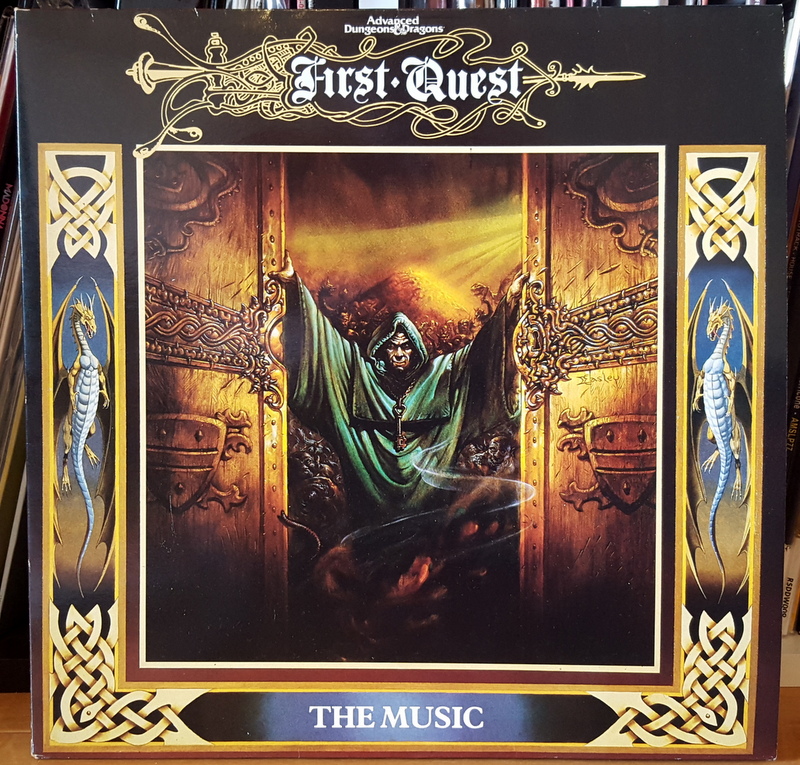
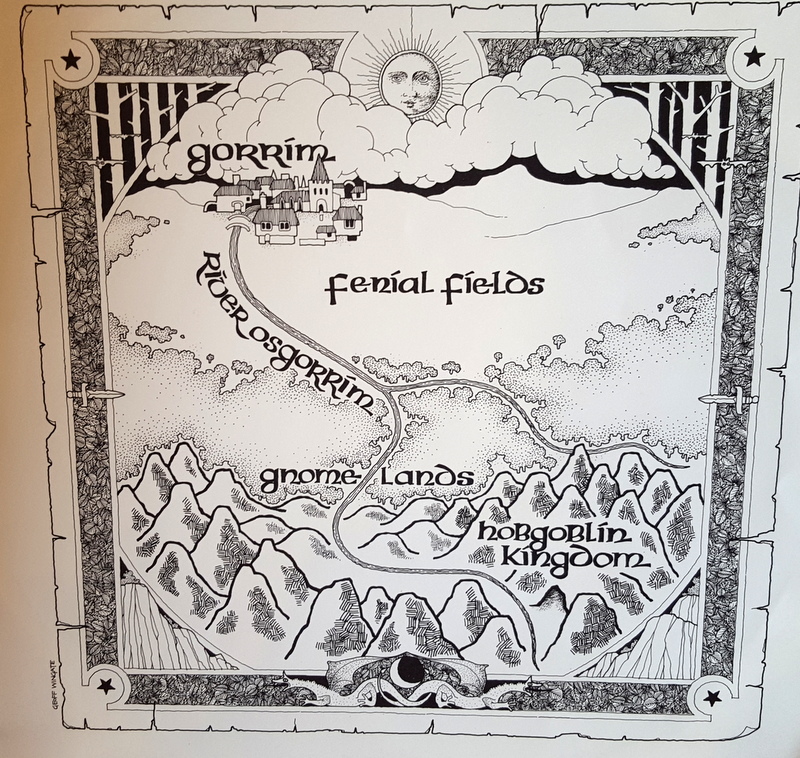
I’ve never been into Dungeons & Dragons and I’m never going to be into Dungeons & Dragons, or any form of table-top gaming for that matter. Video games got me at a young age, and the idea of setting up a board and rolling dice while some dude tells me a story about wizards just never appealed to me in the least. I guess I just don’t get the appeal. I’ve tried several times too. I had friends in junior high, college and in my adult life who were way into D&D. Many of them tried to suck me in, all to no avail. But if they would’ve came at me with their 20-sided dice in one hand, and this rad 2LP set of instrumental electronic music in the other, they might have fared a little bit better.

20160208_134721

First Quest (Complete Album Download)
I didn’t know what I was expecting when I first dropped the needle on this record after finding it in a record store on the outskirts of Tokyo last week, but it certainly wasn’t a surprisingly above-average collection of minimal, John Carpenter-inspired instrumental electronic music. Considering the inspiration material, I guess I imagined something a little more classically-minded. Perhaps I was expecting a full-on symphonic score or some sort of symphonic metal. Although I guess the latter would’ve been impossible, as this album came out in 1985 and symphonic metal didn’t really exist as a genre at that time.

20160208_134800

Save for the final track, First Quest is entirely electronic, and while it features original music by a variety of musicians (of whom I’ll get to in a bit), the album has a fairly consistent creepy, vaguely dark, vibe that carries itself across all of the songs, regardless of composer. The previously mentioned Carpenter influence is strong with this one, echoes of Halloween are all over this record. But while the Carpenter comparison is the obvious one, when I listen to this I much more pick up the ambient stylings of Tangerine Dream, with a menacing hint reminiscent of Goblin’s work with Dario Argento.

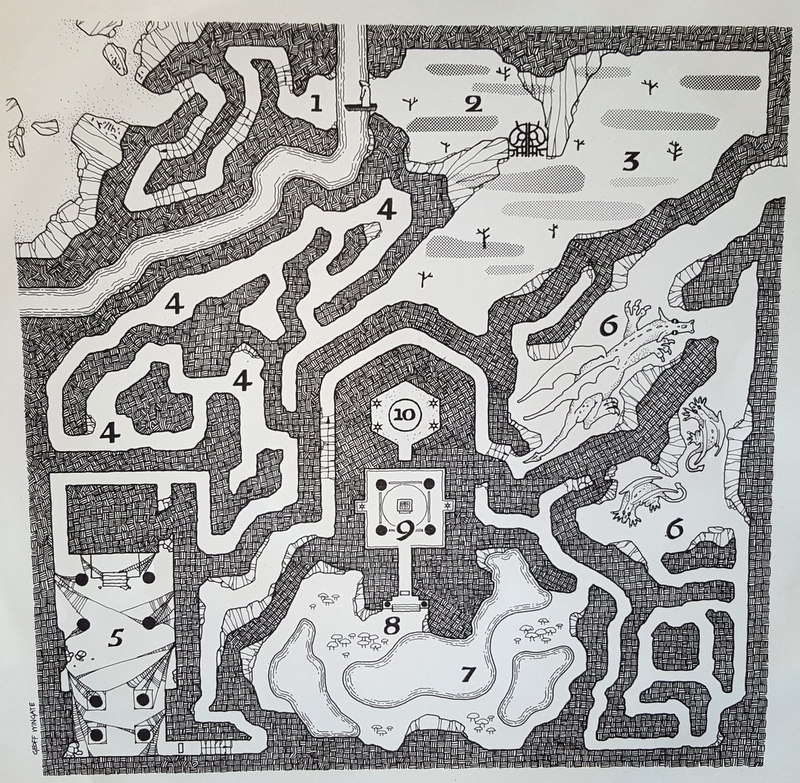
20160208_134756

With pedigree like that I’m probably overselling it a bit. No, this album isn’t a lost classic that’s ripe for recognition, but it’s certainly worth a listen, and way better than you’d probably expect a cheap collection of instrumental electronica inspired by a table-top board game to be. It’s catchy, fits the inspiration material damn near perfectly, and it’s a lot of fun. If some asshole in a jean jacket and retro-style shades put this out in 2016 ironically, it would probably be an indie-hit. Pitchfork would give it a 7.6.

A total of seven different artists are credited as composers on First Quest. Of them, the most prominent is probably Denis Haines, who was a member of Gary Numan’s backing band for the recording of Telekon. That group went onto form Dramatis, who released one album in the mid-80s before breaking up. He also played on albums by Fischer-Z, The Skids and, strangely enough, Marianne Faithfull. Haines’ work on the record runs the gamut, with some being rather upbeat, and others a tad more dreary and ambient. A standout of his selections is “Gnomes,” an poppy yet dark number that I could easily imagine Gary Numan singing over.

20160208_134835

Click for hi-res.

Two other names that pop up a lot on First Quest are Phil Thornton and Dave Miller, who compose about half of the record. Together they were part of an early-80s synth-pop group called Expandis, who continue to release new music, and Thornton has a fairly prolific career as a solo musician putting out new age and ambient music (much of it sci-fi or fantasy themed). Based on their work here and from what I could find of Expandis online, Thornton and Miller probably dug the darker edge of early-80s synthpop and post-punk quite a bit. I bet they totally saw Echo & The Bunnymen live at least once. Their stuff here is good mood music that sets the tone for the album, but sometimes it falls a bit too far into new age territory for my tastes. “The Return Of Light” is a damn fine closer though.

Then there’s Steve Parsons, in addition to the handful of tracks he donated to this record, he also worked a bit as a film composer in the 80s, contributing songs to the superb Empire State soundtrack, and composing the horrifically bad score the the hideously awful Howling II. His tracks here aren’t that great, but I’ve read that the solo stuff he released under the name Snips is much better.

There’s also Barrie Guard, whose one contribution to First Quest, “The Heroes Ride Out” is an easy highlight. If his Discogs is any indication, Guard got a lot of work in the 70s and 80s, working for musicians as diverse as Bonnie Tyler, Dusty Springfield and Cliff Richard. He was also the orchestra conductor for the score to one of my boyfriend’s favorite films, A Room With A View, so the next time you want to connect Merchant And Ivory to D&D in just one step, there you go. Too bad he never stuck with the minimal electronic score thing, he was pretty good at it.

20160208_134901

The only group credited on First Quest is a band called The Device, who only show up for one track. Their tune isn’t bad, and is definitely one of the more Carpenter-inspired joints on the album. They didn’t seem to do anything outside of the album though, and I can’t find much about them. Finally, there’s guitarist G.P. Hall, who concludes the album with an entirely out-of-place guitar track. He has a fairly expansive Wiki entry that he probably wrote and should probably be deleted.

The album also features some brief snippets of narration by Valentine Dyall, who geeks will probably recognize as The Black Guardian from Doctor Who. He also starred in a shitload of British movies throughout the 40s and into the 80s before he passed away in 1985, shortly before the release of this album, hence his credit as “The Late Valentine Dyall.”

20160208_134823

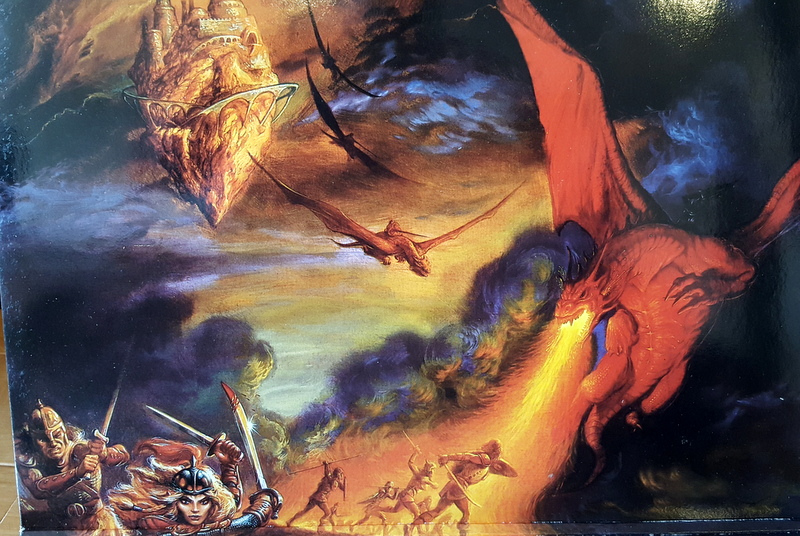
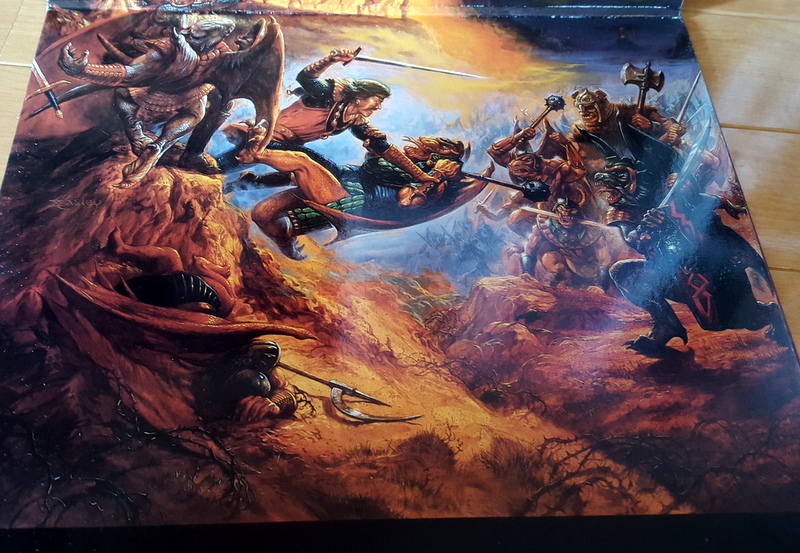
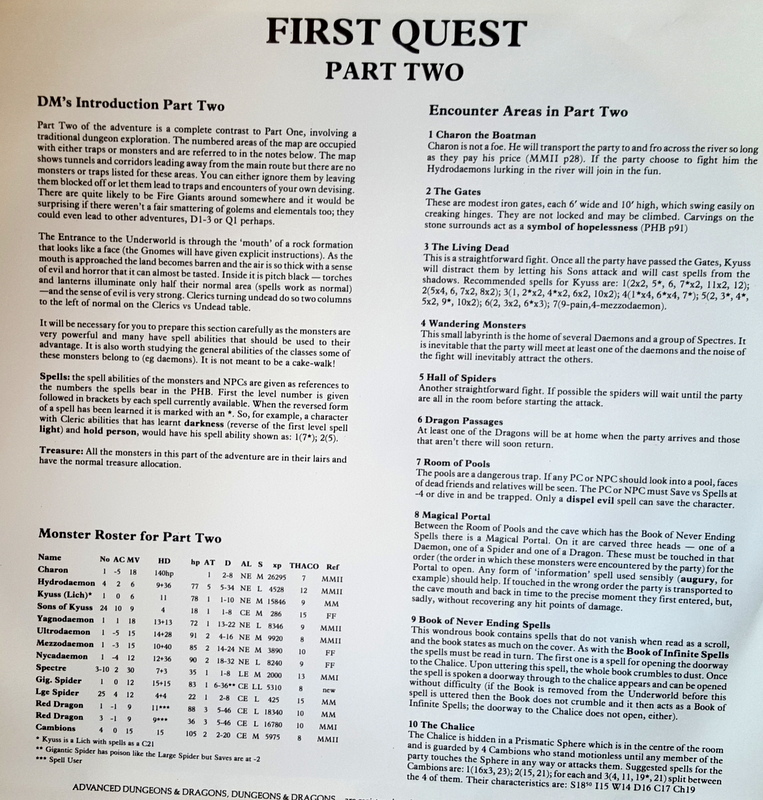
The packaging for First Quest is rather elaborate, featuring a gatefold sleeve and two custom inner sleeves which feature printed instructions for a Dungeons & Dragons campaign that follows the (rather loose) story outlined in the album’s music. Not knowing much about D&D, I couldn’t tell you if the campaign is well thought-out or worthwhile in anyway, I’d love to hear insight from anyone who might know.

Not a great album, but definitely a fascinating one, and a wonderfully dated product of its time that I think is ripe for rediscovery by a more accepting audience. I hope you find it as fun as I do.

フォースと ともに あらん ことを。(May The Force Be With You)

Tuesday, January 5th, 2016

Star Wars is, of course, an international phenomenon, and during my time in Japan I’ve come to realize that the franchise might be even more popular here than it is in the west. Sure, in America you have much the mocked Star Wars fruits, but do you have a Star Wars vacuum cleaner? What about Star Wars chopsticks (that light up)? Can you buy a X-Wing inspired Star Wars pen and pen stand (for a combined price of over $2,000)? Star Wars dishes, high-end Star Wars doormats, Star Wars kimonos. You name it, Japan has it. It’s pretty dope.

In fact, Japan getting exclusive Star Wars goodies is not a new phenomenon, just check this out.

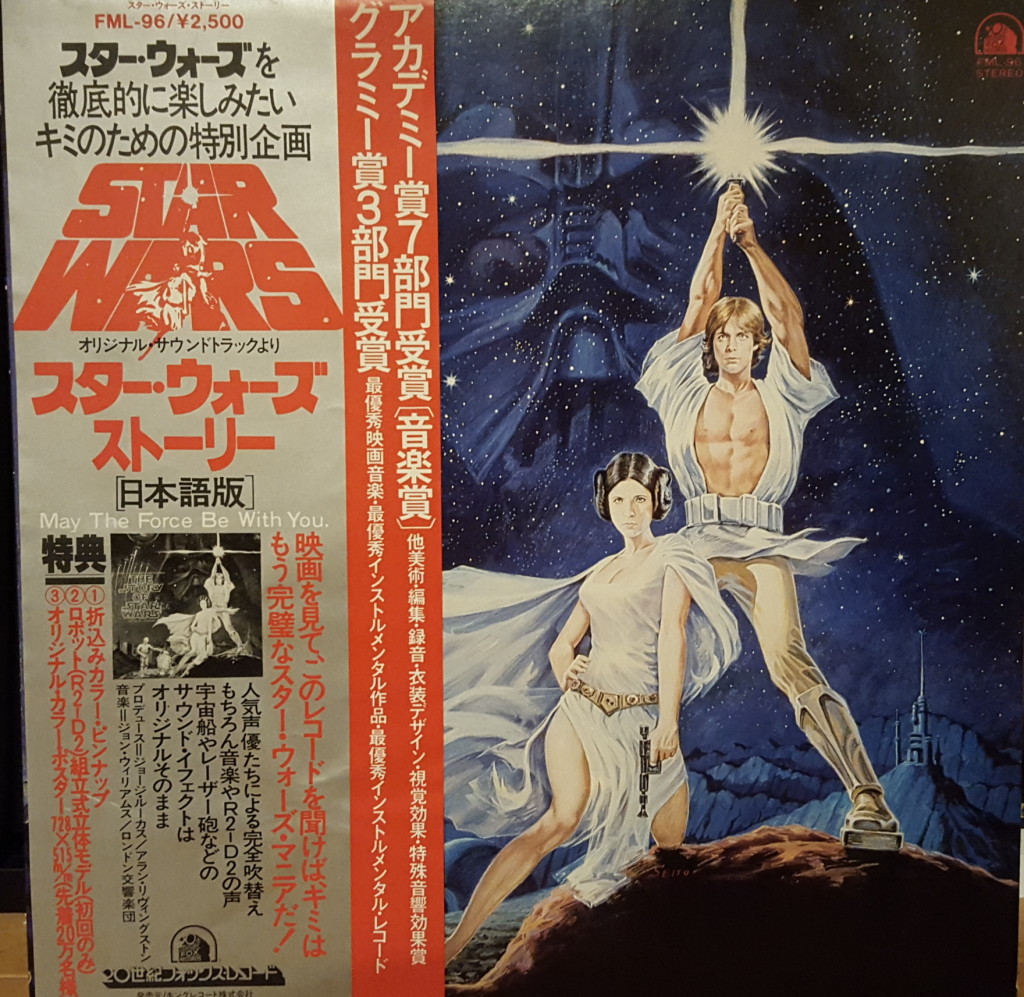
20160105_220340

The Story Of Star Wars (Japanese Edition)
Side 1
Side 2

This is the Japanese edition of the Story of Star Wars LP, a 1978 record that summarizes the…story of Star Wars (duh) by combining audio and dialog from the film alongside original narration that helps to cut down the running time to something that would fit on an LP (and work without the aide of visuals).

Now, a lot of countries got this record, it was released all across North America, and also in several European countries. However, all those countries, no matter what their native language, got the album in English, even if the movie came out in their country dubbed.

This was not the case with Japan.

When the time came for the album to come out in Japan, Fox actually went out of their way to release a Japanese language version of the record, complete with all new Japanese narration, as well as the original Japanese dub of the film.

I don’t know what made Japan so special that they got a uniquely localized version of this record, but I think it probably had more to do with the LP buying habits of the Japanese people than the runaway success of Star Wars in the country. During the late 70s and early 80s, these “audio drama” types of records were oddly popular in Japan. In my time browsing the used LP bins here, I’ve seen audio drama LPs for countless TV shows, feature-length anime, sporting events and even wrestling matches. The releases dry up sometime in the mid-80s, I assume home video killed it.

I’m going to be real for a second. Even though I’ve lived in this country for two years now, my Japanese is still dogshit. In fact, calling it dogshit might be an insult to dogshit. So don’t ask me how loyal to the source material this translation is or anything like that.

So yeah, when I listen to this I can probably only pick up every 10th sentence, if that. But despite my ultra-limited understanding of the language, I still find this record an interesting listen. Not only am I using it to help with my Japanese, it’s also fun to listen to hear the dubbed voices and the stylistic choices they went with for each of them. Han Solo and Obi Wan sound like rough samurais (not surprising) while Luke still comes off like a whiny idiot. Most interesting, to me at least, is that C-3P0 still speaks with a British accent.

In case you’re wondering, R2-D2 remains unchanged. Bleeps and bloops are international.

Special thanks to the boyfriend for translating “may the force be with you” into Japanese. In case you’re wondering, you pronounce that “o-su to tomoni arankoto.”

International New Wave: Life In The Future – Swedish Post-Punk & Synth Wave 79-87

Tuesday, December 8th, 2015

Before I get to the music tonight, I want to share a few things I wrote over at that other site. I put up a review  of some recent game music releases, wrote a thing about how I’m done with horror movies for now, followed that up with a hella bizarre piece about Kiki’s Deliver Service, Amazing Grace and Chuck and the lack of human empathy (I was having a strange week), did a quick write-up of another Nirvana re-issue, put together a sadly relevant piece about a movie that predicted America’s mass shooting problem, and then closed out with a piece on STP.

Been busy. Anyways, some weird shit for the holiday season.

CVs_y78UAAAbQTb

I’m consistently impressed by the oddball shit I find in Japanese record stores.

This is Life In The Future, a bootleg compilation of obscure Swedish post-punk.

Quick, ask me anything about Swedish post-punk.

Okay, I’m going to be honest and tell you that I don’t know shit about Swedish post-punk. I didn’t know the Swedes had post-punk. I thought they only had two genres in Sweden, ultra-poppy and cheery dance-pop and hardcore death metal. Shows you what I know.

But I wished I knew more, but because damn, this is a really great record. It does kind of get off to a rough start with the intentionally abrasive “Forlast Javel” by HörförstÃ¥else, but it picks up soon after that, with all flavors of post-punk getting due mention here. Like dissonant, depressing post-punk ala Joy Division? Then check out “Vanda Inat” by Unter Den Liden. Into quirky dance-punk with an electronic bent? Be sure to play the utterly manic “Happy Funeral” by the wonderfully named Kitchen & The Plastic Spoons. If you like darkwave synth-pop with a touch of New Order you’re more than covered here with great tracks like “East People” by Vitality and “The Gift” by Reasons To Live. And if you like weird shit that would make most people’s head explode, skip straight to the utterly bizarre “I Throw Punches” by one Friz Be.

As I said before, most of the stuff on this record is incredibly obscure. Most of the acts here didn’t even release a full album, and instead just offered a single or two before vanishing completely. Of the acts on here, the most well-known is probably Cortex, who get their material re-issued on a semi-regular basis. I couldn’t tell you much about them though.

Keep in mind, this is a vinyl rip of a bootleg record that was in itself most likely sourced from vinyl. So don’t expect killer audio quality with this one. Still, good stuff overall, so if you’re like me and have exhausted nearly every post-punk act that England and America had to offer, check it out!

Complete Tracklisting (Download Link)

  1. Forlast Javel - Hörförståelse
  2. Tristess No. 3 – GPJ
  3. Happy Funeral – Kitchen & The Plastic Spoons
  4. Envy – Modern Art
  5. Jesus I Betong – Cortex
  6. Chinese Junkies – Njurmannen
  7. Dance – Odd Stories
  8. Rekordmagasinet – Mats Olofsson
  9. The Gift – Reason To Live
  10. I Throw Punches – Friz Be
  11. Vanda Inst – Unter Den Liden
  12. East People – Vitality
  13. She’s A Waitress – Elektriska Cellskapet
  14. Operator – Tres-Operator