Author Archive

(A) (Post) (With) (Excessive) (Parenthesis) Featuring Dead Or Alive and Coil (And Telex)

Wednesday, June 6th, 2012

I’m going ahead and I’m writing The Lost Turntable Guide to Buying Vinyl. So if you have any questions or topics you want covered, let me know! I think it’s going to be a pretty cool piece. So far I’m covering the following topics:

  • What to look for when buying new/used/collectible records
  • Audiophile vinyl terms
  • Where to buy records
  • Tips for buying records online
  • The perils of download cards

Anything I’m missing? Let me know! Until then, here’s an incredibly random assortment of music.

Telex
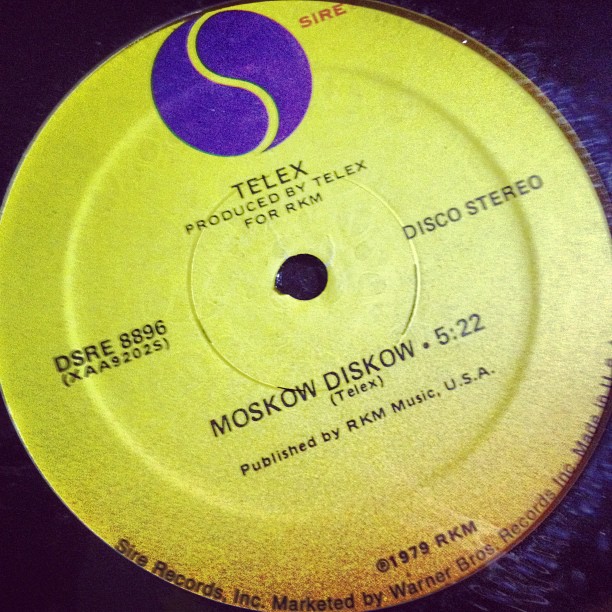
Moskow Diskow
Is this disco? Is it synthpop? Who cares! It’s awesome! I never heard of these guys until I bought this single, and now I think I’m falling in love. I think that if Kraftwerk and YMO had a baby, and that baby was raised by Sparks (in Belgium), it would sound like Telex. Really goofy, but still incredibly well-done, dance music with a slick sense of humor. I’m loving it and want to hear more.

This version of “Moskow Diskow” is taken from a 12″ single, and is not the same version as the one that can be found on their first album.

Coil
Windowpane (Astral Paddington Mix)
I know nothing about Coil aside from the fact that most of their releases are crazy rare, weird and hard-to-find. This single to “Windowpane” is actually the first Coil release I’ve ever seen in a record store, which is why I bought it. The original version is pretty good. This incredibly bizarre remix is…something else, especially for 1990. Trent Reznor is a fan right? I could see that.

Dead Or Alive
That’s The Way (I Like It) (Dance Version)
Keep That Body Strong (That’s The Way I Like It)
I have to imagine that Dead Or Alive’s take on this KC & The Sunshine Band “classic” is one of the few synthpop covers of a disco tune. I don’t remember much of the early 80s, (as I was born in 1979), but I do recall that there was a strong disco backlash that continued pretty much until the mid-90s. Of course when your lead singer is an androgynous gay man who enjoys dressing up as a woman, I guess all bets are off.

Both of these mixes are from a 12″ single. They’re available on some versions of Dead Or Alive’s first LP, Sophisticated Boom Boom (wow, that title) but not the one that’s easily available in America, so I’m sharing them.

Exotic Birds – Cleveland Synthpop (featuring some dude named Trent Reznor)

Wednesday, June 6th, 2012

Exotic Birds
Dancing On The Airwaves
Have You Heard The News
The Meaning Of Love
This Must Be Heaven
Nothing Lasts Forever
Fighting Fire With Fire 

So who the hell are the Exotic Birds and why the hell should you care about them?

I’ll just cut to the chase, lest you skip this post completely from lack of interest. The Exotic Birds were one of the many bands that Trent Reznor was a member of before he decided to strike out on his own with Nine Inch Nails. And when you hear about the Exotic Birds today on blogs and on YouTube, it’s usually because of that fact. While that’s an interesting bit of trivia, I think that does a disservice to the rest of the band. Trent Reznor was barely in Exotic Birds after all, he only played keyboards on one EP (L’oiseau – the album I’m featuring tonight) and he wrote none of the songs.

The Exotic Birds was barely more than a for-hire gig for Reznor, the real man behind the group was Andy Kubiszewski. On L’oiseau he not only plays keyboards and sings, but he is credited as a guitarist, programmer, percussionist and even xylophone player in the linear notes. He’s the sole writer on four of the album’s tracks, with drummer Tom Freer getting a sole writing credit on one tune and a co-writing credit with Andrew on another. While the line-up to Exotic Birds changed a lot during its short time, Andrew remained in the group until he broke it up for good sometime in the early 90s.

But that was only the beginning of Andrew’s musical career. After he was done with the Exotic Birds he briefly joined The The as a drummer, before rejoining with Trent Reznor in 1994. This time he was the backing member in Reznor’s musical endeavor, playing drums with Nine Inch Nails on their album The Downward Spiral. Maybe working with Reznor’s industrial group gave Andy a taste for the harder-edged music, because just a couple years later he was with Stabbing Westward, the NIN-derivative act who gave us the uber-downer alt-rock hits “What Do I Have To Do” and “Shame” and “Save Yourself.” After Stabbing Westward decided to mope their separate ways in 2002, Andy went on to work with a few other bands before turning to production/songwriting work in 2005, oddly contributing music to t.A.T.u’s sophomore album Dangerous And Moving (which, by the way, isn’t that bad!) among other things. Today, Kubiszewski mostly does television work, composing music for Discovery shows like The Colony, Axmen and Monster Garage.

I said before that I’ve always thought that the lesser-known, more workmanlike musicians have more interesting careers and trajectories than the superstars and one-hit wonders, and I really think the Andrew Kubiszewski’s path of synthpop frontman to British alt-rock drummer to industrial drummer to eurodance songwriter to TV composer really proves that point.

All that and I never even really mentioned how the Exotic Birds sounded! Well, they weren’t bad. They definitely sound like a band that really doesn’t know what it’s doing, going after trends in music instead of trying to forge its own way. Some tracks are incredibly radio friendly pop numbers, while others have a slightly harder edge that might have played well on college radio at the time, kind of  Eurthymics meets The Cure meets InSoc (although not as good as any of those bands). It’s dated as hell, that’s for sure, but if I was Andy Kubiszewski I would be less embarrassed about “Nothing Last Forever” (which has a really great instrumental breakdown) than this.

Okay, that was kind of mean. Stabbing Westward had some good tunes too. “Shame” holds up alright, even if it takes miserablism and self-loathing to levels that NIN could only dream of. I mean, “I only see myself reflected in your eyes”? Pathetic perfection.

Lou Reed Singing about Motorcycles

Wednesday, May 30th, 2012

Just one song tonight, but it’s a doozy.

The Beachnuts
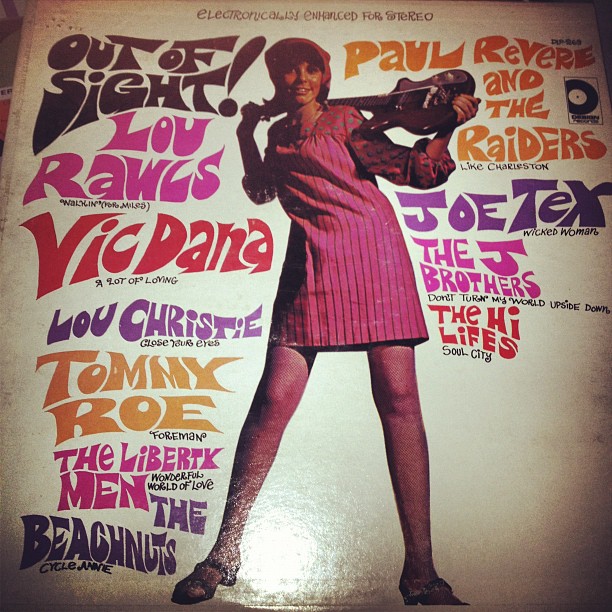
Cycle Annie 

I’m browsing through some crates at Jerry’s today when Jerry pulls out this record.

He recently bought it in a bulk sale. He gives it to me and tells me to give the last track a listen.  The song is something called “Cycle Annie” by a group calling themselves The Beachnuts.

As I drop the needle on the record I’m thinking to myself, “Why the hell does Jerry want me to listen to this?” I go to Jerry’s a lot, he knows my musical tastes. If it doesn’t have a synthesizer on it or if it isn’t by a 90s rock band, I’m usually not interested. So why the hell does he want me to hear some silly surf-rock song from the late 60s?

As the song starts I quickly realize why, it’s because “The Beachnuts” are really Lou Reed. This is a pre-Velvet Underground Lou Reed recording. Jerry said he’d knew I like it because I like “weird shit like this.”

He knows me well.

Needless to say, I bought the record (for five bucks) and immediately dove into the Internet to find out more about the song. Turns out that this wasn’t the first record that “Cycle Annie” made an appearance on. While Out Of Sight! originally came out in 1967, most of the songs on it were originally on another album called Soundsville, which was released two years earlier in 1965.  That entire album was co-written by Reed, and featured another song with him on vocals, “You’re Driving Me Insane.”

It’s crazy how much both “Cycle Annie” and “You’re Driving Me Insane” sound like other Lou Reed songs from that era, even if they are a little more polished and “pop.” If the lyrics to “Cycle Annie” were changed to be about a junkie rather than a biker, it would have totally fit on a Velvet Underground record. I’d give anything to ask Lou about this song now, but given what a dick he is to interviewers who ask him legit questions, I’m sure he wouldn’t take kindly to that. Of course, that kind of makes me want to do it even more. How could he be ashamed/embarrassed by this song?

I mean shit, It’s better than Lulu.

Blackest Cats

Wednesday, May 30th, 2012

Did everyone have a wonderful Memorial Day weekend (and for my international readers, did everyone have a lovely…um…regular weekend)? Mine was a mixed bag. The family stuff was less than stellar, but I did get to spend my Saturday at Movement in Detroit watching Public Enemy (with Ice-T!!!) tear shit up. That was pretty damn rad.

When I wasn’t at Movement or trying desperately not to swallow my own tongue as a means to avoid my brother, I visited a few record stores in my decrepit hometown of Toledo, Ohio, a city that still has a surprising number of quality independent record stores. I’ll be posting some highlights from that shopping outing in a few days. Until then, some Janet.

Janet Jackson
Black Cat (Funky 12″)
Black Cat (Funky 7″)
Black Cat (Video Mix Short Solo)
Black Cat (3 Snaps Up 12″)
Black Cat (3 Snaps Up 7″)
Black Cat (3 Snaps Up Dub)
I posted a couple of these remixes ages ago, and at the time the equipment I had was so sub-standard that I wasn’t able to record the other tracks in a way that I thought would be worth sharing. The times have changed! Now here are all the remixes from the amazing 12″ single to this classic Janet Jackson tune.

I am also using this opportunity to beg for some more remixes to this song. Specifically, I am looking for the following:

  • Edit Version
  • Video Mix / Long Solo
  • Featuring Vernon Reid
  • “The 1814 Megamix” (Full Version)

If anyone can help me locate these mixes I’ll totally be your best friend forever. I know I’ve said that before, but this time I really…am saying it again. Seriously though, if you can help me out I’ll hook you up with some mixes as well. Leave a comment if you can! Hey, leave a comment if you can’t too. I like comments.

Mirror Mirror

Friday, May 25th, 2012

Now that I finished the mannoth undertaking that was The Lost Turntable Guide To Recording Vinyl, I’m starting to wonder what I should try next. Is there anything in the guide that I left out? Any topics that any of you thought I should have covered but didn’t? I’m thinking about writing something about what to look for when buying vinyl, because if there’s one thing I’m really good at, it’s spending money on records. Would anyone be interested in that?


Anyways, this is the last post for the week, and I probably won’t post until the second half of next week, thanks to some work commitments (which are good) and family commitments (which are more of a mixed bag).

One good thing, if all goes well this weekend I should be coming back to Pittsburgh with a new turntable! It’s not going to replace my Technics, but it’s certainly an interesting deck. If I get it I’ll be sure to do a full write-up, most of you have probably never seen anything like it.

Love And Rockets
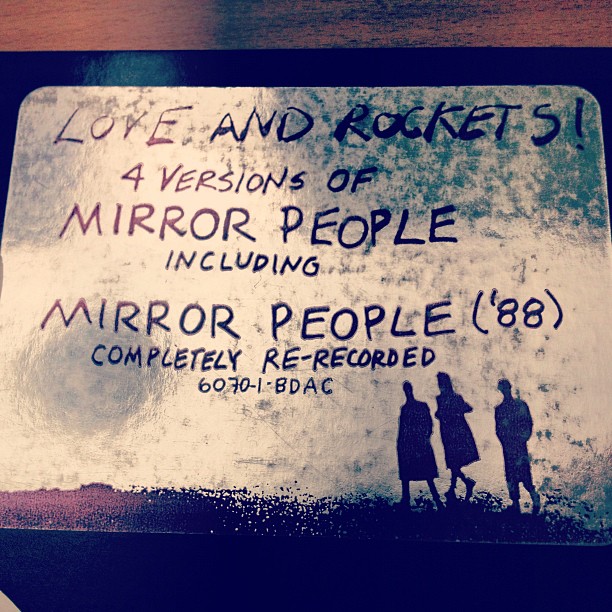
Mirror People (88 Version Re-Recorded)
Mirror People (88 Version Edited)
What a weird song, and not just because of the lyrics, but because there are so many damn versions of it. The original version of “Mirror People” leads off the band’s 1987 tour-de-force Earth Sun Moon, and if you have the CD or digital editions of the album, a “slow version” of the song serves as the record’s coda.

However,  a year after the album came out the band re-recorded the song, as a more fast-paced and polished work that was no doubt intended to capitalize off of the band’s success with the single “No New Tale To Tell.” This new version is a lot less shoe-gazey than the original, and has much more of a “punchier” sound over all. I’m sure it was all a tactic to turn the song into a hit single, although I don’t think it worked. I have to say though that I prefer this version, I’m always a sucker for some more anthemic sounding drums. I do love the wall-of-sound production of the original too though.

The B-52’s
Channel Z (Rock Mix)
Channel Z (Remix Edit)
Channel Z (Rock Dub)
I just like saying “Channel Z” like  Fred Schneider does in the beginning of this song.

“Channel ZEEEEEEEEEEEEEEEEE!”

ZEEEEEEEEEEEEEEEEEEEEEEEEEEEEEEEEEEEEEEEEEEEEEEEEEEEEEEEEEEEEEEEEEEEEEEEEEEEEEEEEEEEEEEEEEEEEEEE!

Okay, yeah so maybe I wrote so much stuff this week that I’ve ran out of constructive or interesting things to say, what’s your point?

Love Kills, the best song about junkies in love you’ll hear all day.

Wednesday, May 23rd, 2012

Okay, last time I’ll plug it. If you haven’t read it and you’re at all interested in recording vinyl, please check out my guide to recording records. It’s more than a bit lengthy, but I’ve been told my multiple people that it’s full of useful facts and tips. I also don’t swear in it at all (I don’t count saying the band name Fucked Up as a swear). And I’m crazy proud of that. Because we all know that’s pretty uncommon.

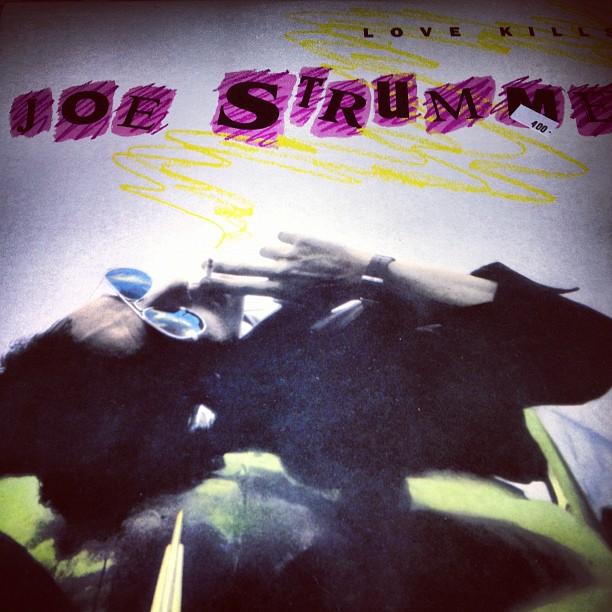
Joe Fucking Strummer
Love Kills (12″ Version)
Love Kills (Dub Version)
Love Kills (Instrumental)
Sid & Nancy is not the kind of movie that I have any interest at all in seeing. From what I know about the film, it’s wildly inaccurate about the actual events surrounding Sid’s role in The Sex Pistols, and it takes some pretty drastic dramatic licence in assuming the situation surrounding Nancy’s death. I also have no desire to see a film about a couple of junkies killing themselves with smack. If I want to know how opiates fuck with someone I’ll just call some of my old high school friends, thanks.

All that aside, the soundtrack sure is fucking magnificent, the highlight being this legendary track by Joe Strummer. It’s probably the darkest “love” song outside of a Bauhaus record, with its references to drug addiction, lynching and even the murder of Nancy. Still, I sense some sort of joy or optimism in the lyrics, especially in the chorus.  “But if my hands are the color of blood/then I can tell ya, sure I can tell ya/Love kills,” is a line that’s so damn great, so perfect, that I desperately want to believe that there’s a positive message to be found in it somewhere. That’s probably just me being oddly optimistic though. I get that a lot.

I bought this 12″ single just because I love the song. I got a great bonus when I found that it included an extended 12″ version of the song! That’s not mentioned on either the album sleeve or the label, as such, I don’t know the name of this remix. I’m just calling it the “12 inch version.” If anyone wants to correct me, please feel free. But do that after you download it, because damn it’s a great version of a great song. The dub mix isn’t half bad either, especially as dub versions go, probably because it still has most of the lyrics of the original.

Just the one song tonight. I might have another post near the end of week that will be more substantial.

Human League Conspiracy Theories and Happy Mondays

Tuesday, May 22nd, 2012

In case you hadn’t heard, I recently completely the epic-length Lost Turntable Guide to Recording Vinyl. You should totally read it. It’s almost 5,000 words though, so maybe you might want to pee first.

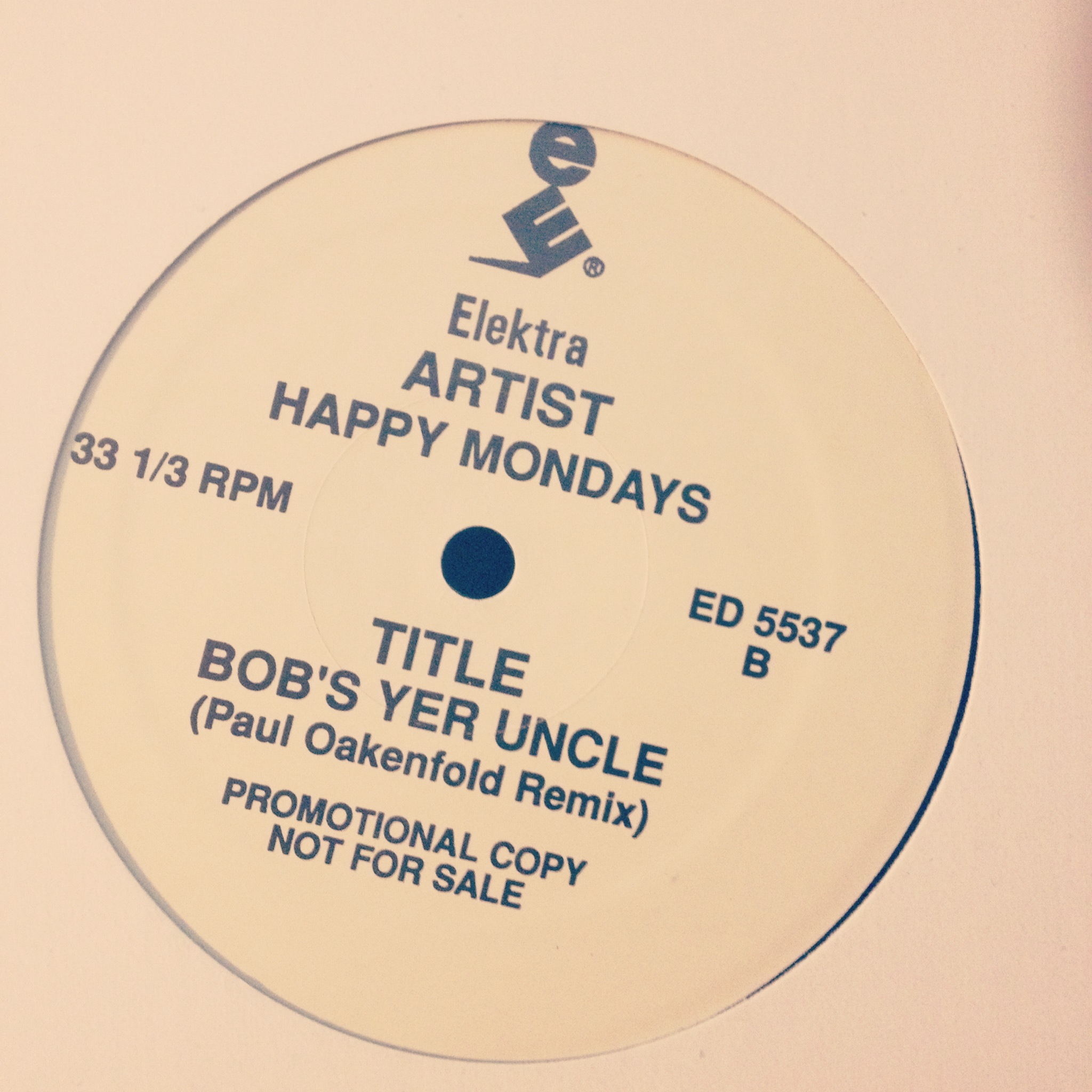
Happy Mondays
Bob’s Yer Uncle (The Grid Mix)
Bob’s Yer Uncle (Paul Oakenfold Mix)
These remixes are from a 12″ promo copy I snagged last week, they’re chill as shit. This song is my new jam.

The Human League
All I Ever Wanted (Oliver Lieb’s Main Mix)
All I Ever Wanted (Oliver Lieb’s Alternative Mix)
All I Ever Wanted (The Vanity Case Mix)
All I Ever Wanted (The Vanity Case Instrumental Mix)
I love it when a band’s fans obviously hi-jack Wikipedia and the moderators are none the wiser. Take The Human League for instance. Not only does their wiki have a tremendous amount of extraneous data (not to mention the most needlessly complicated band members section I’ve ever seen), but pages for individual members, albums and even songs are freakishly in-depth and filled with unsubstantiated “facts” and bizarre justifications for why The Human League is no longer the biggest band in the world. For instance, both the wiki for this song as well as the wiki for Secrets, the album from which the song came from, claim that the song/album were not hits because the band’s label was on the verge of bankruptcy when the album came out, and that the BBC had blacklisted the band. I think the whole “it’s 2001 and we’re an 80s synthpop band” had more to do with the album’s lack of success than anything else.

I’m not knocking The Human League, don’t get me wrong, I love them, I just don’t love them enough to oddly rationalize why they’re no longer popular. Shit, I love me some Toadies, but you don’t see me saying that their lack of current success is due to a conspiracy involving Clear Channel, the Freemasons and the Gin Blossoms.

Wait, I may be on to something here…

Anyways, these are good remixes, download them.

The Lost Turntable Guide To Recording Vinyl

Monday, May 21st, 2012

Well, here it is! The long-awaited, long-overdue and just plain long Lost Turntable Guide to Recording Vinyl.

What took so long? (And why is it so damn long?)

Well, what I thought was going to be a quick cut-and-dry “how to” guide slowly began to morph, mutate and altogether spin out of control. When I first started writing this thing I thought it was just going to be nothing more than some tips and tricks on recording records. But then I decided I should expand it to be a more conclusive guide covering the entire vinyl ripping process, but once I got there I realized that I had include sections on hardware and software too…

So yeah, things kind of got out of hand. But here it is! Split into four convienent and hopefully easy-to-understand chapters.

Chapter one deals strictly with hardware. Turntable, pre-amps, cartridges. I go over my recommendations and what I think you should look for when choosing gear.

Chapter two is all about software, the recording and restoration software that I think is must-have if you want to do this right.

Chapter three is an in-depth step-by-step guide showing what I do when I record vinyl. It’s only 100% applicable if you’re using the exact same equipment and software as I am, but even if you’re not it should help you out a bit.

And finally chapter four is where I offer some tips, tricks and links that didn’t fit anywhere else.

So without further ado…an introduction.

Introductions and Disclaimers

Before I really get going, there are two things I want to get out of the way.

First, I’ve been recording vinyl for six years now. I learned as I went, making a ton of mistakes along the way. And I’m fairly certain I’m not done making mistakes. So if at anytime during this guide you think I’m full of it, or doing something horribly wrong, I very well might be. Let me know! Just don’t be a jerk about it. I’m always looking for ways to make my rips better, so any polite and constructive criticism is welcome.

Second, this is not a guide on how to record vinyl “on the cheap” or “fast and easy.” This is a guide on how to record vinyl properly, with high-quality results that are worthy of being in your MP3 collection. You can’t do that quickly, easily, or inexpensively. Not including my computer, my final cost for my set-up, which includes my turntable, cartridge, pre-amp and recording/restoration software cost me over $600, and that’s substantially cheaper than what many “audiophiles” pay for their set-ups. It sucks, but this isn’t an endeavor for those who aren’t willing to spend a bit of cash. Sorry.

Okay, now that I have that stuff out of the way…let’s do this!


Chapter 1 – Hardware


Turntables
This part is pretty important, so you might want to take notes.

If you ask me, there’s only one turntable in the world worth getting (more on it in a bit). However, I realize that not everyone has the same tastes as me, so before I offer my singular recommendation, let me extend a few general tips you should keep in mind when picking a deck.

First of all, always avoid USB turntables. Almost all of them are abominations that can neither effectively play nor record vinyl.

Why?

First of all, most use ceramic needles. In addition to sounding horrible, these things destroy records. They’re outdated garbage, keep them away from your vinyl.

Secondly, many use built-in pre-amps (a pre-amp boosts your phono signal so it can be heard properly), and those just don’t cut it when it comes to sound quality. Your music will sound muffled, muddled and altogether bad. Whenever I go back to recordings I made using my old ION USB turntable, I can’t believe how hideous they sound. It’s like they were recorded underwater.

Finally, recording straight from a turntable to your computer via a USB port isn’t as easy as it might seem. You’ll get a lot of interference from the electronics in the turntable, and the process itself takes a lot out of your computer’s resources. It’s just not worth the hassle.  Get a real turntable, you can hook it up to your PC with little effort.

With that out of the way, the biggest decision you’ll have to make when choosing a turntable is whether you want a  belt-drive or direct-drive model.

With a belt-drive turntable, the motor is connected to a belt, which in turn is connected to the platter. The motor spins the belt, and the belt spins the platter. On a direct-drive turntable, the motor is connected directly to the platter (typically underneath), spinning it directly.

Which usually sounds better? It’s a contentious subject. Some believe that direct-drive turntables can create a noticeable “hum” in your recordings.  Others, myself included, don’t like belt-drive tables because they don’t always spin at the right speed. Belts wear down over time, and a worn down belt will cause your turntable to spin too fast (audiophiles call this “flutter”). It’s the kind of thing that you never notice at first, it only comes to your attention after you’ve recorded half-a-dozen records at slightly the wrong speed. It can be maddening.

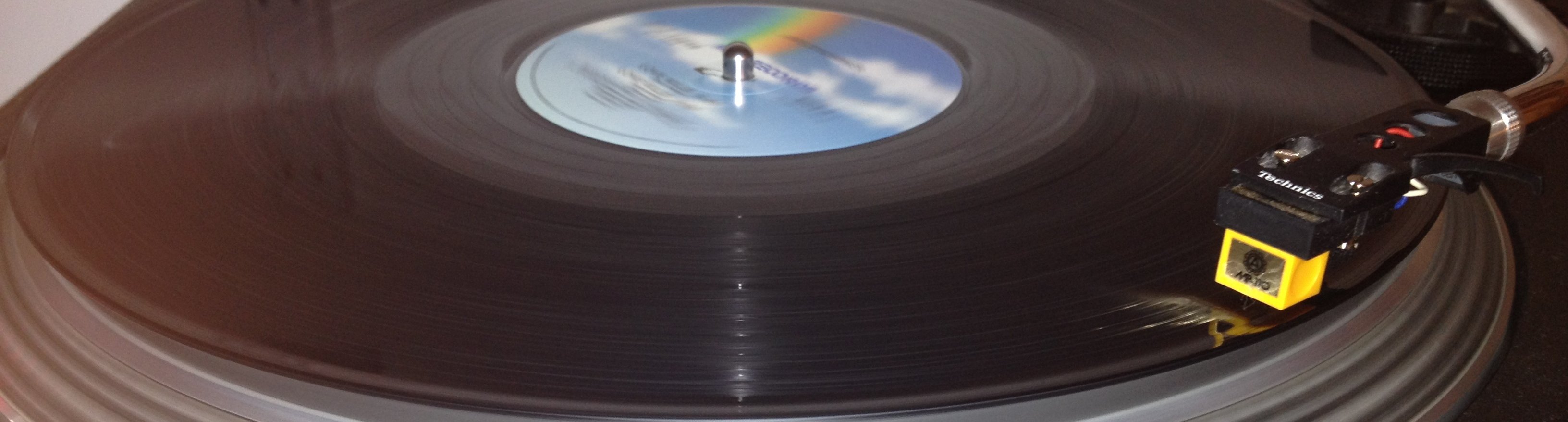
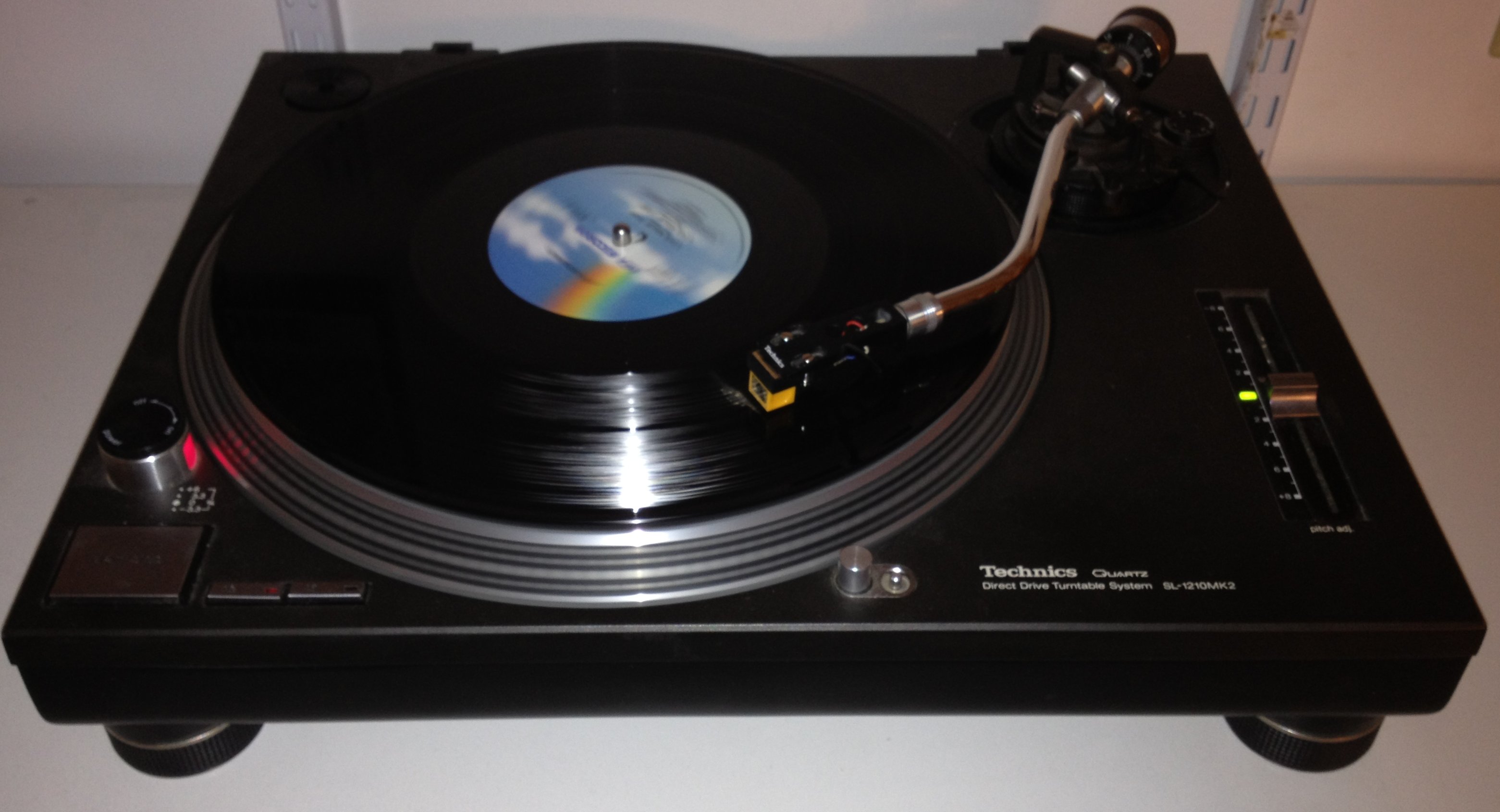
On the other hand, I’ve never heard any noticeable “hum” coming from any medium-to-high-end direct-drive turntable I’ve owned, and they always spin at precisely the right speed. I’ve been told that super-high-end belt-drive decks, ones that cost upwards of a grand, don’t have problems with flutter, but I’ve never wanted to spend enough money to find out. I would recommend a direct-drive deck, for ripping vinyl it’s almost always a safer bet. In fact I would recommend one direct-drive turntable in particular, the  Technics SL-1200.
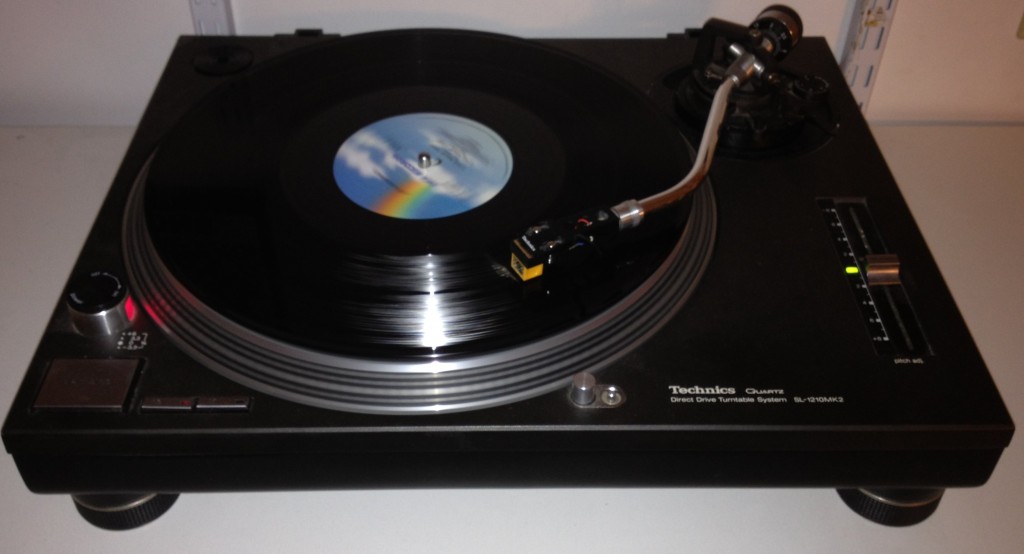
My Technics SL-1210 MK2. Yes, I know it’s dusty. No, you can’t have it.

In all honesty, if you want a turntable that sounds great, runs great and even looks pretty damn great, then just get a Technics. There’s a reason why nearly every turntable on the market today is trying to emulate the look and feel of the Technics SL-1200. It’s because they’re some of the best turntables ever made. Sadly, Panasonic shut down production of the Technics line a few years ago, so you probably won’t be able to find a new one at a fair price. Don’t let that stop you though, since the Technics 1200 was one of the most popular turntables of all time, you can usually find one used online for less than $300 if you know where to look online. I picked one up on Craigslist for $300 and it was worth every penny.


Cartridges
While I have no problem recommending just one turntable, I can’t do the same with cartridges. There are just too many out there that it’s impossible for to keep track. The best advice I can give you when choosing a cartridge is to do your research. Different cartridges work better with different turntables. So go to Google and search for something like “best cartridge for [turntable model]” and see what comes up. Check out AudioKarma, that’s my go to message board for this stuff (although most people there will tell you that direct-drive decks are the devil). The audiophile message board nerds who talk about this stuff are usually good sources. Just don’t spend over $150-$200 for a cartridge if you’re just getting into vinyl, you should be able to find a decent one for between $70-$100.

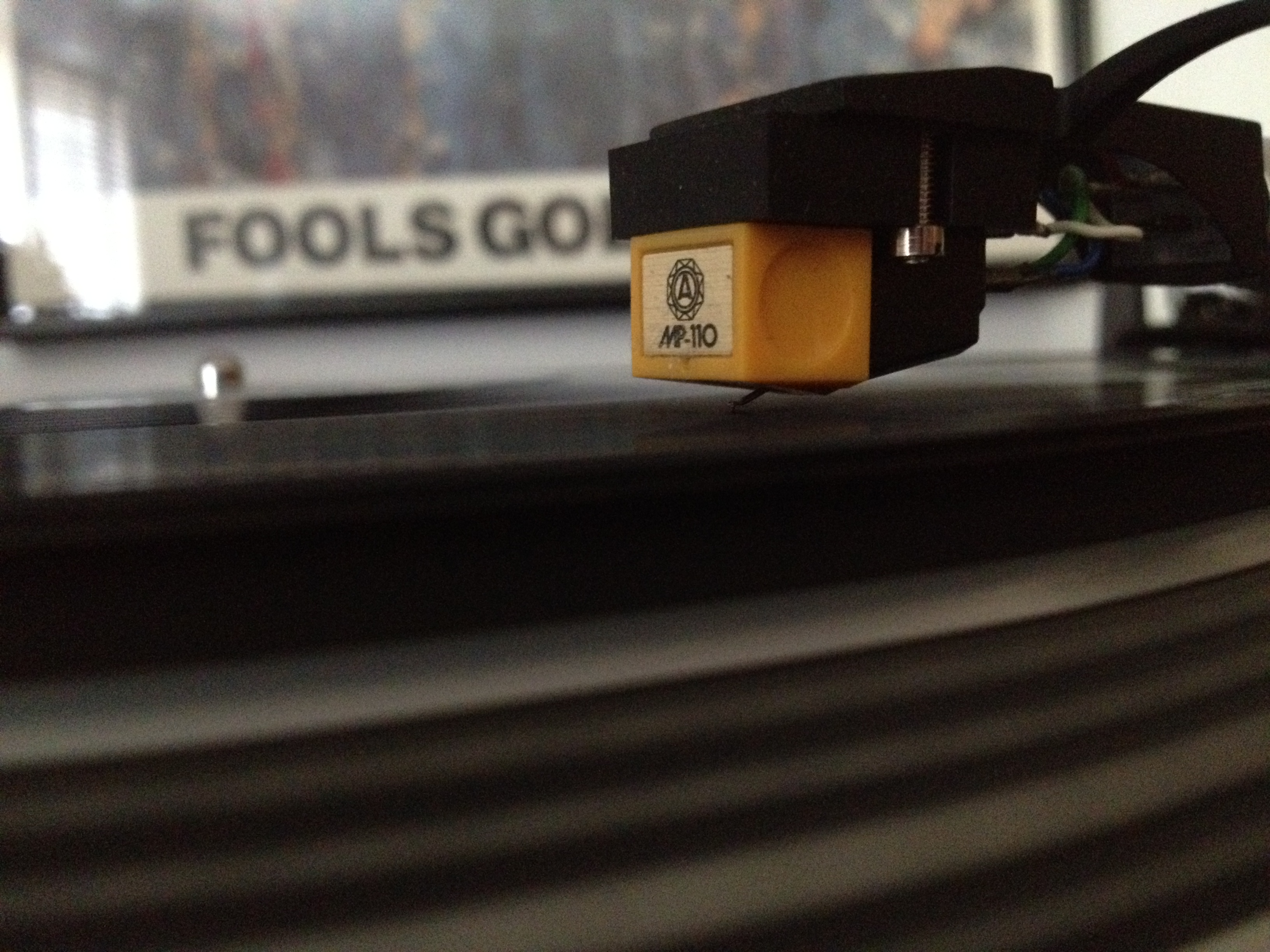
Me personally, I play all my records using a Nagaoka MP-110 cartridge. From everything I’ve read, it comes highly rated for Technics SL-1200 turntables, and is fairly priced at around $100. Of all the cartridges I’ve used it has the best stereo separation and the best tracking; it also doesn’t amplify bass or polish the audio in anyway, it just plays the records accurately and beautifully.
All that, and it’s pretty too.


Conversely, I recommend you avoid the Ortofon Arkiv (lousy tracking, too sensitive), DarkHorse Sanyo (horrible all around) and the Stanton Groovemaster (too damn heavy and loud). But once again, that only goes for the Technics SL-1200 and for recording vinyl, results may vary with other kinds of turntables.

No matter what cartridge you end up going with, I suggest buying it from The Needle Doctor, the best site for turntable supplies on the Internet.

102/24/13 Update
While I still recommend the Nagoka MP-110 for most systems, I recently discovered that for whatever reason, the cartridge did not play nice with my new computer. I don’t know why and I can’t explain it, but for some reason when I upgraded my computer all my recordings became muddled. When I replaced my cartridge with another model, the problem disappeared!

If you find yourself with this problem, then I recommend the Audio Technica 120E/T. It’s also about $100, and gives a sound that is nearly identical to how the MP-110 used to sound on my system.


Pre-amp/Soundcard
Often overlooked, a phono pre-amp is a vital part of any turntable system. These special amplifiers are made with turntables in mind, and raise the levels of a turntable signal to the proper volume/EQ settings that make it possible for you to hear your records at a comfortable volume. If your turntable doesn’t have an internal pre-amp (and it shouldn’t, those suck) you will need a pre-amp in order to listen to and record your LPs.

In addition to a pre-amp, you’ll also probably need an external soundcard, unless your internal card has a line-input. And even if it does, it’s still not a bad idea to get an external soundcard. Most internal cards just aren’t cut out for recording from a line signal. It’s hard to explain, and I don’t entirely understand it, but I was never happy with the results whenever I tried to record vinyl using my internal soundcard. Everything always sounded like half the treble was missing.

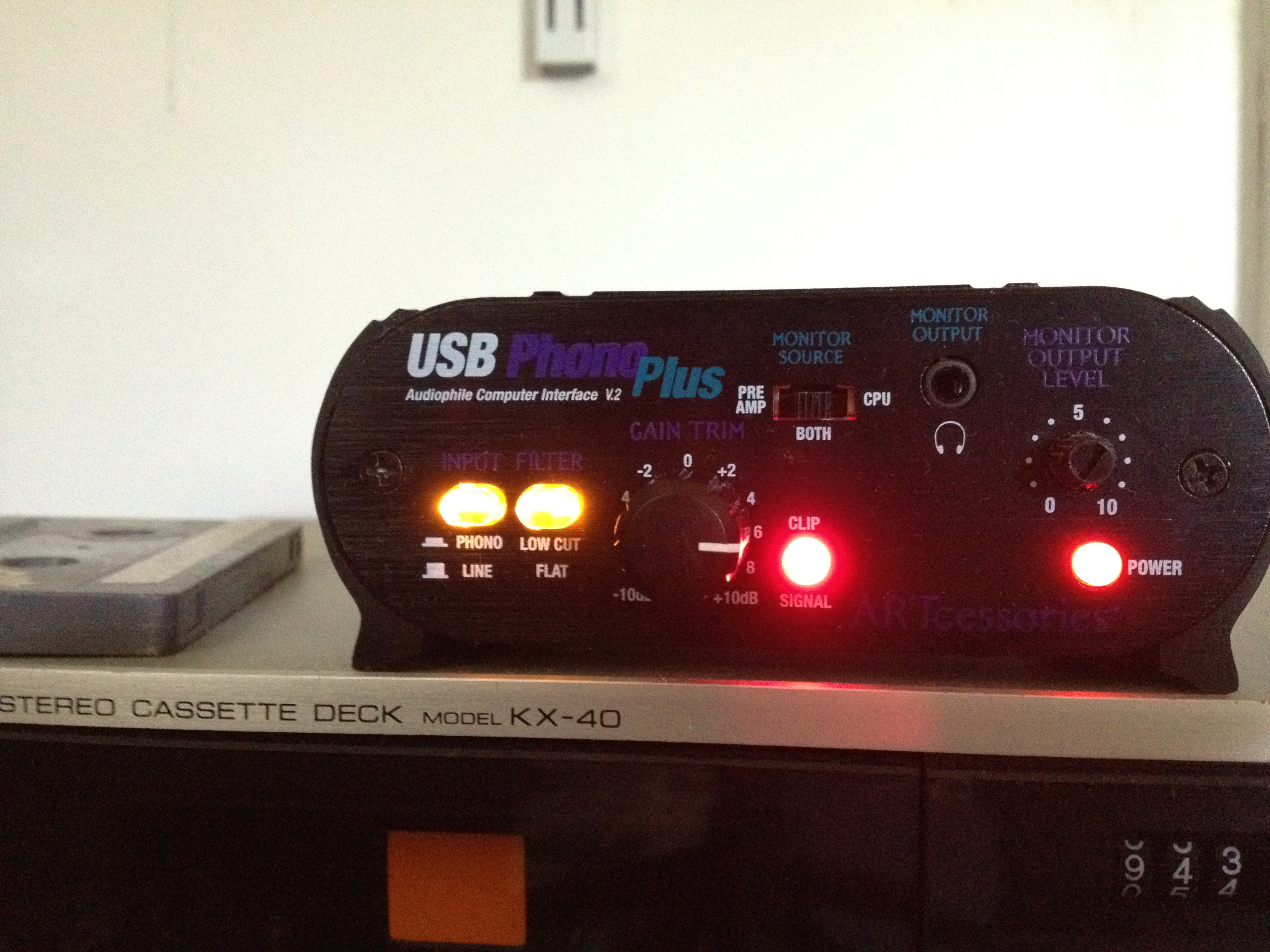
Fortunately, you don’t need to buy both an external soundcard and a pre-amp, as there are a lot of pre-amps made today that function as both. I’ve used a few, and the one I’ve gotten the best results with is the  ART USB PhonoPlus v2 Computer Audio Interface.

This thing is a godsend. It requires no drivers, has optional built-in hum removal (great for tape recording or if your system has a lot of R/F interference) and it only takes a few minutes to set up (which I’ll get to in another section). I really cannot recommend this thing enough, nor can I say enough good things about it.

Conversely, I can’t say enough bad things about any external soundcard made by M-Audio. While these guys make great professional-grade (translation: incredibly expensive) hardware, their entry-level stuff consistently proved itself to be completely worthless to me. It never works right, requires a ridiculous amount of drivers, and it even crashed my system to the point where I had to re-install Windows 7. If you have a choice between an M-Audio soundcard and getting punched in the gut, I recommend the gutpunch.

…moving on.


Chapter  2 – Software

Recording/Basic Editing Software
There are a lot of ways to go here. Some people really like Audacity, and it’s really hard to argue with free and open-source…unless you’re me.

I’m not a fan of that program, I find it clunky, hard to understand, and needlessly complicated. It’s also a resource hog and slows down my system whenever I’m working with it. I avoid it. My own personal preference for recording and basic editing software is Sony Sound Forge Audio Studio. It’s probably a little over-powered for what I do, but it works, it doesn’t slow down my system, and it’s easy to use. Those are three very big selling points for me. It’s also great for whenever I do want to do something a little more complicated with my audio files, such as adjusting the EQ settings or fiddling with the playback speed.

Sony Sound Forge Audio Studio also gets a ton of little things right. It’s ultra-versatile, allowing you to record in quality as high as 32-bit/192,000 Hz audio, and you can save in just about any format you could desire, including WAV, MP3, FLAC and even OGG. It also allows you to zoom in and out of an audio file by using your mouse’s scroll wheel (something Audacity cannot do), which is incredibly handy when removing pops and cracks from a recording. It’s also very efficient and fast, I can edit and save a file in Sound Forge in about half the time it takes me to do so in Audacity. So, yeah, it might not be free, but my time is worth the money.


Click Removal
No matter how good your system, no matter how clean your records, you will hear the occasional snap, crackle or pop in your recordings. There’s nothing you can do about it. However, you can remove most of them with the help of the right click removal software. Ever since vinyl has come back a ton of programs have appeared on the market claiming to be able to restore even the most haggard of records to near-CD quality. For the most part, these programs are hogwash. Either they don’t remove enough of the clicks and pops, or they remove all of them at the expense of the overall fidelity of your music.

To date, I have only found one program that can easily remove most pops and clicks from a recording while not affecting the quality of the recording. That program is ClickRepair. Setting it up can be a bit of a bother (I’ll get to in my next section), but once you figure out how it works it can be a real life saver. ClickRepair has saved recordings that I thought were lost causes. It costs $45, but it’s totally worth it in my opinion.. But if you’re hesitant to spend the dough without giving it a test drive, a trial version is available at the official website as well.


Hum/Noise Removal
Sometimes when you’re listening to vinly you might pick up a kind of hum or hiss that’s omnipresent over your entire recording. Typically it’s radio frequency (R/F) interference. If you have a decent turntable and pre-amp, then you shouldn’t be having this problem. Before you go the software route, try moving your equipment around; hook it up to a different power outlet; or try some different cables.

However, not all hiss and hum is caused by R/F interference, some records are just naturally noisy. It can be especially annoying if the music on the album is quiet (Tangerine Dream albums have this problem far too often). If that’s the case, then you might have to go the software route to scrub your recordings free of hum and hiss. One program I’ve found that can do this pretty well is the iZotope Music and Speech Cleaner. While it doesn’t work miracles, it does a good job of removing these incredibly annoying noises on exceptionally quiet records. Like ClickRepair, iZotope’s Music and Speech Cleaner isn’t free, but there is a trial version available for you to check out before you shell out the bucks.


ID3 Tagging
ID3 tags are metadata on an MP3 file that tell you the name of the track, what album it’s from, the artist and so on. For years, I just used iTunes for this, until I discovered that for some reason iTunes does not like creating ID3 tags for songs I ripped from vinyl. Why? I have no idea. But whenever I had to rebuild my library, any ID3 tag I created in iTunes came out broken, song titles would vanish, genres would change, it was a mess. Now, the only thing I use iTunes for is to number the tracks after I give them ID3 tags.

For everything else I use MP3Tag. It’s free, works like a charm, and has a ton of batch editing features that make tagging large groups of files a breeze. I love it.

Okay, now that you know what hardware and software I use, it’s time for me to show you how I use it!


Chapter 3 – The Walkthrough

As I said before, this walkthrough only details how I do this using my equipment and nothing else. That’s all I know, so that’s all I can give. If you want help with other kinds of pre-amps, turntables or software, I can’t help you. Sorry.

So let’s get started.

As I said before, I do all my recording on Sony Sound Forge, but before I commit to a recording, I make sure all my setting are accurate. To do this, I start a recording that I will not save, and drop the needle somewhere in the middle of the record. I try to find an especially loud part to check the levels.
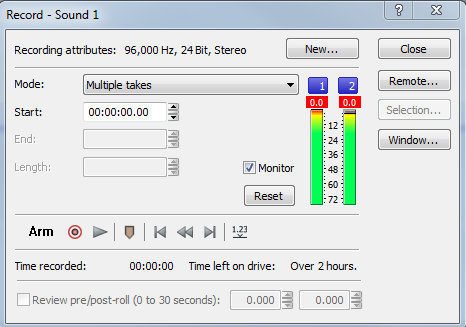
Red is bad, that means my levels are too high, which will lead to clipping and distorted sound. I have to go into Windows’ audio settings and make some minor adjustments.
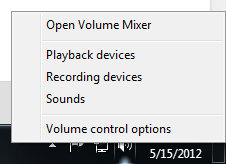
To do this, I right-click on the speaker in the task-bar and select “Recording Devices” from the pop-up menu that appears.
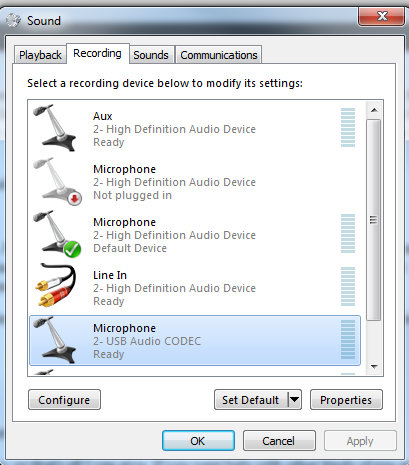
I select my turntable from the list that appears, most systems will identify it as a “USB Audio CODEC.”
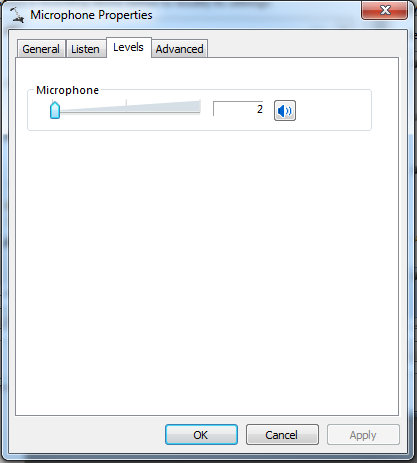
Windows adds a lot of gain to a turntable signal, I take it all the way down to “2” and then click “OK.” Now I can head back into Sound Forge and see how my levels look.
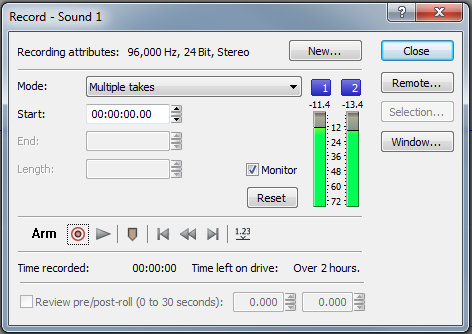
Bars Are Green, The signal is clean.

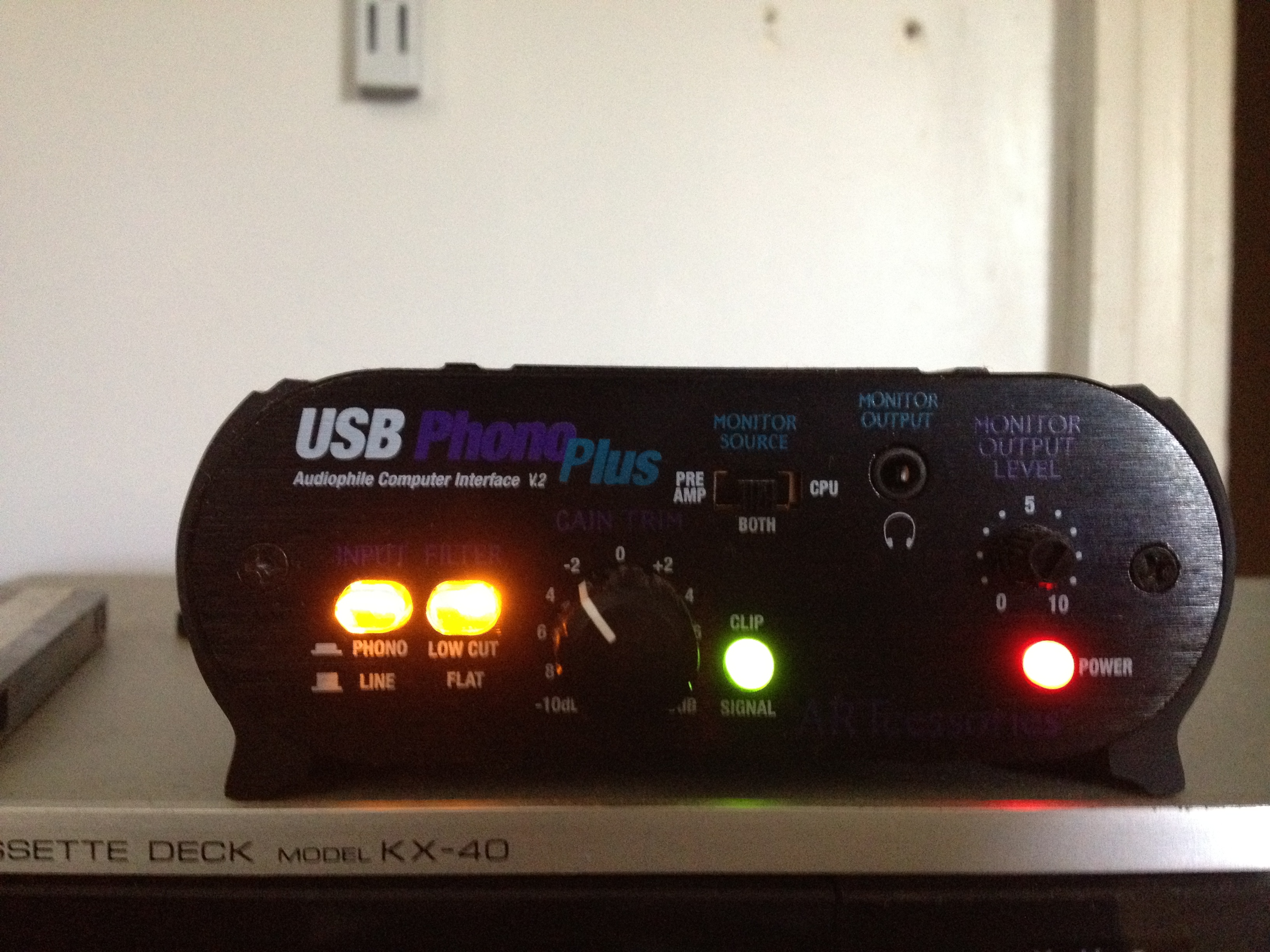
Next up, I make sure that my pre-amp isn’t doing some clipping of it’s own. The ART V2 has gain controls on it, complete with a monitoring light that tells you if the gain is too high. While I rarely need to adjust my Windows volume settings, I often have to change my gain settings on my pre-amp, as some records can be much quieter than others. You always want to have as much gain as possible without the signal going into the red, this cuts down on hiss and other line noise that can be a real pain to get rid of later.

To make sure the pre-amp is set up right, I once again drop the needle on a loud section of the record and look at the signal light. I adjust the gain settings until it is as loud as it can be without the signal going into the red.
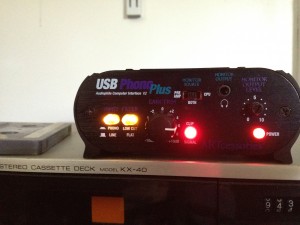
Remember, red is bad! To fix this, I turn the knob next to the signal light to the left.
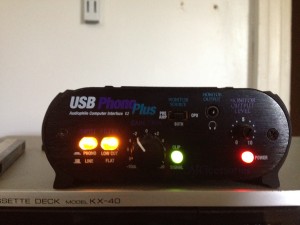
Green is good! Most albums are fine with a gain of around -2, but for some quieter albums I crank it up a bit.


After that’s all set, I can move onto actually recording and listening to my record, which for the purposes of this example will be Polyrock’s 1980 self-titled debut.

I usually record one record at a time. Some people will stop a recording after each side as to keep the size of the audio files down. I usually don’t find that necessary, but whatever floats your boat is fine.

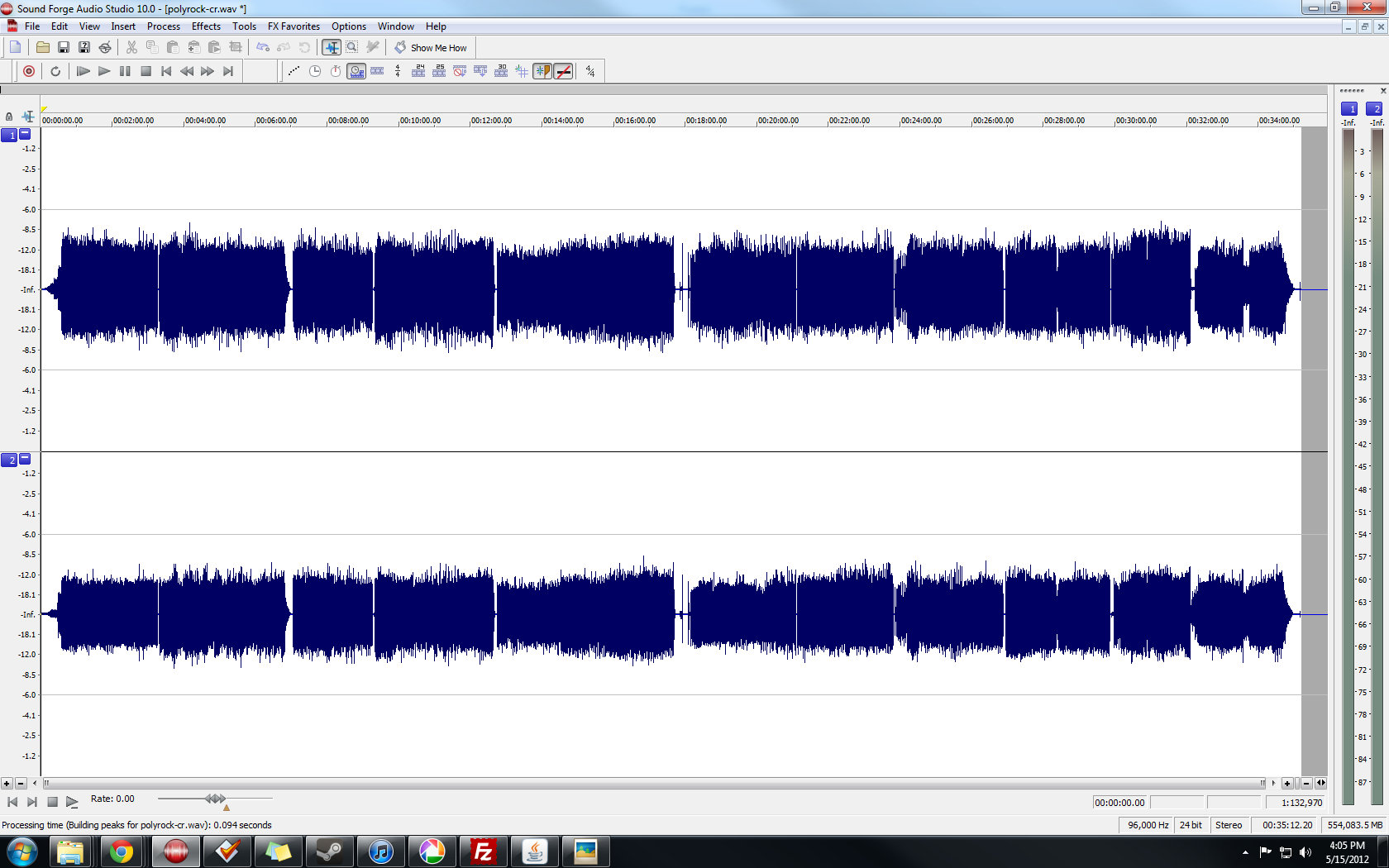
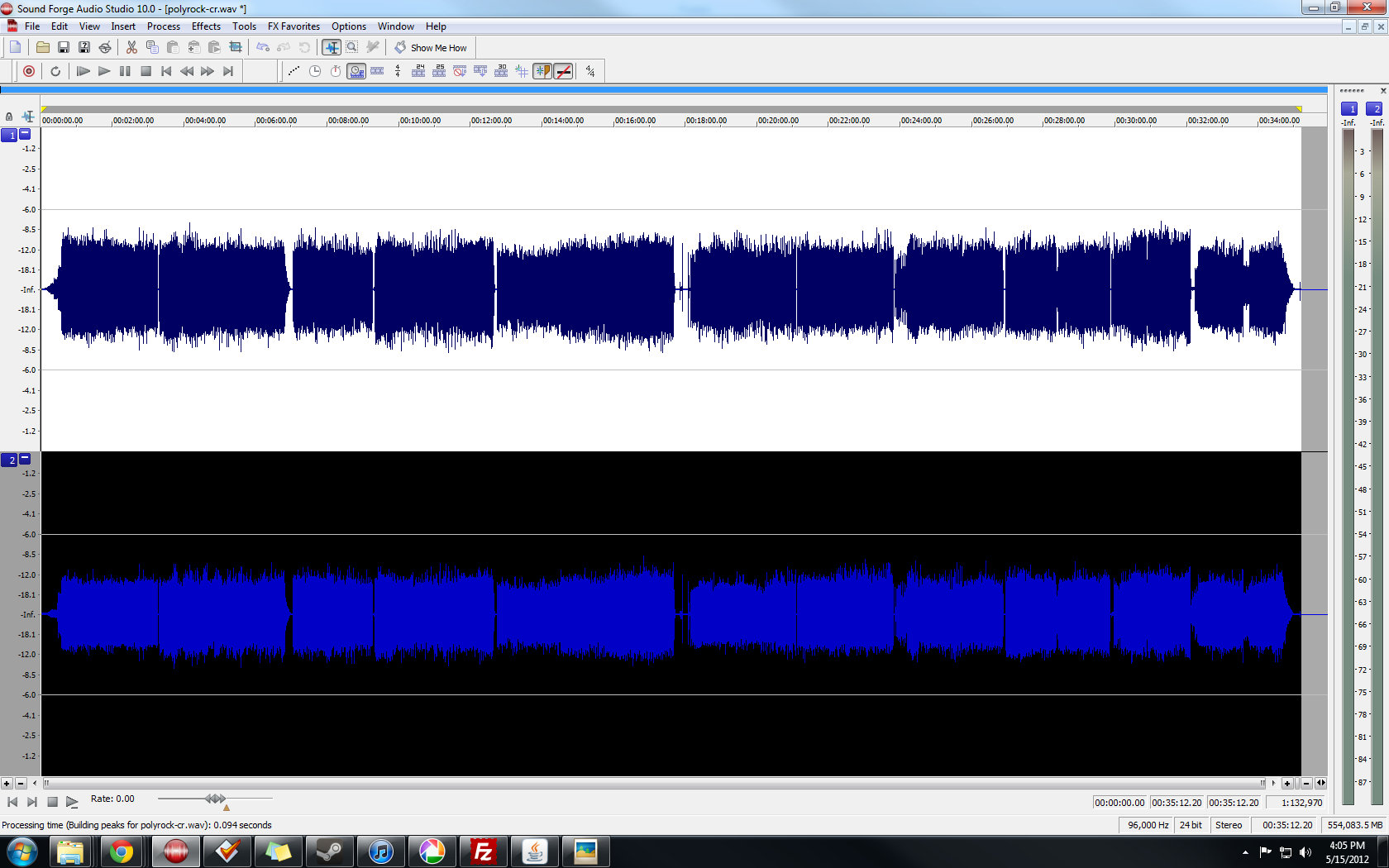
After I’m done recording the album I hit stop in Sound Forge, and I’m presented with a waveform of the album.
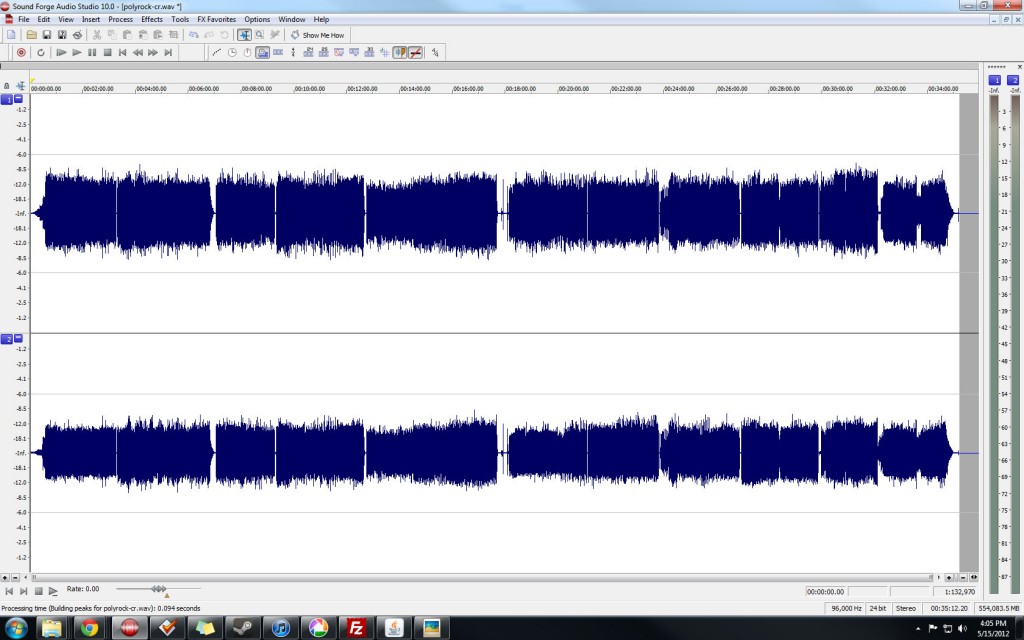
 

Polyrock – in waveform


Now, before I do anything I save it as a WAV file. Most sound editing programs like ClickRepair can only read WAV files, so its best to save them in that format. I don’t convert my recordings to MP3 until I’m done doing everything else.

After I save the file as a WAV I open it in ClickRepair to clean it up a bit. ClickRepair is an amazing program that can work wonders, but not at the default settings. For ClickRepair to work right, without any noticeable distortion or unwanted sound removal, I always tone it down a bit by adjusting the following settings, which were suggested to me from Paul at Burning The Ground:

Slide the DeClick bar all the way down to 10, and enable “Pitch Protection.”

Turn off DeCrackle. You’ll never need it.

Then I run ClickRepair on auto. Some people use it manually, but honestly, I don’t know how, and even if I did, that seems like it would take forever.

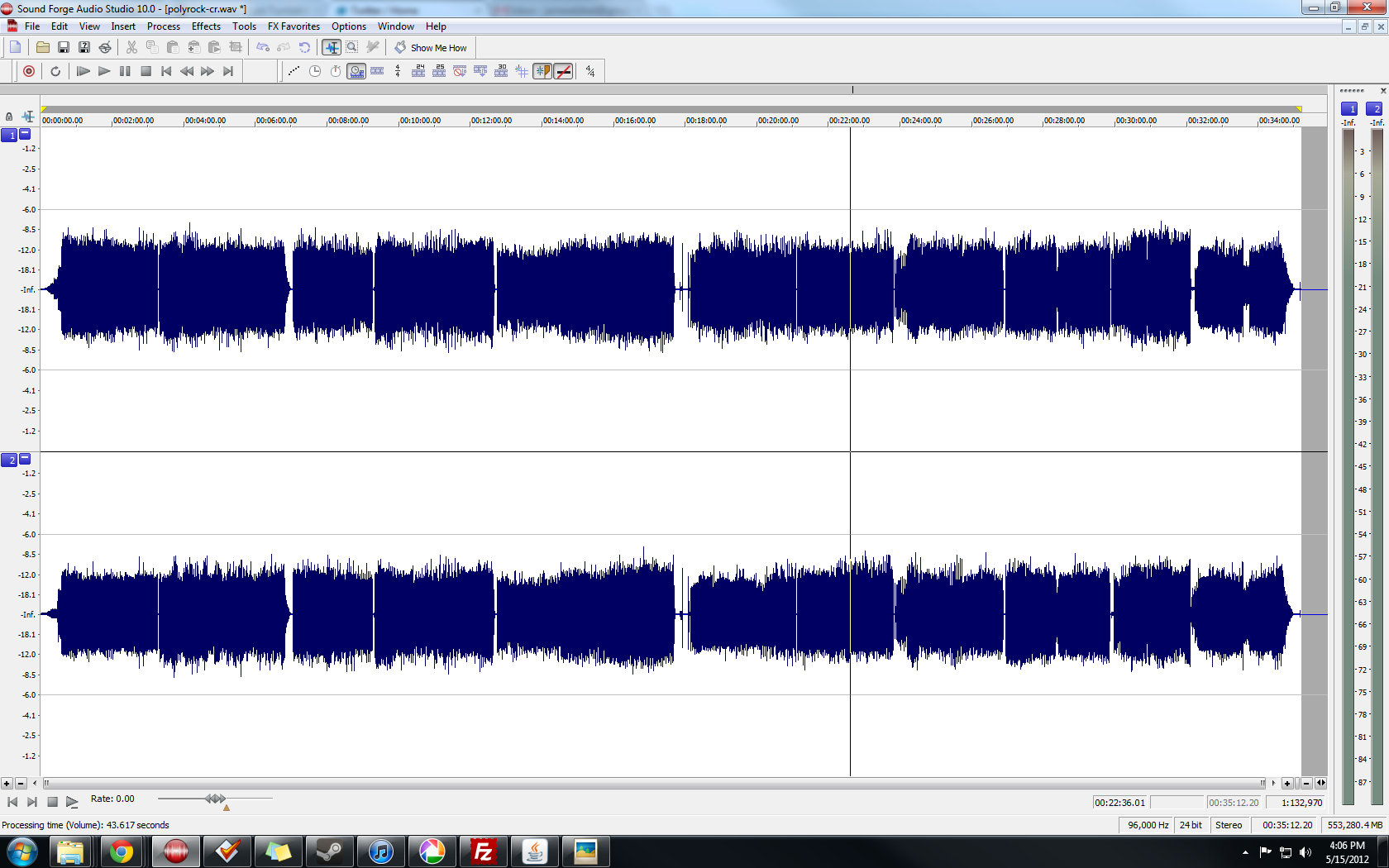
ClickRepair doesn’t overwrite the original file, instead it saves a copy with a “CR” suffix added to the file name. After it’s done running, I open that file, along with the original, in Sound Forge and compare them. If I see any major differences between the files’ waveforms, I listen to compare and make sure no music has been removed along with the clicks. I would say that 99 times out of a 100, there are no problems. But if I’m recording drum and bass, glitch (obivously) or anything that actually incorporates the sound of a record click into the song, then ClickRepair might have a problem with it. In those cases, I usually go back to the original file and manually edit it. It’s actually easier than it sounds. All I do is zoom in until I am able to highlight the defect and nothing else and then I just delete it. These clicks are usually less than a tenth of a second long. I don’t lose any music when I delete them, just the defect.

(If there’s any hum or hiss in the recording, this is when I go into iZotope to try and fix that. Since that program is 100% idiot-proof, and I almost never use it, I’m not going to go into that.)

Now the file is declicked to the best of my ability, but there’s one problem left I need to tend to.

If you look closely, you may notice that the right audio channel is just a hair quieter than the left channel. This is a problem that I’ve run into with many turntables and cartridges over the years. Truth be told, it’s not much of an issue. The difference between the volumes is actually barely noticeable, if at all. However, since it is a fixable problem, I usually take care of it. While the difference in volume can vary from album to album, I’ve found that a volume of change 115% usually takes care of it. This is how I take care of that:
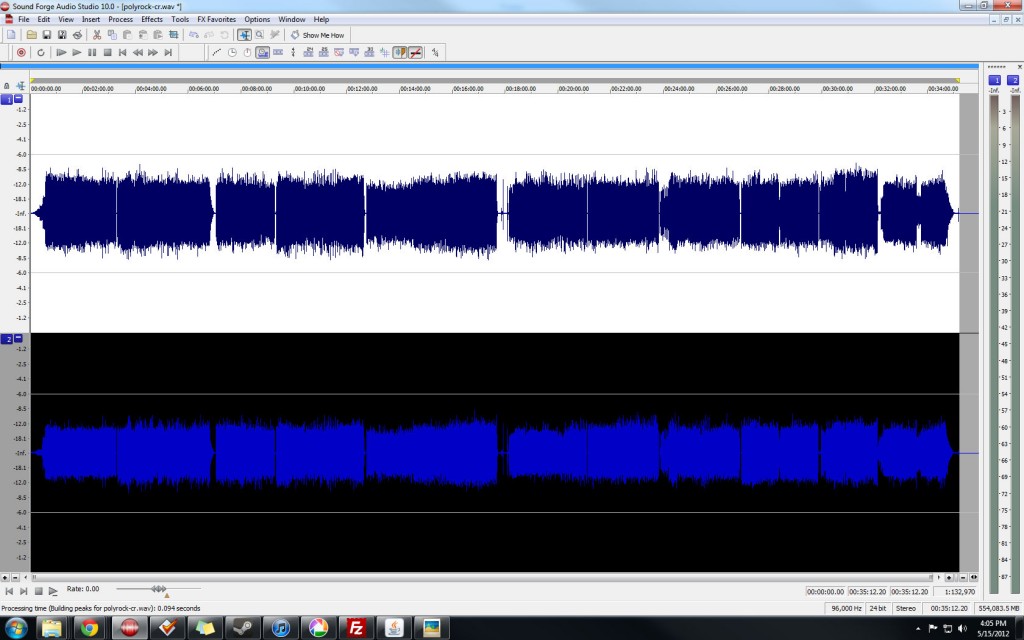
First, I double-click on the left audio channel to select it.
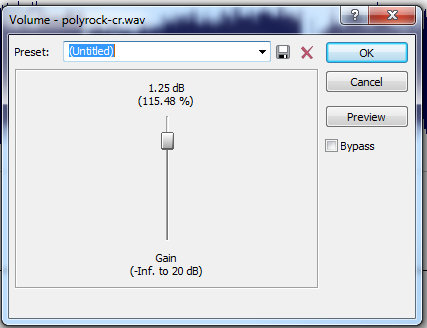
Then I go to “Process” and then “Volume” to open up this menu. I adjust the bar so it’s increasing the volume by 1.25 dB (115%).
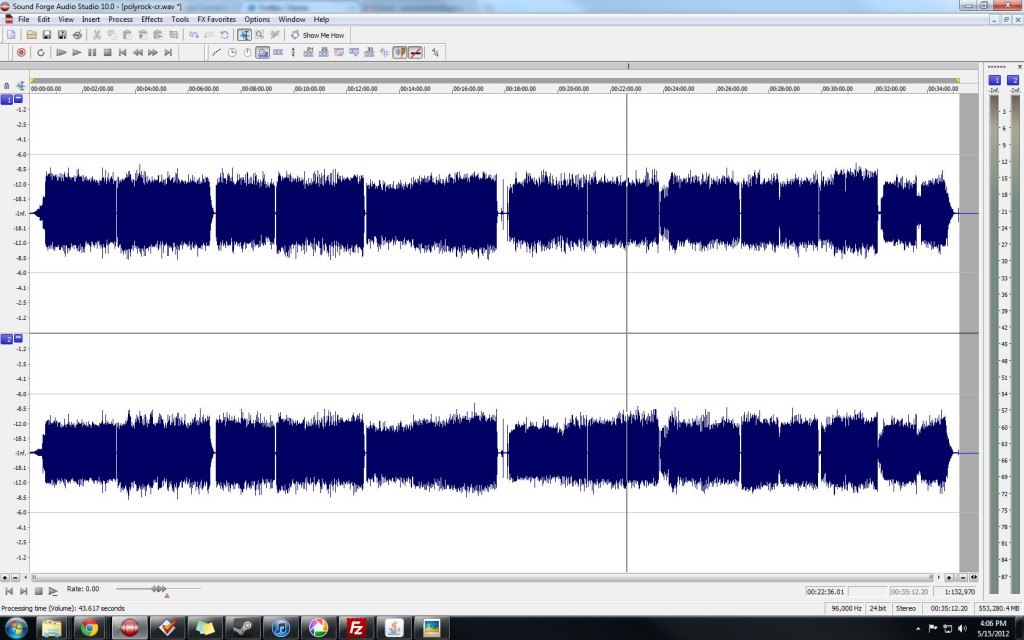
It’s never perfect, but it’s usually good enough,and your ear won’t be able to tell the difference anyways.

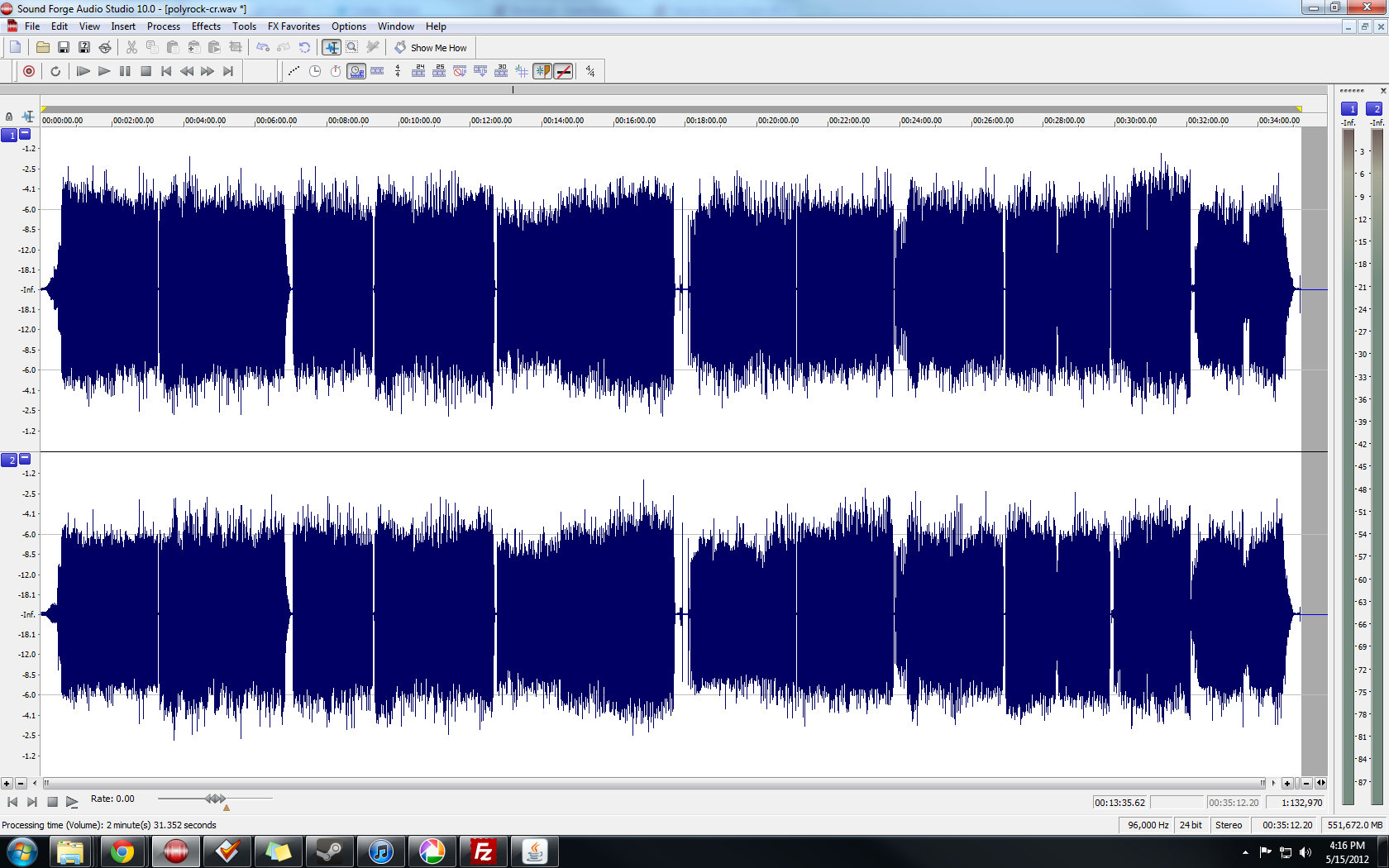
Now to make one more volume change. While there’s nothing wrong with the recording as it stands now, it’s a little too quiet, especially when you compare it to newer songs, which are far too loud. While I don’t want to equalize my recordings to match the over-compressed volume of those new recordings, it wouldn’t hurt to boost them a bit by going back into the volume adjustment settings.
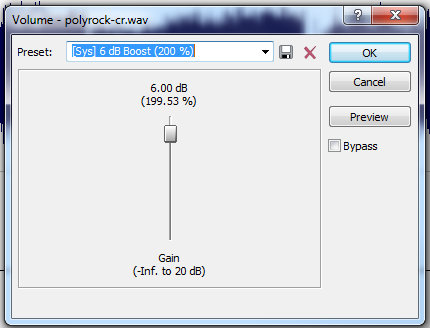
200% sounds like a lot, but it’s usually fine.
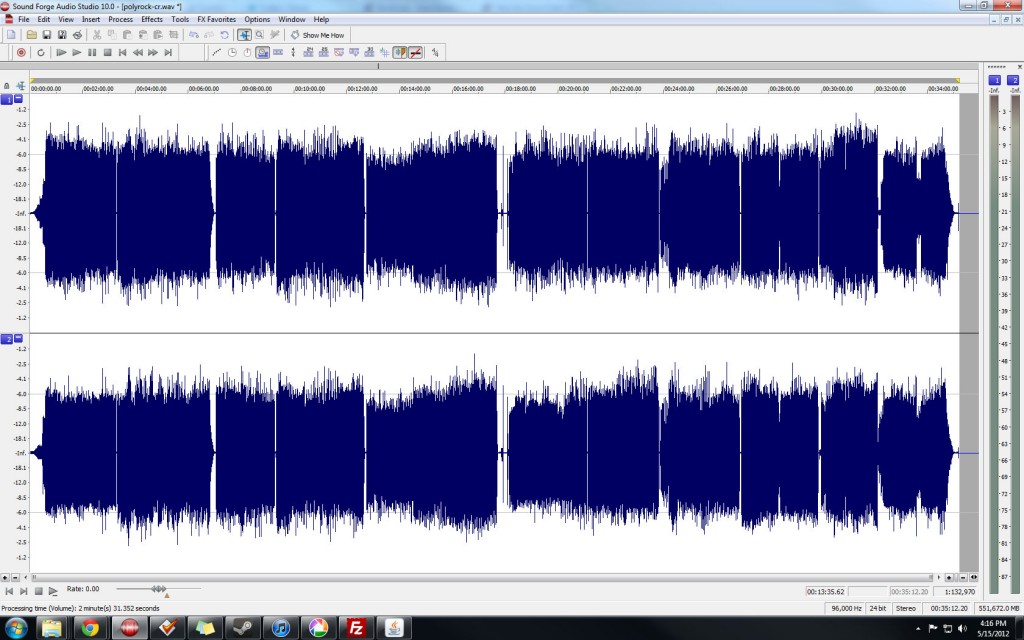
The Results: Loud. But not too loud.


Now that reocrding has been cleaned and adjusted to the best of my ability, it’s time for me to cut it up into individual tracks by selecting them one at a time; pressing “CTRL+X” to cut them out of the audio file; opening a new audio file; and then pressing “CTRL+V” to paste the song into that new file. Then I save the file.
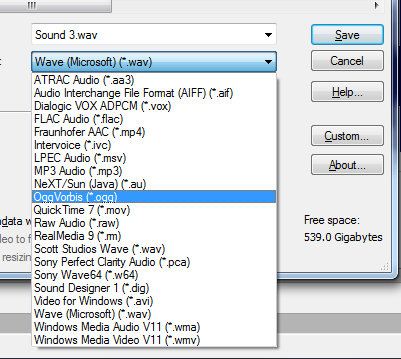
 

Enough choices for you?

I’m old school and stick with MP3s, but if you’re super-concerned with audio quality, then you can always go FLAC. As far as my MP3 settings go, I always save at 320Kpbs and at 44,1000 Hz. I’m sure some audiophiles out there are screaming at me right now, but I’ve tried higher sample rates and other formats, I honestly couldn’t hear a difference. Sound Forge also lets you choose encoding speed. Go for quality over speed every time.
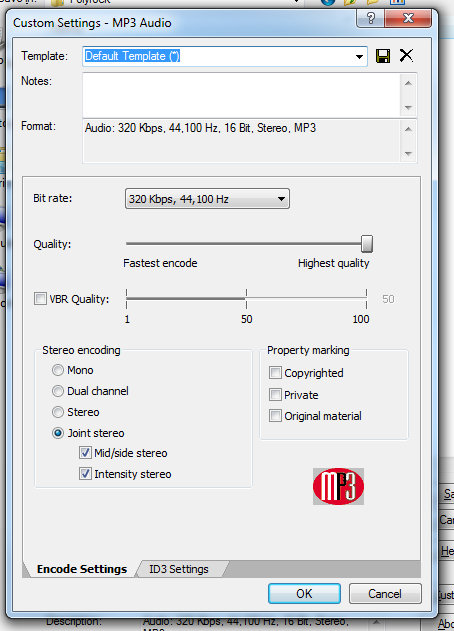
My custom MP3 encoding settings. I’ve never heard a difference between Joint and regular stereo, so don’t ask me about it.

When I save the songs, I make sure that I save them in the proper directory in my iTunes library (artist name/album name). As far as file names go, I just name them the title of the song. This comes in handy for the next step, editing the files’ ID3 tags.


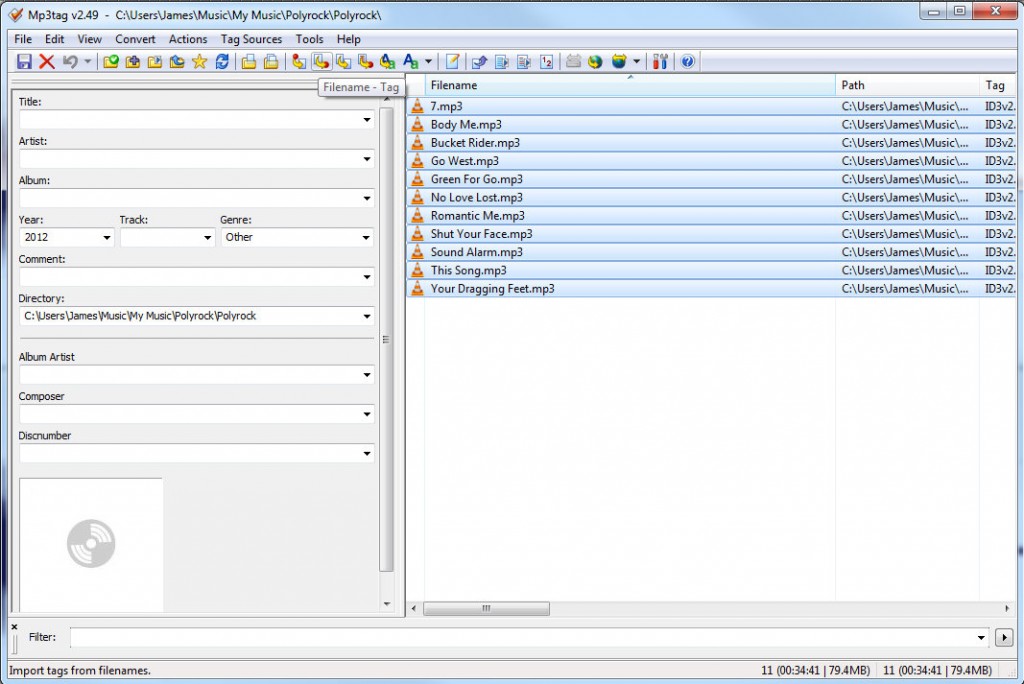
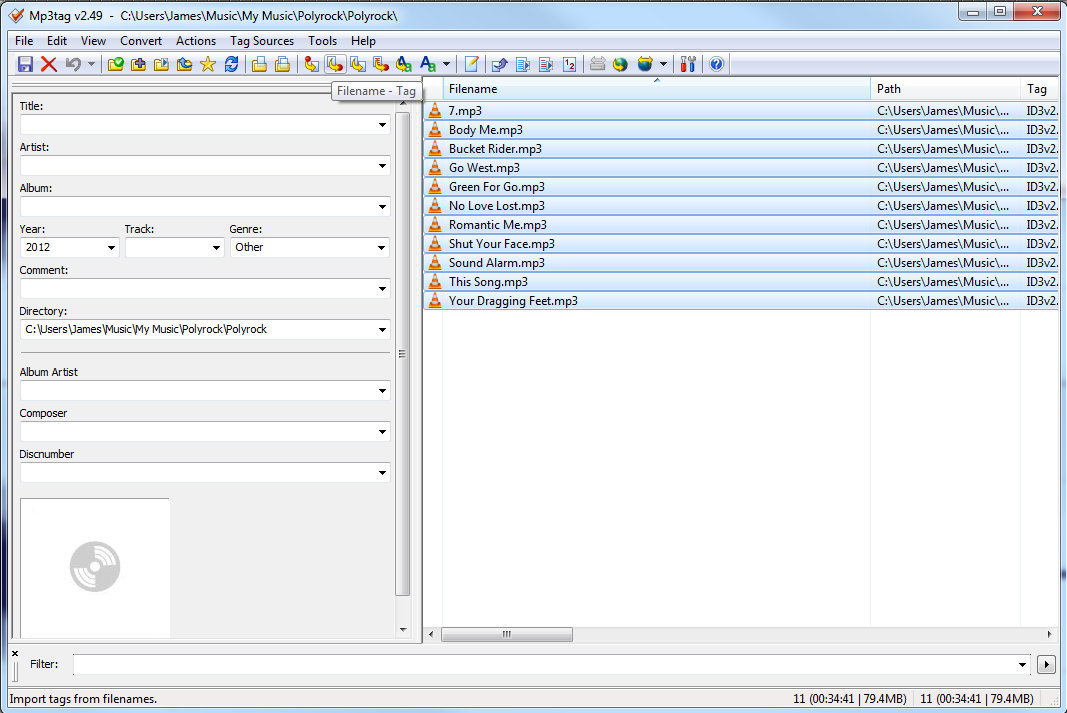
As I said before, I do all my tagging in MP3Tag. I love its interface. After I drag the songs I want to tag into the program window,  I just have to do the following:

Once I have the songs highlighted, I click on the “Filename – Tag” button.
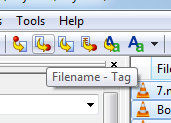
A closer look at the “filename – tag” button.
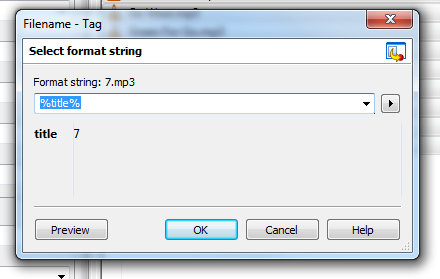
The “filename – tag” button creates an ID3 tag based on the filename. Since my filenames are the song titles, I just set the parameter “%title%” and it fills in the title field with the filename.
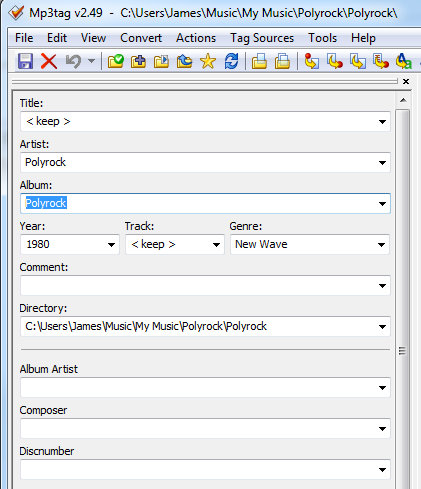
With all the songs still highlighted, I add the album, artist, genre and release year info.

MP3TAG is kind of a pain when it comes to track numbers, so I do that part in iTunes, after I’ve imported them into my library. And in case you’re wondering, I import my tracks into iTunes by creating a new playlist and dragging the songs into it. From there I can go into the song information, add track numbers, and make any other minor adjustments might be needed.

And that’s it! I now have my album recording, cleaned up, converted and tagged, ready for listening. Recording time not included, it usually takes me about 15-20 per LP, with 12″ singles and 45s taking no more than 10 minutes. Of course there are always exceptions to the rule, some albums are so scratchy that I have to clean them manually, and if a record has a skip in it that’s a whole other beast. But for the most part it’s not that time-consuming, it only becomes a chore when I let 20 recordings sit on my hard drive for a week and I have to plow through them all in one sitting.  Even then, I find the process oddly soothing, like its something I can do to shut my brain off from the outside world and just zone out on for a bit.


Chapter 4 – Addendum/Tips

Properly Set Up Your Turntable
You could have a $100,000 turntable with a $10,000 cartridge, but it will all be for naught if you don’t set it up right. I almost wrote a guide for this as well, but there are a ton of them on the Internet already. Here’s a good one that should explain everything you need to know.

Clean Your Records!
If you’re buying used records, then you need to do your cartridge a favor and clean those bad boys before you plop them on your turntable. A record may look clean, but there could be boundless amounts of gunk, dirt, dust and grime hidden in its grooves. Not only does all that make your recordings sound worse, but it can even damage your records. You want to clean your records, and the best way to do that is with some sort of record-cleaning machine.  A lot of people recommend high-end motor-powered machines that can cost hundreds of dollars, but I don’t think you need to go that crazy. I use the Spin Clean Record Cleaner. It’s only $80, and it works wonders. You can find out more about it on their official website.

Some Records Just Sound Horrible
Vinyl is a physical medium, and with that comes physical flaws that cannot always be avoided or fixed. Scratches, warps and other signs of wear and tear are a way of life when you’re buying used records. But don’t assume that all new records are going to be flawless either. For example, I have never heard a 12″ single of the Eurythmics “Right By Your Side” that didn’t sound mis-pressed; I have three copies of the single to Michael Jackson’s “Moonwalker” that all skip in the exact same place; and my copy of The Chemistry of Common Life by Fucked Up came with a loud pop on the title track.

It sucks, but these things happen. Learn to live with them, fix them when you can, and don’t let your head explode worrying about them. Trust me. It’s for the best.

Don’t Get Discouraged!
This is probably the most important piece of advice I can offer. If you really want to record your records and you’re having a lot of problems getting everything to sound right – don’t give up! It took me years to really get my act together when it came to recording vinyl, and I’m still learning stuff every time I check out an audiophile message board or visit other MP3 blogs who do the same thing I do. Just keep at it, and you’ll get better!

And if you really love your music and the sound of vinyl, it’s totally worth it.
 

This is still not a blog post

Thursday, May 17th, 2012

Public Image Ltd. – Commercial Zone (complete album download)

In 1983, Keith Levene and Pete Jones left Public Image Ltd. Considering the events that followed, it can be assumed that the split was not a clean one.

When Keith left the band, he didn’t leave empty handed. He took with him the master tapes to their yet-unreleased follow-up to The Flowers of Romance. As if that act of sabotage wasn’t enough, he then mixed and mastered the recordings on his own and put the album out under the title Commercial Zone. He did this without permission from anyone in the band or their label.

Think about that for a second. Think about how crazy that is. Imagine if that happened today. Dinosaur Jr. are recording a new album at the moment. Imagine if, after the sessions were mostly done, Lou Barlow just said “fuck it, I’m sick of J and his bullshit (again)” and, without telling anyone, he stole the master tapes to the album and put them on the Internet. But not just as a “fuck you,” but as an illegal bootleg release that you would have to actually buy. It just wouldn’t happen! He’d be able to get five copies out the door before the label would bust in and shut his ass down.

But I guess things were different in 1984, because Levene was able to make two complete pressings of this album and even sell it in American record stores for over a year before the label was able to successfully shut him down. As such, fans were able to get two entirely different versions of the same album in 1983/84, the Levene-mixed Commercial Zone, as well as the final version, This Is What You Want…This Is What You Get. Listening to them both back-to-back is a lesson in album production, as most of the songs on Commercial Zone found their way onto This Is What You Want… albiet in radically re-worked forms.

I was originally going to do a track-by-track rundown of the differences between the Commercial Zone and This Is What You Want… versions of the songs, but that’s really pointless because all the tracks were changed in the exact same way. While the Commercial Zone versions of the songs are incredibly stark and minimal, with Lydon’s caustic vocals the center of attention, the This Is What You Want versions are polished with an 80s shine. Synthesizers are amplified. Drum beats are made danceable. Horn sections are brought in. And the abrasive nature of Lydon’s voice is died down ever so slightly so the countless reverb and echo effects added to it wouldn’t drive the listener mad.

So which version is better?

While most die-hard PiL fans enjoy Commercial Zone more, I actually find This Is What You Want… to be a better record. Fans would say that Commercial Zone is better because it retains the non-commercial sound and feeling of the group’s previous records, and that’s precisely why I don’t like it as much.

I think that after the band recorded something as brutally antipop as The Flowers of Romance, they had no need to continue in that direction. There was nowhere else to go. To me, Commercial Zone sounds the group is still trying to hang on to that caustic, abrasive sound while still attempting to record something that has some sort of commercial aspirations. This Is What You Want… on the other hand, makes no attempt to hide its pop sensibilities and is a more honest, more engaging record because of it.

Still, Commercial Zone isn’t a bad record. And if you’re at all interested in studying how songs can evolve and change during the recording process, both it and This Is What You Want… are essential listening. Like a lot of stuff I’ve been posting recently, I originally posted Commercial Zone back in 2006/2007 that sounded like dogshit. Here’s a new rip that sounds a hell of a lot better.

Bonus Songs!

Public Image Ltd.
This Is Not A Love Song (12″ Remix)
(This Is Not A) Love Song (The Best Of British £1 Notes Version)
Probably my third-favorite PiL track behind “Disappointed” and “Rise,” “This Is Not A Love Song” is a wonderfully angry bit of bile, no matter which version you find. The original Commercial Zone take is still the harshest and most in-your-face, but I feel the upbeat tempo and added horn sections on the This Is What You Want… version make that version much more catchy and interesting, even if the song’s spiteful message is somewhat lost in the sheen. As it is one of PiL’s biggest hits, it’s been repackaged and re-released several times over, sometimes in versions that differ from both the Commercial Zone and This Is What You Want… takes.

The 12″ remix, is really more of a dub version of the track, and removes almost all of Lydon’s vocals aside from the very opening. While this version is undoubtedly weaker as a result, the instrumental does a good job of standing on its own, and it also makes for a killer workout mix tune.

One of the most interesting versions of the song, however, is the version that’s on John Lydon’s greatest hits record, which features tracks all the way from The Sex Pistols to his late-90s solo work. This alternate version (which is not labeled as such) sounds like a mix of the song that was made in between the Commercial Zone and This Is What You Want… versions. It’s more polished and produced than the original version, but its still way rougher and abrasive than the final version that made the album. It’s actually probably my favorite take of the track, keeping most of the anger and spite of the original, while injecting a bit of the energy and excitement from the final version.

Listen to all three back-to-back-to-back and tell me which one you prefer. Just, go hug a kitten or something later, that’s a lot of Lydon angst to be carrying around with you.

And don’t forget that PiL has a new album coming out in a couple weeks! Get that too! It should be rad!


More Random Electronic Music

Wednesday, May 16th, 2012

Lost Turntable news!

The long-awaited, incredibly-overdue, far-too-complex, incredibly-well-written Lost Turntable Guide To Recording Vinyl will be published here within one week’s time! Now, that doesn’t mean this week, that means a week from today (Wednesday). I mean it. It’s actually almost done. I’m just polishing up the rough edges and adding in screencaps/photos. It’s turned into a damn epic, well over 4,000 words, and I’m going to have to split it up into multiple parts (which will all be published simultaneously).

I really hope it doesn’t suck.

Anyways, time I got something off my chest.

I usually love The A.V. Club. I think it’s one of the best entertainment sites on the web, with a good balance of light “Top 10” type articles and more in-depth quirky pieces that really examine pop culture in a unique way.

One of my favorite recurring features on the site is “Gateways To Geekery.” In it,  a writer looks at a fairly geeky piece of pop culture (Dr. Who, Pub Rock, Harvey Pekar) and breaks it down in a way that outsiders to the geekiness can understand, while giving examples of perfect points of entry for newcomers. It’s almost always just as educational as it is fun.

The latest Gateway To Geekery is on a topic that I consider myself a high-level geek on: 90’s ‘electronica.’ Like most people my age, I first got into dance and electronic music in the late 90s, cutting my teeth on stuff like Fatboy Slim and The Prodigy before discovering deeper acts like Aphex Twin, Boards of Canada and countless British drum and bass acts. A lot of the music from that time served as a major influence on my life, so I hold a great deal of nostalgia and fondness for it to this day. As such, I was very interested to read what the A.V. Club would recommend.

Oh well.

The article starts out decent enough, arguing that The Chemical Brothers are a good entry level band for those looking to explore the genre. But when the writer (more on that asshole in a bit) starts to talk about The Prodigy and Moby, things get a bit dicey.

First there’s this choice bit about Prodigy mastermind Liam Howlett:

“Liam Howlett earned his chart success with impeccably constructed tracks that showed off his ear for melody and drew from teen years spent gorging on hip-hop and jungle. “

As a commenter at The A.V. Club points out, Liam Howlett was born in 1971. Jungle/drum and bass didn’t exist as a genre until around 1990-91. Teenage Liam Howlett was not listening to jungle, as it did not yet exist.

From there, the author goes on to cover Moby (while finding ways to backhandedly compliment him along the way) and Underworld (oddly leaving out Darren Emmerson’s name entirely) before going on to Orbital. Most of this stuff is fine, if incredibly vague. It’s at the very end where the article falls apart.

First the writer concludes the main section of the piece by listing off other artists to make note of:

Leftfield’s dubby progressive house, Fatboy Slim’s lampshade-on-head chart pop, Lo-Fidelity All-Stars’ pub-Dadaism, and the jazz-noir of future Steven Soderbergh and Darren Aronofsky collaborator David Holmes are all worth exploring beyond the odd single or two.

All right on (although I don’t think this person knows what Dada is). But let’s take a look at what he says to avoid:

Almost anything called “big beat.”

You mean stuff like Fatboy Slim? The king of big beat? And while The Chemical Brothers and The Prodigy were never strictly big beat artists, a lot of their early (great) stuff certainly has a lot of trappings of the subgenre. And by dismissing big beat entirely he’s also telling you to ignore Fluke, Lunatic Calm, Meat Beat Manifesto (partially) and the Dub Pistols. All acts whose discographies are well worth visiting.

The final bit of  the “what to avoid” section really takes the cake though:

A lot of the acts that arrived in the wake of The Chemical Brothers and The Prodigy were the electronic equivalents of the dullard bro-rockers taking cues from Oasis at the time. Often lumbering, obvious, and oddly self-satisfied, acts like The Crystal Method, Bentley Rhythm Ace, Propellerheads, Death In Vegas, Groove Armada, and Apollo 440 now sound like relics.

This is stupid in two parts.

First of all, to dismiss an act simply because they came out in the wake of another, more innovative, act is ridiculous. Music scenes are built on the idea of artists drawing immediate influence from other artists. And yes, this does often lead to poor pathetic copycats (post-grunge, I’m looking at you), it doesn’t mean those other acts are without any merit.

But that’s not even the dumbest, most ignorant thing about that statement. The Crystal Method were taking cues from The Chemical Brothers? Let’s visit or discography timelines, shall we?

The Crystal Method’s first single was “Now Is The Time,” it was originally released in 1994. That’s a full year before The Chemical Brothers’ first single or album came out. (I know that they were making music as The Dust Brothers beforehand, but that didn’t really put them on the map).

So the idea that The Crystal Method were a Creed to The Chemical Brother’s Pearl Jam is nonsensical and chronologically impossible. Same for the Proppellerheads, their first single dropped in 1996, less than a year after The Chemical Brothers’. Groove Armada’s first singles were in 1997, far enough away for them to possibly cite The Chemical Brothers as an influence, but not far enough away for them to be second-generation copycats. Same for Death In Vegas and even Bentley Rhythm Ace.

(I can kind of give the writer Apollo 440 though.)

Sigh.

I get the point of this article, and why acts like Aphex Twin, Autechre, Squarepusher and Boards of Canada weren’t mentioned. It’s supposed to be an introduction to a genre, and nothing about a lot of the best electronic music of the late-90s is newbie-friendly. But to not mention The Orb, Goldie, Roni Size, Basement Jaxx or Faithless? That’s some of the best, most accesible electronic music of all-time! When you see those kinds of glaring omissions, along with the blatant factual errors that run rampant throughout the piece, it makes you wonder: what kind of electronic “expert” wrote this article? Who could be that clueless?

Then you see that the writer of the article was Scott Plagenhoef and it all makes a lot more sense.

Plagenhoef is the former editor of Pitchfork, the hispster online music mag. The place where music journalism and originality go to die, replaced with bullshit posturing and elitist second-guessing over what’s cool, what’s ironically cool, and what’s trying too hard to be ironically cool. How this asshat somehow got to be the goto electronic music expert for The A.V. Club just goes to show that you can bullshit your way into anywhere if you’re popular enough.

Even if portions of your article are nearly self-plagiarized from an entirely similar piece that you wrote for GQ just a month earlier.

Lazy fuck.

Lament the state of music journalism with me as you check out these great remixes, all culled from various 12″ singles.

Daft Punk
Around The World (Motorbass Vice Mix)
Teachers (Extended Mix)
Some of the commenters on the AV Club article bemoan that Daft Punk wasn’t mentioned. I can see their point, but it’s really not a legit complaint. Daft Punk only released one album in the 90s, 1997’s Homework and when you go back to that record now, it really pales in comparison to Discovery, which came out in 2000. Sure, “Around The World” may still sound great, even in remixed form, but a track like “Teachers”? It doesn’t hold up nearly as well.

BT
Mercury And Solace (Dub Mix)
Mecury And Solace (Quivvers Transatlantic Remix)
Another almost-but-not-quite act that one could consider for an “intro to electronica” playlist, BT’s body of work is just too damn diverse to serve as a friendly/easy introduction for anyone looking to get into electronic music today. At least nearly everything the dude has put out has been good to great. If you do know someone who you are trying to get into electronic music, you could do worse than this track, but I would also recommend “Blue Skies,” his rad collaboration with Tori Amos.

Orbital
Lush (1926 Trancedance Mix)
Orbital have a new album out don’t they? Any word? I want to check it out, but I knew they kind of ran out of steam when they called it quits before. This mix is early-90s Orbital. Prime stuff.

Moby
Go (Low Spirit Mix)
Go (Voodoo Child Mix)
So many people continue to hate on Moby and I just don’t get it. So he sold off all his music to commercials? So what? It’s not like he’s Rage Against The Machine or Anti-Flag, with some crazy punk rock anti-corporate stance. A Moby’s gotta eat! Let the dude make his cash. I’ve met Moby twice, he’s the nicest dude on the planet. Give it a rest already. These two mixes of “Go” are from a 1991 12″ single. Put them on your workout mix, it’ll work wonders.

The Crystal Method 
Busy Child (Taylor’s Hope for Evolution Mix)
The Dubeliscious Groove (Fly Spanish Version)
Now Is The Time (Secret Knowledge Overkill Mix)
Now Is The Time (Cloud 9 Mix)
Now Is The Time (The Olympic Mix) (Record Live In Atlanta)
$20 (or a cookie) to the person who can tell me how to pronounce “Dubeliscious.”