Hey, this blogging thing is fun, maybe I’ll try and do it more often again!
I just finished my most ambitious YouTube video to date, a massive 70+ minute look at Tower Records in Shibuya. I was really happy with the video I made about Tower Records a few years ago, but the store has changed so much since then that I thought it was worth re-doing with something a bit more expansive. I didn’t plan for it to be feature-length, it just kind of turned out that way. Give it a watch, leave a comment, click those like and subscribe buttons, you know the drill.
Also, and I’m going to keep saying this until someone responds, I want to work with someone to revamp this website, drastically. It’s a paid gig. If you’re interested, reach out on Blue Sky. Don’t bother leaving a comment here, as they are broken – like most things on this website.
Anyways, music time.
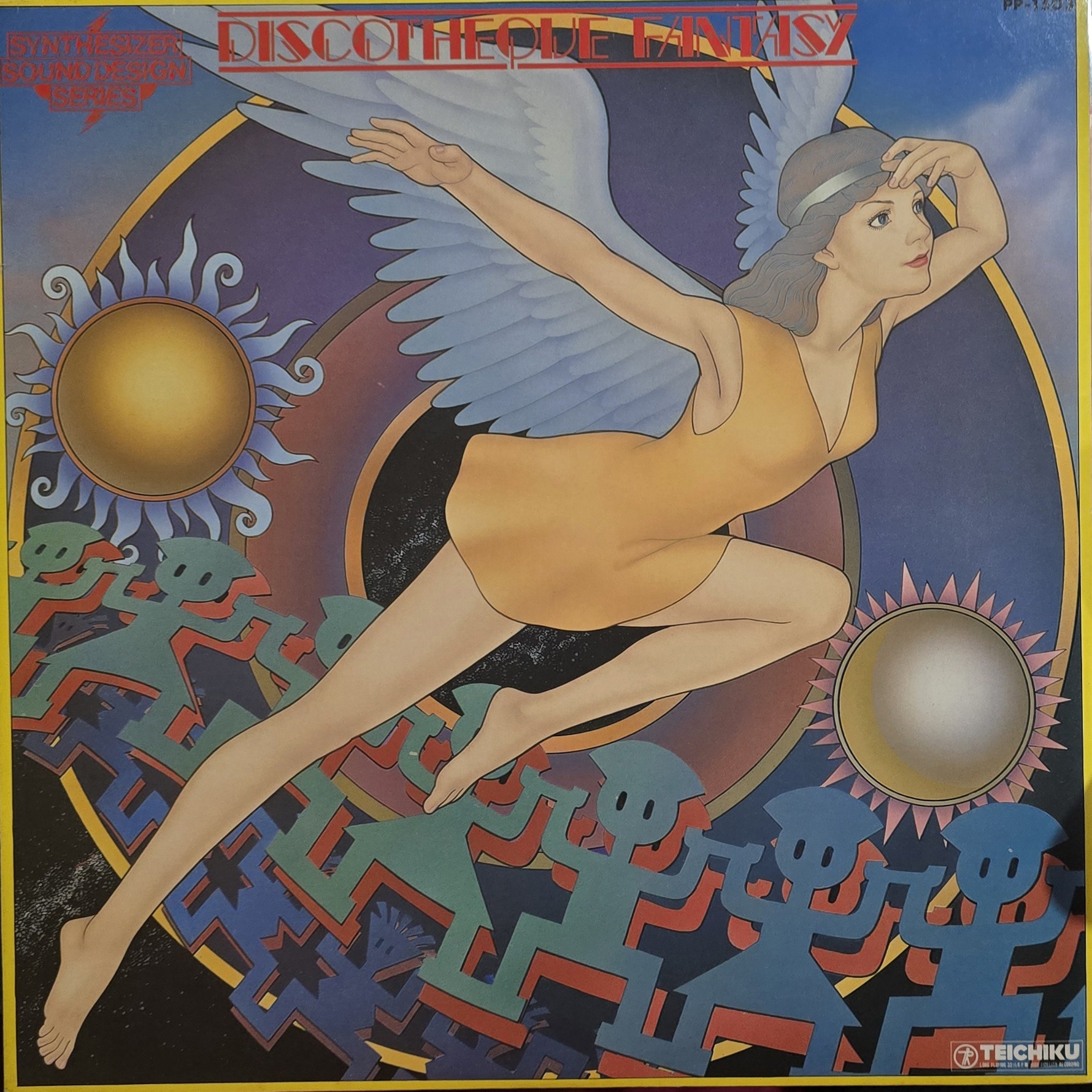
Oriental Mechanic Band – Discotheque Fantasy (Click here for complete album download)
How many times have I featured out-of-print and hard-to-find music featuring Hideki Matsutake (aka Logic System) on this blog? I’ve lost count and my tags are broken as shit (like everything else on this website) so who knows?
For those who may not know, Hideki Matsutake is a very influential Japanese electronic musician who is best-known for his work with Yellow Magic Orchestra and various YMO associates. He got his start in the industry at a young age, working with Tomita when he was still a teenager.
In addition to working on YMO’s first two releases, he also contributed to early albums by many other greats of the Japanese techno-pop and new wave scenes, including Sheena & The Rokkets, Akiko Yano, Rajie, Susan, Mioko Yamaguchi, and many more (as well as solo releases by all the members of YMO). If you have any notable Japanese pop music release from the late 70s or early 80s with prominent synthesizers or sequences on it, odds are he had his hand in it.
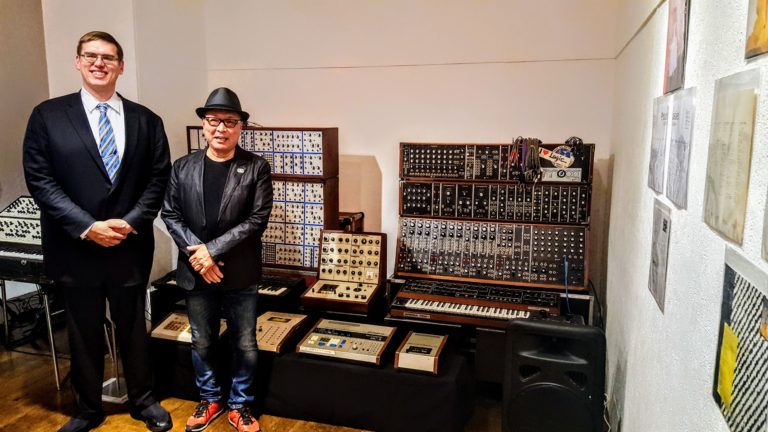
I also met him once. I tried not to be that big of a geek about it.
But before his work with YMO and other big-name artists in Japan, he released a few albums under other assorted names, a few of which I know I’ve shared in the past. One of my favorites is The Charm of Synthesizer: Japanese Melody (which you can find here), an album composed entirely of covers of Japanese enka tracks. He release that under the name Beautiful Shateau & Synthesizer. At the time I wrote that, I didn’t know what year that album came out, since then I’ve discovered that it most likely was released in 1976, meaning that it was one of his earliest releases.
This album, released under the name Oriental Mechanic Band, came out just one year later, but it’s a bit different. While that previous record was nothing but Japanese folk songs given the plugged-in/synth treatment, this album features more contemporaneous music, mostly on the disco side of things, hence the name.
The album opens with two Bee Gees covers, “Night Fever” and “Stayin’ Alive.” I’m an established Bee Gees hater, but I dig these takes on their tunes. Maybe it’s because there’s no high-pitched squealing distracting from the solid melodies or basslines. Or maybe it’s the totally radical shakuhachi playing?
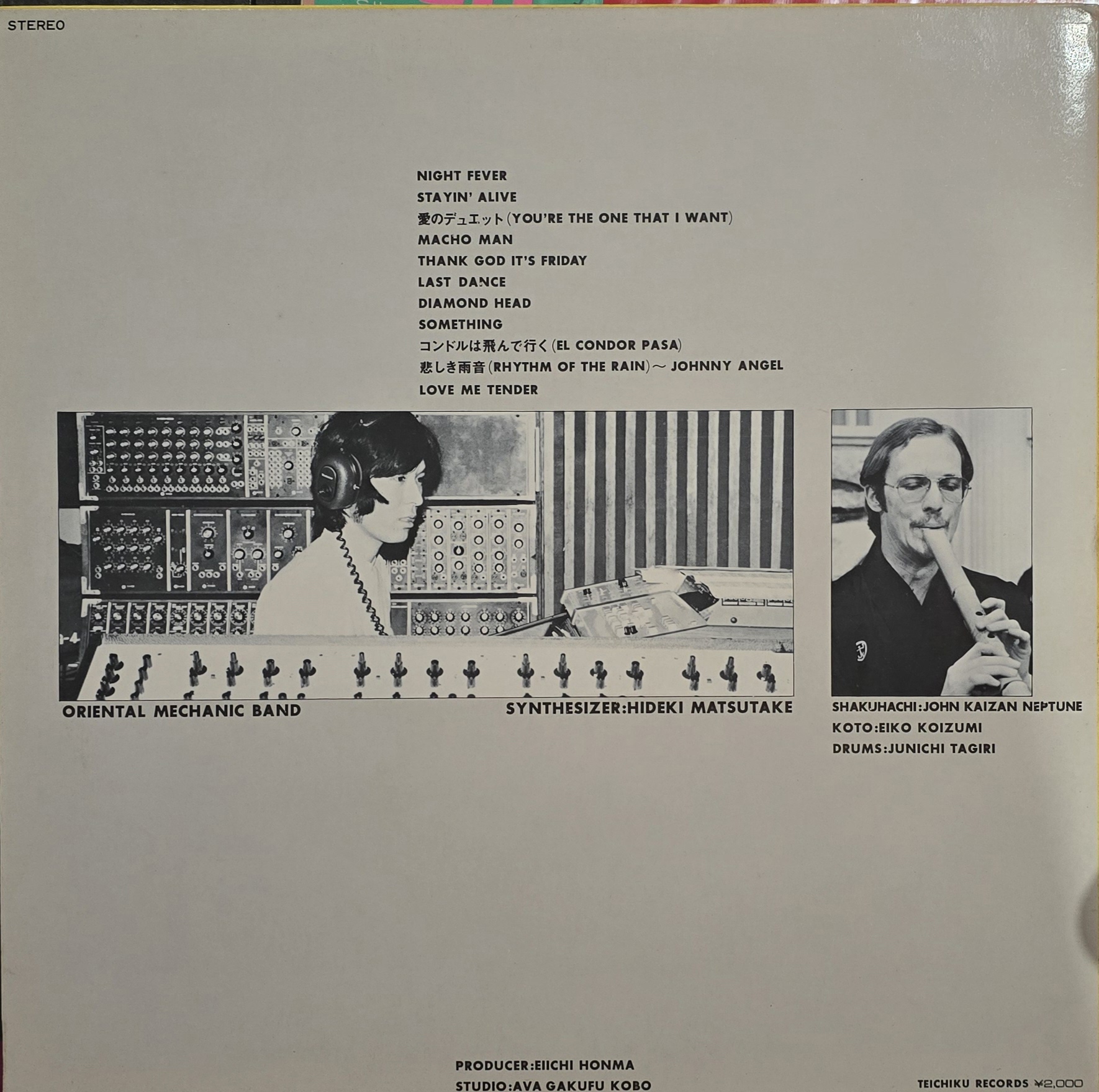
These aren’t purely electronic arrangements. This is not a Wendy Carlos album. In addition to Matsutake’s synths, we also have Junichi Tagiri on drums, Eiko Koizumi on koto, and, most notably, John Kaizan Neptune on shakuhachi (Japanese flute). Most of those people haven’t done a ton, but Neptune has been around. He’s American-born, but lives in Japan and has apparently made the shakuhachi his life. Not only does he play the thing, he makes them. He’s released a ton of albums since the 1970s. I can highly recommend his 1981 album, Shogun, it’s some good jazz-funk with a Japanese edge. If the city pop people ever stumble upon that record, my vinyl copy is going to skyrocket in value, I know it.
Anyways, after the Bee Gees covers we get a take on “You’re The One That I Want” from Grease. Much like the Bee Gees, I’m assuredly not a fan of Grease. But I’m also not deaf and I realize that “You’re The One That I Want” slaps pretty goddamn hard. Matsutake infuses his version of the song with a synth sound that I can only describe as “bouncy as hell” and Neptune delivers a fantastic wavering flute melody over it all.
After that brief lapse into musical theater we go back into full disco mode with a cover of “Macho Man” that has vocoder and tons of random robotic bleeps and bloops. What was an anthem for hyper-masculine presenting gay men in the late-70s club scene now sounds like a declaration of independence by a queer robot. It rules. Disco-mode continues with equally entertaining covers of “Last Dance” and “Thank God It’s Friday.”
Things take a bit of a turn moving onto side B. First, there’s a cover of “Diamond Head,” a Ventures song. I had never heard of it before. I’ve lived in Japan a long time, but not long enough to get into The Ventures. I assume I’ll get there at some point. In case you didn’t know, The Ventures were INSANELY popular in Japan, second only to The Beatles. If the wiki for this song is to be believed, it was the first song to sell one million copies in the country. When people think of the phrase “big in Japan,” the first band that comes to mind shouldn’t be Cheap Trick, it shouldn’t be Mr. Big, it should be The Ventures.
Anyways, I’ve only listened to the original a handful of times after listening to this version. They’re quite different to the point that I didn’t think that they were the same song at first. Matsutake uses the synth like a bass here to good effect, giving it some great percussive energy.
Then there’s a cover of The Beatles “Something.” I have so many covers of “Something.” I have a version played on bamboo flute that I like quite a bit. I have a baroque arrangement by a group called Tokyo Solisten. I have two versions by Shirley Bassey. “Something.” It’s a good song. It’s really hard to fuck up “Something”. Good news, Matsutake and company don’t fuck up “Something.” But there’s only so much you can do with it. It’s fine.
I really like what comes next, however, a cover of “El Condor Pasa,” a Peruvian orchestral song made famous by Simon & Garfunkel. Apparently it was really popular in Japan, because this is the fourth cover I have that’s performed by a Japanese artist. I have a cover by funk musician Akira Ishikawa, one by Tomita, and another by koto (Japanese harp) performer Tadao Sawai. Much like “Something,” it’s a very hard song to screw up. The melody is so powerful and haunting. A basic cover of the tune is going to earn you an easy B+ at the least.
This cover is fantastic. While the main melody is playing on the synthesizer, the koto and flute do a lot of work, and it really transforms the song. This song has always made me think of Morricone, listening to other versions I always imagine a cowboy wandering the desert or something similar. This one evokes the image of a lone samurai wandering the Japanese countryside, sword in one hand…and possibly a keytar in the other.
We go back even further in time after that, with a medley of “Rhythm of the Rain” and “Johnny Angel,” the former by The Cascades and the latter made famous by Shelley Fabares. This is some real golden oldies stuff, pre-Beatles pop tracks from the early 60s. Honestly, not my thing and this doesn’t do much to change that. However, the medley still piqued my interest due to the opening that Matsutake plays on the synth. It’s there for just a second, but you listen to that and tell me that you don’t hear at least the glint of the opening to Yellow Magic Orchestra’s “Behind The Mask.”
Am I crazy? I totally hear it. The earliest version of “Behind The Mask” is from 1978, used for a Seiko watch commercial, and Matsutake worked on that version as well. It would not surprise me if he took the sounds he created for this album and applied them there.
And finally we close with a cover of “Love Me Tender,” another song that I’ve never been a big fan of, but I enjoy what they do with it. Who knew that an Elvis Presley song could be improved with concurrent synth and koto melodies playing along a synth drumbeat and a funky-ass bassline? Makes me want to hear more synth covers of songs Elvis made famous. And honestly, given the shocking number of Beatles-themed synthesizer albums, I’m surprised that isn’t more of a thing.
My copy of this also includes some liner notes. While my boyfriend can speak English and does translate things for me from time to time, the notes here are pretty massive. I went ahead and used Google Translate on them, which is better than nothing. My boyfriend says the translation gets the point across. You can read the translated notes here and here. If you want to read the untranslated original notes, you can see those here and here. I know that machine translation is no substitute for a real human doing it, but I wanted to get this post up relatively quickly.
Give this one a listen and let me know what you think of it. I’ll probably be sharing some albums similar to it later this year. I actually got really lucky since I started writing this post and stumbled upon two other super-early Japanese electronic albums, including what I think is Matsutake’s first ever credited release!
Matsutake released one more album under the Oriental Mechanic Band moniker, Sonic Syncopation, which came out the year after this release. I’m going to try and track that one down and if I find it I’ll be sure to share it here as well.